Joining Forces to Combat Climate Change and Re-ignite the Global Economy

The world’s three biggest carbon emitters—the United States, China, and the European Union—have all announced emissions goals or limits in the past few months. That’s great news, but global fossil fuel demand continues to rise, and with it, so do climate change’s risks—to economy, to environment, to security, to human health, to people living in poverty in areas where climate change will have devastating impact.

The most recent IPCC report (AR5) found that “warming of the climate system is unequivocal,” “human influence on the climate system is clear,” and “limiting climate change will require substantial and sustained reductions in greenhouse gas emissions.”

The 2014 report Risky Business: The Economic Risks of Climate Change in the United States detailed the serious economic harm we can expect from climate change if we continue on our current path. But the challenge before us is about more than averting the worst economic impacts of climate change. As highlighted in the recently released Better Growth, Better Climate report from The New Climate Economy, it’s also about finding enormous economic opportunity in clean energy solutions that both tackle global warming and unlock growth opportunities for all.

The transformation to a low-carbon future is arguably the greatest business opportunity of our time. Combating climate change through energy efficiency, renewable energy technologies, clean transportation, and smarter land use can reap rewards as great economically as environmentally.

Fortunately, an energy revolution is rising all around us—enabled by smart policies in mindful markets, and led by business for profit. Efficient energy use fuels more economic activity than oil, at far lower cost, while its potential gets ever bigger and cheaper. In each of the past three years, the world invested a quarter-trillion dollars—more than the market cap of the world’s coal industry—to add over 80 billion watts of renewable capacity (excluding big hydro dams). Generating capacity added last year was 37 percent renewable in the United States, 53 percent in the world, 68 percent in China, 72 perent in Europe. Last year, the world invested over $600 billion in efficiency, renewables, and cogeneration.

This growth is accelerating: solar power is scaling faster than cellphones. Last year alone, China added more solar capacity than the U.S. has added in 60 years. Electric vehicle sales are growing twice as fast as hybrid cars did at a comparable stage. Shrewd companies are realizing climate solutions’ enormous business opportunities—a prospect scarcely dimmed by cheaper oil, which makes only a few percent of the world’s electricity.

Global companies like IKEA, Google, Apple, Facebook, Salesforce, and Walmart have committed to 100 percent renewable power. Tesla’s stock is up an astounding 660 percent over the past two years and has half the market value of General Motors Corp. The NEX index, which tracks clean energy companies worldwide, grew by 50 percent over the past two years—far outperforming the general market—while equity raisings by quoted clean energy companies more than doubled. Many of the world’s top financial firms concur that the era of coal and of big power plants is drawing to a close; Germany’s biggest utility is divesting those assets to focus on efficiency and renewables.

Yet we need to create even bigger and faster change. Which is why we are delighted to announce that our two nonprofit organizations—Rocky Mountain Institute and the Carbon War Room—are joining forces. By uniting two of the world’s preeminent nonprofit practitioners of market-based energy and climate solutions, we will help turn the toughest long-term energy challenges into vast opportunities for entrepreneurs to create wealth and public benefit for all. More


Dystopian Fiction’s Popularity Is a Warning Sign for the Future

Dystopian fiction is hot right now, with countless books and movies featuring decadent oligarchs, brutal police states, ecological collapse, and ordinary citizens biting and clawing just to survive. For bestselling author Naomi Klein, all this gloom is a worrying sign.

“I think what these films tell us is that we’re taking a future of environmental catastrophe for granted,” Klein says in Episode 129 of the Geek’s Guide to the Galaxy podcast. “And that’s the hardest part of my work, actually convincing people that we’re capable of something other than this brutal response to disaster.”

Her new book, This Changes Everything: Capitalism vs. The Climate, argues that only dramatic policy shifts can avert climate catastrophe, and that ordinary people need to speak up and demand emissions caps, public transportation, and a transition to renewable energy. That’s a hard sell politically, which is why dubious measures like geoengineering and cap-and-trade have been proposed instead.

“It seems easier, more realistic, to dim the sun than to put up solar panels on every home in the United States,” says Klein. “And that says a lot about us, and what we think is possible, and what we think is realistic.”

But things are starting to change, with indigenous groups winning lawsuits to block drilling on their land, local communities coming together to ban fracking and establish solar energy grids, and a growing divestment campaign seeking to shame and isolate the fossil fuel industry. Many of these movements are being led by young activists like Anjali Appadurai, who gave a speech in 2010 pointing out that the United Nations has been fruitlessly debating climate change action since before she was born.

“Young people have a critical role to play because they’ll be dealing with the worst impacts of climate change,” says Klein. “And when young people find their moral voice in this crisis, it’s transformative.”

Listen to our complete interview with Naomi Klein in Episode 129 of the Geek’s Guide to the Galaxy podcast (above), and check out some highlights from the discussion below.

Naomi Klein on how the wealthy are preparing for climate change:

“There are a lot of examples of ways that companies are preparing. The most insidious is the way that oil companies—who have been funding climate change denial—are simultaneously exploring all the wonderful extraction opportunities there are because the arctic ice is melting, so they obviously know it’s happening. … After Superstorm Sandy, there was a big uptick in the way that luxury developers in New York and elsewhere started to market themselves as being ‘disaster proof’—having their own generators, having their own ‘moats’ in a way, having their own storm barriers, and basically saying, ‘When the apocalypse comes, you’ll be safe.’ … In the aftermath of Hurricane Katrina, there was a company that was launched in Florida called HelpJet. … HelpJet was a private disaster rescue operation that literally had the slogan, ‘We’ll turn your disaster into a luxury vacation.’”

Naomi Klein on geoengineering:

“In general the geoengineering world is populated by very overconfident, overwhelmingly male figures who don’t make me feel at all reassured that they have learned the lessons of large-scale technological failure. When I went to this one conference that was hosted by the Royal Society in England, the Fukushima disaster had just started, and in fact a photographer I was working with—a videographer—had just come back from Fukushima and was completely shell-shocked. And I was surprised it didn’t come up the whole time we were meeting, because it seemed relevant to me. Yeah, we humans screw up. BP had been two years earlier. I have been profoundly shaped as a journalist by covering the BP disaster, the derivatives failure, seeing what’s happened in Fukushima. I’m sorry, but I think the smartest guys in the room screw up a lot. And the kind of hubris that I’ve seen expressed from the ‘geo-clique,’ as they’ve been called, makes me not want to scale up the risks that we’re taking.”

Naomi Klein on our relationship with nature:

“If you go back and look at the way fossil fuels were marketed in the 1700s, when coal was first commercialized with the Watt steam engine, the great promise of coal was that it liberated humans from nature, that you no longer had to worry about when the wind blew to sail your ship, and you no longer had to build your factory next to a waterfall or rushing rapids in order to power your water wheel. You were in charge, that was the promise of coal. It was the promise of man transcending the natural world. And that was, it turns out, a lie. We never transcended nature, and that I think is what is so challenging about climate change, not just to capitalism but to our core civilizational myth. Because this is nature going, ‘You thought you were in charge? Actually all that coal you’ve been burning all these years has been building up in the atmosphere and trapping heat, and now comes the response.’ … Renewable energy puts us back in dialog with nature. We have to think about when the wind blows, we have to think about where the sun shines, we cannot pretend that place and space don’t matter. We are back in the world.”

Naomi Klein on science fiction:

“This boom in cli-fi literature is exciting, but I think it can become dangerous if it isn’t seen as a warning, but just seen as inevitable. I think Margaret Atwood—not to be too Canadian about it—but I think Margaret Atwood’s In the Year of the Flood and that whole trilogy, that whole climate trilogy, is an example of the kind of narrative that really does serve as clarion warning, as opposed to just sort of hopeless ‘we’re on this road, we can’t get off.’ And it’s hard to define what makes something more of a warning than just affirming that sense of the inevitable. I loved Ursula Le Guin‘s acceptance speech at the Booker awards this year. I’m a huge Ursula Le Guin fan, and I think she’s one of the few science fiction writers that has pulled off utopian fiction well. She’s done both. But when she accepted the award she sort of accepted on behalf of the genre, and talked about how important it is to have and nurture voices from people who can imagine different worlds.”


ECLAC Updates Study on Economics of Climate Change in Latin America and the Caribbean read more

5 December 2014: The UN Economic Commission for Latin America and the Caribbean (ECLAC) has published an update of its study ‘The Economics of Climate Change in Latin America and the Caribbean: Paradoxes and challenges of sustainable development,' which provides an overview of expected climate impacts in the region, as well as subregional and national figures.

The report explains that, while growth in the region has led to improved economic and social conditions, it has had negative impacts on the environment, economy and society as a whole, including through more air pollution in urban areas and a deterioration of natural assets, such as water resources and forests.

The report states that the “foundations of the region's economic buoyancy are being undermined” through the region's production structures and consumption patterns, which contribute to a large carbon footprint. The report contends that the region must transition towards a sustainable form of development that will preserve its economic, social and natural assets for future generations and leave them with “a more equal, socially inclusive, low-carbon form of economic growth.”

The report concludes that the climate change challenge is also a sustainable development challenge and recommends achieving “a global consensus that recognizes the asymmetries and paradoxes of the problem.”

ECLAC, in collaboration with the Government of Peru, has also released a document estimating the economic costs of climate change in Peru. Both reports were launched at the Lima Climate Change Conference. [ECLAC Press Release] [Publication: The Economics of Climate Change in Latin America and the Caribbean: Paradoxes and challenges of sustainable development] [IISD RS Coverage of Lima Climate Change Conference]


read more: http://larc.iisd.org/news/eclac-updates-study-on-economics-of-climate-change-in-latin-america-and-the-caribbean/


Climate Change: The State of the Science


Climate Change: The State of the Science

Published on Nov 19, 201 3 • Produced by the International Geosphere-Biosphere Programme and Globaia and funded by the UN Foundation.

The data visualization summarises and visualizes several of the most significant statements in the Intergovernmental Panel on Climate Change’s (IPCC) recent Fifth Assessment Report, (Working Group I summary for policymakers, the Physical Science Basis). In 2014, IPCC will publish summaries concerning societal impacts, mitigation and adaptation. The statements and facts presented are derived from the IPCC summary for policymakers.

Download the IPCC Working Group I summary for policymakers (The Physical Science Basis) here: www.climatechange2013.org

Produced and directed by Owen Gaffney and Felix Pharand-Deschenes

Animation Felix Pharand-Deschenes GlobaTa

Water woes in Lima: A glimpse of our future?

As UN negotiators meet in Lima to work out a plan for dealing with rising temperatures, Matt McGrath visited a community paying a high price for water supplies threatened by climate change and increasing demand. Is Peru’s experience a sign of things to come?

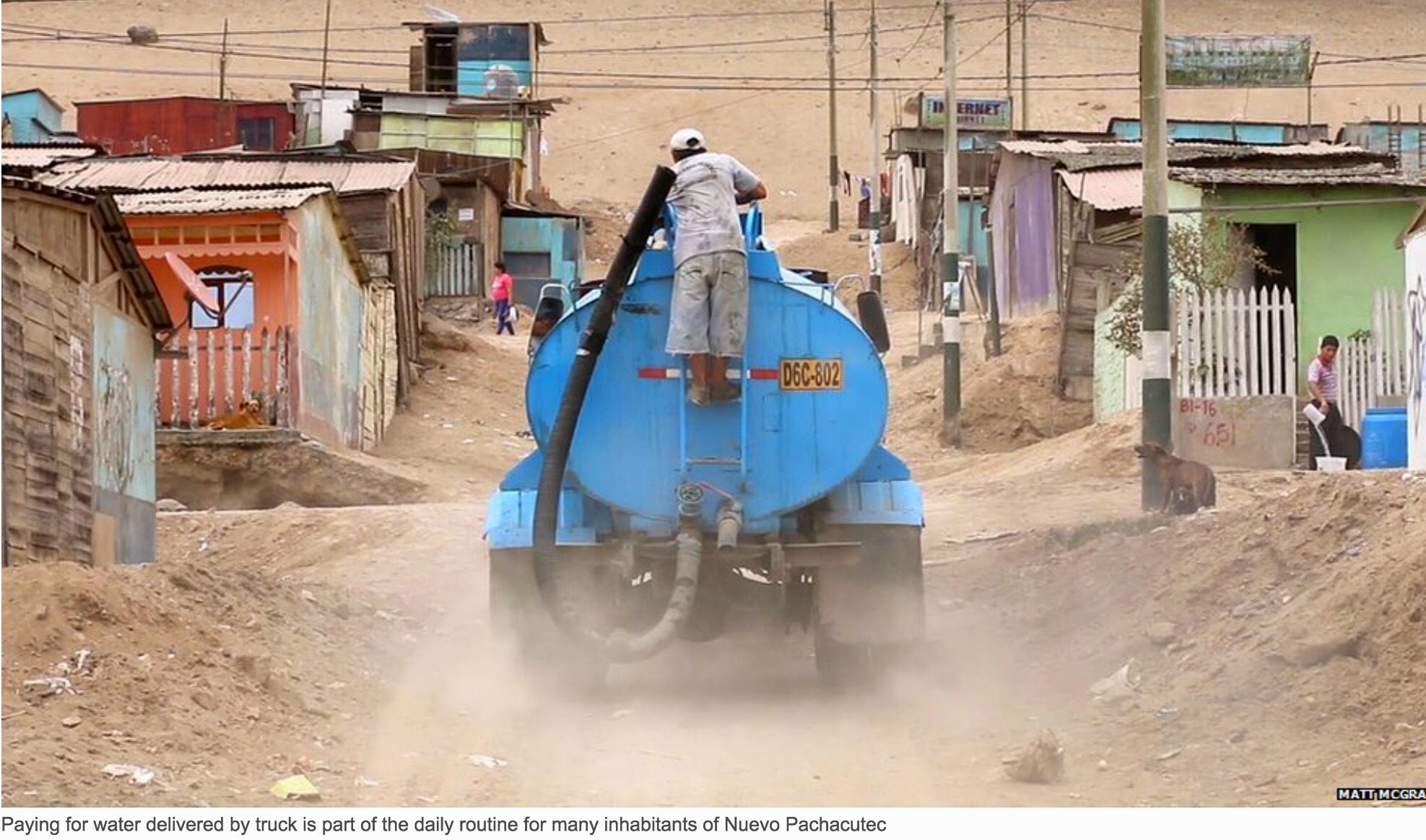
Snarling and screeching, the bouncing water truck speeds backwards down the steep hill, in a cloud of coarse dust.

It halts with a judder and a wild eyed, sweaty man jumps from the cab, grabs a large plastic pipe on the back and starts to fill a series of plastic containers on the ground, with little care.

Dressed in bright pink, a woman looks on nonchalantly.

The man runs up to her and holds out his hand. She drops some coins and away he goes, jumping onto the running board of his vehicle, already snorting its way to the next stop.

This is daily routine for tens of thousands of people who live in this sprawling hillside settlement that looks down on the Pacific Ocean, less than an hour north of Lima, Peru.

Water in Nuevo Pachacutec is not just the vital substance for life, it is a measure of social status and progress.

People first came to these hazy hills in the 1980s, in response to politicians who promised them land in return for votes.

When they first arrived the women said their feet would just sink in the sand. That’s all that was here.

The politicians allowed them to take the ground – but most of the 160,000 people here do not have legal title. They are “possessors of the land” but not the owners.

And land is too grand a word. This is really a desert. After Cairo, Lima is said to be the world’s second biggest city built in one. Rainfall here amounts to just 50mm of water per year.

A river runs through it

A few kilometres south of Nuevo Pachacutec, a miserable, dirty stream meanders under a motorway.

Bags of rubbish sit alongside the ubiquitous tractor tyres.

This is the Chillon river, the sole water source for around two million people in northern Lima.

The waters of the Chillon are fed by glaciers in the Andes. And this is a source of concern.

“We are worried here in Peru because climate change is already having a huge impact on our access to water,” says Armando Mendoza a research officer with Oxfam in the country.

“In the last 40 years, the glacial coverage has retreated by 40% more or less, because of the increase in global warming.

“The predictions are that in the future access to water will become even more difficult and the ones who are most vulnerable to this are the poor.”

These longer term water issues with glaciers are not the immediate priority in Nuevo Pachacutec.

As well as the speeding tuktuks, the sandy roads are festooned with signs for car washes, even private schools.

Despite the fact that 80% of the homes are made of wood, incomes and aspirations are rising here.

Access to water is critical in this development, as it is in developing nations all over the world.

With funding from the German government, a green group called Alternativa has helped build networks of white water tanks, connected by underground tubes that bring water directly to the houses.

They have also installed 900 outside water points in this sprawling settlement.

Their efforts to date have brought the vital liquid to 9,000 households.

In this community, water is more than just a key ingredient for life, it is a reflection of harsh social divisions.

The blue barrels

Despite the fact that 80% of the homes are made of wood, incomes and aspirations are rising here.

Access to water is critical in this development, as it is in developing nations all over the world.

With funding from the German government, a green group called Alternativa has helped build networks of white water tanks, connected by underground tubes that bring water directly to the houses.

They have also installed 900 outside water points in this sprawling settlement.

Their efforts to date have brought the vital liquid to 9,000 households.

In this community, water is more than just a key ingredient for life, it is a reflection of harsh social divisions.

Radios and children play loudly on the street where Daniza Cruz Navarro lives.

The homes on this stretch are known as the “casas azules” – the blue houses.

Outside many sit blue plastic barrels, some with lids, some without, that hold the water residents get from the trucks that constantly career about the local roads.

Dogs lap from the open containers. Mosquitoes lay their eggs in the water.

“You can see the effects of the way the water is being stored in the kids’ health,” says Daniza.

“They often get sick, there is often misuse and mismanagement of the water here.”

She has moved on from the blue barrel and is now the owner of a more effective and efficient water tank that she has bought through the efforts of Alternativa.

However, as she still gets water directly from the delivery trucks, she has to pay significantly more than her neighbours.

Daniza says she pays 120 Nuevo Soles (£26; $40) per month for the precious water. This is about 10% of her household income.

Those who are connected to the main water grid pay just 6-12 Soles per month.

These are big sums of money and the differences can be a source of friction between neighbours.

Despite these problems, those who work with the people in Nuevo Pachacutec say progress is being made. It’s really a story of local self-empowerment.

“Even if they are not perfect, they have bettered considerably,” says engineer Osvaldo Caceres who works with Alternativa.

“This infrastructure is managed by them, for them. The local population know what they want, but they know and understand they have to participate to get it.

Plug and pay


“When we first got here it was all desert – there were no roads, it was pure sand,” says Ycella Bonilla a resident of Nuevo Pachacutec.

She stands proudly in the doorway of her recently built bathroom cum laundry room, completed with the help of microfinance.

Ycella calls it her “unit of dignity”.

Despite this advance, Ycella and her family are still paying heavily for water. She has a hose and a key that allows her family to plug into a water point. For this she pays 80 Nuevo Soles a month (£18; $27) a month.

Despite the gripes over cost, Ycella recognises that water is the bedrock of development for the community.

“We have roads, we have schools, we have a lot of the basic necessities now, including water.”

The struggle for development and the need to have resources like water to empower that development is not just on the minds of those in Nuevo Pachacutec.

An hour down the road in Lima itself, UN climate negotiators are struggling with that same dilemma. How to balance the burgeoning needs of a growing population, with the need to limit those same enriching activities because they threaten the future of the planet.

Osvaldo Caceres says that as in solving the water stresses of Nuevo Pachacutec, the climate battle can be won, by everyone playing their part now. It’s no use passing the buck down the generations.

“Every actor in this chain must take responsibility for what they have to do,” he says.

“The governments, the authorities, and obviously the people, they all need to act.” “There is no other way.” More


Typhoon Hagupit Hits Philippines: Climate Catastrophe Is Here Now! by Kumi Naidoo

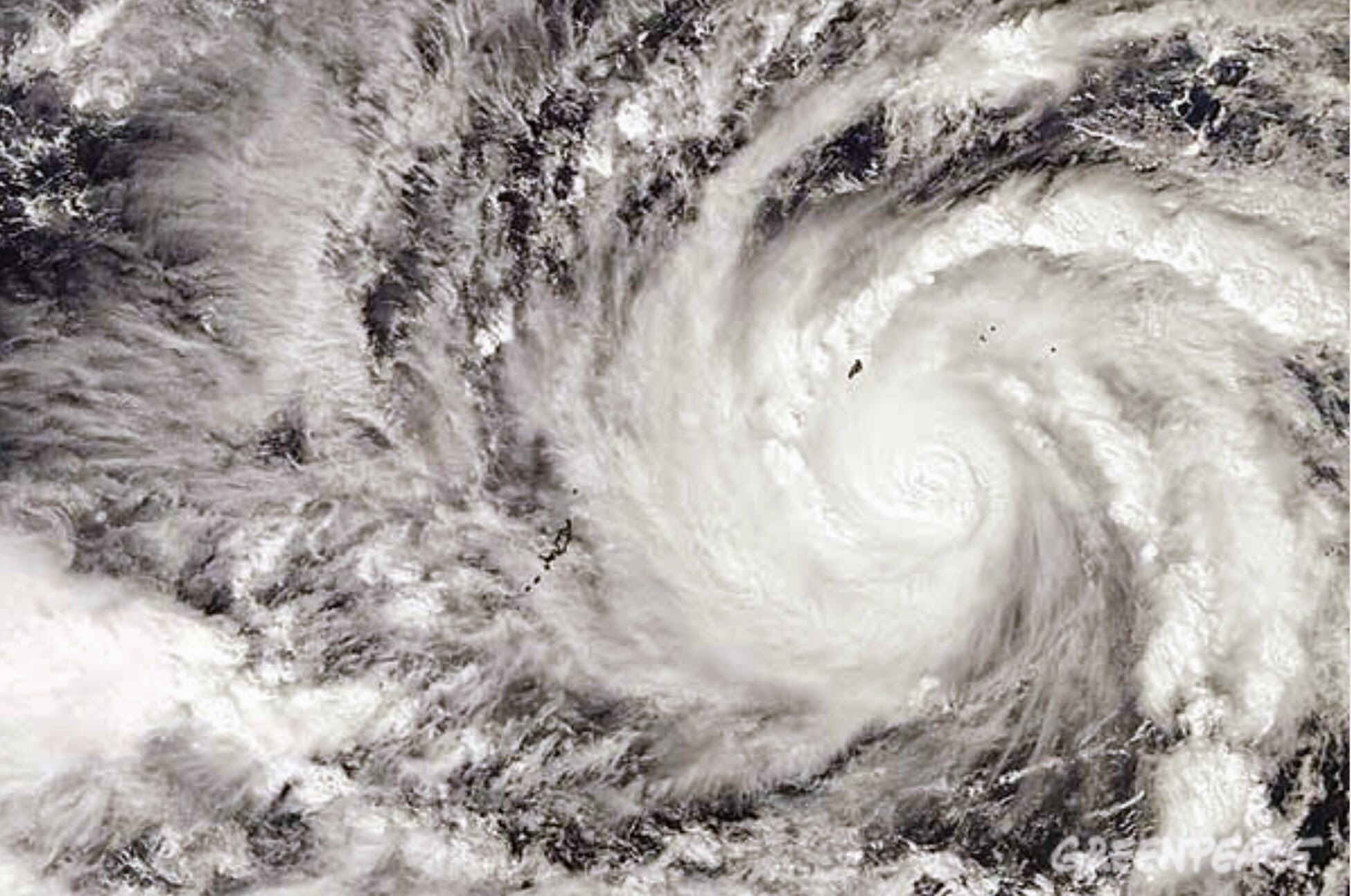
As Typhoon Hagupit hits the Philippines, one of the biggest peacetime evacuations in history has been launched to prevent a repeat of the massive loss of life which devastated communities when Super Typhoon Haiyan hit the same area just over a year ago.

Typhoon Hagupit

“One of the biggest evacuations in peacetime” strikes a sickening chord. Is this peacetime or are we at war with nature?

I was about to head to Lima, when I got a call to come to the Philippines to support our office and its work around Typhoon Hagupit (which means lash). In Lima another round of the UN climate talks are underway to negotiate a global treaty to prevent catastrophic climate change. A truce of sorts with nature.

But these negotiations have been going on far too long, with insufficient urgency and too much behind the scenes, and not so much behind the scenes, interference from the fossil fuel lobby.

This year, like last year and the year before these negotiations take place against a devastating backdrop of a so-called ‘extreme weather event’, something that climate scientists have been warning us about if we don’t take urgent action.

Tragically, we are not taking urgent action. Nature does not negotiate, it responds to our intransigence. For the people of the Philippines, and in many other parts of the world, climate change is already a catastrophe.

Only one year ago, Super Typhoon Haiyan killed thousands, destroyed communities and caused billions of dollars in damage. Many survivors who are still displaced have this week had to evacuate the tents they have been living in as Typhoon Hagupit carves a path across the country as I write.

It’s too early to assess the impact so far—we are all hoping early indications will spare the Philippines of the same pain that was experienced after Haiyan.

Here in Manila, we prepare to travel to the impacted areas in the wake of Typhoon Hagupit, or Ruby, as it has been named. We will offer what minor assistance we can.

We will stand in solidarity with the Filipino people and we will call out those who are responsible for climate change, those who are responsible for the devastation and who should be helping pay for the clean up and for adaptation to a world in which our weather is an increasing source of mass destruction.

With heavy hearts we prepare to bear witness. We challenge those in Lima to turn their attention from the lethargy and process of the negotiations and pay attention to what is happening in the real world.

We call on them to understand that climate change is not a future threat to be negotiated but a clear and present danger that requires urgent action now!

Each year, the people of the Philippines learn the hard way what inaction on emissions mean. They might be slightly better prepared and more resilient, but they are also rightly more aghast that each year—at the same time—the climate meetings seem to continue in a vacuum, not prepared to take meaningful action, not able to respond to the urgency of our time and not holding accountable the Big Polluters that are causing the climate to change with ferocious pace.

Before leaving for Manila I also received a message from Yeb Saño, climate commissioner for the Philippines: “I hope you can join us as we bear witness to the impact of this new super typhoon. Your help would be very valuable in delivering a message to Lima loud and clear.”

Yeb was the Filipino chief negotiator for three years at the UN climate talks and recently visited the Arctic on a Greenpeace ship to witness the Arctic sea ice minimum. Two years ago in Doha, as Typhoon Pablo took the lives of many he broke through the normally reserved language of dispassionate diplomacy that dominates UN climate treaty talks:

“Please … let 2012 be remembered as the year the world found the courage to … take responsibility for the future we want. I ask of all of us here, if not us, then who? If not now, then when? If not here, then where?”

I am joining Greenpeace Philippines and Yeb to visit the worst hit areas, document the devastation and send a clear message from climate change ground zero to Lima and the rest of the world that the ones that are responsible for the majority of emissions will be held accountable by the communities that are suffering the impacts of extreme weather events linked to climate change.

We will call on the heads of the fossil fuel companies who are culpable for the unfolding tragedy to examine their consciences and accept their historic responsibility. They say the truth is the first casualty of war, in this war against nature, the truth of climate science is unquestionable.

Please join us. Please add your voice by signing our petition calling on Big Polluters to be held legally and morally accountable for climate damages. After signing the petition you will be redirected to a site where you can make a donation to the relief efforts of partner organizations. More


Announcing “Disastersand Ecosystems: Resilience in a Changing Climate”

Announcing “Disastersand Ecosystems: Resilience in a Changing Climate”, a new Massive Open OnlineCourse (MOOC) to be launched on 12 January, 2015

What we all know is that disasters are increasing worldwide. Population growth,environmental degradation and climate change will likely exacerbate disasterimpacts in many regions of the world. What role do ecosystems play in reducingdisaster risks and adapting to climate change? This is the topic of an exciting new Massive Open Online Course thatwill go live in January 2015. It was developedjointly by the United Nations Environment Programme (UNEP), the Center for NaturalResources and Development (CNRD) and the Cologne University of Applied Sciences(CUAS), Germany. This is UNEP’s first MOOC, developed through its engagement with universities worldwide including the Global Universities Partnership on Environment for Sustainability (GUPES).

The MOOC covers a broad range of topics from disastermanagement, climate change, ecosystem management and community resilience. Howthese issues are linked and how well-managed ecosystems enhance resilience to naturaldisasters and climate change impacts are the core theme of the course.
The MOOC is designed at two levels: the leadership track, with the first 6 units providing generalintroduction to the fundamental concepts, which is suitable for people from allbackgrounds who wish to have a basic undertaking of the topic. The second level, or expert track comprises 15 units with more in depth learning on thevarious tools of ecosystem-based disaster risk reduction and climate changeadaptation.
The course is delivered by both scientists and practitioners.In addition there are guest lectures from global leaders and experts, such as Achim Steiner, the Executive Director of the United Nations Environment Programme, Julia Marton-Lefèvre, former Director General of the International Union for the Conservationof Nature (IUCN), Rajendra Pachauri of Teri University and Margareta Wahlströmof the UN International Strategy on Disaster Reduction (UNISDR).

Students will have the opportunity to enhance their knowledgethrough quizzes, real life and fictitious problem-solving exercises, additionalreading materials, videos and a discussion forum. An Expert-of-the-Week will be available torespond to questions and interact with students. Students will receive weeklynewsletters with up-to-date news on ecosystem-based disaster risk reduction andadaptation.
The course is invaluable for universities around the world,where faculty members can use it to update their curriculum and use thelectures and teaching materials for blended learning for their own courses. Atthe same time, the MOOC format also allows those currently outside theuniversity system to learn about the new developments in the area of disastersand climate change, without having to enroll in a university or pay for anonline course. Those who successfully complete the course will be provided witha course certificate.

Visit: www.themooc.net<http://www.themooc.net/>, or enroll directly at:
https://iversity.org/en/courses/disasters-and-ecosystems-resilience-in-a-changing-climate


World Is Locked into ~1.5°C Warming & Risks Are Rising, New Climate Report Finds

World Is Locked into ~1.5°C Warming & Risks Are Rising, New Climate Report Finds

Latin America and the Caribbean

In Latin America and the Caribbean, the report warns of longer droughts, extreme weather, and increasing ocean acidification. In the tropical Andes, rising temperatures will reduce the annual build-up of glacier ice and the spring meltwater that some 50 million people in the low-land farms and cities rely on. Heat and drought stress will substantially increase the risk of large-scale forest loss, affecting Amazon ecosystems and biodiversity, as well as the forests’ ability to store carbon dioxide.

Rising temperatures also affect food security. The oceans, which have absorbed about 30 percent of all human-caused carbon dioxide so far, will continue to acidify and warm, damaging coral ecosystems where sea life thrives and sending fish migrating to cooler waters. The result for the Caribbean could be the loss of up to 50 percent of its current catch volume.

Middle East and North Africa

People in the Middle East and North Africa have been adapting to extreme heat for centuries, but the report warns of unprecedented impact as temperatures continue to rise. Extreme heat will spread across more of the land for longer periods of time, making some regions unlivable and reducing growing areas for agriculture, the report warns. Cities will feel an increasing heat island effect, so that by 4°C warming – possibly as early as the 2080s without action to slow climate change – most capital cities in the Middle East could face four months of exceedingly hot days every year Rising temperatures will put intense pressure on crops and already scarce water resources, potentially increasing migration and the risk of conflict. Climate change is a threat multiplier here – and elsewhere.

Eastern Europe and Central Asia

In Eastern Europe and Central Asia, the report shows how the impact of climate change will vary region to region. Melting glaciers and warming temperatures will shift the growing season and the flow of glacier-fed rivers further into spring in Central Asia, while in the Balkans in Eastern Europe, worsening drought conditions will put crops at risk. Rising temperatures also increase the thawing of permafrost, which releases methane, a potent greenhouse gas many times more powerful than carbon dioxide at trapping heat. By mid-century, if temperatures continue to rise toward 2°C, the release of methane from thawing permafrost is likely to increase 20 to 30 percent in Russia, creating a feedback loop that will drive climate change.

Working to Lower the Risk

“The good news is that there is a growing consensus on what it will take to make changes to the unsustainable path we are currently on,” President Kim said. “Action on climate change does not have to come at the expense of economic growth. At the World Bank, we are investing in energy efficiency and renewable energy to help countries lower their emissions while growing their economies, and in clean transportation that can put fast-growing cities onto more sustainable growth paths. We are also working with governments to design policies that support clean growth, including developing efficiency standards, reducing fossil fuel subsidies, and pricing carbon. It’s clear that the public sector cannot solve the climate challenge alone – private investment and smart business choices are crucial, but business leaders tell us they need governments to provide clear, consistent policy direction that reflects the true costs of emissions. We now screen our projects in 77 countries for climate risk and for opportunities for climate action. We are helping countries find opportunities in climate action and developing financial instruments to increase funding that can help them grow clean and build resilience.

“Our response to the challenge of climate change will define the legacy of our generation,” President Kim said. “The stakes have never been higher.” More


Smart Dedicated Eleven-Year-Old Takes Vow of Silence Demanding Climate Action

Eleven-year-old Itzcuauhtli Roske-Martinez is proving to the world that sometimes the most powerful thing you can say is absolutely nothing.

  • Agree on and implement a Global Climate Recovery Plan to get us back to a safe zone of 350 ppm
  • Massively reforest the planet to help absorb our excess carbon
  • Support renewable energy solutions to replace the dirty fossil fuel industry”

Today marks Day 22 of the indigenous eco-rapper’s silent strike demanding science-based climate action. His T-shirt explains, “I am taking a vow of silence until world leaders take action on climate change.” After classmates suggested that one sixth grader in Colorado couldn’t influence leaders, Itzcuauhtli added, “When I say world leaders, I’m talking about us.”

Accusing “so-called ‘leaders’” of failing, Itzcuauhtli (pronounced “eat-squat-lee”) asks why his generation should “go to school and learn all this stuff if there is not going to be a world worth living in? Maybe it’s up to youth. Maybe each one of us has to be a world leader.”

Judging by the hundreds of thousands of hits his site is getting, kids worldwide agree. Several classmates even tried to join his campaign, only to be forbidden by parents certain it wouldn’t change anything.

“He was so disappointed,” his mother, Tamara Roske, said. “He cried silent tears. It was heartbreaking.” Itzcuauhtli, who will begin homeschooling after Thanksgiving, is bolstered by “overwhelming” international support, especially since actor and father-of-three Mark Ruffalo called the boy’s campaign “brave and thoughtful.”

Itzcuauhtli’s greatest champion, however, is 14-year-old brother Xiuhtezcatl, director of Earth Guardians and a co-plaintiff in a youth climate lawsuit, the Supreme Court will consider Dec. 5. The brothers, raised in the Earth-honoring ceremonies of their father’s Aztec culture, perform a passionate eco-rap and count Trevor Hall, Robert F. Kennedy Jr. and Michael Franti among their fans. They rocked Brazil’s 2012 climate summit and, more recently, were part of the 400,000-strong at the People’s Climate March in New York City.

After the march, though, Itzcuauhtli despaired when people insisted it was too late to avoid an apocalyptic future. On the white board he now communicates with, he writes, “I felt desperate. I had to do something drastic to change the outcome of our future. I decided I wasn’t going to speak again until there was concrete action on climate change.”

He looks hopefully toward the 2015 Paris UN conference, where leaders could agree on meaningful—and binding—recovery plans.

When asked why last week’s historic U.S.-China climate deal didn’t prompt him to resume the boisterous jokes his family misses, Itzcuauhtli responds, “It’s not strong enough. [Former director of NASA’s Goddard Institute] James Hansen says we have to cap carbon in the next year. If we wait another 15 years, which is when China said they would cap carbon, it’s going to be too late.

Itzcuauhtli will resume speaking when he sees “we’re moving together in the right direction.” That means applying a planetary “prescription” written by 18 top climate experts, who outlined a recovery plan based on science, not politics—the same remedy demanded in his brother Xiuhtezcatl’s lawsuits against state and federal governments. To achieve the six percent global carbon cuts necessary for a livable planet, Itzcuauhtli invites children and adults to “join me in this vow until world leaders:

Roske wonders when she’ll hear her “little comedian” talk again. “Next month’s climate gathering in Peru on Dec. 10 would be first day he’d break his silence. As a mom, I prefer he start talking before that.” But, she acknowledges, she may have to wait more than a year. “That 2015 Paris climate summit will determine these guys’ future on some level.”

Itzcuauhtli vows to continue as long as he must, despite calling his strike “the hardest thing I have ever done.” While he still laughs and finds ways to communicate with peers, he expresses special gratitude for friends old and new who support him or, better yet, join his campaign to “amplify the voices of children everywhere.”

“One person alone can start the revolution. It takes all of us to be the revolution.”

Visit ClimateSilenceNow to join Itzcuauhtli’s silence “even for an hour!” More