It’s Time for the United States to Start Worrying About a Saudi Collapse

As if there weren’t already enough problems to worry about in the Middle East, Saudi Arabia might be headed for trouble.

From plummeting oil prices to foreign-policy missteps to growing tensions with Iran, a confluence of recent events is mounting to pose some serious challenges for the Saudi regime. If not properly managed, these events could eventually coalesce into a perfect storm that significantly increases the risk of instability within the kingdom, with untold consequences for global oil markets and security in the Middle East.

Here are some of the percolating problems that could throw the country off kilter.

Fissures Within the Royal Family. Last week, the Guardian published two letters that an anonymous Saudi prince recently circulated among senior members of the royal family, calling on them to stage a palace coup against King Salman. The letters allege that Salman, who ascended to the throne in January, and his powerful 30-something son Deputy Crown Prince Mohammed bin Salman have pursued dangerous policies that are leading the country to political, economic, and military ruin. In an interview with the Guardian, the prince insisted that his demand for a change in leadership not only had growing support within the royal family but across broader Saudi society as well. “The public [is] also pushing for this very hard,” he claimed. “They say you have to do this or the country will go to disaster.” The article, which includes the letters, written in Arabic, has been shared more than 15,000 times.

The Yemen War. The longer it drags on, the greater the risk that the Saudi intervention against Houthi rebels could become a serious source of internal dissension. In its story on the prince’s letters, the Guardian reported that “many Saudis are sickened by the sight of the Arab world’s richest country pummelling its poorest.” Particular blame is attached to Prince Mohammed bin Salman, who also serves as the kingdom’s defense minister and by all accounts has been the driving force behind the war effort. Tagged with the unofficial nickname “Reckless,” Prince Mohammed bin Salman has been accused of rushing into Yemen without a clear strategy or exit plan, resulting in mounting costs in blood and treasure, an ever-expanding humanitarian crisis, and growing international criticism.

Economic Problems. Thanks largely to Saudi policy, oil prices plummeted by more than 50 percent in the past year. Facing a market glut due to the U.S. oil boom, Saudi strategy has been to maintain high production, fight for market share, allow prices to collapse, and wait for higher cost producers, particularly in America, to be driven out of business. With cheaper oil spurring increased demand and squeezing out excess supply, the theory was that higher prices would return before the kingdom ever felt any real economic pinch.

But it hasn’t quite worked out that way — at least not as quickly as the Saudis anticipated. Indeed, Saudi Arabia’s 2015 budget was based on the assumption that oil would be selling at about $90 per barrel. Today, it’s closer to half that. At the same time, the Saudis have incurred a rash of expenses that weren’t planned for, including those associated with King Salman’s ascendance to the throne (securing loyalty for a new king can be expensive business) and the war in Yemen.

The result is a budget deficit approaching 20 percent, well over $100 billion, requiring the Saudis to deplete their huge foreign exchange reserves at a record rate (about $12 billion per month) while also accelerating bond sales. The Saudis have reportedly liquidated more than $70 billion of their holdings with global asset managers in just the past 6 months.

While there’s no danger that the kingdom will run out of money anytime soon, the longer this trend of large budget deficits, lower oil prices, and declining foreign exchange reserves continues, the more nervous international markets will become — with potential implications for key indicators like credit rating and capital flight. Adding to long-term concerns is the fact that Saudi net oil exports have been in slow decline for years as internal energy consumption rises dramatically. Indeed, analysts now suggest that rapidly expanding domestic demand could render the kingdom a net importer of oil by the 2030s. It goes without saying that such a development poses a mortal threat to the kingdom, where oil sales still account for 80 to 90 percent of state revenues. More


Report finds many nuclear power plant systems “insecure by design”

A study of the information security measures at civilian nuclear energy facilities around the world found a wide range of problems at many facilities that could leave them vulnerable to attacks on industrial control systems—potentially causing interruptions in electrical power or even damage to the reactors themselves.

The study, undertaken by Caroline Baylon, David Livingstone, and Roger Brunt of the UK international affairs think tank Chatham House, found that many nuclear power plants’ systems were “insecure by design” and vulnerable to attacks that could have wide-ranging impacts in the physical world—including the disruption of the electrical power grid and the release of “significant quantities of ionizing radiation.” It would not require an attack with the sophistication of Stuxnet to do significant damage, the researchers suggested, based on the poor security present at many plants and the track record of incidents already caused by software.

The researchers found that many nuclear power plant systems were not “air gapped” from the Internet and that they had virtual private network access that operators were “sometimes unaware of.” And in facilities that did have physical partitioning from the Internet, those measures could be circumvented with a flash drive or other portable media introduced into their onsite network—something that would be entirely too simple given the security posture of many civilian nuclear operators. The use of personal devices on plant networks and other gaps in security could easily introduce malware into nuclear plants’ networks, the researchers warned.
The security strategies of many operators examined in the report were “reactive rather than proactive,” the Chatham House researchers noted, meaning that there was little in the way of monitoring of systems for anomalies that might warn of a cyber-attack on a facility. An attack could be well underway before it was detected. And because of poor training around information security, the people responsible for operating the plants would likely not know what to do.

That problem is heightened by what the researchers characterized as a “communication breakdown” between IT security professionals and the plant operations staff, and a simple lack of awareness among plant operations people about the potential dangers of cyber-attacks. Cultural differences between IT and nuclear engineering culture cause friction at some facilities, in fact—making it difficult for IT and security staff to get across the problem with the poor security practices in the plants.

Unfortunately, there’s no way to tell how bad the problem really is, because the nuclear industry doesn’t talk about breaches.

“The infrequency of cyber security incident disclosure at nuclear facilities makes it difficult to assess the true extent of the problem and may lead nuclear industry personnel to believe that there are few incidents,” the researchers wrote in their summary. ”Moreover, limited collaboration with other industries or information-sharing means that the nuclear industry tends not to learn from other industries that are more advanced in this field.”

These issues, combined with a lack of regulation, may lead to an underestimation of risk by nuclear operators and result in a lack of budgeting or planning for reducing the risk of attack. More


Welcome to a New Planet Climate Change “Tipping Points” and the Fate of the Earth

Not so long ago, it was science fiction. Now, it’s hard science — and that should frighten us all. The latest reports from the prestigious and sober Intergovernmental Panel on Climate Change (IPCC) make increasingly hair-raising reading, suggesting that the planet is approaching possible moments of irreversible damage in a fashion and at a speed that had not been anticipated.

Scientists have long worried that climate change will not continue to advance in a “linear” fashion, with the planet getting a little bit hotter most years. Instead, they fear, humanity could someday experience “non-linear” climate shifts (also known as “singularities” or “tipping points”) after which there would be sudden and irreversible change of a catastrophic nature. This was the premise of the 2004 climate-disaster film The Day After Tomorrow. In that movie — most notable for its vivid scenes of a frozen-over New York City — melting polar ice causes a disruption in the North Atlantic Current, which in turn triggers a series of catastrophic storms and disasters. At the time of its release, many knowledgeable scientists derided the film’s premise, insisting that the confluence of events it portrayed was unlikely or simply impossible.

Fast forward 11 years and the prospect of such calamitous tipping points in the North Atlantic or elsewhere no longer looks improbable. In fact, climate scientists have begun to note early indicators of possible catastrophes.

Take the disruption of the North Atlantic Current, the pivotal event in The Day After Tomorrow. Essentially an extension of the Gulf Stream, that deep-sea current carries relatively warm salty water from the South Atlantic and the Caribbean to the northern reaches of the Atlantic. In the process, it helps keep Europe warmer than it would otherwise be. Once its salty water flows into sub-Arctic areas carried by this prolific stream, it gets colder and heavier, sinks to lower depths, and starts a return trip to warmer climes in the south where the whole process begins again.

So long as this “global conveyor belt” — known to scientists as the Atlantic Meridional Overturning Circulation, or AMOC — keeps functioning, the Gulf Stream will also continue to bring warmer waters to the eastern United States and Europe. Should it be disrupted, however, the whole system might break down, in which case the Euro-Atlantic climate could turn colder and more storm-prone. Such a disruption might occur if the vast Greenland ice sheet melts in a significant way, as indeed is already beginning to happen today, pouring large quantities of salt-free fresh water into the Atlantic Ocean. Because of its lighter weight, this newly introduced water will remain close to the surface, preventing the submergence of salty water from the south and so effectively shutting down the conveyor belt. Indeed, exactly this process now seems to be underway. More


Why Assad turned to Moscow for help

Iran has long been sending troops and material to help Syrian autocrat Bashar Assad wage war against his own people. But now Tehran is busy establishing a state within a state — which is why Assad now wants help from Russia.

Fear of his enemies was the primary reason for Bashar Assad’s call for help to Moscow. “But right after that came the fear of his friends,” says a Russian official who long worked in his country’s embassy in Damascus. The friend he refers to is Iran, the Syrian regime’s most important protector.

“Assad and those around him are afraid of the Iranians,” the Russian says. Anger over the arrogance of the Iranians, who treat Syria like a colony, is also part of it, the Russian continues. Most of all, though, the Syrians “mistrust Tehran’s goals, for which Assad’s position of power may no longer be decisive. That is why the Syrians absolutely want us in the country.”

What the Russian diplomat, who wants to remain anonymous, has to say is a bit jarring at first. Without the Shiite auxiliaries from Iran, Afghanistan, Pakistan, Iraq and Lebanon — whose recruitment and transfer is organized by the Iranian Revolutionary Guard — Assad’s rule would long since have come to an end. Yet his comments are complemented by a number of additional details that add up to an image of a behind-the-scenes power struggle — one which casts a new, scary light on the condition of the Syrian regime and on the country’s prospects as a whole.

The Iranian Revolutionary Guard has long planned and carried out the most important missions and operations of the Syrian regime. They were responsible, right down to the details, for the sporadically successful offensives in Aleppo in the north and Daraa in the south, which began in 2013. In Iran, the Revolutionary Guard is one of those groups intent on continuing the “Islamic Revolution” — the victory of Shiites over the Sunnis. They are a state within a state, one which owns several companies and is answerable only to Iran’s Supreme Leader Ali Khamenei. President Hassan Rohani has no power over the Revolutionary Guard whatsoever.

Their goals go far beyond merely reestablishing the status quo in Syria. In early 2013, Hojatoleslam Mehdi Taeb, one of the planners behind Iran’s engagement in Syria, said: “Syria is the 35th province of Iran and it is a strategic province for us.” For several decades, the alliance between the Assads and Iran was a profitable one, particularly in opposition to the Iraq of Saddam Hussein, which long had the upper hand in the region. But today, Assad depends on Iran to remain in power, and Tehran is taking advantage of the situation.

Using a variety of pathways, both civilian and military, Tehran is currently in the process of establishing itself in Syria. Military means are being employed to strengthen the holdings of the Shiite militia Hezbollah in areas near the border with Lebanon. To serve this goal, the Syrian National Defense Forces were established, troops that exist alongside the regular Syrian army and which includes tens of thousands of fighters who were trained in Iran. Still, the National Defense Forces have begun to disintegrate into local mafia militias and have actually accelerated the loss of state control over those regions.

Changes Afoot

It is, however, primarily in the civilian sector where significant changes are afoot. Just as in Damascus, Latakia and Jabla, increasing numbers of hosseiniehs — Shiite religious teaching centers — are opening. The centers are aimed at converting Sunnis, and even the Alawites, the denomination to which the Assads belong, to “correct” Shiite Islam by way of sermons and stipends. In addition, the government decreed one year ago that state-run religion schools were to teach Shiite material.

All of this is taking place to the consternation of the Alawites, who have begun to voice their displeasure. “They are throwing us back a thousand years. We don’t even wear headscarves and we aren’t Shiites,” Alawites complained on the Jableh News Facebook page. There were also grumblings when a Shiite mosque opened in Latakia and an imam there announced: “We don’t need you. We need your children and grandchildren.”

In addition, Iranian emissaries, either directly or via middlemen, have been buying land and buildings in Damascus, including almost the entire former Jewish quarter, and trying to settle Shiites from other countries there.

Talib Ibrahim, an Alawite communist from Masyaf who fled to the Netherlands many years ago, summarizes the mood as follows: “Assad wants the Iranians as fighters, but increasingly they are interfering ideologically with domestic affairs. The Russians don’t do that.”

That’s why Assad has now decided to place his fate in the hands of the religiously unproblematic Russia, which last week transferred aircraft and troops to its military base in the northern Syrian town of Latakia and began flying airstrikes. The fight against the Islamic State terror militia served as a pretext for the operation, but the initial air strikes have not targeted the Islamists at all. Rather, they have been flown against areas controlled by Syrian rebels. More


What it takes to be a great leader – TED

What makes a great leader today? Many of us carry this image of this all-knowing superhero who stands and commands and protects his followers. But that's kind of an image from another time, and what's also outdated are the leadership development programs that are based on success models for a world that was, not a world that is or that is coming.

0:45We conducted a study of 4,000 companies, and we asked them, let's see the effectiveness of your leadership development programs. Fifty-eight percent of the companies cited significant talent gaps for critical leadership roles. That means that despite corporate training programs, off-sites, assessments, coaching, all of these things, more than half the companies had failed to grow enough great leaders. You may be asking yourself, is my company helping me to prepare to be a great 21st-century leader? The odds are, probably not.

1:28Now, I've spent 25 years of my professional life observing what makes great leaders. I've worked inside Fortune 500 companies, I've advised over 200 CEOs, and I've cultivated more leadership pipelines than you can imagine. But a few years ago, I noticed a disturbing trend in leadership preparation. I noticed that, despite all the efforts, there were familiar stories that kept resurfacing about individuals. One story was about Chris, a high-potential, superstar leader who moves to a new unit and fails, destroying unrecoverable value. And then there were stories like Sidney, the CEO, who was so frustrated because her company is cited as a best company for leaders, but only one of the top 50 leaders is equipped to lead their crucial initiatives. And then there were storieslike the senior leadership team of a once-thriving business that's surprised by a market shift, finds itself having to force the company to reduce its size in half or go out of business.

2:48Now, these recurring stories cause me to ask two questions. Why are the leadership gaps widening when there's so much more investment in leadership development? And what are the great leaders doing distinctly different to thrive and grow? One of the things that I did, I was so consumed by these questions and also frustrated by those stories,that I left my job so that I could study this full time, and I took a year to travel to different parts of the world to learn about effective and ineffective leadership practices in companies, countries and nonprofit organizations. And so I did things like travel to South Africa, where I had an opportunity to understand how Nelson Mandela was ahead of his time in anticipating and navigating his political, social and economic context. I also met a number of nonprofit leaders who, despite very limited financial resources, were making a huge impact in the world, often bringing together seeming adversaries. And I spent countless hours in presidential libraries trying to understand how the environment had shaped the leaders, the moves that they made, and then the impact of those movesbeyond their tenure. And then, when I returned to work full time, in this role, I joined with wonderful colleagues who were also interested in these questions.

4:26Now, from all this, I distilled the characteristics of leaders who are thriving and what they do differently, and then I also distilled the preparation practices that enable people to grow to their potential. I want to share some of those with you now.

4:44(“What makes a great leader in the 21st century?”)

4:46In a 21st-century world, which is more global, digitally enabled and transparent, with faster speeds of information flow and innovation, and where nothing big gets donewithout some kind of a complex matrix, relying on traditional development practices will stunt your growth as a leader. In fact, traditional assessments like narrow 360 surveys or outdated performance criteria will give you false positives, lulling you into thinking that you are more prepared than you really are. Leadership in the 21st century is defined and evidenced by three questions.

5:29Where are you looking to anticipate the next change to your business model or your life?The answer to this question is on your calendar. Who are you spending time with? On what topics? Where are you traveling? What are you reading? And then how are you distilling this into understanding potential discontinuities, and then making a decision to do something right now so that you're prepared and ready? There's a leadership team that does a practice where they bring together each member collecting, here are trends that impact me, here are trends that impact another team member, and they share these,and then make decisions, to course-correct a strategy or to anticipate a new move.Great leaders are not head-down. They see around corners, shaping their future, not just reacting to it.

6:28The second question is, what is the diversity measure of your personal and professional stakeholder network? You know, we hear often about good ol' boy networks and they're certainly alive and well in many institutions. But to some extent, we all have a network of people that we're comfortable with. So this question is about your capacity to develop relationships with people that are very different than you. And those differences can be biological, physical, functional, political, cultural, socioeconomic. And yet, despite all these differences, they connect with you and they trust you enough to cooperate with you in achieving a shared goal. Great leaders understand that having a more diverse network is a source of pattern identification at greater levels and also of solutions,because you have people that are thinking differently than you are.

7:29Third question: are you courageous enough to abandon a practice that has made you successful in the past? There's an expression: Go along to get along. But if you follow this advice, chances are as a leader, you're going to keep doing what's familiar and comfortable. Great leaders dare to be different. They don't just talk about risk-taking,they actually do it. And one of the leaders shared with me the fact that the most impactful development comes when you are able to build the emotional stamina to withstand people telling you that your new idea is naïve or reckless or just plain stupid.Now interestingly, the people who will join you are not your usual suspects in your network. They're often people that think differently and therefore are willing to join you in taking a courageous leap. And it's a leap, not a step. More than traditional leadership programs, answering these three questions will determine your effectiveness as a 21st-century leader.

8:45So what makes a great leader in the 21st century? I've met many, and they stand out.They are women and men who are preparing themselves not for the comfortable predictability of yesterday but also for the realities of today and all of those unknown possibilities of tomorrow. More


Climate Expert James Hansen: The Planet May Become Ungovernable

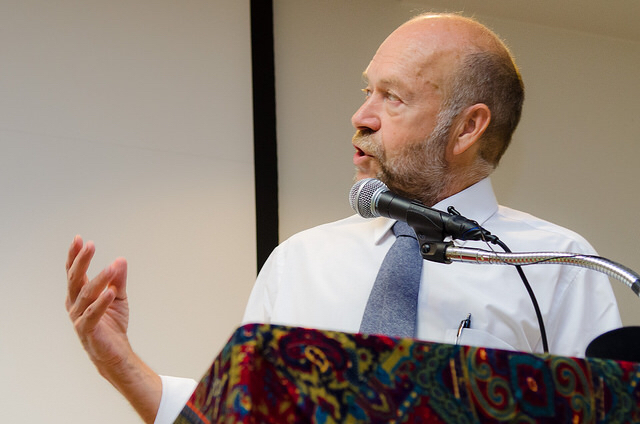
The repercussions of climate disruption are still not being acknowledged fully, warned climatologist Dr. James Hansen, addressing an audience of Baby Boomer and Greatest Generation climate activists on September 9.

Dr. Jim Hansen

“We’ve now got an emergency,” he told about 150 “elder activists” at Calvary Baptist Church in Washington, DC, who were participating in Grandparents Climate Action Day.

Hansen — formerly NASA’s head climate scientist, now adjunct professor at Columbia University — is probably best known for bringing definitive evidence of global warming to Congress in testimony in 1988. In July of this year, he released a report with sixteen co-authors studying glacier melt in Greenland and Antarctica. Unlike previous models, the new report takes into account some feedback loops which may be hastening the loss of ice sheet mass far faster than anticipated.

Time is running out to transition to renewable energy, Hansen said, yet the most “relevant” people in power aren’t aware of the situation’s gravity. “Even people who go around saying, ‘We have a planet in peril,’ don’t get it. Until we’re aware of our future, we can’t deal with it.”

Mass species extinction, extreme weather events, dry spells and fires are climate change impacts which are happening now. A warmer atmosphere and warmer oceans can lead to stronger storms, he explained. Superstorm Sandy, for example, remained a hurricane all the way up the Eastern seaboard to New York because Atlantic waters were abnormally warm.

“Amplifying impacts” and feedback loops will accelerate the changes, according to Hansen. “It will happen faster than you think,” he said. If major coastal cities become “dysfunctional” because of sea level rise, as he believes is possible, the global economy could be in peril of collapse.

It is therefore imperative to stop using coal, oil and gas as energy sources now. “We’ve already burned as much as we can afford,” he said. Fossil fuels already burned will continue to have impacts, because the climate system “has inertia.” “We’ve only felt the warming for half of the gases that are up there,” he said.

The use of fossil fuels is still on the rise in spite of the dangers, he said, because governments subsidize them and don’t make companies bear the real costs to society. The only viable way to make the price of fossil fuels “honest,” in his opinion, is to implement a “fee and dividend” system.

While Hansen denounced “unfettered capitalism”and “scary” trade agreements in the works, he believes government regulation can steer captains of industry onto the right path. “We’ve got to make the system work for us,” he said. “If you properly harness the market, it will work for you.”

He gave an example of incentives and tax breaks for solar panels, which he has on his own home, and how he contributes electricity to the grid. Yet one audience member took issue with a corruption-free scenario. “Come to Virginia, I dare you!” he said. (In Virginia, where Dominion Virginia Power has a stranglehold on state politics, “standby” fees and other barriers stifle solar panel installation by individuals.)

Hansen, a grandparent himself, was the keynote speaker at Grandparents Climate Action Day, an event to mobilize elder activists and promote a policy agenda aimed at reducing greenhouse gas emissions.

Hansen believes elders possess resources and wisdom which, combined with the zeal of youth, can help find solutions to climate change. “Older people have a lot of clout, a lot of votes, and time,” he said. With more older people getting involved, there will be more pressure to make needed changes.

Fellow speaker John Sorensen, co-founder of the Conscious Elders Network, echoed this point. The 80 million elders in the U.S. — 25 percent of the population — are living longer and healthier lives with more time and resources to devote to activism.

Hansen is supporting a lawsuit in which 21 young people are suing the U.S. government. (One of the plaintiffs is his granddaughter Sophie.) The lawsuit alleges that the federal government knew decades ago that burning fossil fuels and climate were linked, but continued on the same course anyway.

In his testimony for Youth v. Obama, Hansen said, “In my opinion, this lawsuit is made necessary by the at-best schizophrenic, if not suicidal, nature of U.S. climate and energy policy.”

The judiciary, he believes, is the only viable recourse left for the younger generation, “because the courts will be less under the thumb of the fossil fuel industry.”

“Young people have all these rights that are guaranteed by the constitution, and that’s what we’re asking the courts to look at, and I think this may be our best chance to force the government to do its job,” he said.

Most of the elders participating in Grandparents Climate Action Day probably won’t live to see the worst effects of climate change, yet they were eager to learn about the earth future generations will inherit. One participant explained her reason for being there. After working with children for her whole career, she realized that “all of it mean[s] nothing if we don’t have a livable planet.”

“Young people have all these rights that are guaranteed by the constitution, and that’s what we’re asking the courts to look at, and I think this may be our best chance to force the government to do its job,” he said.

Most of the elders participating in Grandparents Climate Action Day probably won’t live to see the worst effects of climate change, yet they were eager to learn about the earth future generations will inherit. One participant explained her reason for being there. After working with children for her whole career, she realized that “all of it mean[s] nothing if we don’t have a livable planet.” More


The UK to launch Caribbean infrastructure partnership

caribbeanclimate's avatarcaribbeanclimate

Source: livemint Source: livemint

 The English speaking Caribbean is set to benefit from 300 million pounds in grant funding to support infrastructure development.

British Prime Minister David Cameron made the announcement in a joint sitting of Jamaica’s parliament on September 30, 2015.

“I’m launching a new UK, Caribbean infrastructure partnership to build real tangible things that will make a difference for people across the Caribbean. Roads, bridges, ports, critical economic infrastructure that will set the foundations for growth and prosperity and in turn reduce poverty while helping the region to become more resilient to the risks of Climate Change. Just think about what this could deliver, hundreds of kilometer of roads to link up vital markets. Bridges to unite remote communities. New energy projects to power growth and vital defenses to protect coastal communities. Let me be clear £300 million is not soft loads, not tide aid. It is cash grants.”

Cameron…

View original post 330 more words

Barbados Submits its Climate Action Plan Ahead of 2015 Paris Agreement

caribbeanclimate's avatarcaribbeanclimate

Picture credit: Wikimedia Commons Picture credit: Wikimedia Commons

Barbados submitted its new climate action plan to the UN Framework Convention on Climate Change (UNFCCC).

This Intended Nationally Determined Contribution (INDC) comes well in advance of a new universal climate change agreement which will be reached at the UN climate conference in Paris, in December this year.

This INDC and all others submitted by countries are available on the UNFCCC website here. Including Barbados, 93 parties to the UNFCCC have formally submitted their INDCs.

The Paris agreement will come into effect in 2020, empowering all countries to act to prevent average global temperatures rising above 2 degrees Celsius and to reap the many opportunities that arise from a necessary global transformation to clean and sustainable development.

UNFCCC Executive Secretary Christiana Figueres is encouraging countries to come forward with their INDCs as soon as they are able, underlining their commitment and support towards this successful…

View original post 66 more words

Green Aruba 2015

Green Aruba is an annual conference born in 2010 with the specific aim to place dedicated emphasis on Aruba's energy transition to 100% fuel independence.

Besides showcasing Aruba's progress and challenges to the accelerated penetration of renewables in the total energy mix, Green Aruba also exhibits the experiences and knowledge of other institutions and island nations in this field. Over the past six years, Green Aruba has evolved into a practical and valuable well-known platform within the region for the exchange of information and applied knowledge on sustainable and best practices for the shift to cleaner, more environmentally friendly energy sources and resources.

Green Aruba VI – Share Sustainability

At this year's Green Aruba conference to be held October 27th and 28th, the main theme will focus on sharing sustainability by together confronting the common barriers we face, identifying the solutions moving forward and creating the essential roadmaps to achieve our desired growth paths of the sustainability journey for our island nations.

Aruba has made remarkable progress over the years in the penetration level of renewables and/or efficiency at production level, with in 2015 reaching close to the 20% mark. With the ongoing and upcoming planned projects operational by the end of 2017, the 40% barrier will be surpassed by 2018!

With our goal to reach 100% fuel free energy production by 2020, and in order to surpass the 40% level, it is fundamental to embark on a “deep dive” into our existing energy mix. Aruba is examining cutting-edge technologies and new business models for our utility companies, all in conjunction with our RAS framework, to create a balance between Reliable and Sustainable investments. This balancing act will only be achievable if energy production costs remain Affordable for the customer base.

Local utility stakeholders together with foreign renowned institutions are preparing for this dive known as the Aruba Renewable Integration Study (ARIS), and will present their approach and concept at the upcoming conference. The ARIS will provide models that map out the road forward towards Aruba's aspiring renewable energy goals, while maintaining grid reliability and minimizing overall system costs, and can serve as a prototype or starting point for fellow island nations. More