

Month: July 2015
5Cs Wins Energy Globe Award for Renewable Energy and Potable Water Project in Bequia, St Vincent and the Grenadines
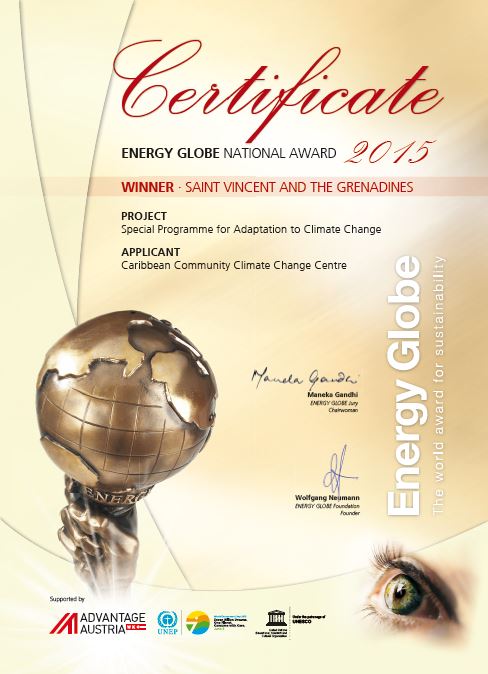
The Caribbean Community Climate Change Centre (CCCCC) received the 2015 Energy Globe Award for its renewable energy and potable water work in Saint Vincent and the Grenadines.
The Cayman Islands should be emulating this initiative and moving towards potable water production for Grand Cayman, Cayman Brac and Little Cayman. Editor

Energy Globe, an internationally recognized trademark for sustainability, is one of the most important environmental prizes today with 177 participating countries. The award, which is made from a cross-section of over 1, 500 entries annually, is given in recognition of outstanding performance in terms of energy efficiency, renewable energy and resource conservation.
The CCCCC won the 2015 Energy Globe National Award for the project “Special Programme for Adaptation to Climate Change”. The project was executed on the island of Bequia in Saint Vincent and the Grenadines and focuses on the production and provision of clean drinking water for more than 1,000 people. This is being done through the acquisition and installation of a reverse osmosis desalination plant. The project is deemed highly sustainable as the water input is inexhaustible sea water and the energy used is solar, a renewable, carbon-free source.
The landmark project was also presented by Energy Globe as part of a global online campaign (www.energyglobe.info) on World Environment Day. The campaign ran under the patronage of UNESCO and in cooperation with UNEP and received significant recognition.
“To be honoured with this award is a great recognition of our work for a better environment and motivates us to continue our endeavours in the future,” – Henrik Personn, Renewable Energy Expert, CCCCC
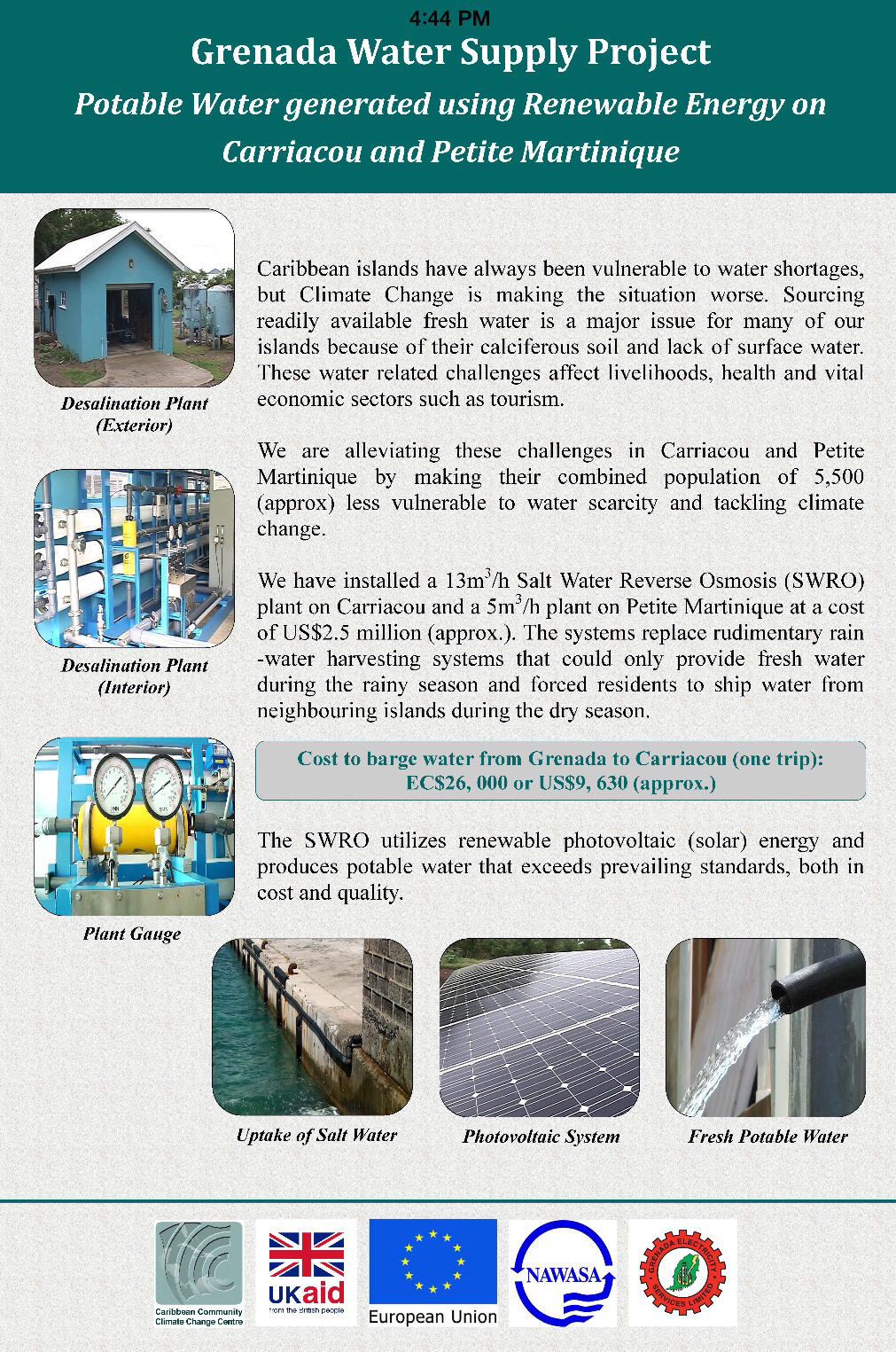
Since completing this key project, we have applied the lessons learned in Belize and on the Grenadian islands of Petite Martinique and Carriacou. Review the poster above to learn more about the progress we are making in Grenada:
 ©
© Tufton Wants Laws On Water Harvesting
EFFORTS TO preserve the country’s water reserves must be supplemented by legislation that makes rainwater harvesting compulsory for all housing developments and other such major projects which put a drain on Jamaica’s limited water resources during construction.

Dr Christopher Tufton
That is the recommendation from Dr Christopher Tufton, who told The Gleaner that such legislation is overdue, given Government’s failure to examine and report back on a resolution passed in the Senate March 1, 2013 on legislating rainwater harvesting.
“This is yet another example of a country that gives lip service to sustainable development, while citizens have to experience the hardships from a water crisis each year. We have heard nothing of the resolution since then, and as is customary, we act surprised that we are in another water shortage crisis, even though we have this situation each year,” said the former government minister.
He wants to make it mandatory that developers include in their applications information on how they will harvest and store rainwater for use during the life of the project. The legislation also speaks to the incorporation of features such as guttering on individual buildings, to ensure that water conservation becomes a part the Jamaican culture going forward.
“What it would mean is that one could determine to what extent existing projects could be retrofitted or adjusted. For new projects, however, part of their design should include a rainwater harvesting process. Now, it does add to the cost of construction, but in some countries, they have done things like tax rebates, among other things, to incentivise developers,” Tufton said. “So once construction is done, you could get a tax write-off in a short period of time to keep costs to a minimum.”
Acknowledging that this additional cost might prove a deterrent for some investors, Tufton said one has to look at the much bigger picture of the emotional distress and financial fallout the country is now experiencing. More
5Cs Wins Energy Globe Award for Renewable Energy and Potable Water Project in Bequia, St Vincent and the Grenadines


The Caribbean Community Climate Change Centre (CCCCC) received the 2015 Energy Globe Award for its renewable energy and potable water work in Saint Vincent and the Grenadines. Energy Globe, an internationally recognized trademark for sustainability, is one of the most important environmental prizes today with 177 participating countries. The award, which is made from a cross-section of over 1, 500 entries annually, is given in recognition of outstanding performance in terms of energy efficiency, renewable energy and resource conservation.
The CCCCC won the 2015 Energy Globe National Award for the project “Special Programme for Adaptation to Climate Change”. The project was executed on the island of Bequia in Saint Vincent and the Grenadines and focuses on the production and provision of clean drinking water for more than 1,000 people. This is being done through the acquisition and installation of a reverse osmosis desalination plant. The project is deemed highly sustainable as the water input is…
View original post 148 more words
UN Secretary General Ban Ki-Moon meets with Caribbean agencies focused on Climate Change
Deputy Director and Science Advisor of the Caribbean Community Climate Change Centre, Dr. Ulric Trotz, and other representatives of leading regional agencies focused on climate change issues met with His Excellency Mr. Ban Ki-Moon, Secretary General of the United Nations, last week at the Caribbean Development Bank (CDB) in Barbados.
Reflecting on the challenges posed by climate change and the way forward for the Caribbean, Dr Trotz noted that:
“Building climate resilient, low carbon economies in the Caribbean will require a transformational change by national governments, regional organisations, NGOs, the private sector and civil society supported by an unprecedented level of financial and technical assistance.”
The Secretary General applauded the Caribbean for its contribution and engagement on climate change and affirmed the importance of regional institutions in keeping on the front burner the concerns about the impact on the Caribbean.
“Regional organizations are critical to moving this agenda forward – and…
View original post 806 more words
Cuba and the Cayman Islands Concerns Grow With Prospect of U.S. Presence
Already, American corporations are poised to rush into a country only 90 miles from Florida’s shores.In March, a delegation from the U.S. Agriculture Coalition for Cuba, an agribusiness group that includes Cargill, the National Grain and Feed Association, the National Chicken Council and other companies and organizations, flew to Havana to meet with Cuban officials.

And cruise ship companies and hotel chains like Marriott and Hilton have indicated their enthusiasm. “I can’t stop thinking about it,” Frank Del Rio, chief executive officer of Norwegian Cruise Line Holdings, said in an interview. “Cuba and the cruise industry are just a match made in heaven, waiting to happen. More
The question for the Cayman Islands, who is considering constructing a new cruise ship dock, is how will the opening of Cuba affect cruise traffic to George Town?
I argue that an Economic Study is needed, in addition to the Environmental Impact Assesment (EIA), to analyse the economics of the cruise business to the Cayman Islands as a whole. This study should compare the financial benefits of stay-over tourism, with the extension of Owen Roberts International Airport (ORIA) to 10.000' feet allowing the handling of long-haul direct flights from Europe, East Asia (China, Japan, South Korea) and the Persian Gulf. It may be possible to turn ORIA into the air-hub of the Western Caribbean with Cayman Airways actually turning a profit as a regional carrier. Editor
IRENA Assesses Renewables Readiness of Fiji, Marshall Islands and Vanuatu
2 July 2015: The International Renewable Energy Agency (IRENA) has released Renewables Readiness Assessments (RRAs) for three small island developing States (SIDS): Fiji, the Marshall Islands and Vanuatu. The RRAs find that the three countries could meet their energy needs, expand energy access, decrease electricity costs and strengthen energy independence through a combination of renewable energy resources.

The Assessments call for employing a combination of solar, wind, geothermal, marine, biomass and biofuel energy to lessen the islands’ dependence on imports and cushion their economies from oil price fluctuations. They find that developing domestic sources of renewable power will be a win-win for both the climate and the economy, mitigating these countries’ carbon emissions and creating local jobs.
As outlined in their RRAs, all three countries are heavily dependent on fossil fuel imports, despite abundant renewable sources: solar, geothermal, wind, biomass and biofuel in Vanuatu; solar and wind in the Marshall Islands; and hydropower, biomass, solar, geothermal and wind in Fiji.
The RRA for Vanuatu assesses progress under the National Energy Roadmap toward sourcing 63% of its energy from renewables by 2030, calling for a grid-assessment study in preparation for large-scale renewables integration. Concluding that off-grid renewables could reach 83% of rural residents without electricity, it also recommends adoption of standard designs for off-grid solar-home systems.
The RRA for the Marshall Islands reports thousands of solar installations since enactment of the National Energy Policy and the Energy Action Plan, but suggests exploring more wind opportunities, forming a national energy agency and a renewable energy coordination committee, planning for off-grid renewables and addressing fuel drum leakage.
The RRA for Fiji examines the National Energy Policy, which hopes to achieve 100% renewables by 2030, finding that the Policy requires further implementation. It calls for a national energy committee to improve coordination among ministries and donors, consideration of maritime transport fueled by renewables, and greater geothermal energy exploration.
IRENA, which has completed more than 20 RRAs for countries around the world, states that the Assessments “offer a holistic evaluation of conditions for renewable energy deployment in a country and outline the actions necessary to further improve these conditions.” [IRENA Press Release] [IRENA Publication Webpage, Fiji] [Publication: Fiji Renewables Readiness Assessment] [IRENA Publication Webpage, Marshall Islands] [Publication: The Republic of Marshall Islands Renewables Readiness Assessment] [IRENA Publication Webpage, Vanuatu] [Publication: Vanuatu Renewables Readiness Assessment] More
CARICOM Countries Address Renewable Energy, SIDS’ Development, Climate Change
CARICOM 5 July 2015: The 36th Regular Meeting of the Conference of Heads of Government of the Caribbean Community (CARICOM) focused on energy, bolstering education systems, and Haiti's “looming humanitarian crisis,” among other issues. A high-level symposium on sustainable development convened on the sidelines of the Conference.

During the meeting, held on 2-4 July 2015, in Bridgetown, Barbados, leaders welcomed the establishment of a Caribbean Centre for Renewable Energy, which will be hosted by Barbados. The Centre will act as the implementation hub for sustainable energy activities and projects within the Caribbean. The Government of Trinidad and Tobago proposed creating a Caribbean Energy Fund, which participants supported.
Discussions at the Conference also addressed: access to concessional development financing for small island developing States (SIDS), with leaders advocating for a vulnerability measurement instead of gross domestic product (GDP) to determine economic health; a climate agreement that would limit warming to below 1.5°C compared to pre-industrial levels; and decision-making mechanisms in the region.
The Conference resulted in a communiqué that addresses: sustainable development; resilience building and wealth creation for Caribbean development, and the role of Caribbean universities; science and technology; and the promotion of sustainable energy. Participants also adopted 'The CARICOM Declaration for Climate Action,' which outlines the Caribbean region's priorities for the 2015 climate agreement, including loss and damage, limiting warming to below 1.5°C, a compliance mechanism, and finance measures, including improved and privatized access to funds by SIDS.
Speaking during the high-level symposium on sustainable development, UN Secretary-General Ban Ki-moon said that, by 2020, Barbados will be one of the world's top five solar energy users on a per capita basis, and Caribbean countries “are lighting the path to the future.” Noting that sustainable development and climate change are “two sides of the same coin,” Ban reiterated that this generation could be the first to end global poverty, and the last to prevent the worst impacts of climate change, “before it is too late.”
Ban underscored that the proposed Sustainable Development Goals (SDGs) must be “focused, financed and followed up,” and that partnerships must be strengthened with regard to capacity building, financing, access to technology, and improved data collection and statistics.
Ban also called on countries to: link the global agenda to regional agendas; deepen regional integration; focus on the needs and vulnerabilities of SIDS and middle-income countries (MICs), including by addressing the debt challenge; and achieve a low-carbon, climate-resilient development pathway. He said he will continue working to guarantee that SIDS and the least developed countries (LDCs) are top funding priorities of the Green Climate Fund (GCF), among other sources.

New NASA data show how the world is running out of water
The world’s largest underground aquifers – a source of fresh water for hundreds of millions of people — are being depleted at alarming rates, according to new NASA satellite data that provides the most detailed picture yet of vital water reserves hidden under the Earth’s surface.

Twenty-one of the world’s 37 largest aquifers — in locations from India and China to the United States and France — have passed their sustainability tipping points, meaning more water was removed than replaced during the decade-long study period, researchers announced Tuesday. Thirteen aquifers declined at rates that put them into the most troubled category. The researchers said this indicated a long-term problem that’s likely to worsen as reliance on aquifers grows.
Scientists had long suspected that humans were taxing the world’s underground water supply, but the NASA data was the first detailed assessment to demonstrate that major aquifers were indeed struggling to keep pace with demands from agriculture, growing populations, and industries such as mining.
“The situation is quite critical,” said Jay Famiglietti, senior water scientist at NASA’s Jet Propulsion Laboratory in California and principal investigator of the University of California Irvine-led studies.
Underground aquifers supply 35 percent of the water used by humans worldwide. Demand is even greater in times of drought. Rain-starved California is currently tapping aquifers for 60 percent of its water use as its rivers and above-ground reservoirs dry up, a steep increase from the usual 40 percent. Some expect water from aquifers will account for virtually every drop of the state’s fresh water supply by year end
The aquifers under the most stress are in poor, densely populated regions, such as northwest India, Pakistan and North Africa, where alternatives are limited and water shortages could quickly lead to instability.
The researchers used NASA’s GRACE satellites to take precise measurements of the world’s groundwater aquifers. The satellites detected subtle changes in the Earth’s gravitational pull, noting where the heavier weight of water exerted a greater pull on the orbiting spacecraft. Slight changes in aquifer water levels were charted over a decade, from 2003 to 2013.
“This has really been our first chance to see how these large reservoirs change over time,” said Gordon Grant, a research hydrologist at Oregon State University, who was not involved in the studies.
But the NASA satellites could not measure the total capacity of the aquifers. The size of these tucked-away water supplies remains something of a mystery. Still, the satellite data indicated that some aquifers may be much smaller than previously believed, and most estimates of aquifer reserves have “uncertainty ranges across orders of magnitude,” according to the research.
Aquifers can take thousands of years to fill up and only slowly recharge with water from snowmelt and rains. Now, as drilling for water has taken off across the globe, the hidden water reservoirs are being stressed.
“The water table is dropping all over the world,” Famiglietti said. “There’s not an infinite supply of water.”
The health of the world’s aquifers varied widely, mostly dependent on how they were used. In Australia, for example, the Canning Basin in the country’s western end had the third-highest rate of depletion in the world. But the Great Artesian Basin to the east was among the healthiest.
The difference, the studies found, is likely attributable to heavy gold and iron ore mining and oil and gas exploration near the Canning Basin. Those are water-intensive activities.
The world’s most stressed aquifer — defined as suffering rapid depletion with little or no sign of recharging — was the Arabian Aquifer, a water source used by more than 60 million people. That was followed by the Indus Basin in India and Pakistan, then the Murzuk-Djado Basin in Libya and Niger.
California’s Central Valley Aquifer was the most troubled in the United States. It is being drained to irrigate farm fields, where drought has led to an explosion in the number of water wells being drilled. California only last year passed its first extensive groundwater regulations. But the new law could take two decades to take full effect.
Also running a negative balance was the Atlantic and Gulf Coastal Plains Aquifer, which stretches across the southeast coast and Florida. But three other aquifers in the middle of the country appeared to be in relatively good shape.
Some groundwater filters back down to aquifers, such as with field irrigation. But most of it is lost to evaporation or ends up being deposited in oceans, making it harder to use. A 2012 study by Japanese researchers attributed up to 40 percent of the observed sea-level rise in recent decades to groundwater that had been pumped out, used by humans and ended up in the ocean.
Famiglietti said problems with groundwater are exacerbated by global warming, which has caused the regions closest to the equator to get drier and more extreme latitudes to experience wetter and heavier rains. A self-reinforcing cycle begins. People living in mid-range latitudes not only pump more water from aquifers to contend with drier conditions, but that water — once removed from the ground — also then evaporates and gets recirculated to areas far north and south.
The studies were published Tuesday in the Water Resources Research journal.
Famiglietti said he hoped the findings would spur discussion and further research into how much groundwater is left.
“We need to get our heads together on how we manage groundwater,” he said, “because we’re running out of it.” More
 Democracy & Good Governance