Abu Dhabi summit to discuss water security challenges

More than 32,000 global leaders from 170 countries representing government, industry, investment and research to Abu Dhabi, will provide an upfront look at affordable technologies to enable sustainable water resource management to help meet the Middle East’s rising demand for water.

Hosted by Masdar, Abu Dhabi’s renewable energy company, ADSW is a yearly platform that addresses the interconnected challenges of energy and water security, climate risk and sustainable development.

Running from January 17 to 24, ADSW includes the World Future Energy Summit (WFES), the world’s foremost event dedicated to the advancement of renewable energy, energy efficiency and clean technology; and the International Water Summit (IWS), which provides a business approach to addressing water scarcity, sustainable growth and economic development in arid regions.

“The Mena region is in a truly unique position to solve the challenge of water security,” remarked Raed Bkayrat, vice president of development for Saudi Arabia at First Solar, which is participating in WFES.

“While the region is quite arid, it also has one of the highest solar irradiances of any region in the world, and much of the population has ready access to seawater. Accordingly, solar photovoltaic projects are proving to be sustainable means of powering water desalination in the region, ensuring that the supply of clean water will keep up with the region’s increasing demand for it,” he noted.

Masdar took a major step by launching a pilot project to test energy-efficient desalination technologies – such as reverse osmosis and forward osmosis – powered by renewable energy.

The company awarded contracts to Abengoa, Degremont, Sidem/Veolia and Trevi Systems to build the desalination plants, which are expected to enable the implementation of cost-competitive desalination plants powered by renewable energy in the UAE and abroad.

“Engaging different sectors of the industry is really crucial to bring forward innovative solutions, as well as pilot projects that demonstrate to governments the value of new integrated systems,” Bkayrat added.

Both WFES and IWS will offer numerous keynote addresses, panel discussions and workshops as well as exhibitors introducing affordable technologies to enable sustainable water resource management.

Along with WFES and IWS, ADSW will include the second EcoWaste and the seventh Zayed Future Energy Prize Award Ceremony; it also coincides with the Fifth General Assembly of the International Renewable Energy Agency.-TradeArabia News Service More


The ‘Land of the Free’ supports one of the most repressive states in the world

Crimes against humanity in Gaza: is it really a 'buffer zone' – or a bigger plan

The international community and states parties to the United Nations should hang their heads in shame

Late last week, the White House decried Israel’s attack on a UN school in Gaza as “totally unacceptable” and “totally indefensible”, then proceeded to approve $225m in funding for its Iron Dome. On Monday, the US state department went further, calling the airstrikes upon a UN school “disgraceful” – and yet America provides Israel with more than $3.1bn every year, restocking the ability of the Israel Defense Force (IDF) to hit more schools, and to wage total war against an imprisoned people, because of their nationality.

American taxpayers should not be paying for this. And the western world should stop rejecting serious inquiries about Israel’s moral inconsistencies, or allow it to benefit from cognitive dissonance and information overload amid the current crisis in Gaza.

There is a land grab going on. The Israeli prime minister, Binjamin Netanyahu, has shrunk Gaza’s habitable land mass by 44%, with an edict establishing a 3km (1.8-mile) buffer zone, a “no-go” zone for Palestinians – and that’s quite significant, because a good part of Gaza is only 3 to 4 miles wide. Over 250,000 Palestinians within this zone must leave their homes, or be bombed. As their territorial space collapses, 1.8m Gazans now living in 147 square miles will be compressed into 82 square miles.

Gaza’s entire social and physical infrastructure of housing, hospitals, places of worship, more than 130 of its schools, plus markets, water systems, sewer systems and roads are being destroyed. Under constant attack, without access to water, sanitary facilities, food and medical care, Gazans face an IDF-scripted apocalypse.

With Gaza’s land mass shrinking due to Israeli military action, it’s about time someone asked: What is the end game? Three weeks ago, Moshe Feiglin, deputy speaker of the Knesset, called for Gaza to “become part of sovereign Israel and will be populated by Jews. This will also serve to ease the housing crisis in Israel.”

Israel has a housing crisis? After the “no-go” buffer zone is evacuated, there will be 21,951 Palestinians per square mile in Gaza, while Israel’s population density stands at 964 persons per square mile.

Deputy Speaker Feiglin wants the Palestinians in Gaza to lose all of their land. One must not assume that Mr Feiglin or his Likud faction speak for the main government actors like Prime Minister Netanyahu. After all, Knesset politics are complex and divergent. But since Gaza has just lost control of that 44% of its land, it may also be time to ask: does the establishment of that 3km zone represent the unfolding of a larger plan? Is that the end game?

At the very point where an aroused public becomes aghast at the slaughter of Gazans, the western world becomes inured to the violence, hypnotized by the media’s cadence of body counts. The intolerable becomes normalized, and later ignored as old news. Which would seem a perfect time to leave in place the 3km zone – for security purposes, of course – and then advance the proposal that Palestinians crammed into the remaining 56% of Gaza simply … leave.

I assume the IDF acts with deliberation, under orders from the Netanyahu government. And I think the extraordinary and illegal forced relocation of over 250,000 Palestinians from 44% of Gazan land is a crime against humanity under the guise of establishing a “buffer zone” for security purposes.

Look at the region’s maps from recent history. Look at the steady erosion of Palestinian land and the acquisition of land by Israel, and you can understand that the present attack on Gaza is not about solely about Hamas. It’s about land. It isn’t just about Hamas’s rockets. It’s about land. It isn’t just about Hamas’s tunnels. It’s about land. It isn’t about kidnappings. It is about land. It isn’t even about meeting a housing crisis in Israel. It is about grabbing land from the Palestinians in Gaza and the natural resources that go with the land, upon the occasion of Israel’s military invasion of Gaza.

Yes, Hamas’s attacks on Israel are illegal and should be condemned, and those who ordered the attacks should be held accountable under law. All policies and practices which refuse to recognize Israel’s right to exist should be condemned. Israel has a right to exist. But Israel’s right to exist is impaired when Israel decides Palestinians have no right to exist on their own land. It’s time for us to stop paying for Israel’s dubious, destructive self-righteousness. And it’s time for the solipsism syndrome afflicting Israel’s leaders to get a day of discussion in the International Criminal Court concerning their attacks on Gaza – and especially their new 3km “buffer zone”. More


Citing Next Generations, Lawsuits Demand Courts Recognize ‘Mind-Blowing’ Climate Impacts

By caving to industry pressures, environmental regulatory agencies are failing to uphold their obligation to future generations, declared Mary Christina Wood, the author pushing a new legal framework to fight global warming, on the final episode of Moyers & Company.

Wood, a University of Oregon law professor who wrote Nature's Trust: Environmental Law for a New Ecological Age (2013; Cambridge University Press), advocates an idea called “atmospheric trust litigation,” which takes the fate of the Earth into the courts, arguing that the planet’s atmosphere—its air, water, land, plants, and animals—are the responsibility of government, held in its trust to insure the survival of all generations to come.

“If this nation relies on a stable climate system, and the very habitability of this nation and all of the liberties of young people and their survival interests are at stake the courts need to force the agencies and the legislatures to simply do their job.”
—Mary Christina Wood, University of Oregon Law School

“The heart of the approach is the public trust doctrine,” she told her host, longtime journalist and political commentator Bill Moyers. “And it says that government is a trustee of the resources that support our public welfare and survival. And so a trust means that one entity or person manages a certain wealth, an endowment, so to speak, for the benefit of others. And in the case of the public trust, the beneficiaries are the present and future generations of citizens.”

The theory underpins lawsuits filed by Our Children's Trust, which ask for the courts to order state and local governments and agencies to act more aggressively to bring down carbon emissions.

“[I]f this nation relies on a stable climate system, and the very habitability of this nation and all of the liberties of young people and their survival interests are at stake the courts need to force the agencies and the legislatures to simply do their job,” Wood explained.

Environmental laws passed in the 1970s “held a lot of promise” decades ago, she said but they've lost what little power they once possessed. Wood continued:

Americans thought they had solved the problem by getting these laws passed. What they didn't realize was that industries got inside the agencies through various means, through campaign contributions, through pressure on the system over and over again. And so one thing we have to keep in mind is we're nearing the end of our resources. And there are laws of nature that we have to comply with.

And those laws are supreme. And they determine whether we will survive on this planet. And they will determine the future conditions for our children. And so right now, our environmental laws are out of whack with the laws of nature. They are allowing destruction, whereas they should be structuring society to create a balance with the natural systems that support our lives.

And Wood disagreed with those who argue that climate change is a political issue to be dealt with outside the courts.

“Climate is not just an environmental issue,” she said. “This is a civilizational issue. This is the biggest case that courts will get in terms of the potential harm in front of them, the population affected by that harm, and in terms of the urgency. Climate is mind-blowing. It can't be categorized any longer as an environmental issue.”

In a related feature earlier this year, Moyers spoke to a member of the next generation who is a co-plaintiff in one of the atmosphere trust litigation lawsuits being spearheaded by Our Children’s Trust.

“Public trust states that the government is a trustee to protect these natural resources that every living species, including humans, rely upon for our survival, for our well-being,” 18-year-old Kelsey Juliana told Moyers at the time. “And so the public trust says, government, we hold you, we trust you to put these resources, air, water, land, you know, to protect them for this generation and for many generations down the line.” More


A New Canal Through Central America Could Have Devastating Consequences

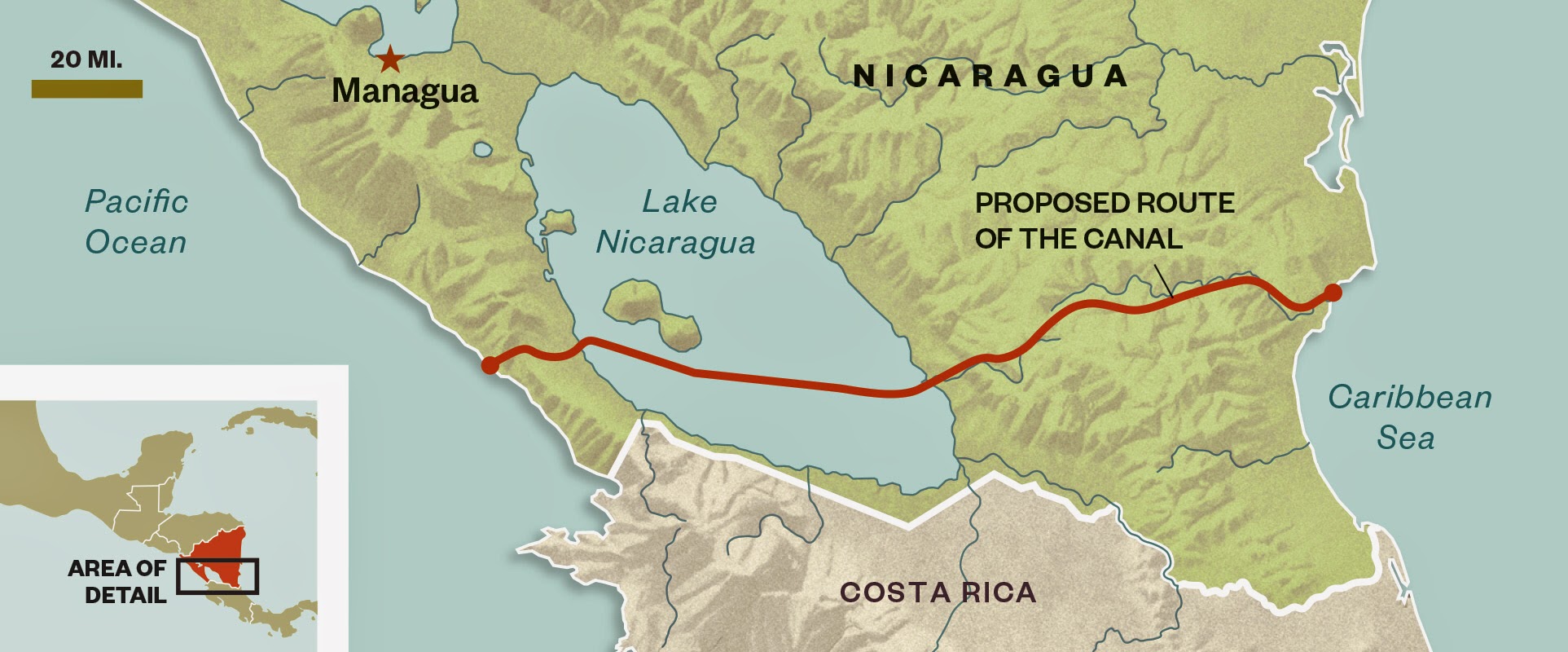
When construction crews begin digging a new canal this month across Nicaragua, connecting the Pacific and Atlantic, it’ll be a boon to global shipping and, the government says, to the economy of the second-poorest nation in the Americas.

But activists, scientists and others are increasingly alarmed by the environmental impact of a 173-mile artificial waterway—wider, deeper and three and a half times the length of the Panama Canal.

Developed by Wang Jing, an enigmatic Chinese industrialist with ties to China’s ruling party, the Grand Nicaragua Canal will cost an estimated $40 billion and take five years to build. At 90 feet deep and 1,706 feet across at its widest, the channel will accommodate the newest cargo supertankers, which are longer than the Empire State Building is tall and carry 18,000 shipping containers. The vessels are too big to pass through the Panama Canal (even after a $5 billion expansion is completed) or to dock in any U.S. port.

The new canal and its infrastructure, from roads to pipelines to power plants, will destroy or alter nearly one million acres of rainforest and wetlands. And that doesn’t include Lake Nicaragua, a beloved 3,191-square-mile inland reservoir that provides most Nicaraguans with drinking water. The canal cuts through the lake, and critics say ship traffic will pollute the water with industrial chemicals and introduce destructive invasive plants and animals.

Plus, the canal route lies in the middle of a hurricane belt, says Robert Stallard, a research hydrologist with the U.S. Geological Survey and the Smithsonian Tropical Research Institute. “You’re likely going to be looking at hurricanes vastly more powerful than anything that ever hit Panama, and ever will,” Stallard says. A storm like Hurricane Mitch, which killed 3,800 people in Nicaragua in 1998, would probably cause the canal to flood, triggering mudslides that would breach locks and dams. Communities, homes, roads and power lines would be swamped.

The Nicaraguan government has yet to release promised analyses of the canal’s likely environmental impacts, and has even dodged neighboring Costa Rica’s request to share disaster plans. “We’ve got a lack of information and a potentially big threat to the environment,” says Jorge A. Huete-Pérez, vice president of the Academy of Sciences of Nicaragua. “The government just wants to rush the thing through.” The canal’s true benefits can’t be calculated, Huete-Pérez and others argue, as long as the costs to Nicaragua’s forests, waterways and wildlife remain hidden. More


Behind the veil of the Islamic State is a war for water

A little known fact of the war in Syria is that it started at the end of the worst drought in Syrian history, a biblical drought which forced over 1 million farmers into the cities.

Pulitzer Prize-winner Thomas L. Friedman interviewed Syrian refugees and farmers in Syria about the link between this drought and the start of the civil war. He comes to the conclusion that the drought certainly played some role and was probably a key tipping point for a bad situation to turn into a full scale war. In the documentary “Years of living dangerously” we see how wiki-leaked diplomatic cables and high level US officials such as Condoleezza Rice acknowledge this link.

But there’s a lot more happening to explain why behind the veil of a quest for an Islamic State (IS), there’s also a war for water in Syria and Iraq. Making the plight of citizens worse is the continued targeting of water supply networks by both regime and opposition forces, which have attacked strategic lifelines, such as water channels, to gain control of territory and to punish and put pressure on their opponents.

Opening the flood gates …

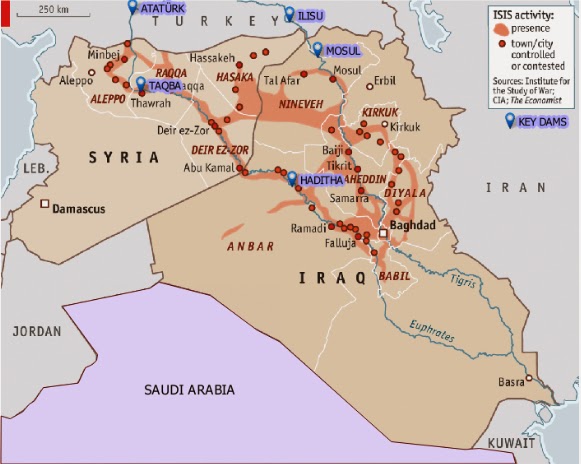
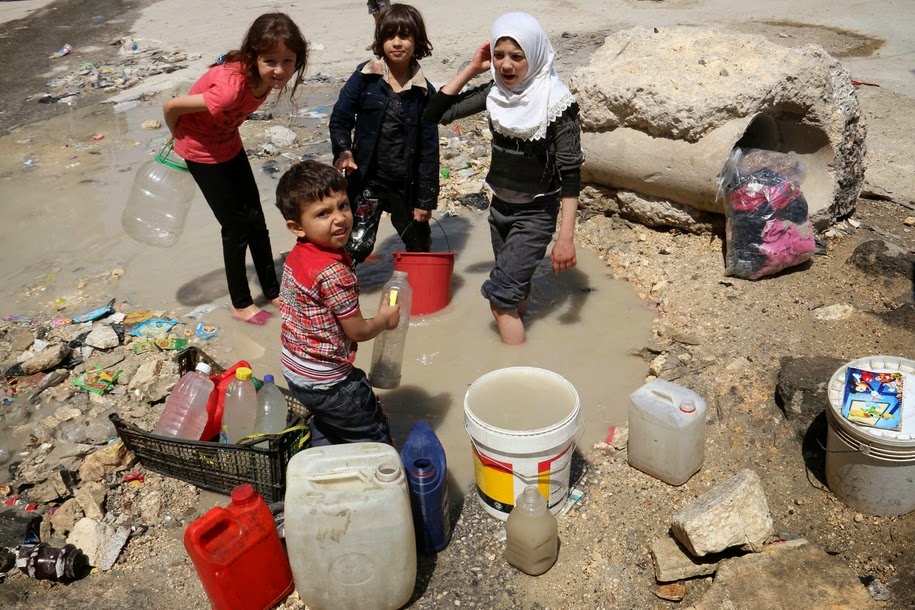
The Islamic State’s quest for hydrological control began in Syria, when it captured the Tabqa Dam in 2013. Rebel-held areas had been systematically denied electricity by President Bashar al-Assad’s forces in their effort to turn the population against the insurgency. The Tabqa Dam was built more than 40 years ago with Russian help and aimed to make Syria self-sufficient in energy production. Behind the dam is Lake Assad, which provides millions of Syrians with drinking water and is a vital irrigation source for farms. After the capture of the dam, IS opened the flood-gates to get maximum electricity supply for the areas they control and win favour with the local population. As a result, the lake dropped six metres, to a record low in May, which worsened the plight of millions of already destitute Syrians as severe water cuts began to hit Aleppo province.

Conflict over the water flowing though the Euphrates and Tigris is of course nothing new and predates religious wars. They were the first rivers to be used for large scale irrigation, in the region once known as the Fertile Crescent. Somewhere between 1720 and 1684 BC, a grandson of Hammurabi dammed the Tigris to prevent the retreat of rebels led by Iluma-Ilum, who declared the independence of Babylon. The Euphrates was already used as a weapon somewhere around 2500 BC, in another fight for Babylon, when the king of Umma cut the banks of irrigation canals alongside the Euphrates dug by his neighbor, the king of Girsu.

The Euphrates and Tigris are the two major and longest rivers in the Middle East. They both originate in Turkey. The Euphrates flows through Syria and Iraq to reach the Persian Gulf while the Tigris flows through Kurdish territory, meeting up with the Euphrates in the Southern Mesopotamian Marshes of Iraq. There are currently at least 46 dams in the Tigris-Euphrates basin, with at least 8 more planned or under construction. These dams have become key pieces of geo-political control in the region.

… and shutting down the flows

While one act of war is opening the flood gates, another is closing them. In 1974, Iraq threatened to bomb the same Tabqa Dam in Syria, alleging that the dam had reduced the flow of Euphrates River water to Iraq. But between then and now, Turkey, through its position upstream, has taken over as the most powerful regional commander of water, by completing the giant Ataturk Dam. In 1990 Syria and Iraq protested that Turkey now has a weapon of war: by closing the gates they could leave them dry. They had good reason to protest. In mid-1990 Turkish president Turgut Özal threatened to restrict water flow to Syria to force it to withdraw support for Kurdish rebels operating in southern Turkey.

In April 2014, the Islamic State blamed the low water levels in Lake Assad to Turkey’s closure of the Ataturk Dam. Sources found by Al Jazeera said that these claims are disputed. But even if the allegations are only partly true: they were used by the Islamic State to issue threats to ‘liberate Istanbul’, if that was necessary. So while Turkey, IS and Assad fight over water, millions of ordinary Syrians and Iraqi’s see their water levels drop dramatically. Not just by a new drought, with rainfall down by 50-85 percent since October 2013, but mostly due to a power struggle.

Tensions over water control in the region are set to heat up further if Turkey completes the Ilisu Dam on the Tigris River near the border of Syria. The Ilisu Dam will generate 1,200 MW and is part of the vast and ambitious Southeastern Anatolia Project, known as GAP after its Turkish title (Guneydogu Anadolu Projesi): a network comprising 22 dams and 19 power plants. The Ilisu reservoir will flood 52 villages and 15 towns, including Hasankeyf, a Kurdish town of 5,500 people, which is the only town in Anatolia that has survived since the Middle Ages and is under archaeological protection. It will displace approximately 16,000 people in the troubled Kurdish region.

The World Bank (WB), the British construction company Balfour Beatty and the Italian company Impreglio have all withdrawn from the problematic project. So have international funds and export credit from Austria, Germany and Switzerland. However, the project is currently funded by Turkish banks. Iraq and also Syria will be the most heavily impacted if the dam and others go through, with the most extreme projections holding that, owing to a combination of climate change and upstream dam activity, the Tigris and Euphrates rivers won’t have sufficient flow to reach the sea by as early as 2040.

If you live in Syria or Iraq and the water irrigating your field stops coming you might join the ranks of any army promising to attack those who kept the water for themselves – no matter if they tell you the truth or not. As is often the case in conflicts or epidemics it is not the facts themselves that count most but what people believe to be the facts. Those who can convince it’s the enemies fault that there’s not enough water will have the key to where the hearts and minds of the people will go to – no matter what the facts are.

The US finally finds a Weapon of Mass Destruction in Iraq

The Tabqa Dam is not the only dam attacked by IS. They are also trying to take the Haditha Dam, the second-largest in Iraq, raising the possibility of catastrophic damage and flooding. On Sunday, the US was bombing IS positions close to the dam. The IS militants are also fighting for control of the Euphrates River Dam, about 120 miles northwest of Baghdad and government forces were fighting to halt their advance. Insurgents from IS seized the Falluja Dam in Iraq in February and closed the floodgates to cause upstream flooding and to cut downstream water supply. Some 40.000 people were displaced just to flood the area around the city of Falluja to force government troops to retreat and lift a siege, while cutting water supplies and hydroelectricity generation for other parts of the country. All that was peanuts compared to what IS did next.

On August 7 IS captured the 1GW Mosul Dam on the Tigris – sending shock waves through Bagdad, Kuwait and the US. Whoever controls the Mosul Dam, the largest in Iraq, controls most of the country’s water and power resources. Located on the Tigris River upstream of Mosul, the dam, 3.6 km long and with 320 MW of capacity daily, formerly known as the Saddam dam, was built beginning in 1980 at a cost of 1.5$ billion USD, to bolster the regime during the Iran-Iraq war by a German-Italian consortium that was led by Hochtief Aktiengesellschaft. Its construction submerged many archaeological sites in the region yet more troubling is that because the dam was constructed on a foundation of soluble gypsum, it requires continuous grouting of the dam’s foundation to promote stability. Due to the engineering problems it presents it has been described recently by US engineers as “the most dangerous dam in the world.” And that was before the “most dangerous terror group ever” captured it.

A senior U.S. administration official said that “The failure of the Mosul Dam could threaten the lives of large numbers of civilians, threaten U.S. personnel and facilities – including the U.S. Embassy in Baghdad – and prevent the Iraqi government from providing critical services to the Iraqi populace,” (Source: Reuters). A 2006 U.S. Army Corps of Engineers report obtained by the Washington Post said the dam, which blocks the Tigris and holds 12 billion cubic meters of water, could flood two cities killing over a half a million people if it were destroyed or collapsed. The tsunami going to Mosul, a city of 1.7 million people, can be 20m high if the dam breaks with a full reservoir.

But even without a catastrophic failure, the dam is already at the epicenter of the war. Soon after the Islamic State captured the Mosul Dam they cut supplies to some villages in the north of the country that have not joined their cause. Recapturing this instrument of war was a sufficient reason for US forced to deploy air power to support Kurdish forces to recapture the dam. Saving the Yazidis from their mountain captured most media attention, but a key reason for the US to bomb Iraqi soil for the first time since 2011 was the fact that IS took the Mosul Dam. After bombing IS positions for several days, freshly re-equipped Kurdish fighters recently regained control of the dam.

Mega Dams & Water Management Practices

The importance of hydro-infrastructure in these battles and how it can be wielded firstly underlines the need for a serious re-appraisal of water management practices. Big dams (with funding from Multilateral agencies such as the WB, national and regional development banks, private equity and pension funds as well as from the Clean Development Mechanism, etc.) cause large scale displacement of populations, are ecologically destructive, wash away any other source of livelihood, and often saddle countries with debt while performing well below planned outputs as regards electricity generation. Moreover, compounded by climate change, contemporary ecological crises are leading to ever more conflict over trans-boundary water rights, such as for example between Ethiopia and Egypt, which are also on the verge of war over the construction of the Grand Renaissance and Gibe 3 dams, which would become Africa’s tallest. The world’s Big Dam Fan Club should take note of what has just happened in Syria and Iraq and realise that once disaster hits, hatred will not go to any God but to those who constructed the weapon of mass destruction. Water, rather than oil, is shaping up to be the key strategic resource in the region. More


Paving Way for War Crimes Charges, Palestinians Move to Join International Criminal Court

Following the defeat of a United Nations Security Council resolution that demanded an end to Israeli occupation and recognition of Palestinian statehood, Palestine's president Mahmoud Abbas signed a Palestinian request to join the International Criminal Court on Wednesday, a move that the Guardian wrote sets “Palestinians on a diplomatic collision course with Israel and the U.S.”

“There is aggression practiced against our land and our country, and the Security Council has let us down—where shall we go?” Mr. Abbas reportedly said at his headquarters in the West Bank city of Ramallah, as he signed the Rome Statute, the founding charter of the Hague court, as well as over a dozen other international treaties and conventions.

“We want to complain to this organization,” he said, referring to the court. “As long as there is no peace, and the world doesn’t prioritize peace in this region, this region will live in constant conflict. The Palestinian cause is the key issue to be settled.”

As expected, the decision elicited an angry response from Israel. “The one who needs to fear the International Criminal Court in the Hague is the Palestinian Authority, which has a unity government with Hamas, a terror organization like (the Islamic State group) which commits war crimes,” Prime Minister Benjamin Netanyahu said in a statement.

According to the Associated Press, Netanyahu called Israel's soldiers “the most moral army in the world” and said the country would take unspecified “retaliatory steps.”

The AP noted that “turning to the International Criminal Court marks a major policy shift by transforming Abbas' relations with Israel from tense to openly hostile. Abbas has been threatening to join the court since 2012, but held off under American and Israeli pressure. The Palestinians can use the court to challenge the legality of Israeli settlement construction on occupied lands and to pursue war crimes charges connected to military activity.”

The State Department criticized the move as well. In a statement issued Wednesday, it said it was “deeply troubled by today’s Palestinian action regarding the ICC,” and called it “an escalatory step that will not achieve any of the outcomes most Palestinians have long hoped to see for their people.” More