Climate Injustice – Excerpt from Disruption

‘When it comes to climate change, why do we do so little when we know so much?’

Through a relentless investigation to find the answer, Disruption takes an unflinching look at the devastating consequences of our inaction.

The exploration lays bare the terrifying science, the shattered political process, the unrelenting industry special interests and the civic stasis that have brought us to this social, moral and ecological crossroads.The film also takes us behind-the-scenes of the efforts to organize the largest climate rally in the history of the planet during the UN world climate summit.

This is the story of our unique moment in history. We are living through an age of tipping points and rapid social and planetary change. We’re the first generation to feel the impacts of climate disruption, and the last generation that can do something about it. The film enlarges the issue beyond climate impacts and makes a compelling call for bold action that is strong enough to tip the balance to build a clean energy future. More


Perpetual War, Indefinite Detention, And Torture: The U.S. And Israel’s Shared Values

The United States and Israel have “shared values” but not when it comes to upholding democracy and the rule of law. Their shared values are perpetual war, torture, indefinite detention, and military courts.
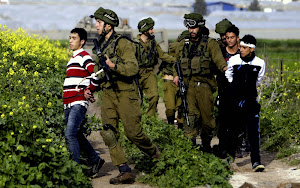
Israeli soldiers arrest Palestinian
minors in the West Bank city of Jenin

Guantanamo is a perfect example of this. Both states have been in a state of perpetual war for quite some time with Israel against the Palestinians since its founding in 1948 while the U.S. can trace back its war to its founding in 1776 and the colonization of Native American lands. Today’s global war on terror is the latest chapter in that saga. Under perpetual war, the United States and Israel can justify a litany of draconian policies, such as indefinite detention, torture, and extrajudicial killing.

International human rights law prohibits torture and detention without charge or trial. The UN Convention Against Torture strictly forbids torture, even in “exceptional circumstances” like “a state of war or threat of war, internal political instability or any other public emergency.” Meanwhile, article 9 of the International Covenant on Civil and Political Rights states, “No one shall be subjected to arbitrary arrest or detention.” The rights to a fair trial, due process, and to be free from torture and inhumane treatment are basic human rights that governments are obliged to uphold. Yet, both the United States and Israel practice indefinite detention – also known as “administrative detention” in Israel – and torture.

Administrative detention and torture in Israel

Israel has detained thousands of Palestinians in the occupied territories without charge or trial over the years “for periods ranging from several months to several years,” according to Israeli human rights group B’Tselem. B’Tselem figures also report that, “At the end of May 2014, 196 Palestinian administrative detainees were held in facilities run by the Israel Prison Service (IPS).” Israel recently locked up over 250 Palestinians in administrative detention as part of its operation to find the three missing but killed Israeli settlers, putting the current population at around 450.

Three Israeli laws allow and regulate Israel’s administrative detention powers – the Administrative Detention Order, theEmergency Powers (Detention) Law, and the Internment of Unlawful Combatants Law.

The Administrative Detention Order, which applies to the West Bank except East Jerusalem, allows military commanders to detain a person for a maximum of six months “for reasons to do with regional security or public security.” Commanders can repeatedly add six months of administrative detention, since there is no limit on extensions. The 1979 Emergency Powers Law allows the defense minister to detain a person for up to six months, like the Order, and extend the detention repeatedly six months at a time. It applies to Israeli residents, residents living in Israeli occupied territories, and residents of other countries, such as Lebanon. However, this law grants detainees more protections than the Order does. The 2002 Internment of Unlawful Combatants Law allows for the administrative detention of a civilian who directly or indirectly participates in hostilities against Israel or is a member of a force that does so. Under this law, persons can be detained for an unlimited period of time. This law is used to detain Palestinians living in the Gaza Strip.

While the occupation is illegal and unjust, Israel, as an occupying power, has an international legal responsibility to uphold the welfare of Palestinians living under its control. International humanitarian law permitssome internment (or detention without charge or trial) in wartime but only “for imperative reasons of security,” according to Article 78 of the Fourth Geneva Convention. Internment [detention] also has to be done on a case-by-case basis rather than implemented widely.

B’Tselem names the numerous ways in which Israel’s use of administrative detention violates its international legal responsibilities as an occupying power. One is its “[e]xtremely extensive use” in contravention of international law. “Administrative detention has become routine practice, rather than an exceptional measure,” according to B’Tselem. Relatedly, administrative detention is used as “an alternative to criminal proceedings” with authorities using it “as a quick and efficient alternative to criminal trial, primarily when they do not have sufficient evidence to charge the individual, or when they do not want to reveal their evidence.” Administrative detention also lacks due process as detainees “are not provided meaningful information on the reasons for their detention and are not given an opportunity to refute the suspicions against them.” Additionally, detention periods are repeatedly extended, which leaves Palestinians detained for several months to years without charge or trial. Israel has also used administrative detention against political opponents, including non-violent political activists. Finally, many Palestinian administrative detainees are held inside Israel.

In 1999, Israel’s High Court of Justice issued a ruling that prohibited interrogators from using methods of torture as a means of interrogation. Before that ruling, Israeli security forces regularly “tortured thousands of Palestinian detainees each year,” according to the Public Committee Against Torture in Israel. In 1987, an Israeli government commission, headed by former Supreme Court President Moshe Landau, issued a report that provided a framework for Israel’s torture regime. The Landau Commission recommended Shin Bet interrogators utilize torture methods, namely “psychological pressure” and a “moderate degree of physical pressure,” against people suspected of “hostile terrorist activity.” It argued that “an effective interrogation is impossible” without some physical force.

Despite the High Court’s 1999 ban on torture, rights groups like the Public Committee Against Torture in Israel (PCATI) point out that the Israeli intelligence agency Shin Bet and other law enforcement agencies still commit acts of torture. The PCATI largely relied on testimonies from Palestinian prisoners and forensic evaluations. In response, the Shin Bet denies it commits torture and argues that its interrogation methods are not only lawful but save lives.

Methods of torture and ill treatment of Palestinian prisoners since 1999, according to the PCATI, include “sleep deprivation, binding to a chair in painful positions, beatings, slapping, kicking, threats, verbal abuse and degradation,” special methods like “bending the body into painful positions,” “forcing the interrogee to crouch in a frog-like position (‘kambaz’), choking, shaking and other violent and degrading acts (hair-pulling, spitting, etc.),” and psychological torture. Prisoners, some of whom are children, in solitary confinement often face “sleep deprivation, exposure to extreme heat and cold, permanent exposure to artificial light, detention in sub-standard conditions.”

The High Court’s ruling has loopholes for Israeli intelligence to circumvent the torture ban. One is the “necessity defense”, which, according to PCATI, “under certain circumstances, exempts interrogators who employ illegal interrogation techniques, including physical violence, from criminal responsibility.” Another is well-known the “ticking bomb” scenario, where torture is allowed to prevent an imminent threat, such as a bomb about to explode. PCATI argues that the government exploited this loophole to declare more detainees ticking time bombs and overstepping the court’s intended scope. PCATI also accused the Shin Bet “taking advantage of the fact that only sleep deprivation for the sake of deprivation is illegal, not sleep deprivation indirectly caused from an extended interrogation,” according to the Jerusalem Post.

Guantanamo, U.S. global war on terror

The 2001 Authorization for Use of Military Force, passed shortly after 9/11, authorizes the President of the United States “to use all necessary and appropriate force against those nations, organizations, or persons” who “planned, authorized, committed, or aided” the 9/11 terrorist attacks “or harbored such organizations or persons.” This bill gives the United States wide power to wage perpetual war around the world against alleged terrorist groups.

When the Obama administration entered office, it not only kept the AUMF in place, but expanded the bill’s scope to continue the global war on terror. The Obama administration interprets the AUMF to include “associated forces” – essentially co-belligerents – of al-Qaeda, even though the bill does not include those words. Last year, the Washington Post reportedthat Obama administration officials were debating whether the AUMF could be stretched to include “associates of associates” of al-Qaeda, including groups like al-Nusra Front in Syria or Ansar al-Sharia in North Africa. Thus, Obama has shifted the war on terror’s goalposts and continued its perpetuity.

The AUMF is the legal linchpin for the United States’ global war on terror. It justifies the U.S. detention facility at Guantanamo Bay, indefinite detention, kill-or-capture raids, extraordinary rendition, and drone strikes. But it is not the only legal measure for doing so. Last year, a week before President Obama’s national security speech, Obama administration officials told the Senate that even without AUMF, the government could use other laws to continue lethal operations against suspected terrorists, such as self-defense under international law. While both states engage in perpetual war under the language of “fighting terror,” Israel’s battlefield mostly extends to the West Bank and Gaza Strip, while the United States’ is the entire world.

The Guantanamo Bay detention facility was opened in 2002, as the global war on terror began. When the U.S. invaded Afghanistan, it provided bounties to tribal allies and Pakistani security forces to capture anyone believed to be connected with al-Qaeda or the Taliban and send them to American forces. This led to large swaths of low-level fightersand guys at the wrong place at the wrong timegetting snatched up thanks to informants looking for money or scores to settle with their enemies. ASeton Hall study pointed out that only 5 percent of Guantanamo detainees were captured by U.S. forces, while 86 percent were captured by Pakistan or the Northern Alliance and handed to the United States.

Presently, there are 149 men detained in Guantanamo. Of those, 79 are cleared for release, 37 are designated for indefinite detention without charge or trial, 6 currently being tried in military commissions, and 36 who could go to trial. However, Guantanamo chief prosecutor Brig. Gen. Mark Martins told reporters last summer that 20 could be “realistically prosecuted.”

Recently, Defense Secretary Chuck Hagel told Congress that the military intends to release six Guantanamo detainees to Uruguay – four of whom are Syrian, one is Palestinian, and the other is Tunisian. All six have been cleared for release for over four years. This would bring the number of detainees cleared for release down to 73 and total Guantanamo inmate population to 143. Meanwhile, the U.S. government deems the indefinite detainees too difficult to prosecute, as there is little to no admissible evidence against them (some was obtained through torture), but too dangerous to release. According to Martins, these indefinite detainees will remain in Guantanamo “until the end of hostilities” against al-Qaeda, the Taliban, and “associated forces.” Thus making them prisoners of war in an endless war.

In 2012, President Obama signed the National Defense Authorization Act (NDAA), sections of which allow the military to indefinitely detain American citizens on US soil who allegedly “substantially supported al Qaeda, the Taliban, and associated forces.” When Obama stepped into office, he pledged to close the U.S. prison in Guantanamo. But the other half of his plan was less advertised. In order to close Guantanamo, Obama’s original plan was to to move some Guantanamo detainees to an Illinois prison. Moreover, his administration decided, early on, to continue utilizing indefinite detention, much to the chagrin of civil liberties groups. However, Congress, particularly members of the Republican Party, fought against this plan not out of opposition to indefinite detention but because they did not want “terrorists” on American soil. This past May, the Obama administration’s legal team told Congress that if Guantanamo detainees “were relocated to a prison inside the United States, it is unlikely that a court would order their release onto domestic soil,” reported The New York Times.

Despite the fear-mongering of releasing “terrorist” from Guantanamo, according to a New America Foundation study, only 4 percent of released Guantanamo detainees engage in “militant activities against U.S. targets.”

Abuses in Guantanamo, according to a 2006 Center for Constitutional Rights report, include beatings, shackling, solitary confinement, sexual harassment and rape, sleep deprivation, medical abuse, and religious and cultural humiliation. Some Guantanamo detainees were detained in secret CIA prisons before arriving at the U.S. military prison in Cuba. An ICRC report on the treatment of 14 “high value” detainees held in CIA black sites revealed that torture techniques in the secret prisons included sleep and food deprivation, playing of loud music, waterboarding, beatings, stress positions, cold temperatures and water, prolonged shackling, threats, and forced shaving. Around 100 detainees were held in CIA black sites and themajority of them were tortured. More


Targeted Killing of Terrorists

High technology enables the United States and other countries to kill specific terrorists with limited collateral damage. Yet, as Nicholas Rostow reminds us, just because targeted killings may be arguably legal and even ‘prudential’, that doesn’t mean they avoid certain costs.

The struggle against terrorism—more specifically, the effort to prevent terrorist attacks—has raised difficult legal and policy issues including so-called targeted killing, or the killing of specific individuals because of their involvement in terrorist organizations and operations. As we shall see, this form of targeted killing involves domestic and international legal authorities and policy and prudential issues. A substantial number of countries confronting what they consider to be terrorist attacks and threats engage in targeted killings. Each has to resolve questions about authorities and prudence because, while terrorists are always criminals, they also may be lawful military targets. The dual character of terrorists leads to the conclusion that, as a matter of policy, a state should weigh the totality of the circumstances and conclude that no other action is reasonable to prevent a terrorist attack before engaging in the targeted killing. Careful analysis in advance may preempt problems later.

This essay addresses the question principally from the American perspective. It examines the authority, as a matter of U.S. law, for the United States to kill individual terrorists and the international legal context for such operations. The operating premise is that the targeted killing of al Qaeda leaders is emblematic of the subject under review in contrast to such domestic police action against terrorists as the arrest, prosecution, conviction, and execution of Timothy McVeigh, who was principally responsible for the bombing of the Federal office building in Oklahoma City in April 1995.1 The essay concludes that authority in domestic and international law exists for such operations and that, as a policy choice, the United States would do well to apply the Geneva Conventions of 1949 in the conflict with terrorists whether or not it is legally required. In any event, policymakers need to weigh the consequences of targeted killing operations because, like all military operations, unforeseen results—positive and negative—are likely.

Authorities for Targeted Killing

As spokesmen for the U.S. Government have emphasized,2 America’s use of force against terrorists takes place in the context of “armed conflict.” For practical and legal reasons they distinguish the conflict with al Qaeda and similar organizations from counterterrorism law enforcement at home or in other countries, which principally involves the police. This delimitation is commonsensical. It is also important. One does not want the U.S. Government engaging in military operations on American soil absent extraordinary circumstances. Authority for using the military instrument abroad against terrorists in the context of “armed conflict” comes from the Constitution and statute, and the use of armed force needs to comply with the international law of armed conflict (also known as the laws of war or international humanitarian law).

More than 200 years of practice have confirmed that the President has the responsibility to direct the Armed Forces to defend the country. The President accordingly had constitutional authority to order counterattacks by U.S. forces against terrorists who had engaged in attacks against the United States and its citizens even before September 11, 2001.

Presidents George W. Bush and Barack Obama have not had to rely on their constitutional authority alone. After September 11, 2001, Congress gave the President broad authority

to use all necessary and appropriate force against those nations, organizations, or persons he determines planned, authorized, committed, or aided the terrorist attacks that occurred on September 11, 2001, or harbored such organizations or persons, in order to prevent any future acts of international terrorism against the United States by such nations, organizations, or persons.3

This statute provided explicit authority for U.S. military operations in Afghanistan and against those the President determined were involved in the September 11 attacks. The words “necessary and appropriate” limit the use of the military instrument to those situations where police action, by the United States or the state in which the terrorist is found, is impossible. Had the perpetrators resembled Timothy McVeigh and been subject to arrest inside the United States, the use of the Armed Forces would have been neither necessary nor appropriate. One therefore should not expect remotely piloted aircraft attacks in London. In states unable or unwilling to take action to prevent their territories from being used by terrorists, the legal and practical situation is different. A use of force, as against Osama bin Laden, may be lawful as well as the only practicable course, especially when a host government withholds its cooperation. On balance, it became more important to the United States and to the international multilateral effort to suppress terrorism to capture or kill bin Laden than to be sensitive to a breach of Pakistan’s territorial integrity and amour propre.

The conduct of military operations pursuant to these constitutional and statutory authorities has to conform to U.S. legal obligations regarding armed conflict. In the main, the rules for American use of force are contained in the Geneva Conventions of 1949 and subsequent treaties to which the Nation is a party or, as in the case of some articles of the 1977 Protocols Additional to the 1949 Geneva Conventions, which Washington regards as accurate statements of the customary international law of armed conflict. In 2010 the State Department Legal Adviser stated that the United States applied “law of war principles,” including:

First, the principle of distinction, which requires that attacks be limited to military objectives and that civilians or civilian objects shall not be the subject of the attack; and

Second, the principle of proportionality, which prohibits attacks that may be expected to cause incidental loss of civilian life, injury to civilians, damage to civilian objects, or a combination thereof, that would be excessive in relation to the concrete and direct military advantage anticipated.4

In other words, if the target is lawful under the laws of armed conflict, a state may use weapons, including weapons delivered by remotely piloted, unmanned aerial vehicles, against such targets. In this sense, targeted killing is high technology sniping.

This analysis rests on the premise that the United States is in an armed conflict with al Qaeda as a result of the attacks of September 11, 2001, a conclusion that itself reflects a process of analysis. Under longstanding principles of international law, a state bears responsibility for uses of force from its territory about which it knew or should have known. That responsibility includes a duty to prevent and, if prevention proves impossible, suppress. When a state is unable or unwilling to discharge such international legal obligations, the victim state presumptively has rights of self-defense. Thus, when Afghanistan was the base from which the 9/11 attacks were conducted and when Afghanistan was unwilling or unable to take action against the perpetrators, the United States enjoyed the right to use force in self-defense to attack those actors in Afghanistan. This legal analysis provides the basis for the U.S. use of force in Afghanistan commencing in 2001.

Laws of War and Targeted Killing

Confusion has bedeviled discussion of the conflict between the United States and al Qaeda. Assuming that al Qaeda is a true nonstate actor, governments have had to decide whether the United States is in international armed conflict with al Qaeda and, if so, what rules apply. These questions are rooted in the language of the four Geneva Conventions of 1949.

By their terms, the Conventions apply to conflicts among the “High Contracting Parties” or to “armed conflict[s] not of an international character occurring in the territory of one of the High Contracting Parties.”5 This language means, respectively, conflicts between or among states and civil wars.6 Based on that language, the U.S. Supreme Court determined that the conflict with al Qaeda was a global, noninternational armed conflict to which Common Article 3 of the Geneva Conventions of 1949 applied because that seemed to be the only part of the Conventions that could apply to nonstate actors.7 While the effort to avoid placing alleged terrorists in a legal no-man’s land is laudable, the Supreme Court’s effort in this regard involved intellectual incoherence. As it must, the executive branch adheres to the Supreme Court decision. At the same time, without violating that decision, the U.S. Government may follow an intellectually coherent and simpler approach than the Supreme Court’s by following the Geneva Convention lead.8

The Geneva Convention Approach

The Geneva Conventions, binding as they are on all states, provide a useful guide to governments. They do so whether one uses military or law enforcement instruments against terrorists. If a government treats terrorists outside its jurisdiction or the jurisdiction of a state capable of using the criminal law against terrorists as subject to the Geneva Conventions, then its course is clear. If it captures a terrorist fighter, that fighter may be prosecuted for violations of the Geneva Conventions and then returned to prisoner of war status once a sentence, if any, is served. Prisoner of war status ends with the end of the conflict. Today it is difficult to foresee an end to the U.S. conflict with al Qaeda notwithstanding the deaths of so many al Qaeda leaders and followers.

Treating terrorists as if they are not combatants and are not entitled to prisoner of war status may be legally correct; it nonetheless puts a government in a policy and legal straitjacket. Terrorists inevitably fail the requirements set forth in the third Geneva Convention to wear a uniform, carry weapons openly, obey the laws of war, and operate in an organized fashion under a commander responsible for his or her subordinates, with rigorous systems of command and control, in order to enjoy the privileged status of combatant and prisoner of war upon capture.9 The terrorists’ failure in these respects does not make it easier to deal with detainees, as the American experience during the past 11 years demonstrates. As a result, a new approach is needed. That approach should be rooted in the law and in common sense. The Geneva Conventions provide both.

For the United States, acting as if terrorists captured in battlefield conditions are combatants and therefore prisoners of war would have a number of benefits. First, it would limit challenges to the legal status of detainees because they would not be held in what might appear to be legal limbo. As a result, whether they were held in prisoner of war facilities within the United States or at Guantánamo Bay would not matter in legal terms. Detainees would not acquire more rights by being held as prisoners of war within the United States than they do in Guantánamo Bay, and the administration should be able to close the prison facilities there without increasing its legal exposure. Second, it would clarify the status of prisoners for prison guards by making clear that the prisoners were not in a penitentiary status unless convicted of a crime. Third, it could improve the international reputation of the United States, which stands sullied as a result of allegations of torture and questions about its authority to hold alleged terrorists indefinitely, even those who might be acquitted at trial.

Since 9/11, the United States has traveled far in its quest to diminish, if not eliminate, the risk of terrorist attack. In the process it has revealed much about its willingness to engage in targeted killing and the conclusion that this tactic is useful and “wise” as well as legal.10 The argument for wisdom is that technology permits such a high degree of accuracy that collateral damage—the killing of bystanders—and the risk to American lives are reduced. The third test of wisdom is an act’s consequences. The wise strategist will weigh consequences of chosen tactics. For example, the negative consequences of the frequent U.S. use of remotely piloted aircraft to attack al Qaeda in Pakistan in 2011 led to an intense “Pakistani animus toward unilateral U.S. action [with] huge implications for America’s counterterrorism aspirations in the country.”11 To avoid negative consequences does not require inaction, but rather an effort at forethought and foresight. It is something that cannot be guaranteed even if one abides by the law. So far the United States has followed U.S. and international law by engaging in targeted killing as a combat tactic against military targets. Keeping to this line will be clarifying and simplifying even though one may argue that the law does not require treating terrorists as if they were military targets. Lawfulness by itself does not guarantee wisdom. But it is a good starting place. JFQ More


No nuclear waste: Fuel of future produced at Russia’s high-tech underground plant

Russia’s ‘Breakthrough’ energy project enables closed a nuclear fuel cycle and a future without radioactive waste. The first batch of MOX nuclear fuel has been manufactured for the world’s only NPP industrially power generating breeder reactors.

The first ten kilograms of the mixed-oxide fuel (MOX) – a mixture of plutonium and uranium dioxides (UO2 and PuO2), have been industrially produced by Russia’s nuclear monopoly, Rosatom, at the Mining & Chemical Combine (GKhK) in the Krasnoyarsk region.

Mixed-oxide fuel (MOX

A world first, tablets of the fuel of the future have been put on serial production and are destined for Russia’s next generation BN-800 breeder reactor (880 megawatts), currently undergoing tests at the Beloyarskaya nuclear power plant.

The production line, now undergoing start-up and adjustment, was assembled in a mine 200 meters underground and will become fully operational by the end of 2014.

Fast fission reactors solve the problem of depleted uranium nuclear fuel on the planet. They can ‘burn’ not only ‘classic’ uranium-235, (scarce and already coming to an end), but also uranium-238, which is abundant, and expands the world’s nuclear fuel capacity by an estimated 50 times.

Fuel for breeder reactors could even be made from nuclear waste, which from an ecological point of view is a priceless advantage.

The GKhK facility will be equipped with a unique dissolvent reactor that will break down nuclear waste containing plutonium and extract plutonium dioxide to be used in MOX-fuel production.

Also, while producing electric energy, breeder reactors actually generate more fissile material, and that one also can be used as nuclear fuel.

The GKhK plant is Russia’s leading full nuclear fuel cycle complex, processing nuclear waste from power generating nuclear reactors to establish future nuclear fuel ring closure.

MOX-fuel for previous versions of fast breeder reactors in the USSR and Russia had limited production at Russia’s oldest Mayak nuclear processing facility.

Starting from 2016, industrial-level MOX-fuel production in Russia will run at full capacity.

“Produced MOX-fuel tablets fully conform to the technical specifications,” Rosatom’s statement said, adding that the fuel will now be thoroughly tested.

Energy from here to eternity

Humankind has already produced so much nuclear waste that it would take decades, if not hundreds of years to process and recycle it. As of now, the only light at the end of the tunnel is fast-neutron reactor technology.

The fast-neutron nuclear – or breeder – reactors use technology that enables the use of a wider range of radioactive elements as fuel, thus considerably enlarging the potential stock of nuclear fuel for electric power generation.
Russia is the only country that operates fast neutron reactors industrially.

After decades of research, practically all breeder reactor projects around the world, including in the US, France, Japan and several other countries possessing nuclear energy technologies, were closed down. The only country that currently has operating breeder reactor power generation is Russia.

Over the last 50 years the USSR, then Russia, introduced a number of industrial and research fast neutron reactors. One of them, the BN-600 (600 megawatt), running at the Beloyarskaya nuclear power plant since 1980, is the only fast neutron reactor in the world that generates electricity on an industrial scale. The BN-600 is also the most powerful operable fast neutron reactor in the world.

The Beloyarskaya nuclear power plant is in Zarechny, some 45 kilometers from the regional center of Yekaterinburg, in the Urals region.

This year a new BN-800 breeder reactor will become operable at the Beloyarskaya plant.

The service life of the BN-800 breeder reactor is expected to be 45 years. Every month it will produce 475 million kilowatt hours of electricity, enough to ensure constant supply to 3.15 million families (the average monthly consumption of a family of three is 150 kilowatt hours).

The BN-800 uses liquid metal sodium (Na) as a coolant heat transfer agent. Commercial operation of the new reactor is planned to start in early 2015.

Russian physicists have already elaborated the next step for the revolutionary technology: a BN-1200 breeder reactor that is set to be assembled at the same Beloyarskaya nuclear power plant by 2020.

Overall, eight BN-1200 breeder reactors are expected to be constructed by 2030, which means that Russia is the only nation that is entering a new era of nuclear energy power generation – the closed nuclear fuel cycle, in other words truly clean and practically unlimited nuclear power generation. More


Jamaican’s Cautioned Against False Sense Of Water Security

THE RAINS have returned, bringing with them relief from drought conditions that plagued the island during the summer, but Jamaicans must guard against a false sense of water security.

Hope River in dry season

So says Director of the Climate Studies Group Mona Dr Michael Taylor, who is supported in his caution by Herbert Thomas, deputy managing director of the Water Resources Authority.

Taylor, a physicist, urges Jamaicans to be mindful not only of the El Niño phenomenon that promises a return to the dry spell towards the end of this year and into next year. They need, too, he warned, to be cognisant of climate change, which will see the island experiencing longer and more severe dry spells over the long term, as well as flooding incidents.

“As El Niño peaks, we might revert to dry conditions somewhere between the end of the year and early next year, but as it declines, we are susceptible to the reverse, which is flooding, when the early rainfall season kicks in,” he said.

“So the point is, we have to figure out how to be resilient to these swings in extremes from drought to flood within the course of a year, and these kinds of swings will become more and more the norm under climate change,” the scientist posited.

This is borne out by research done over the last two to three years by the Climate Studies Group for the Planning Institute of Jamaica.

That research, Taylor said, looks at climate scenarios up to 2040, with a focus on projections for temperature and rainfall.

“The temperature will continue increasing about one degree up to 2040, and that is further from where we are now. We have warmed by about one degree over the last 50 years. What that really translates into is, the number of really hot days is increasing every year and the number of really hot nights is also increasing and will continue to increase,” he said.

“Rainfall will continue with this form of variability, which is a yearly swing between drought and flood conditions, but by 2040 will show the beginning of an overall long-term drying trend. This means that, from 2040 onward, even though we will get rain, we will get less overall rain,” added Taylor.

The solution, he said, is a comprehensive look at water security, something Government is attempting to tackle, with work ongoing on a new water policy that takes account of climate impacts.

“We need to be concerned about water capture, water storage, water access, conservation, efficiency, and using science to help us to better plan for these kinds of extreme variations,” the head of the physics department at the University of the West Indies said.

Thomas agreed, noting that the island’s long-term water security will depend on a comprehensive plan, informed by the new water policy now nearing completion, and with both private citizens and Government working in concert.

“Some people like to stand under the shower and sing. Cutting out things like those [is important]; you would be surprised to know the amount of water you waste that way,” he told The Gleaner recently.

Retrofitting for conservation

In addition, Thomas said Jamaicans might have to look at retrofitting their homes and offices to include features such as low-flush toilets and faucets that use less water for showers. This, while the island looks at alternative energy sources in order to reduce the overall cost of getting water to the areas where it is needed.

Checks with communications manager at the National Water Commission, Charles Buchanan, revealed that current electricity cost for water stands at some of $500 million monthly.

Beyond that, Thomas said there is the need to look at rainwater harvesting and the comprehensive use of wastewater, to which the water policy also gives attention.

“For example, the treated sewage out at Soapberry, there is the thinking that some of the water could be used in St Catherine areas for agriculture and, therefore, the water normally used for agriculture could be freed up for domestic use in Kingston,” he noted.

“And there are other things … . You might have to consider a double-plumbing system so you separate grey water (water from bathroom sinks, tubs and washing machines, etc) from black water. Grey water you can use to flush toilets and water lawns,” Thomas added. More


The Peak Oil Crisis: It‘s All Around Us

Ten years ago peak oil was assumed to be a rather straight forward, transparent process. What was then thought of as “oil” production was going to stop growing around the middle of the last decade.


Shortages were going to occur; prices were going to rise; demand was going to drop; economies would falter; and eventually a major economic depression was going to occur. Fortunately or not, depending on your point of view, the last ten years have turned out to a lot more complicated than expected. Production of what is now known as “conventional” oil did indeed peak back around 2005, and many of the phenomena that were expected to result did occur and continue to this day.

Oil prices have climbed several-fold from where they were in the early years of the last decade – surging upwards from $20 a barrel to circa $100. This rapid jump in energy costs did slow many nations’ economies, cut oil consumption, and with some other factors set off a “great” recession. Real economic hardships have not yet occurred

What is so interesting about all this is that a temporary surge in what was heretofore a little known source of oil in the U.S. is masking the larger story of what is taking place in the global oil situation

Much of this is due to the reaction that set in from high oil prices and increased government intervention into the economy. In the case of the U.S., Washington turned on the modern day equivalent of the printing presses and began handing out money that was used to develop expensive sources of oil and gas. The high selling price per barrel, coupled with cheap money led to a boom in U.S. oil production where fortuitous geological conditions in North Dakota and South Texas allowed the production of shale oil at money-making prices provided oil prices stay high.

U.S. unconventional oil production soared by some 3.3 million barrels a day (b/d) in the last four years, and, if the US Energy Information Administration is correct, is due to climb by another million b/d or so in 2015. While this jump in production was unexpected by most, it was just another phenomenon resulting from unprecedentedly high oil prices, which in turn resulted from the lack of adequate “conventional” oil production. As is well known, economic development can have major reactions and feedbacks

What is so interesting about all this is that a temporary surge in what was heretofore a little known source of oil in the U.S. is masking the larger story of what is taking place in the global oil situation. The simple answer is that except for the U.S. shale oil surge almost no increase in oil production is taking place around the world. No other country as yet has gotten significant amounts of shale oil or gas into production. Russia’s conventional oil production seems to be peaking at present, and its Arctic oil production is still many years, or perhaps even decades, away. Brazilian production is going nowhere at the minute, deepwater production in the Gulf of Mexico is stagnating and the Middle East is busy killing itself. On top of all this, global demand for oil continues to increase by some million b/d each year – most of which is going to Asia.

If we step back and acknowledge that the shale oil phenomenon will be over in a couple of years and that oil production is dropping in the rest of the world, then we have to expect that the remainder of the peak oil story will play out shortly. The impact of shrinking global oil production, which is been on hold for nearly a decade, will appear. Prices will go much higher, this time with lowered expectations that more oil will be produced as prices go higher. The great recession, which has never really gone away for most, will return with renewed vigor and all that it implies.

An additional factor which has grown considerably worse in the last ten years is climate change, largely brought about by the combustion of fossil fuels. We are already seeing global weather anomalies with record high and low temperatures and record floods as well as droughts. This too will take its toll on economic development as mitigating this change will soon become enormously expensive. We are already seeing migrations of restive peoples. Thousands are dying in efforts to get from the Middle East and Africa into the EU. Millions are already homeless across the Middle East and recent developments foretell hundreds of thousands if not millions more being added to ranks of refugees as decades and even centuries-old political arrangements collapse.

All this is telling us that the peak oil crisis we have been watching for the last ten years has not gone away, but is turning out to be a more prolonged event than previous believed. Many do not believe that peak oil is really happening as they read daily of surging oil production and falling oil prices. Rarely do they hear that another shoe has yet to drop and that much worse in terms of oil shortages, higher prices and interrupted economic growth is just ahead.

We are sitting in the eye of the peak oil crisis and few recognize it. Five years from now, it should be apparent to all. More


The Real Weapons of Mass Destruction: Methane, Propaganda & the Architects of Genocide | Part I

Cory Morningstar's avatarFrom the NonProfit Industrial Complex with Love

An investigative report. [Part 1: http://bit.ly/fV8slf | Part II: http://bit.ly/gMITca | Part III: http://bit.ly/gMrxw9 | Part IV: http://bit.ly/g9xbFN]

By Cory Morningstar

Part I

World Marches to Methane Annihilation

“[T]he question is not will this methane be released, but when.” – Robert C. Hendricks, NASA, November 2007

The architects of death: The Real Weapons of Mass Destruction are the melting permafrost, the destabilizing methane hydrates and the corporations such as Halliburton, ChevronTexaco, BP, Shell, Exxon Mobil and the banking and investment industry who, hand in hand with the US Department of Energy and the US Department of Defense, have been planning and waiting to exploit methane hydrates for decades. Methane hydrates are considered the ultimate in climate wealth opportunity because the control of these hydrocarbons could literally shift the balance of global power (US Department of Defense). It is clear that nothing has been done to prevent catastrophic climate change –…

View original post 7,022 more words

Why Greenland’s “Dark Snow” Should Worry You

Jason Box’s research into Greenland’s dark snow raises more concerns about climate change.

Jason Box knows ice. That’s why what’s happened this year concerns him so much. Box just returned from a trip to Greenland. Right now, the ice there is … black:

The ice in Greenland this year isn’t just a little dark—it’s record-setting dark. Box says he’s never seen anything like it. I spoke to Box by phone earlier this month, just days after he returned from his summer field research campaign.

“I was just stunned, really,” Box told me.

The photos he took this summer in Greenland are frightening. But their implications are even more so. Just like black cars are hotter to the touch than white ones on sunny summer days, dark ice melts much more quickly.

As a member of the Geological Survey of Denmark and Greenland, Box travels to Greenland from his home in Copenhagen to track down the source of the soot that’s speeding up the glaciers’ disappearance. He aptly calls his crowdfunded scientific survey Dark Snow.

There are several potential explanations for what’s going on here. The most likely is that some combination of increasingly infrequent summer snowstorms, wind-blown dust, microbial activity, and forest fire soot led to this year’s exceptionally dark ice. A more ominous possibility is that what we’re seeing is the start of a cascading feedback loop tied to global warming. Box mentions this summer’s mysterious Siberian holes and offshore methane bubbles as evidence that the Arctic can quickly change in unpredictable ways.

This year, Greenland’s ice sheet was the darkest Box (or anyone else) has ever measured. Box gives the stunning stats: “In 2014 the ice sheet is precisely 5.6 percent darker, producing an additional absorption of energy equivalent with roughly twice the US annual electricity consumption.”

Perhaps coincidentally, 2014 will also be the year with the highest number of forest fires ever measured in Arctic.

Box ran these numbers exclusively for Slate, and what he found shocked him. Since comprehensive satellite measurements began in 2000, never before have Arctic wildfires been as powerful as this year. In fact, over the last two or three years, Box calculated that Arctic fires have been burning at a rate that’s double that of just a decade ago. Box felt this finding was so important that he didn’t want to wait for peer review, and instead decided to publish first on Slate. He’s planning on submitting these and other recent findings to a formal scientific journal later this year.

Box’s findings are in line with recent research that shows the Arctic is in the midst of dramatic change.

A recent study has found that, as the Arctic warms, forests there are turning to flame at rates unprecedented in the last 10,000 years. This year, those fires produced volumes of smoke and soot that Box says drifted over to Greenland.

In total, more than 3.3 million hectares burned in Canada’s Northwest Territories alone this year—nearly 9 times the long term average—resulting in a charred area bigger than the states of Connecticut and Massachusetts combined. That figure includes the massive Birch Creek Complex, which could end up being the biggest wildfire in modern Canadian history. In July, it spread a smoke plume all the way to Portugal.

In an interview with Canada’s National Post earlier this year, NASA scientist Douglas Morton said, “It’s a major event in the life of the earth system to have a huge set of fires like what you are seeing in Western Canada.”

Box says the real challenge is to rank what fraction of the soot he finds on the Greenland ice is from forest fires, and what is from other sources, like factories. Box says the decline of snow cover in other parts of the Arctic (like Canada) is also exposing more dirt to the air, which can then be more easily transported by the wind. Regardless of their ultimate darkening effect on Greenland, this year’s vast Arctic fires have become a major new source of greenhouse gas emissions from the thawing Arctic. Last year, NASA scientists found “amazing” levels of carbon dioxide and methane emanating from Alaskan permafrost.

Earlier this year, Box made headlines for a strongly worded statement along these lines:

That tweet landed Box in a bit of hot water with his department, which he said now has to approve his media appearances. Still, Box’s sentiment is inspiring millions. His “f’d” quote is serving as the centerpiece of a massive petition (with nearly 2 million signatures at last count) that the activist organization Avaaz will deliver to “national, local, and international leaders” at this month’s global warming rally in New York City on Sept. 21. More


Wastewater recycling, part of the solution to water shortage?

After the report on mountaineering and my experiences on the ascent to Mount Aconcagua, I return to the subject of water, and the opportunities and challenges in recycling it.

In earlier posts here I wrote about a very sophisticated system of wastewater recycling in Singapore, which turns it back into drinking water.

And at this year’s Singapore International Water Week, the Californian Orange County received the highest recognition, for a scheme where perfectly treated wastewater is pumped back into underground aquifers, to be later pumped up again as drinking water. It also serves as a barrier to seawater intrusion.

These two examples, especially Singapore, are probably the most far-reaching examples I know of achievement in water recycling.

Places like San Diego, hit by a drought, are now re-considering again the idea to follow the Singapore example, despite some opposition from civil society. So, to what extent is it possible to scale up these kinds of activities globally; is there potential for wastewater to contribute in a substantial way to closing the gap of some 300 cubic kilometres between the level of water withdrawals and sustainable supply?

Estimates show close to 300 cubic kilometres of wastewater is generated by municipalities per year (average 2003-12). This is the equivalent of some 50% of global average annual withdrawals for household use.

Part of the other 50% of withdrawals not counted as ‘wastewater’ may well be lost in leakage in pipes (in some countries this accounts for up to 70% of the water withdrawn by the municipal water supply schemes). Another part could be ‘used’ through evapotranspiration in lawns and gardens, etc.

As the table below shows, only about half of this wastewater is actually collected and treated, but less than 10% of the treated wastewater is directly reused.

Table 1: Municipal wastewater generation and treatment data 2003-2012, country groups by income per capita

Source: FAO aquastat


To get an idea of how municipal water could contribute to closing the gap between withdrawals and sustainable supply, let me go through the water supply chain.

The first step would require a better understanding of what happens with the 50% of municipal water apparently ‘disappearing’. Where this is down to leakage, governments have to set the right incentives so municipal water authorities address the issue.

One way proposed by the 2030 Water Resources Group (2030 WRG) in South Africa, which has been implemented by the government there, is to measure both water delivery and water intake, and to pay a premium to the schemes where the difference (i.e., water unaccounted for) gets smaller.

According to 2030 WRG cost-curve estimates, the cost savings would by far exceed the necessary spending to reduce the leakage.

As part of my proposals for targets within the water goal for post-2015 sustainable development, I suggest primary treatment of all wastewater by 2030 – an idea I will come back to in a later post.

So, what happens with 285 km³ of estimated wastewater generated, and what needs to be done? We will first have to increase collection, particularly in economically deprived areas, to make sure wastewater is collected and available for proper treatment.

Actually, only 36% of the world’s population has a sewage connection; this leaves 4.6 billion people unconnected. According to a WHO study, initial investment to set up a sewer connection is about USD 170 per capita; so the investment cost to connect them would be somewhere close to USD 800 billion. The annual cost of capital, repayment and operating cost is estimated at USD 1 per m³.

Next: treatment of both the up-to-now untreated collected – and the newly collected – wastewater. Estimates amount to USD 0.35 per m³. A big part of this cost is energy, an often forgotten link in the water-food-energy nexus framework.

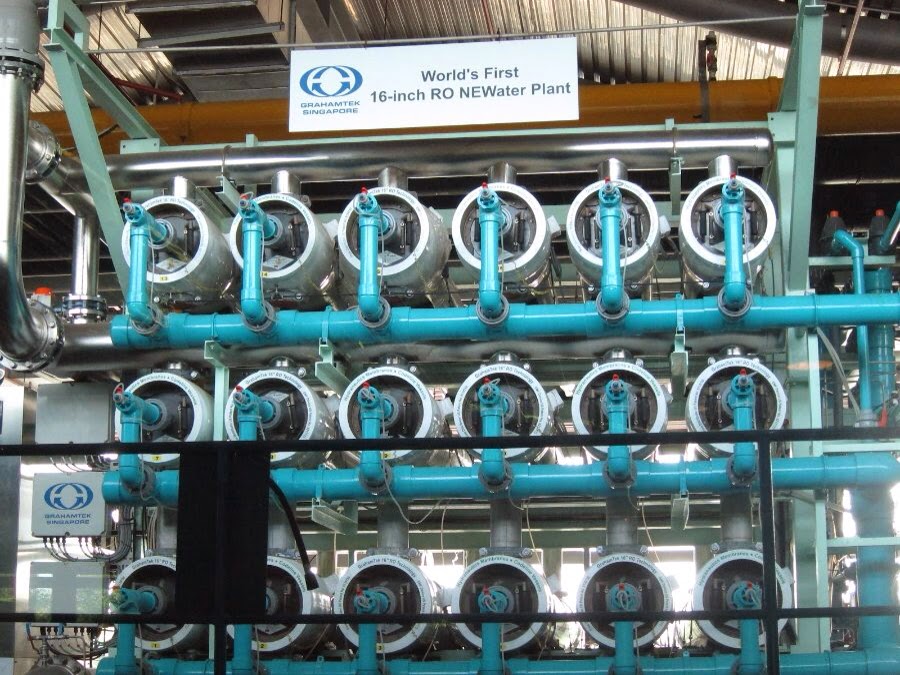
And last but not least: less than 10% of treated wastewater is used directly. This can and must be increased. Direct use is, for instance, the Singapore approach, bringing treated water back to consumers as so-called ‘NEWater’.

Another example is Australia: around 1.4 cubic kilometers of municipal wastewater are treated, of which 0.4 cubic kilometers are used directly, mostly in agriculture.

At Nestlé we have a similar approach. All our factories treat wastewater (in fact the first wastewater treatment plant in the group was built in the 1930s, so we understood the need for this very early) and as much of this treated wastewater as possible is used directly.

At the same time, we should keep in mind indirect use, even though it’s often difficult to measure. Treated wastewater is returned to rivers and then often withdrawn again and treated further for human consumption.

One might, for instance, assume that a significant part of the water in the River Thames, once it reaches London, is treated wastewater from communities further up the river. Increasing the share of direct use of wastewater should clearly be encouraged – in a form accepted by local communities.

So, all in all there are some significant opportunities to use treated wastewater as a resource, helping to close the gap between freshwater withdrawals and sustainable supply. But these opportunities need to be carefully evaluated, to make sure they are fully accepted, but also cost and energy effective when compared to other solutions. Via Peter Brabeck-Letmathe – Linkedin More


It’s clear that prosperity and climate change action can go hand in hand

The UK has been at the forefront of integrating climate change action into economic decision-making

The link between economic growth and action to reduce the risks of climate change is the focus of the New Climate Economy report issued on Tuesday.

Its credentials are impressive and its findings emphatic.

Released by a global commission of 24 global economic leaders from government, business, finance and academia, led by former president of Mexico Felipe Calderón, the year-long study has involved individuals from over 100 organisations across every continent and advised by a panel of world-leading economists chaired by Lord Nicholas Stern.

It has come to a clear conclusion – action on climate change can improve economic performance.

This report provides compelling further evidence that firmly supports the UK’s vision for a global climate deal in Paris 2015 that I launched last week in the city of London – which was clear that prosperity and climate action can go hand in hand.

The reason, the New Climate Economy report concluded, is that raising resource efficiency, stimulating innovation and new investment in infrastructure are making it possible to tackle climate change at the same time as improving economic performance.

That means new opportunities to improve growth, create jobs, boost company profits and spur innovation for all countries that take action now.

The report finds that over the next 15 years, trillions of pounds could be saved by building low-carbon into the key sectors of the global economy that include our cities, agriculture and energy. This could include better connected and more compact cities, through to restoring degraded lands and focusing on a transition to clean energy to improve economic performance and quality of life with lower emissions.

And we are putting this into action. The UK has been at the forefront of developing the climate change policy architecture that can ensure climate action is integrated into economic decision making.

This includes the 2008 Climate Change Act, which was the world’s first long-term, legally-binding national framework for reducing emissions, through our innovative carbon budgets regime. This means that our five year carbon budgets – that will eventually reach out to 2050 – are now being looked at as a potential model in other countries and we have already delivered on our first budget, which has seen a reduction in UK emissions by 24% between 1990 and 2012.

The 2013 Energy Act, for example, is creating the world’s first low-carbon electricity market and we are attracting record amounts of investment in renewables and our low carbon business sector is booming. In renewables, almost £29bn of investment delivered since 2010 and 2013, was a record year – with £8bn invested across the range of renewables technologies.

Electricity generation from renewable sources has doubled since 2010 and now supplies over 15% of the UK’s electricity.

We’re now a world leader in offshore wind – with more installed offshore wind capacity than the rest of the world combined, and supporting 18,300 jobs in the UK.

It has required UK business and international investors to recognise the costs of failure and the benefits of change and it has been sustained by a strong, vocal and committed network of NGOs, pressure groups and activists who have been instrumental in sustaining political will and public acceptance.

Last year, the world’s leading climate scientists, under the IPCC, reaffirmed that the Earth’s climate is indisputably changing, that human activity is the dominant cause – and the longer we leave action, the more difficult and costly it will be to avoid the worst effects. We now have the economics confirming that not only is climate action required to reduce climate risks, but that it is vital to building long-term, sustainable economic growth.

In the run up to the UN climate meeting in Paris next year I am determined that we continue to build on our success at home and expend every effort, and work with determination across government, across the parties, in partnership with business and civil society to reach a global, comprehensive, legally binding climate change deal. More