By sending vast amounts of military aid to Israel, members of the US Congress, President George W. Bush, President Barack Obama and Defense Secretary Chuck Hagel have aided and abetted the commission of war crimes, genocide and crimes against humanity by Israeli officials and commanders in Gaza.
An individual can be convicted of a war crime, genocide or a crime against humanity in the International Criminal Court (ICC) if he or she “aids, abets or otherwise assists” in the commission or attempted commission of the crime, “including providing the means for its commission.”
There is growing evidence that Israeli leaders and commanders have committed the following war crimes, genocide and crimes against humanity as defined in the Rome Statute for the ICC. US military aid has aided, abetted and assisted the commission of these crimes by providing Israel with the military means to commit them.
During Operation Protective Edge, Israeli forces again used the Dahiye Doctrine, which, according to the UN Human Rights Council [Goldstone] Report [PDF], involves “the application of disproportionate force and causing of great damage and destruction to civilian property and infrastructure, and suffering to civilian populations.”
A summary of Israeli leaders' extensive crimes is presented below.
US military aid to Israel
According to the Congressional Research Service, in 2007, the Bush Administration agreed to provide Israel with $30 billion [PDF] in military assistance from 2009 to 2018, provided in annual increments of $3.1 billion. During his March 2013 visit to Israel, Obama pledged that the US would continue to provide Israel with multi-year commitments of military aid subject to the approval of Congress.
Since 2012, the US has sent $276 million worth of weapons and munitions to Israel, not including exports of military transport equipment and high technologies. From January to May 2014, the US transferred to Israel almost $27 million for rocket launchers, $9.3 million worth of parts of guided missiles and nearly $762,000 for bombs, grenades and munitions of war.
On July 20, 2014, Israel requested additional ammunition, including 140mm tank rounds and 40mm illumination grenades, and the Defense Department approved the sale three days later. It came from a $1 billion stockpile of ammunition the US military stores in Israel for that country's use; it is called War Reserve Stockpile Ammunition-Israel. In early August 2014, both houses of Congress overwhelmingly passed, and Obama signed, an appropriation of $225 billion for Israel's Iron Dome missile defense system, which has also been used in Gaza. The Senate vote was unanimous. With no debate, the House of Representatives voted 395 to 8 to approve the deal.
Here is a summary of the crimes, as defined in the Rome Statute, Israeli leaders have committed and US leaders have aided and abetted:
War crimes
(1) Willful killing: Israeli forces have killed nearly 2,000 Palestinians (more than 400 children and over 80% civilians). Israel used 155-millimeter artillery, which, according to Human Rights Watch, is “utterly inappropriate in a densely populated area, because this kind of artillery is considered accurate if it lands anyplace within a 50-meter radius.”
(2) Willfully causing great suffering or serious injury to body or health: Nearly 10,000 people, 2,500 of them children, have been wounded. Naban Abu Shaar told the Daily Beast that the dead bodies from what appeared to be a “mass execution” in Khuza'a looked like they were “melted” and were piled on top of each other; assault rifle bullet casings found in the house were marked “IMI” (Israel Military Industries). UNICEF said the Israeli offensive has had a “catastrophic and tragic impact” on children in Gaza; about 373,000 children have had traumatic experiences and need psychological help. The UN Relief and Works Agency for Palestine Refugees (UNRWA) said: “There's a public health catastrophe going on. You know, most of the medical facilities in Gaza are non-operational.”
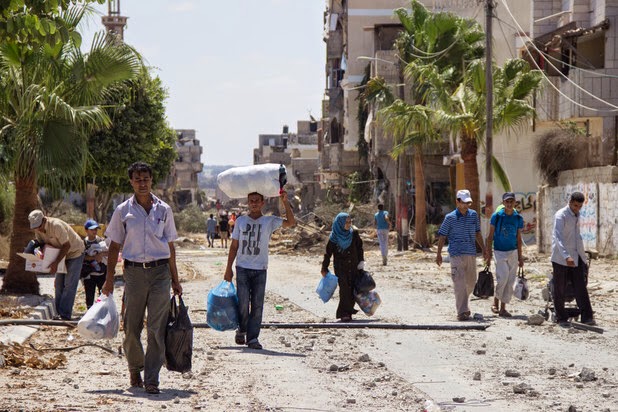
(3) Unlawful and wanton, extensive destruction and appropriation of property not justified by military necessity: Tens of thousands of Palestinians have lost their homes. More than 1,300 buildings were destroyed and 752 were severely damaged. Damage to sewer and water infrastructure has affected two-thirds of Gazans. On July 20, Israeli forces virtually flattened the small town of Khuza'a; one man counted 360 shell attacks in one hour. Reconstruction of Gaza is estimated to cost $6 billion. Israel shrunk Gaza's habitable land mass by 44 percent, establishing a 3 km “no-go” zone for Palestinians; 147 square miles of land will be compressed into 82 square miles. Oxfam described the level of destruction as “outrageous … much worse than anything we have seen in previous [Israeli] military operations.”
(4) Willfully depriving a prisoner of war or a civilian the rights of fair and regular trial: Nearly 2,000 Palestinians were arrested by Israeli forces during July 2014, according to the Palestinian Prisoners Center for Studies. Prisoners include 15 members of the Palestinian Legislative Council, about 240 children, dozens of women, journalists, activists, academics and 62 former prisoners previously released in a prisoner exchange. Israeli forces executed many prisoners after arrest, either by directly firing on them, refusing to allow treatment or allowing them to bleed to death. More than 445 prisoners are being held without charge or trial under administrative detention.
(5) Intentionally directing attacks against the civilian population, civilian objects, or humanitarian vehicles, installations and personnel: “The civilian population in the Gaza Strip is under direct attack,” reads a joint declaration of over 150 international law experts. Israeli forces violated the principle of “distinction,” which forbids deliberate attacks on civilians or civilian objects. Israeli forces bombed 142 schools (89 run by the UN), including six UN schools in which civilians were taking refuge. Israeli forces shot and killed fleeing civilians (warnings, which must effectively give civilians time to flee before bombing, do not relieve Israel from its legal obligations not to target civilians). Israeli forces repeatedly bombed Gaza's only power plant and other infrastructure, which are “beyond repair.” Israeli forces bombed one-third of Gaza's hospitals, 14 primary healthcare clinics and 29 ambulances. At least five medical staff were killed and tens of others were injured.
(6) Intentionally launching attacks with knowledge they will cause incidental loss of life or injury to civilians or damage to civilian objects or long-term severe damage to the natural environment, if they are clearly excessive in relation to the anticipated military advantage: The principle of “proportionality” forbids disproportionate and excessive civilian casualties compared to the claimed military advantage gained in the attack. The Dahiye Doctrine directly violates this principle. Responding to Hamas' rockets with 155-millimeter artillery is disproportionate. Although nearly 2,000 Palestinians (over 80 percent civilians) have been killed, 67 Israelis (all but three of them soldiers) have been killed. The coordinates of all UN facilities were repeatedly communicated to the Israeli forces; they nevertheless bombed them multiple times. Civilians were attacked in Shuja'iyyah market.
(7) Attacking or bombarding undefended towns, villages, dwellings or buildings, or intentionally attacking religious, educational and medical buildings, which are not military objectives: On July 20, Israeli forces virtually flattened the small town of Khuza'a; one man counted 360 shell attacks in one hour. Israeli forces bombed 142 schools (89 run by the UN), one-third of Gaza's hospitals, 14 primary healthcare clinics, and 29 ambulances. Israeli shelling completely destroyed 41 mosques and partially destroyed 120 mosques.
Genocide
(a) With the intent to destroy, in whole or in part, a national, ethnical, racial or religious group: Palestinians, including primarily civilians, and Palestinian infrastructure necessary to sustain life were deliberately targeted by Israeli forces.
(b) The commission of any of the following acts
(i) killing members of the group: Israeli forces killed nearly 2,000 Palestinians.
(ii) causing serious bodily or mental harm to members of the group: Israeli forces wounded 10,000 Palestinians.
(iii) deliberately inflicting on the group conditions of life calculated to bring about its destruction in whole or in part: Israeli forces devastated Gaza's infrastructure, knocking out Gaza's only power plant, and destroying homes, schools, buildings, mosques and hospitals.
Crimes against humanity
(A) The commission of murder as part of a widespread or systematic attack against any civilian population: Israeli forces relentlessly bombed Gaza for one month, killing nearly 2,000 Palestinians, more than 80 percent of whom were civilians. Israeli forces intentionally destroyed Gaza's infrastructure, knocking out Gaza's only power plant, and destroying homes, schools, buildings, mosques and hospitals.
(B) Persecution against a group or collectivity based on its political, racial, national, ethnic or religious character, as part of a widespread or systematic attack against any civilian population: Israeli forces killed, wounded, summarily executed, and administratively detained Palestinians, Hamas forces and civilians alike. Israel forces intentionally destroyed the infrastructure of Gaza, populated by Palestinians. UN Secretary General Ban Ki-moon said: “the massive death and destruction in Gaza have shocked and shamed the world.” He added the repeated bombing of UN shelters facilities in Gaza was “outrageous, unacceptable and unjustifiable.”
(C) The crime of apartheid (inhumane acts committed in the context of an institutional regime of systematic oppression and domination by one racial group over another racial group, with the intent to maintain that regime): Ali Hayek, head of Gaza's federation of industries representing 3,900 businesses that employ 35,000 people, said: “After 30 days of war, the economic situation has become, like, dead. It seems the occupation intentionally destroyed these vital factories that constitute the backbone of the society.” Israel maintains an illegal barrier wall that encroaches on Palestinian territory and builds illegal Jewish settlements on Palestinian lands. Israel keeps Gazans caged in what many call “the world's largest open air prison.” Israel controls all ingress and egress to Gaza, limits Gazans' access to medicine, subjects Palestinians to arbitrary arrest, expropriates their property, maintains separate areas and roads, segregated housing, different legal and educational systems for Palestinians and Jews and prevents mixed marriages. Only Jews, not Palestinians, have the right to return to Israel-Palestine.
Collective punishment
Although the Rome Statute does not include the crime of collective punishment, it is considered a grave breach of the Fourth Geneva Convention, which constitutes a war crime. Collective punishment means punishing a civilian for an offense he or she has not personally committed; it forbids reprisals against civilians and their property (civilian objects).
Ostensibly to rout out Hamas fighters, Israel has wreaked unprecedented devastation on the people of Gaza, killing nearly 2,000 people (more than 80 percent of them civilians) and destroying much of the infrastructure of Gaza. This constitutes collective punishment.
On August 5, 2014, veteran Israeli military advisor Giora Eiland advocated collective punishment of Gaza's civilian population, saying: “In order to guarantee our interests versus the other side's demands, we must avoid the artificial, wrong and dangerous distinction between the Hamas people, who are 'the bad guys,' and Gaza's residents, which are allegedly 'the good guys.'” That is precisely the strategy Israel has employed during Operation Protective Edge.
Israel's occupation of Palestinian lands also constitutes collective punishment. Israel maintains effective control over Gaza's land, airspace, seaport, electricity, water, telecommunications and population registry. Israel deprives Gazans of food, medicine, fuel and basic services.
Prospects for criminal accountability
Both Israel and the US have refused to ratify the Rome Statute. But if Palestine were a party to the statute, the ICC could exercise jurisdiction over crimes committed by Israelis and Americans in Palestinian territory. The ICC could also take jurisdiction if the UN Security Council refers the matter to the ICC, or if the ICC prosecutor initiates an investigation of the crime. The US would veto any Security Council referral to the ICC. And the ICC prosecutor has not initiated an investigation. So the question is whether Palestine can ratify the statute, thereby becoming a party to the ICC.
In 2009, the Palestinian National Authority filed a declaration [PDF] with the ICC accepting the court's jurisdiction. In 2012, the UN General Assembly overwhelmingly recognized Palestine as a non-member observer state. During the present war, the Palestinian minister of justice and the deputy minister of justice both submitted documents to the ICC indicating that the 2009 declaration is still valid. On August 5, 2014, the Palestinian minister of foreign affairs met with officials from the ICC and inquired about the procedures for Palestine to become a party to the statute.
On July 25, 2014, a French lawyer filed a complaint with the ICC on behalf of the Palestinian justice minister. Citing Israel's military occupation of Palestinian territories, Israel's blockade of the Gaza Strip and the ongoing military operations there, the complaint alleges that Israel committed war crimes and other crimes. The Palestinian government has not formally commented on this complaint.
On July 23, 2014, the UN Human Rights Council established a commission of inquiry into Israeli violations of international human rights and international humanitarian law. The resolution also called on parties to the Fourth Geneva Convention to convene and respond to the alleged violations. That convention requires parties to prosecute violators. Countries can bring foreign nationals to justice for war crimes, genocide and crimes against humanity under the well-established doctrine of universal jurisdiction. Genocide charges could also be brought under the Genocide Convention, to which both Israel and the United States are parties. That convention also punishes complicity in genocide; US leaders' provision of military aid would constitute complicity.
Although the Israeli and US governments continue to maintain that Israel has only acted in self-defense against Hamas' terrorism, the weight of world opinion points in the opposite direction. There is overwhelming opposition to Israeli aggression in Gaza and calls for justice and accountability.
Both Israeli and US leaders must be criminally prosecuted for committing and aiding and abetting these crimes.
Marjorie Cohn is a professor at Thomas Jefferson School of Law, deputy secretary general of the International Association of Democratic Lawyers, and a former president of the National Lawyers Guild. Her next book, “Drones and Targeted Killing: Legal, Moral, and Geopolitical Issues,” will be published in September.
Suggested Citation: Marjorie Cohn, US Leaders Aid and Abet Israeli War Crimes, Genocide & Crimes against Humanity, JURIST – Forum, August 8, 2014, http://jurist.org/forum/2014/08/marjorie-cohn-israel-crimes.php.


 © 2014




 Democracy & Good Governance