Image

Climate Wake Up with Greta Thunberg

“Sit down — t.r.u.m.p’s puppet. Who do you think you’re representing?”


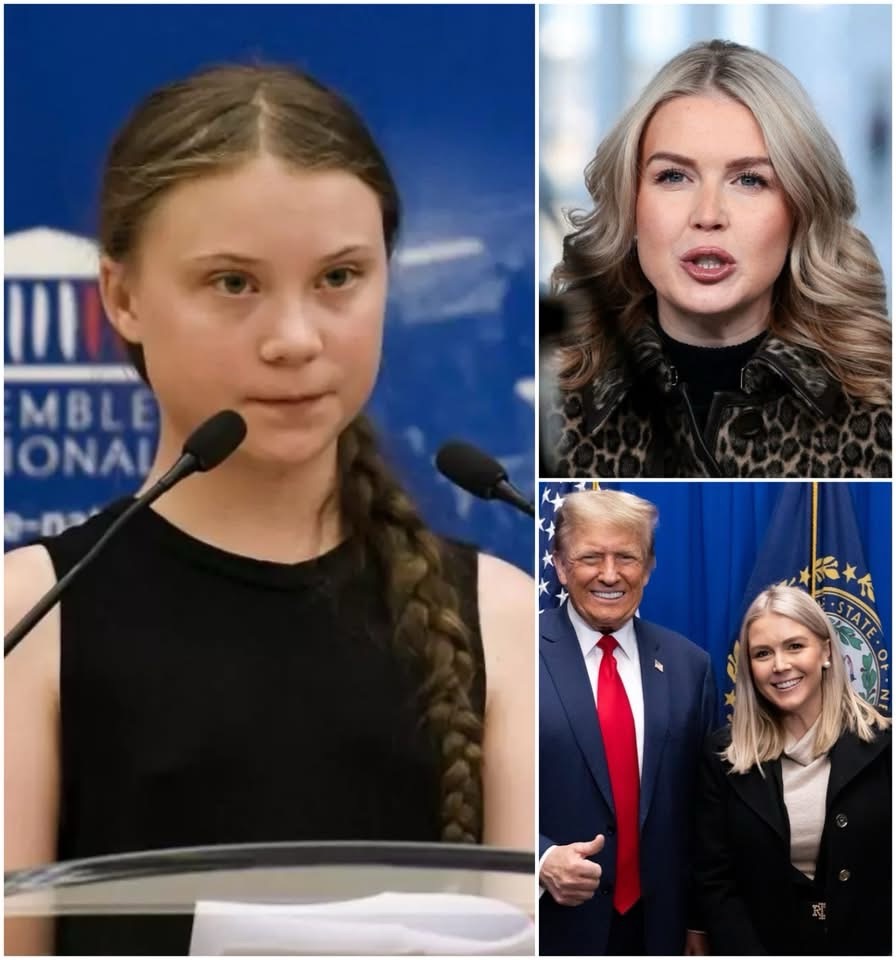
Greta Thunberg left Karoline Leavitt speechless in a shocking live TV moment

When Karoline Leavitt belittled Greta Thunberg on live television, mocking her as “just a childish activist,” no one could have predicted what would happen next.

Greta didn’t flinch. Calm, focused, her gaze sharp — she looked straight into the camera and spoke slowly, clearly emphasizing every word:
“You don’t represent everyone.”

WATCH FULL https://nexivon.biz/posts/moment-greta-thunberg-dismantled-trump-machinery-live-tancanh123-team-bao-botg

The studio fell silent. No sound. No interruptions. Leavitt looked momentarily rattled, forcing a smile as she tried to respond — but Greta leaned forward, her voice low yet firm:
“You only represent the power and interests of don@ld t.r.u.m.p. That is not the voice of the people, and certainly not of future generations. When you truly understand what it means to live in a world that is being destroyed — when wildfires, floods, and the climate crisis are no longer political slogans — then you’ll understand what we are fighting for.”

Then Greta ended with the line that set social media on fire:
“Sit down. Listen. We don’t have time for puppets anymore.”

The audience erupted — murmurs, shock, and applause echoed throughout the room. Within minutes, the clip spread rapidly across every platform. Millions praised Greta for her composure, clarity, and courage, calling it “an iconic live television moment for the climate movement.”

Political commentators agreed: this wasn’t just a comeback — it was a wake-up call. Greta didn’t shout or resort to personal insults. She spoke with facts, with science, and with responsibility toward the future.

One user wrote on X (formerly Twitter):
“Greta Thunberg didn’t attack Karoline Leavitt — she exposed her role. That’s the power of truth.”

In an era where propaganda and power often drown out the voice of science, Greta reminded the world that real influence doesn’t come from titles or politics — but from integrity and responsibility to humanity. The girl once mocked for being “too young” now stands on the global stage, speaking for an entire generation.

That’s the power of an icon — someone who dares to speak, dares to confront, and refuses to bow to power. Greta Thunberg didn’t just silence a “t.r.u.m.p puppet” — she forced the world to listen.

https://nexivon.biz/posts/moment-greta-thunberg-dismantled-trump-machinery-live-tancanh123-team-bao-botg

Image

A German-American businessman who made billions as a military supplier enthusiastically took his $250 million superyacht to Hawaii, only to be stopped at the shore by locals who did not want him to set foot on their island

Money can buy some truly remarkable things, take superyachts, for instance. They are one of the most extravagant byproducts of billionaire status (in most cases). But there are certain treasures money cannot acquire. No, we won’t say love in this 21st-century world, but nature, pristine and unspoiled. While money can repair damages, often, it ends up being the root cause of destruction, as seen with these floating palaces, which leave a massive carbon footprint.

Perhaps it was with this concern that local Hawaiian protesters vehemently opposed the mooring of the $250 million superyacht Liva O off the island of Molokai earlier this month. So much so, that a group of Molokai residents banded together and blocked the group’s access to shore.

The 387-foot yacht, owned by German-American billionaire Stephen Orenstein, a commercial real estate magnate, was indulging in the pristine Hawaiian islands when it hit this unexpected roadblock. Sailing from Maui, the luxury vessel had moored off Coconut Island before arriving at Hawaiʻi’s fifth largest island, where its intentions were met with skepticism. Residents were primarily concerned about the purpose of the visit and its potential impact on their untouched Molokai environment.

(https://luxurylaunches.com/transport/liva-o-yacht-stopped-at-hawaii-27012025.php)

The cities stripping out concrete for earth and plants – BBC Future

From Australia to Ontario, cities are taking up unnecessary stretches of concrete and asphalt, allowing nature to take hold in their place.
On a hot July day, Katherine Rose picked up a sturdy metal pole and jammed it under the tempting lip of a pre-cut concrete slab. Rose, communications and engagement director at Depave, a non-profit in Portland, Oregon, was sweating in the heat – but she was going to win this fight.
The grubby, rectangular section of urban crust in front of her was about to move. Pushing down on her metal bar, applying it like a lever, she eased the concrete covering up and away. Now sunlight could fall once again on the ground below. A mess of gravel and dirt that was, to Rose, just bursting with potential.

(https://www.bbc.com/future/article/20240222-depaving-the-cities-replacing-concrete-with-earth-and-plants?fbclid=IwAR1xOC2kpLse0WOeNtC6eLt7dms1AjSyBum76oKeDJILFVG3QG7w9-szuH8_aem_AWsuO8VJdS4hGUWPANOyVTwzYcD3aaRdbef9nUxut7uVdHw4E30Lc0ih2wWvfepCbt4)

New IPCC Chair Elected

7 October 2015: The Intergovernmental Panel on Climate Change (IPCC) has elected Hoesung Lee, Republic of Korea, as its new Chair. Lee was elected by 78 votes to 56 in a run-off with Jean-Pascal van Ypersele of Belgium.

Hoesung Lee

Speaking after the vote, Lee said he was “honored and grateful” to have been elected. He underscored the need for more information regarding existing options for preventing and adapting to climate change.

Lee further noted that the next phase of the IPCC's work will see an increased understanding of regional impacts, especially in developing countries, and an improvement in the manner in which the IPCC's findings are communicated to the public.

Various UN officials congratulated Lee on his election, including UN Secretary-General Ban Ki-moon, UNFCCC Executive Secretary Christiana Figueres, UNEP Executive Director Achim Steiner and WMO Secretary-General Michel Jarraud.

The election took place in Dubrovnik, Croatia, on 6 October, where the IPCC is holding its 42nd session (IPCC 42). Six candidates had been nominated for the position: Ogunlade Davidson, Sierra Leone; Chris Field, US; Hoesung Lee, Republic of Korea; Nebojsa Nakicenovic, Austria and Montenegro; Thomas Stocker, Switzerland; and Jean-Pascal van Ypersele, Belgium.

Elections for other IPCC Bureau positions also took place during the course of IPCC 42. On 7 October, Thelma Krug, Brazil, Ko Barrett, US, and Youba Sokona, Mali, were elected IPCC Vice-Chairs.

Lee is a professor of the economics of climate change, energy and sustainable development at Korea University's Graduate School of Energy and Environment in the Republic of Korea, and is currently one of the IPCC's three vice-chairs. The election of the new IPCC Bureau, which will have 34 members including the Chair, paves the way for work to begin on the IPCC's Sixth Assessment Report, expected to be completed in 5-7 years.

The IPCC was established by the WMO and UNEP in 1988 to provide a clear scientific assessment of the current state of knowledge in climate change and its potential environmental and socioeconomic impacts, and to identify possible responses. [IPCC Press Release] [UNEP Press Release] [WMO Press Release] [UN Press Release] [Statement of the UN Secretary-General] [UNFCCC Press Release][IISD RS coverage of IPCC 42]


Climate Reality Training in Miami with Al Gore

Hello!

I’m reaching out today on behalf of The Climate Reality Project, an organization started by former Vice President Al Gore focused on creating a global movement calling for action on climate. We have an upcoming training opportunity in Miami, Florida that I believe you and others who follow The Climate War Room and The Cayman Institute will be interested in.

As we are all aware, the time has come for action on climate. On September 28-30 in Miami, The Climate Reality Project and Mr. Gore will be hosting a training for new Climate Reality Leaders to help grow the movement. There has never been a better time to engage your friends and colleagues on this issue. The Miami training will not only provide attendees with cutting edge tools to most effectively communicate climate change to your community but will also enter them into a community of over 8,000 devoted individuals from 126 countries who are committed to using their voices to address the climate crisis.

Our training in Miami will highlight the unique challenges that climate change poses to the state of Florida and what some local governments are already doing to tackle them; Florida’s huge untapped solar energy generating capacity; and the role of the ever strengthening Latino voice and vote in driving climate action. At the training, Mr. Gore, and experts and influencers from across the climate sphere will present in panels, take questions, and host breakout sessions.

We encourage you to recommend outstanding leaders in your personal and professional life who would be well suited for giving presentations and helping to build strong support for action on climate change. They can apply for the Climate Leadership Corps Training here. I’ve also attached a document you can share with your network, which has a little more information about who we are and what the Miami training will cover. The deadline to apply is August 26th, 2015.

Please do not hesitate to reach out if you have any questions!

Warm regards,

Joseph Moran | Program Assistant-Climate Reality Leadership Corps

750 Ninth Street, NW, Suite 520 | Washington, DC 20001

NOTICE OF CONFIDENTIALITY & DISCLAIMER
The information contained in this e-mail and any attachments is CONFIDENTIAL and is intended only for the use of the addressee. Any unauthorized use, disclosure, distribution, dissemination, or copying is strictly prohibited and may be unlawful. If you are not the intended recipient, you are prohibited from any further viewing of the e-mail or any attachments or from making any use of the e-mail or attachments. If you believe you have received this e-mail in error, notify us immediately and permanently delete the e-mail, any attachments, and all copies thereof from any drives or storage media and destroy any printouts of the e-mail or attachments and any copies of such printouts. Although this e-mail and any attachments are believed to be free of any virus or other defect that might negatively affect any computer system into which it is received and opened, it is the responsibility of the recipient to ensure that it is virus-free and no responsibility is accepted by the sender for any loss or damage arising in any way in the event that such a virus or defect exists. Thank you for your cooperation.


New IUCN publication: Making an Economic Case for EbA

Knowledge Gaps in Making an Economic Case for Investing in Nature Based Solutions for Climate Change”.

This report is available both in English and French on the IUCN EBA web page. This preliminary rapid assessment is now being followed up with an in-depth analysis in the Philippines and Peru. We aim to have this study available for the Paris COP 21.

Climate change is having increasingly adverse impacts on people and nature. It exacerbates existing environmental threats, poses new risks and impedes our ability to achieve global conservation and development objectives such as the Aichi Biodiversity Targets and the proposed Sustainable Development Goals. Across the globe, initiatives have been established to help communities implement approaches that enable them to adapt to climate change and mitigate its effects.

Ecosystem-based Adaptation (EbA) is one such approach. EbA uses biodiversity and ecosystem services as part of a larger adaptation strategy – an excellent example of a viable nature-based solution. As well as providing climate change adaptation benefits, this approach also contributes to biodiversity conservation and enhances local economies. IUCN has been extensively involved in EbA work, strengthening community resilience and livelihoods in almost 60 countries. This work demonstrates our ongoing commitment to the implementation of nature- based solutions.

The conservation and sustainable development community considers EbA to be a strong method of addressing climate change and its associated challenges. However, there is still a tendency for policy makers to implement traditional engineering solutions for adaptation, rather than investing in EbA. The need for solid data on the cost-effectiveness of this nature-based approach was the driver behind an IUCN study identifying the economic costs and benefits associated with EbA. The lessons learned from this appraisal process will make it easier for policy makers to compare EbA options with engineered solutions. Download English / French


World Is Locked into ~1.5°C Warming & Risks Are Rising, New Climate Report Finds

World Is Locked into ~1.5°C Warming & Risks Are Rising, New Climate Report Finds

Latin America and the Caribbean

In Latin America and the Caribbean, the report warns of longer droughts, extreme weather, and increasing ocean acidification. In the tropical Andes, rising temperatures will reduce the annual build-up of glacier ice and the spring meltwater that some 50 million people in the low-land farms and cities rely on. Heat and drought stress will substantially increase the risk of large-scale forest loss, affecting Amazon ecosystems and biodiversity, as well as the forests’ ability to store carbon dioxide.

Rising temperatures also affect food security. The oceans, which have absorbed about 30 percent of all human-caused carbon dioxide so far, will continue to acidify and warm, damaging coral ecosystems where sea life thrives and sending fish migrating to cooler waters. The result for the Caribbean could be the loss of up to 50 percent of its current catch volume.

Middle East and North Africa

People in the Middle East and North Africa have been adapting to extreme heat for centuries, but the report warns of unprecedented impact as temperatures continue to rise. Extreme heat will spread across more of the land for longer periods of time, making some regions unlivable and reducing growing areas for agriculture, the report warns. Cities will feel an increasing heat island effect, so that by 4°C warming – possibly as early as the 2080s without action to slow climate change – most capital cities in the Middle East could face four months of exceedingly hot days every year Rising temperatures will put intense pressure on crops and already scarce water resources, potentially increasing migration and the risk of conflict. Climate change is a threat multiplier here – and elsewhere.

Eastern Europe and Central Asia

In Eastern Europe and Central Asia, the report shows how the impact of climate change will vary region to region. Melting glaciers and warming temperatures will shift the growing season and the flow of glacier-fed rivers further into spring in Central Asia, while in the Balkans in Eastern Europe, worsening drought conditions will put crops at risk. Rising temperatures also increase the thawing of permafrost, which releases methane, a potent greenhouse gas many times more powerful than carbon dioxide at trapping heat. By mid-century, if temperatures continue to rise toward 2°C, the release of methane from thawing permafrost is likely to increase 20 to 30 percent in Russia, creating a feedback loop that will drive climate change.

Working to Lower the Risk

“The good news is that there is a growing consensus on what it will take to make changes to the unsustainable path we are currently on,” President Kim said. “Action on climate change does not have to come at the expense of economic growth. At the World Bank, we are investing in energy efficiency and renewable energy to help countries lower their emissions while growing their economies, and in clean transportation that can put fast-growing cities onto more sustainable growth paths. We are also working with governments to design policies that support clean growth, including developing efficiency standards, reducing fossil fuel subsidies, and pricing carbon. It’s clear that the public sector cannot solve the climate challenge alone – private investment and smart business choices are crucial, but business leaders tell us they need governments to provide clear, consistent policy direction that reflects the true costs of emissions. We now screen our projects in 77 countries for climate risk and for opportunities for climate action. We are helping countries find opportunities in climate action and developing financial instruments to increase funding that can help them grow clean and build resilience.

“Our response to the challenge of climate change will define the legacy of our generation,” President Kim said. “The stakes have never been higher.” More