No Immediate Danger

William Vollmann’s Brutal Book About Climate Change
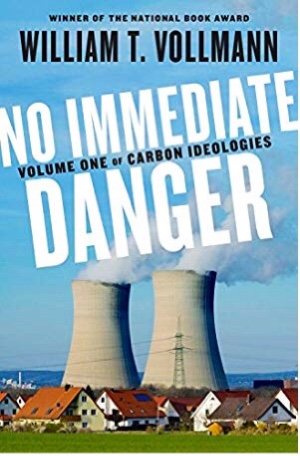
It is also an almanac of global energy use. The initial volume opens with a 200-page primer busy with tables, lists, and data (“I assure you that there will be no harm in skipping to page 217”) and concludes with 80 pages of definitions, units, and conversions (“Readers should feel free to skip this section”). It is a travelogue to natural landscapes riven by energy production, most prominently Fukushima (nuclear), West Virginia (coal), Colorado (natural gas), and the United Arab Emirates (oil). It is a work of oral history, containing dozens of interviews with laborers who toil in or live beside nuclear reactors, caves, and oil refineries, paired with Vollmann’s own snapshots. And it is a compassionate work of anthropology that tries to make sense of man’s inability to weigh future cataclysm against short-term comfort. Carbon Ideologies is most fascinating, however, for what it is not: a polemic.

Nearly every book about climate change that has been written for a general audience contains within it a message of hope, and often a prod toward action. Vollmann declares from the outset that he will not offer any solutions, because he does not believe any are possible: “Nothing can be done to save [the world as we know it]; therefore, nothing need be done.” This makes Carbon Ideologies, for all its merits and flaws, one of the most honest books yet written on climate change. Vollmann’s undertaking is in the vanguard of the coming second wave of climate literature, books written not to diagnose or solve the problem, but to grapple with its moral consequences. http://bit.ly/2wXUAMF

Sustainablin

A VIP guest

We started our class 30 minutes earlier today because a Chinese official from UNESCO International Research and Training Center for Rural Education (INRULED) visited us and wanted to spend some time in the class before going to catch his flight in Chengdu.

Lin Fan

We are participating in a 4 week course in ecovillage design at the UNESCO rural development center in Chengdu, China and fortunately there is a VPN connection here that allows us to “spoof” the Chinese censors and reach into Medium, Blogger, Google, Facebook, Twitter and all the otherwise banned sites, so this week I can post.

Putting ecovillage movement in the grand background of ecological civilization, highlighting the role of education and training

In a 10-minutes, rapid-fire informative speech, the official traced the history of sustainable movements to two influential books: Silent Spring (Wiki, 1962) and The Limits to Growth (Wiki,1972). The model of our industrial civilization is basically consuming the resources of our planet and leave us trash eventually. This is not sustainable. In March, 2018, Chinese government added in constitution “the building of an ecological civilization” to the duties and powers of the State Council (1). It’s a new form of human civilization based on sustainable principles (Wiki).

How can we realize ecological civilization? He firmly believes that education and training are critical building blocks. He went on that UNESCO has laid the theory groundwork by a few profoundly influential reports: Learning to Be (1972), Learning, the Treasures within (1996), and Rethinking Education (2015) For people in the class who may become future designers or developers of ecovillages, you will have a lot of work, as one of his few ending points.
http://bit.ly/2oTS7ze

Maya Farmers in South Belize Hold Strong to Their Climate Change Experiment

caribbeanclimate's avatarcaribbeanclimate

In one of Belize’s forest reserves in the Maya Golden Landscape, a group of farmers is working with non-governmental organisations to mitigate and build resilience to climate change with a unique agroforestry project.

Magnus Tut a member of the Trio Cacao Farmers Association cuts open a white cacao pod from one of several bearing treen in his plot. The group is hoping to find more buyers for their organic white cacao and vegetables. Credit: Zadie Neufville/IPS

BELMOPAN, Sep 5 2018 (IPS) – In one of Belize’s forest reserves in the Maya Golden Landscape, a group of farmers is working with non-governmental organisations to mitigate and build resilience to climate change with a unique agroforestry project.

View original post 1,185 more words

How America Overdosed on Capitalism


America is something like history’s greatest experiment in capitalism. In a sense, we’re lucky to have it — it’s rare that a society devotes itself furiously, single-mindedly, one-dimensionally to an ideology, rejects the world, and pursues its own course. Here we have something truly rare and unique, which doesn’t happen often in social thinking: a perfect experiment to test the hypothesis — what would happen if a society only ever chose capitalism?

Waves of capital began to corrupt the political system. In other words, capital was beginning to corrode democracy. The idea of the neutral, benevolent capitalist, in other words, was beginning to be revealed as a myth.


Or, one I like better: what would happen if capitalism were given total freedom to be itself? If it could unfold according to its own logic, rules, choices, destiny — what would it naturally become? What is its nature? Now we can answer that very question, not with theory, but with reality.

http://bit.ly/2Q9wTJO

Gallery

The Benefits and Age-Old Success of Waffle Gardens: A history on one of the oldest sustainable farming methods of the Southwest

UNM Sustainability Studies Program's avatarABQ Stew

Located in the arid Southwest, on the Southeastern edge of the Colorado Plateau lives the A:shiwi also known as the Zuni people. Zuni Pueblo is the largest of the nineteen pueblos in New Mexico and perhaps the most isolated. Zuni Pueblo and its farming villages are nestled in valleys surrounded by Jurassic, Triassic and Early Cretaceous mudstone and sandstone mesas. Since the time Zuni was inhabited their survival was dependent on what the land provided. They developed different types of farming methods that enabled them to contest the variable water availability and inadequate soil quality that is common in desert soils. These methods include terrace gardening, a type of farming that allowed them to use the hillslopes of the mesas to divert water among several stair case terraces. On a larger scale is a type of agriculture known as dry-land farming or run-off agriculture which farmers used to grow…

View original post 987 more words

EPA rolls back Obama-era coal pollution rules as Trump heads to West Virginia


CNN)As his Environmental Protection Agency delivers its latest blow to environmental regulations aimed at reducing carbon emissions, President Donald Trump is heading into the heart of coal country to deliver the good news.

Trump will join supporters in Charleston, West Virginia, for a political rally on Tuesday to celebrate his administration’s proposal to allow states to set their own emissions standards for coal-fueled power plants.
The move would reverse Obama administration efforts to combat climate change and marks the fulfilment of a campaign promise at the heart of his appeal in coal-producing states like West Virginia.
The EPA Tuesday morning formally unveiled the details of its new plan to devolve regulation of coal-fired power plants back to the states, one that is expected to give a boost to the coal industry and increase carbon emissions nationwide.
The move is just the latest effort by the Trump administration to revive an ailing coal industry and strip climate change-fighting regulations established by the Obama administration. He previously announced plans to withdraw from the Paris climate accords, calling it an unfair deal for Americans. Read More

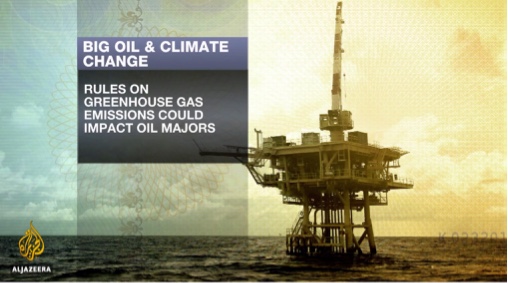
Big oil and climate change

Though oil and gas companies have known about global climate change for decades, they’ve deferred reducing crude and gas production until the second half of this century. But with global weather patterns in flux, activists have been demanding that energy companies set and commit to more rapid action on curbing oil and gas production in line with the Paris climate agreement.
New calls for action come amidst forecasts by the International Energy Agency (IEA) that, by 2014, demand for oil and gas could fall by almost 50 percent – but only if carbon emissions reduction targets are met. With this threat to profits, many ask if big oil companies are serious about addressing global climate change.

Facing an eventual drop in demand, energy companies delay caps on the production of carbon-emitting products.

Oil majors like Royal Dutch Shell has acknowledged that climate change will be a major challenge for years to come, but Total and others are still expecting strong demand for fossil fuels over the next few decades – and Exxon Mobil is under investigation over financial disclosures for climate change.
Anthony Hobley, CEO for the financial think-tank Carbon Tracker, told Counting the Cost that when it comes to profits and compliance with international carbon reduction agreements, big energy companies are sending mixed messages:
“I think they’ve been a bit schizophrenic. They are looking at climate risk and we’re now being deluged with disclosure and scenario analysis from the companies that are, effectively, stress testing their business models against a Paris compliant two degrees pathway. But then when they talk to investors they’re still talking up demand.” Read More

How the U.S. Helped Prevent North Korea and South Korea From Reaching Real Peace in the 1950s


Signing the Armistice ending three-year conflict in Korea, on July 30, 1953. Lt. Gen William K. Harrison, Jr (seated left), Chief UN Delegate and Gen Nam Il, (Seated right), Senior Communist Delegate, sign at Panmunjom. PhotoQuest/Getty Images

In the long history of Korea, nothing compares to the 20th century division of the peninsula or the war that followed. That war has not finished, and a peace treaty remains elusive. China, North Korea and South Korea all seek a peace treaty, but 11 U.S. presidents since 1953 have been unwilling to agree.

If President Trump turns out to be the exception, that shift could help put an end to more than a half-century of conflict — and the role of the United States in determining whether peace arrives is not a small one. Neither is it coincidental: in fact, the U.S. has played a key role in keeping the conflict going as long as it has.

The division of Korea is not what Franklin Delano Roosevelt intended as World War II ended. Read Morenorth,south

Smith Barcadere – Smith Cove, Grand Cayman

caymannature's avatarcaymannature

by Ann Stafford

Historic area

People came from West Bay by boat to Smith Barcadere. They cut ‘tops’, the new, unopened leaves of the Silver Thatch Palms that were plentiful on the large estate of J. S. Webster.

180725 Smith Barcadere, Jul.25-18DID YOU KNOW THAT? 58 Tidbits of Cayman’s History….

By Captain Paul Hurlston

The first sea going vessel ever built in Grand Cayman was built at Smith’s Barcadere by a carpenter who was shipwrecked on Spotts Reef. He was the carpenter on the vessel that brought Rex Crighton’s ancestors to Cayman. Tidbit 36

Dolly Well    There was a well in South Sound called “Dolly Well” located in Webster’s Estate somewhere in the back of Lemuel Hurlston’s old house on Antoinette Avenue. It was round and not very deep and where all South Sounders got their water. It has since been filled in. Tidbit 13

180725 Smith Barcadere

Plants

Rare, Critically Endangered Trichilia trees (

View original post 684 more words

Using one occupation to legitimize another.

Miko Peled's avatarMiko Peled

Legitimizing The Occupation: An Occupied Palestine is a Land Without Hope

One of the most important achievements of the war of 1967 was making the conquests of 1948 legitimate, and now it was about post-1948 Israel “giving back” or not “giving back” the territories it occupied in 1967. One clear example of that is the well known and totally ignored UN resolution 242, which was passed in November of 1967. It mentions “withdrawal of Israel Armed Forces from territories occupied in the recent conflict;” in other words, the territories captured in 1948, in violation of prior UN resolutions regarding Palestine and regarding the status of Jerusalem, became irrelevant as a result of the 1967 conquests.

View original post