Can the United Nations operate for the benefit of the planet and its inhabitants, without political / nation-state and funding concerns?

Emails: WHO was warned of fallout over yanked Italy report

 The agency took it down a day after it was posted on its website, prompting the official who coordinated the work to appeal directly to WHO chief Tedros Adhanom Ghebreyesus on May 28 and warn that the report’s disappearance was undermining WHO’s credibility. He cautioned that any further attempts at censorship would compromise the agency’s independence and its relations with donor nations that funded the research.
The handling of the report could cause a “scandal of huge proportion — in a delicate moment for the U.N. health agency with the forthcoming COVID-19 investigation,” wrote Francesco Zambon, WHO’s chief field coordinator for Italy and its regions during the pandemic.
WHO did not immediately respond to a request, sent late Friday, for comment on Zambon’s email to headquarters.
The report, written by Zambon and a team of WHO public health experts and consultants, was posted May 13 after it had received necessary approvals within the U.N. system, according to internal WHO documents seen by AP. Read More

American Democracy Was Never Supposed to Work

 [We] do not have a democracy, and not because Trump undermined it but because the framers of the Constitution did not create one. They felt the Articles of Confederation left too much power in the hands of economic populists in the states, and so they constructed a system meant to serve and protect the rich. The Constitution was designed specifically to prevent, as James Madison put it in the Federalist Papers, “an abolition of debts” or “an equal distribution of property” from passing into law.
Nearly two and a half centuries on, the antidemocratic provisions of the Constitution are still working as the framers intended. Even in an era of global capital, the wealthy benefit from a sclerotic, dysfunctional government. When early election results suggested a Joe Biden presidency with Republicans maintaining their grip on the Senate, the Associated Press reported that “stocks rallied on Wall Street as investors embraced the upside of more gridlock in Washington.” Divided government, these investors seem to think, will derail what Madison called “wicked or improper projects”: the abolition of student debt, higher taxes on the wealthy, the Green New Deal. https://bit.ly/2Kp0D7c

The Terrible and Catastrophic Price of American Cruelty

But let’s start at the beginning. American life is now one long exercise in cruelty — first learning to survive it, then learning to appreciate and admire it (as perverse as that sounds), then learning, in the end, to perform and enact it — bang!! — thus, the cycle keeps going. Do I exaggerate? You go ahead and be the judge.
You’re born, you go to school. “Active shooter drills” and “lunch debt.” From an early age, you learn that life is divided, therefore, into predator and prey. You go to middle school, high school — it’s a uniquely awful, dispiriting experience, about being mean and nasty, bullying and submission, popularity and vanity and selfishness — and while you might think, “it’s like that everywhere!” my friends, it isn’t. Other nations don’t base their entire adolescent cultures on the trauma of…just waking up and going to school. But Americans do, because that’s life. Hence, among disastrous effects, skyrocketing suicide rates among teens.
Those that do survive a culture of extreme cruelty from the day they’re born? Off you go go to college — and you’re hazed mercilessly to join a fraternity. What are you being trained for, really? Education, creativity, insight — or dominance, submission, and tribalism? Never mind. You graduate and go to work. And the workplace is one where bullying itself is called management, and every kind of abuse is normalized. No one else in the civilized world, really, puts up with bosses shouting at them and berating them and demeaning them, like feudal overlords. It just isn’t tolerated — it’s usually quite literally against the law. But America created a culture where overwork is work, where 80 hour weeks for shrinking pay are just fine, and you have to perform with a rictus smile of submission on your face. You’re not really “working” — more than that, you’re performing a kind of flamboyant display of emotional and intellectual servitude, which proves what you really are, a social nobody. Better not make that capitalist mad — or is he your feudal lord? Yet for Americans, all these are perfectly normal and acceptable.  Read More

Democracy & Good Governance In The Cayman Islands

Democracy & Good Governance In The Cayman Islands

 Basic income, also called universal basic income (UBI), citizen’s income, citizen’s basic income, basic income dividend, basic living stipend, guaranteed annual income, or universal demogrant, is a governmental public program for a periodic payment delivered to all adult citizens of a given population without a means test or work requirement.
Basic income can be implemented nationally, regionally, or locally. An unconditional income that is sufficient to meet a person’s basic needs (i.e., at or above the poverty line ) is called a full basic income.
A number of countries have implemented a citizens basic income, with the most recent being Spain, and Germany (by way of a high court ruling). Citizens are shareholders in the government, as they would be in a corporation and as such are entitled to a dividend paid in monthly installments. Read More

COVID-19 Is a Symptom of a Planet That’s Been Pushed Past a Tipping Point

 The pandemic could signal that we’ve passed a series of civilizational tipping points that will usher in a new era of ecological emergencies.
By Nafeez Ahmed – November 23, 2020, 9:15am
The COVID-19 pandemic signals that civilization has breached a major ‘tipping point’ that could pave the way for a dangerous new era of interacting ecological emergencies.  
Scientific evidence accumulated over the last five years suggests that the pandemic didn’t come out of the blue, but is a direct consequence of industrial civilization’s breaching of key ‘planetary boundaries’—these are important natural ecosystems needed to maintain what scientists describe as the ‘safe operating space’ for human survival on the planet.

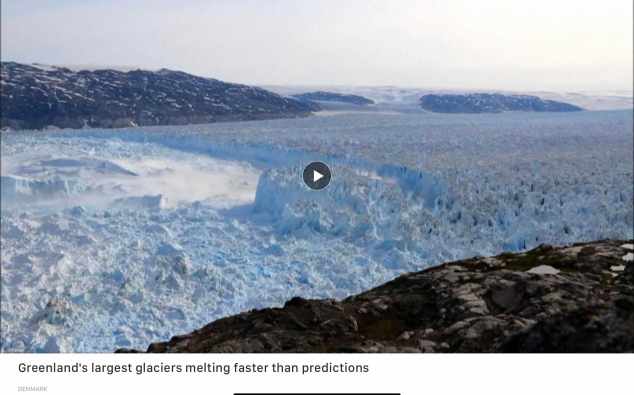
Greenland’s largest glaciers melting faster than predictions

Greenland’s largest glaciers melting faster than predictions 


Research shows that the three largest glaciers in Greenland could melt faster than even the worst-case warming predictions.

The glaciers hold enough frozen water to lift global sea levels some 1.3 metres.

The world’s ice sheets in Greenland and Antarctica have become the largest sources of sea level rise.

A team of researchers based in Denmark and Britain estimated how much ice was lost from the glaciers in the 20th century by using historical images and other data.

They found that Jakobshavn Isbrae lost more than 1.5 trillion tonnes of ice between 1880-2012, while Kangerlussuaq and Helheim lost 1.4 trillion and 31 billion tonnes from 1900–2012, respectively.

The ice melt has already contributed more than eight millimetres to global sea levels, the researchers wrote.

“The worst-case scenario is underestimated. Ice loss may be anywhere from three or four times larger than previous predicted for the thee glaciers considered in this study,” Shfaqat Abbas Khan, a researcher at the Technical University of Denmark, told AFP. Read More

Caribbean vital to tackling COVID-19, climate change, UN chief tells regional leaders

Caribbean vital to tackling COVID-19, climate change, UN chief tells regional leaders | | UN News


 António Guterres was addressing a virtual meeting of the Caribbean Community (CARICOM), where he praised countries for their leadership during the crisis, even as they confront shocks to their economies, tourism sector, trade and remittances. 

“Your unique voice is vital as we tackle shared threats such as climate change, citizen insecurity and the COVID-19 pandemic that expose deep and systemic inequalities,” he said. 

Devastating regional impacts 

The UN chief stated that the pandemic’s socioeconomic impacts have been worse than the virus itself for some developing economies, including the Caribbean. 

He highlighted his push for a relief package equivalent to at least 10 per cent of the global economy, as well as an appeal for debt relief. 

 “As you have long advocated, the world must look beyond incomes and factor in the vulnerabilities of countries. The private sector, including the credit rating agencies, also must be engaged in relief efforts”, he said. 

A strong moral voice 

Mr. Guterres also underlined his solidarity with CARICOM members in addressing climate change. 

“Your leadership and moral voice on the front lines is crucial for charting a recovery that will accelerate the decarbonization of the global economy and build a more inclusive and resilient future,” he said. Read More

Coronavirus vaccines: Will any countries get left out?

There have been more than 55 million cases of the virus confirmed around the world and more than 1.3 million deaths. Many hopes are pinned on a vaccine as a solution. But there are concerns that poorer nations could get left behind.  

We have spoken to the experts about the main concerns that lie ahead and whether efforts to come up with a fair system will actually work. 

The rush to buy in advance
Early results indicate that at least two vaccines are highly effective, several others have reached late-stage trials, and many more are at some stage of development.
None of these vaccines has been approved yet, but that hasn’t stopped countries purchasing doses in advance. Read More

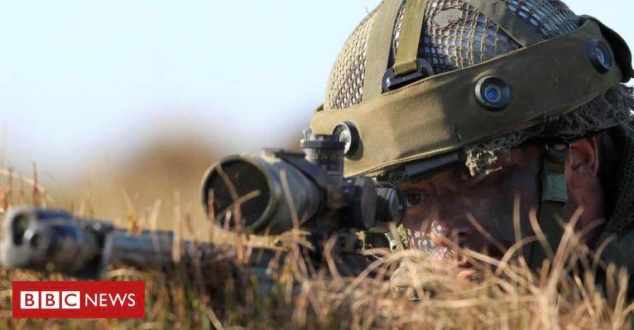
British Army to get new “space command”, which will be capable of launching a first rocket in 2022

UK military to get biggest spending boost in 30 years

[Including] A new “space command”, which will be capable of launching a first rocket in 2022, 

The relevant question, is of course, against whom? Given that the rest of the universe is uninhabited… Read More
The BBC has changed the above article removing the mention of a Space Force, but it is also online as posted below.


Boris Johnson to announce ‘Space Command’ force in Scotland

Boris Johnson is set to announce a new ‘Space Command’ as part of a £16.5bn pledge to boost the UK’s defence capabilities.

The new programme will launch its first rockets from Scotland by 2022, Number 10 says.

The spending plans will also include a commitment to expand naval ship building on the Clyde, it is understood.

Johnson will make the announcements in a speech to the House of Commons on Thursday afternoon. Read More

I Am Greta isn’t about climate change. It’s about the elusiveness of sanity in an insane world

Which is why I recommend the new documentary I Am Greta, a very intimate portrait of the Swedish child environmental activist Greta Thunberg

 Before everyone gets started, let me point out that I Am Greta is not about the climate emergency. That is simply the background noise as the film charts the personal journey begun by this 15-year-old girl with Asperger’s syndrome in staging a weekly lone protest outside the Swedish parliament. Withdrawn and depressed by the implications of the compulsive research she has done on the environment, she rapidly finds herself thrust into the centre of global attention by her simple, heart-felt statements of the obvious.
The schoolgirl shunned as insane by classmates suddenly finds the world drawn to the very qualities that previously singled her out as weird: her stillness, her focus, her refusal to equivocate or to be impressed.
Footage of her father desperately trying to get her to take a break and eat something, if only a banana, as she joins yet another climate march, or of her curling up in a ball on her bed, needing to be silent, after an argument with her father over the time she has spent crafting another speech to world leaders may quieten those certain she is simply a dupe of the fossil fuel industries – or, more likely, it will not. Read More