Gallery

We have reached water!!!!!!!

irishingaza's avatarIrish in gaza

We need your help to complete this project, please read, share and if Possible, Please donate below.

Part 2.

Thursday 23 October… Another milestone reached. This morning, more than 45 metres below ground, we hit Water…

014

So, The drilling now comes to an end, No more pictures of men below ground throwing out buckets of sand, no spitting and puffing from an old generator and no more listening to the repetitive thud of an old drill forcing open the ground…  It really is the most primitive of equipment, it keeps breaking down, it has been mended more times but it’s all there is, and they manage to use it successfully… obviously. So now, we have water…

002

Tomorrow, Friday, is a day of rest… Back at it again on Saturday. Next in line is the submersion of the pump which will then feed the water up to a de-salination /filtration system…

View original post 239 more words

Belize Fights to Save a Crucial Barrier Reef

caribbeanclimate's avatarcaribbeanclimate

The humble CREWS buoy hosts several instruments designed to measure conditions above and below the water, and keep track of these developing threats. Credit: Aaron Humes/IPS The humble CREWS buoy hosts several instruments designed to measure conditions above and below the water, and keep track of these developing threats. Credit: Aaron Humes/IPS

Home to the second longest barrier reef in the world and the largest in the Western Hemisphere, which provides jobs in fishing, tourism and other industries which feed the lifeblood of the economy, Belize has long been acutely aware of the need to protect its marine resources from both human and natural activities.

However, there has been a recent decline in the production and export of marine products including conch, lobster, and fish, even as tourism figures continue to increase.

“What happens on the land will eventually reach the sea, via our rivers.” — Dr. Kenrick Leslie

The decline is not helped by overfishing and the harvest of immature conch and lobster outside of the standard fishing season. But the primary reason for less…

View original post 712 more words

Turks & Caicos Joins The Caribbean’s Renewable Energy Race

New York, October 16,2014— Tlirks & Caicos fTCI) deepened its commitment to advancing renewable energy by joining the Carbon War Room’s Ten Island Challenge today.

The Premier of Turks and Caicos, the Honorable Doctor Rufus Ewing, and Carbon War Room Operation Director, Justin Locke, signed a Memorandum of Understanding, committing to work together to reduce the island’s dependence on fossil fuels through increased renewable energy production and improved energy efficiency.

“With the addition of Turks & Caicos, the Ten Island Challenge continues to expand its efforts to transform Caribbean economies and help the region achieve independence from fossil fuels.”Sir Richard Branson, Founder of Carbon War Room

The Ten Island Challenge, driven by partners Carbon War Room and Rocky Mountain Institute, provides the Government of TCI the opportunity and platform to define and realize its own vision of a clean economy. In order to achieve this vision, the Carbon War Room and Rocky Mountain Institute will provide a range of technical, project management, communications, and business advisory support services.

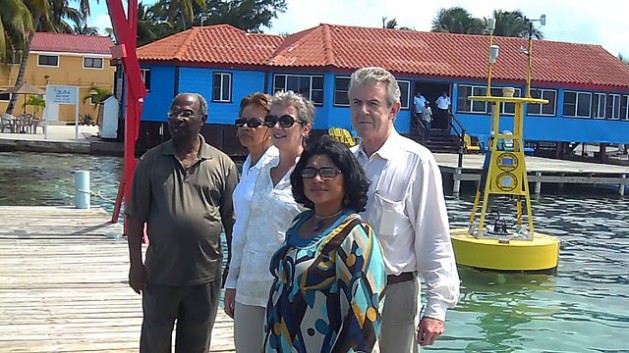
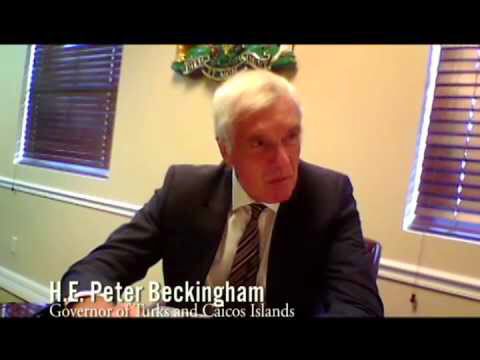
The MOU signing builds on a commitment made by the Governor of Turks and Caicos, Peter Beckingham at the Creating Climate Wealth Islands Summit in February 2014, when Turks & Caicos expressed interest in joining the Challenge.

Governor Peter Beckingham

The Ten Island Challenge

The Ten Island Challenge works to accelerate the transition of Caribbean island economies from a heavy dependence on fossil fuels to renewable resources. Caribbean economies suffer from some of the highest electricity prices in the world—contributing to their national debts, and slowing efforts toward sustainable development. Despite an abundance of sun and wind, Caribbean islands have implemented relatively low amounts of renewables to date. The Ten Island Challenge is tackling this by identifying the technical and commercial solutions that can facilitate low-carbon energy use in the Caribbean.

In 2013, Sir Richard Branson committed his home of Necker Island in the British Virgin Islands to serve as a ‘demo’ island in the Challenge, and, in February of this year, US energy giant NRG Energy was awarded the contract to transition the island to renewables. More


5 Things to Know About Climate Change in the Caribbean!

caribbeanclimate's avatarcaribbeanclimate

Natural events and human activities contribute to an increase in average temperatures around the world. Increases in greenhouse gases such as Carbon Dioxide (CO2) is the main cause. Our planet and our region are warming. This leads to a change in climate.

  1. The Caribbean is a minute contributor to global greenhouse gas emissions, but will be among the most severely impacted.
  2. We are already experiencing its impacts. More frequent extreme weather events, such as the 2013 rain event in the Eastern Caribbean; the extreme droughts being experienced across the region, with severe consequences in places like Jamaica; the 2005 flooding in Guyana and Belize in 2010. And further Climate Change is inevitable in the coming decades.
  3. Inaction is VERY costly! An economic analysis focused on just three areas - increased hurricane damages, loss of tourism revenue and infrastructure damages - could cost the region US$10.7 billion by 2025. That is…

View original post 128 more words

Live Updates:- Caribbean Launch: IPCC AR5 Report Overview. What does it mean for the Caribbean?

caribbeanclimate's avatarcaribbeanclimate

Bookmark this page for live updates during the event.

The Caribbean Community Climate Change Centre (CCCCC) will host the Caribbean Launch of The Fifth Assessment Report (AR5) of the United Nations Intergovernmental Panel on Climate Change (IPCC)  this evening at 6pm (-4 GMT).

The public education event, which will be held at the Frank Collymore Hall, Central Bank of Barbados, is intended to raise the profile of Climate Change as a key development challenge in the Region, and the high degree of scientific certainty surrounding the predictions about our changing and variable climate.

The report offers some specific messages about the impacts of climate change on small island states – and some of its general findings on climate change adaptation and mitigation are of particular relevance to Small Island Developing States such as those in the Caribbean. The 120 minute public education launch event, which will be live streamed via…

View original post 111 more words

Take a PDC with Rhamis Kent in Marrakesh, December 22nd to January 5th, 2015!

marrakeshorganics's avatarMarrakesh Organics

The Course

banner

We will be running a Permaculture Design Course (PDC) December 22nd to January 5th, 2015!

This 15-Day course follows the standard accredited 72-hour design course syllabus and will include several hands-on sessions including making Bio-vital compost, Bio Fertilizer, Actively Aerated Compost Tea, Vegetable beds and Organic Gardening, land surveying, natural building and much more!

This Course is in English only, there will be no translation.

The course will be hosted in an organic olive farm in the foothills of the gorgeous Ourika valley, 25 Km south of Marrakesh, right on the way to historical and scenic destinations such as the Siti Fatma waterfall, Lake Lalla Takerkoust, the Oukaimeden ski resort, the ancient Berber village of Tinmel and the Toubkal national park.

The course covers in detail the ecological basis of Permaculture design, the ethics, the principles of design, strategies for restoring soils, managing water, partitioning land between intensity of…

View original post 741 more words

Latin America And Caribbean Region Expected To Install 9 GW Of Solar In 5 Years

That solar photovoltaic (PV) technology is poised to become a dominant energy generation technology throughout the world is of no surprise to most, but the sheer wealth of possibility being forecast throughout the middle and southern hemispheres begins to give an idea of just how prevalent the technology will be by the end of the decade.

Figures published by NPD Solarbuzz have so far predicted that several of the major Asia Pacific nations will account for 60% of solar PV demand in 2014, while being primary drivers of growth over the next several years, at the same time as the Middle East and Africa region currently has close to 12 GW of solar demand in the pipeline.

So it should really come as no surprise that NPD Solarbuzz’s recent figures show that the Latin America and Caribbean region is set to install 9 GW of solar PV over the next five years.

Latin America and Caribbean Five-Year Cumulative Demand Forecast by Project Status

“Solar PV is now starting to emerge as a preferred energy technology for Latin American and Caribbean countries,” said Michael Barker, senior analyst at NPD Solarbuzz. “The region has high electricity prices and it also benefits from strong solar irradiation, which makes it a good candidate for solar PV deployment. As a result, experienced global solar PV developers are seeing strong solar PV growth potential in the region.”

NPD Solarbuzz’s Emerging PV Markets Report: Latin America and Caribbean shows that the total PV project pipeline now exceeds 22 GW of projects across all stages of development — with 1 GW of projects already under construction, and another 5 GW of projects have received the appropriate approval to proceed.

The Latin America and Caribbean region was previously home to many small-scale and off-grid solar PV applications, however governments are now looking to solar PV to address large-scale utility power requrements — specifically in Brazil, Chile, and Mexico.

“Many countries across the LAC region have the potential to develop into major solar PV markets in the future,” added Barker. “While project pipelines vary by country, there is a strong contribution from early-stage developments that have yet to finalize supply deals or find end-users to purchase the generated electricity, which presents both risks and opportunities for industry players.”

A number of countries throughout the developing and second-world countries are turning to renewable energy technologies to develop strong, future-proof, and economically efficient energy generation. Such a trend is being backed by major manufacturing companies who are focusing their efforts on these regions, hoping to increase their own profits while fulfilling renewable energy demand. More


The Real Weapons of Mass Destruction: Methane, Propaganda & the Architects of Genocide | Part I

Cory Morningstar's avatarFrom the NonProfit Industrial Complex with Love

An investigative report. [Part 1: http://bit.ly/fV8slf | Part II: http://bit.ly/gMITca | Part III: http://bit.ly/gMrxw9 | Part IV: http://bit.ly/g9xbFN]

By Cory Morningstar

Part I

World Marches to Methane Annihilation

“[T]he question is not will this methane be released, but when.” – Robert C. Hendricks, NASA, November 2007

The architects of death: The Real Weapons of Mass Destruction are the melting permafrost, the destabilizing methane hydrates and the corporations such as Halliburton, ChevronTexaco, BP, Shell, Exxon Mobil and the banking and investment industry who, hand in hand with the US Department of Energy and the US Department of Defense, have been planning and waiting to exploit methane hydrates for decades. Methane hydrates are considered the ultimate in climate wealth opportunity because the control of these hydrocarbons could literally shift the balance of global power (US Department of Defense). It is clear that nothing has been done to prevent catastrophic climate change –…

View original post 7,022 more words

The Role of Education in Climate Change Risk Management

caribbeanclimate's avatarcaribbeanclimate

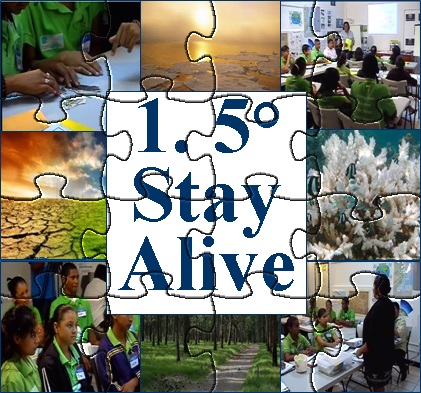
We need a “multi-faceted approach for educating the children and adults vulnerable to climate change […] to reduce the adverse impacts of climate change,” according to Dr. Leslie A. North, Assistant Professor in the Department of Geography and Geology at the Western Kentucky University , and Mr. Kianoosh Ebrahimi, Center for Water Resource Studies, Western Kentucky University in an  exclusive guest post to Caribbean Climate.

Credit: The 5Cs Credit: The 5Cs

Communities of scientists acknowledge that global climate change is happening, and is predominantly the result of human activities (IPCC, 2014). Yet, despite the wealth of information about the potentially catastrophic impacts of climate change, there are many persons still skeptical about the importance of understanding and responding to climate change risk. There are equally as many people simply unaware of how to minimize the impacts of climate change (Alejandro et al., 2012). Generally speaking, as climate change is typically perceived as remote and distant…

View original post 749 more words