Chagos Islands: UK should pay reparations, says Human Rights Watch

Chagos Islands: UK should pay reparations, says Human Rights Watch

Britain should pay reparations to people removed from the Chagos
Islands, a British territory in the Indian Ocean, a human rights group has said.
Human Rights Watch also called on Britain to allow Chagossians to return to the islands, from which more than 1,000 people were forced to leave in the 1960s and 1970s.
The group accused the UK of “committing an appalling colonial crime”.
The Foreign Office said it rejected this characterisation.
After a military base leased to the United States was established in 1966 on Diego Garcia, the largest of the 60 small islands of the Chagos Archipelago, the indigenous inhabitants were evicted from their homes. Chagossians have fought to return to their homes ever since.

Read More

Brazil pushes illegal miners out of Indigenous territory

Feb 8, 2023  ALTO ALEGRE, Brazil (AP) – Armed government officials with Brazil’s justice, Indigenous and environment agencies Wednesday began to press thousands of illegal gold miners out of Yanomami Indigenous territory citing widespread river contamination, famine and disease they have brought to one of the most isolated groups in the world.

People involved in illegal gold dredging streamed away from the territory on foot. The operation could take months. There are believed to be some 20,000 people engaged in the activity, often using toxic mercurty to separate the gold.
The authorities – the Brazilian environmental agency Ibama, with support from the National Foundation of Indigenous Peoples and the National Public Security Force, found a helicopter, an airplane, a bulldozer, and makeshift lodges and hangars and destroyed them. Two guns and three boats with 5,000 liters (1,320 gallons) of fuel were also seized. They also discovered a helicopter hidden in the forest and set it ablaze.  https://to.pbs.org/3YkrO4b

Rejecting the Willow Drilling Project Should Be the No-Brainer of All Time | Common Dreams

Opinion | Rejecting the Willow Drilling Project Should Be the No-Brainer of All Time | Common Dreams
 Opinion | Rejecting the Willow Drilling Project Should Be the No-Brainer of All Time | Common Dreams

 If you wanted an example of the reason we’re still losing the fight to slow the earth’s heating, the proposed Willow oil project in Alaska should suffice.
This should be the no-brainer of all time. The ConocoPhillips plan for a massive new oil field development flies in the face of all climate science and reason. It would be producing huge quantities of oil for at least the next three decades—long past the point when scientists say we must stop using it (and long past the point when, with a serious effort to electrify transportation, we’d need it).
And it would do so in a place—Alaska—already warming faster than almost any place on the planet. Warming so fast that taxpayers are already having to pony up huge sums of money to relocate coastal villages inland. Emissions from the Willow project’s oil would cause $19.8 billion in climate damages; it would generate $3.4 billion in federal tax revenue, which is…a lot less.
(https://lnkd.in/e8aEuPnS) If you wanted an example of the reason we’re still losing the fight to slow the earth’s heating, the proposed Willow oil project in Alaska should suffice.
This should be the no-brainer of all time. The ConocoPhillips plan for a massive new oil field development flies in the face of all climate science and reason. It would be producing huge quantities of oil for at least the next three decades—long past the point when scientists say we must stop using it (and long past the point when, with a serious effort to electrify transportation, we’d need it).
And it would do so in a place—Alaska—already warming faster than almost any place on the planet. Warming so fast that taxpayers are already having to pony up huge sums of money to relocate coastal villages inland. Emissions from the Willow project’s oil would cause $19.8 billion in climate damages; it would generate $3.4 billion in federal tax revenue, which is…a lot less.

NuScale small nuclear reactor design certified for use in U.S.

NuScale small nuclear reactor design certified for use in U.S. 

 The U.S. Nuclear Regulatory Commission has certified the design for what will be the United States’ first small modular nuclear reactor.
The rule that certifies the design was published Thursday in the Federal Register. It means that companies seeking to build and operate a nuclear power plant can pick the design for a 50-megawatt, advanced light-water small modular nuclear reactor by Oregon-based NuScale Power and apply to the NRC for a license.
It’s the final determination that the design is acceptable for use, so it can’t be legally challenged during the licensing process when someone applies to build and operate a nuclear power plant, NRC spokesperson Scott Burnell said Friday. The rule becomes effective in late February.
The U.S. Energy Department said the newly approved design “equips the nation with a new clean power source to help drive down” planet-warming greenhouse gas emissions.
It’s the seventh nuclear reactor design cleared for use in the United States. The rest are for traditional, large, light-water reactors.
Diane Hughes, NuScale’s vice president of marketing and communications, said the design certification is a historic step forward toward a clean energy future and makes the company’s VOYGR power plant a near-term deployable solution for customers.

Joseph Stiglitz: tax high earners at 70% to tackle widening inequality

Joseph Stiglitz: tax high earners at 70% to tackle widening inequality

 Joseph Stiglitz, the Nobel prize-winning Keynesian economist, has called for the super-rich to be subjected to taxes as high as 70% to help tackle widening inequality.
Stiglitz, who won the Nobel prize in economics in 2001 and pioneered many ideas about globalisation and inequality, said introducing a special worldwide income tax rate of 70% on the highest earners “would clearly make sense”.
“People at the top might work a little bit less if you tax them more. But on the other hand, our society gains in having a more egalitarian, cohesive society,” the former World Bank chief economist, 79, told Oxfam’s Equals podcast.
Currently, the top rate of income tax in the UK is 45% on annual earnings above £150,000. In the US, the highest rate of tax is 37% on earnings above $539,901.
Stiglitz said that while an increase in the top rate on income would help lead to a more equal society, introducing wealth taxes on the fortunes accumulated by the world’s wealthiest over many generations would have an even bigger impact.

2nd Members Roundtable at UNGA77

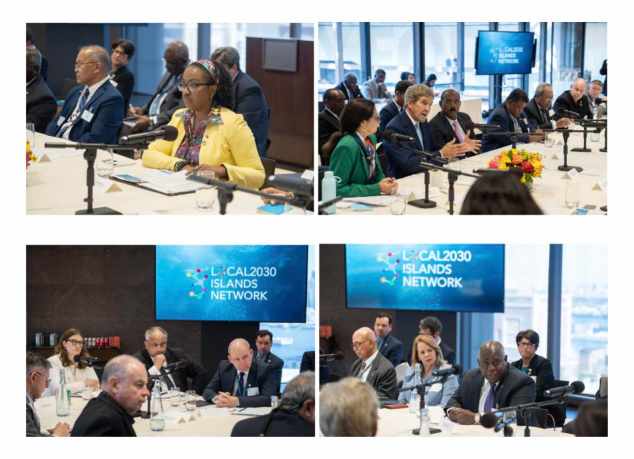
2nd Members Roundtable at UNGA77 (September 2022) — Local2030 Islands Network
 In advance of the Pacific Island Country Summit, the Local2030 Islands Network convened the second in-person high-level meeting on September 21, 2022, co-chaired by Antigua and Barbuda Prime Minister Gaston Browne, Palau Minister of State for Foreign Affairs Gustav N. Aitaro, and Special Presidential Envoy for Climate John Kerry during the 77th session of the UN General Assembly (UNGA 77). The co-hosts opened the meeting by outlining a shared vision for the Network to be a forum for candid dialogue and concrete action by its members to advance progress and island leadership on shared 2030 Sustainable Development Goals.
Prime Minister Browne, Minister Aitaro, and Secretary Kerry were joined at the in-person gathering by Leaders, Ministers and other senior officials from Local2030 member islands, including the Republic of the Marshall Islands, the Federated States of Micronesia, Ireland, Aruba and Hawai‘i, as well as observers to the meeting, including Australia, Bahamas, Belize, and Sint Maarten. Local2030 Islands Network partners, including the U.S. National Oceanic and Atmospheric Association (NOAA), Secretary of the Navy, UN Foundation and University of Guam were also in attendance. The meeting was moderated by U.S. Assistant Secretary of State for Oceans and International Environmental and Scientific Affairs, Monica Medina.

Vanuatu makes bold call for global treaty to phase out fossil fuels

Vanuatu makes bold call for global treaty to phase out fossil fuels | Vanuatu | The Guardian

 The Pacific island of Vanuatu has called for a first-of-its-kind global treaty to phase out the use of fossil fuels in a bold public call at the UN general assembly.
Speaking in New York on Saturday, Nikenike Vurobaravu, the Vanuatuan president, urged countries to join his country’s call for a fossil fuel nonproliferation treaty.
Pope calls for courage in halting use of fossil fuels to protect planet
“We call for the development of a fossil fuel nonproliferation treaty to phase down coal, oil and gas production in line with 1.5C and enable a global just transition for every worker, community and nation with fossil fuel dependence,” he said.

Living in Peace & Hope for the Future

Homo sapiens need a safe, secure, quality of life in which to prosper. People, humans, who have all the basics needs met, as in secure sources of food and drinking water, and a suitable dwelling , a territory in which  they feel secure, an area where life is relaxed, they will prosper and not be aggressive.
Conversely, those who live under stress with a poor quality of life, under conditions of insecurity, will more often than not be inclined to engage in conflict with their neighbors. Conflict driven by the need to accumulate sufficient resources for their survival.
Stress inducing factors in today’s world range from anthropomorphic climate change causing conditions of drought or massive flooding destroying homes, crops and livestock, to rising sea levels and reduced sea food catch leading to food insecurity.
When one compares what our quality of life has  become in the last thousand years, to what it was previously, when all the planet’s land was global commons, when we were free to hunt and gather and follow the great herds and the yearly crops produced by the multi-generational food forests.  When our ancestors had unimaginably good food security, with a high quality lifestyle,  their culture flourished relatively peacefully.
I am a Peace Scholar, I hold a Masters degree in Peace and Conflict from the University of Bradford,a one of seven universities offering degree programs in Peace and Conflict Resolution chosen by Rotary International. 
I also studied with the United Nations Institute for Training and Research, as well at the International Human Right Academy at the University of Utrecht.
 All of the above keep the need for discussions around Peace Making in the forefront of my mind, given that conflict can be triggered by so many issues.
The Global Peace Dialogue is an initiative to ramp up the dialogue globally, using video Padcasts to host discussions with Academics, Heads of State, Diplomats, Scientists and Policy Makers from around the world. 
These discussions will take place online on our YouTube Channel  and Dialogue’s will start in approximately two weeks.