Small islands to sign historic treaty in Samoa

Small islands to sign historic treaty in Samoa, to help finance climate change adaptation
Representatives from 31 small islands and low lying countries that are members of the Alliance of Small Island States (AOSIS) will reaffirm their commitment to the Small Island Developing States (SIDS) Sustainable Energy mechanism – SIDS DOCK – at an Official Ceremony for the Opening of Signature for the Statute Establishing the SIDS DOCK, on 1 September 2014, during the upcoming United Nations (UN) Third International Conference on SIDS, in Apia, Samoa, from 1-4 September. The opening for signature of this historic SIDS-SIDS Treaty is a significant highlight and outcome of the Conference, and a major step toward the treaty’s entry into force.

Representatives scheduled to attend the ceremony confirmed their continuing support for, and preparation to sign the Statute as soon as possible, and reiterated their resolve to continue cooperating to achieve its prompt entry into force and to support the SIDS DOCK goal of 25-50-25 by 2033: Island Energy For Island Life. SIDS need to mobilize and facilitate in excess of USD 20 billion by 2033, about USD 1 billion per year, to help finance the transformation of the SIDS energy sector in order to achieve a 25 percent (from the 2005 baseline) increase in energy efficiency, generation of a minimum of 50 percent of electric power from renewable sources, and a 25 percent decrease in conventional transportation fuel use, in order to significantly increase financial resources to enable climate change adaptation in SIDS.

The Hon. Roosevelt Skerrit, Prime Minister and Minister of Foreign Affairs and Finance, for the Commonwealth of Dominica, and acting in his country’s capacity as Chair of the SIDS DOCK Steering Committee, said that SIDS DOCK represents a significant achievement in solidifying SIDS-SIDS relationships and cooperation and is, “an extraordinary lesson learned of what can happen when a genuine partner takes ‘a chance’ on a new and innovative idea that has the potential to help SIDS adapt and become more resilient to the changing climate and sea level rise.” Recognising that the lives of more than 20 million people in small islands and low lying states are at high risk, the majority of them young people, the Government of Denmark was the first country to provide support for SIDS DOCK start-up activities with a grant of USD 14.5 million in 2010, during climate talks in Copenhagen, Denmark. This gesture and demonstration of support was followed by a grant of USD 15 million, over two years in 2011, from the Government of Japan during climate talks in Cancun, Mexico.

In March 2014, in partnership with the United Nations Industrial and Development Organization (UNIDO), the Government of Austria extended support under a Memorandum of Understanding, with a grant of 1 million euros, for start-up activities for Centres for Renewable Energy and Energy Efficiency in the Caribbean (CCREEE), the Pacific (PCREEE), and support to African SIDS through the Economic Community of West African States (ECOWAS) ECREEE in Cabo Verde, and at a later date, support for a centre in the Indian Ocean region (IOCREEE). The new centres will also act as SE4ALL Hubs, assisting SIDS to translate commitments to actions. SIDS DOCK is highly complementary to the work being done under the Sustainable Energy For All (SE4All) Initiative, a personal initiative of the UN Secretary-General, Ban Ki-moon, that has SIDS as the largest group of signatories and with the highest ambitions.

During the Third International Conference on SIDS, the Government of Samoa and its people will host hundreds of representatives from small islands and low lying states, donors, investors and civil society groups, to what is expected to be the most important conference on SIDS to date, and one that is expected to define SIDS in a Post-2015 world, with genuine partnerships at the core of the agenda. SIDS DOCK is well-positioned to participate in the SIDS Post-2015 Agenda with its partners, the Governments of Denmark, Japan and Austria; the United Nations Development Programme (UNDP) and the United Nations Industrial and Development Organization (UNIDO); The World Bank; and The Clinton Foundation – Clinton Climate Initiative (CCI).

During the Signing Ceremony on September 1, the Dominican Prime Minister will invite other members of the AOSIS to consider joining the organisation. The Statute will remain open for signature in Apia, Samoa until September 5, and will re-open for signature in Belmopan, Belize, from September 6, 2014 until it enters into force. Belize is the host country for SIDS DOCK, with Samoa designated as the location for the Pacific regional office. More


Why Island Wisdom Is Crucial to Help the World Adapt and Prepare for the Im

For decades, small island countries have been warning the world about the consequences of climate change. While many countries have been debating whether climate change is even happening or who is to blame, small islands have just had to deal with its impact, from extreme weather to rising sea levels and increasing environmental vulnerability.

Major storms have always been a fact of life for small islands. But in recent years they have intensified in their destructive capabilities. In 2004, Hurricane Ivan struck the Caribbean island of Grenada, causing widespread destruction. The financial cost of the disaster was estimated at more than $900 million – more than twice the country’s gross domestic product (GDP). Only 10 months later, the country was hit again, this time by Hurricane Emily, which caused another $50 million in damage.

In the Caribbean, changes in hurricane intensity and frequency could eventually result in additional annual losses of $450 million, largely due to disruption of a key source of revenue and jobs: tourism. Limited diversification and small market size means that small island economies are not resilient to disaster loss. This is true not just in the Caribbean, but the world over.

According to global risk models developed by the UN Office for Disaster Risk Reduction (UNISDR), six of the top 10 countries with the greatest proportion of resources at risk during hurricanes or cyclones are small islands. These losses will only increase due to sea-level rise, water scarcity, drought, and other factors.

The 38 small island developing states, which spread across the Caribbean, the Pacific and Indian Oceans, are not sitting and waiting for the next storm to hit. They have been taking measures to adapt to and manage the risks posed by climate change.

Several Caribbean islands came together seven years ago to create an insurance pool of easy-to-access disaster funding. Spreading the risk across countries reduces premiums and provides contributors with a safety net which can fund vital services when disaster strikes. Since 2007, more than $30 million has been paid out by the 16 participating countries. A similar initiative is under way in the Pacific region where the memories of the massive human toll and devastation due to Typhoon Haiyan that claimed more than 6,000 lives in the Philippines last November are still all too vivid.

Ideas and actions for reducing the risk from disasters will be at the forefront of the United Nations Conference on Small Island Developing States, to be held in Samoa from 1-4 September. The Conference will be a showcase for those living on the frontlines of climate change and could have a lasting and positive influence on the post-2015 development agenda.

The Conference is an acknowledgement by all the countries of the world of the unique circumstances that small island developing countries face. Their size, combined with their remoteness, and economies of scale, have made it that much more difficult for small islands to implement measures to become resilient. This is compounded by the impacts of climate change, a problem that is hardly of their own making as they collectively contribute less than 1 per cent of total greenhouse gas emissions. In fact, many are striving to become carbon neutral by using renewable energy, improving energy efficiency, and offsetting their greenhouse gas emissions.

Next week’s conference in Samoa is the first of two critical global gatherings. Just a few weeks later, on 23 September in New York, UN Secretary-General will host heads of State, CEOs and civil society leaders at the Climate Summit. The Summit aims to spur accelerated and ambitious actions to reduce emissions and build resilience to climate change worldwide, from the largest countries to the smallest island States. It’s about turning promises into performance.

With international attention on small islands, climate change and the post-2015 framework for disaster risk reduction, there has never been a better chance to turn the tide. Now is the time to listen, support and partner with those who have seen first-hand what climate change can do to your economy and your community. It would be one of the greatest tragedies of our time to continue to ignore the warnings from small islands; their issues will soon become our own. More

_________________

Han Seung-soo is the UN Secretary-General’s Special Envoy for Disaster Risk Reduction and Water and former Prime Minister of the Republic of Korea


UN Outlines Expectations for SIDS Conference


21 August 2014: The UN announced key outcomes that are expected from the Third International Conference on Small Island Developing States (SIDS) taking place in Apia, Samoa, on 1-4 September, including over 300 new, SIDS-focused partnerships that will be monitored for their achievements.


Wu Hongbo, Secretary-General of the SIDS Conference and UN Under-Secretary-General for Economic and Social Affairs, highlighted that the preparatory process leading to the Conference has already produced an agreed outcome document, called the SIDS Accelerated Modalities of Action Pathway, or ‘SAMOA Pathway.' He said the early agreement on the outcome document clears the way for the Conference itself to focus on developing partnerships that will support ‘concrete and focused actions' to tackle the specific development issues faced by SIDS.


The document outlines agreed actions in the areas of economic growth, decent work, climate change, and health and non-communicable diseases (NCDs). Wu stressed that governments alone will not be able to deliver sustainable development, and that partnerships with the private sector and civil society will be needed.


A UN press release said that heads of 21 UN agencies will attend the Samoa conference, and that the UN Department of Economic and Social Affairs (DESA) will continue to maintain a SIDS partnerships platform, and will monitor the implementation of SIDS-focused initiatives. More


IISD Reporting Services will be providing daily coverage of the four pre-conference fora, the conference plenary sessions and six Partnership Dialogues, and selected side events. [UN Press Release] [SAMOA Pathway] [SIDS Conference Website] [IISD RS Meeting Coverage]


Global campaign launched to improve weather & climate services for small island developing states (SIDS)

A global campaign to improve weather and climate services for all small island developing states was launched today with the support of the World Meteorological Organisation (WMO), the Secretariat of the Pacific Regional Environment Programme (SPREP) and Digicel Pacific.

The Small Islands, Weather Together campaign (www.weathertogether.org) aims to show how the small island developing states of the world can work together to improve their vital weather and climate services.

In the Pacific region alone, extreme weather already accounts for 76% of all disasters with 50% directly related to cyclones. The increase in extreme weather events is also hampering the sustainable development of many small island developing states. For example, when Cyclone Evan hit Samoa in December 2012 it resulted in the loss of one third of the country’s entire annual economic output.

WMO Secretary-General Michel Jarraud stresses that small island developing states need greater investment to further strengthen their vital weather and climate services and to ensure that efforts towards sustainable development are not wasted.

“If we don’t invest in stronger weather and climate services for small island developing states then extreme weather events could simply wipe out years of development effort if they are not well prepared. It is much more cost-effective to invest in early preparedness and prevention than to focus only on rehabilitation and post-disaster action,” he asserted.

Climate change is increasing the frequency and intensity of weather and climate events – cyclones, typhoons, drought, flash floods – in many small island developing states. But many of their Meteorological Services still lack the basic infrastructure, technology and expertise they need to protect vulnerable island communities and economies.

For Mr. Jarraud, there is an urgent need to enhance the quality of early warnings for extreme weather. He pointed out that the formulation and dissemination of these warnings also need to be improved so that they can be understood and used by the island communities and government agencies.

In the Pacific islands, SPREP and other partners are working to improve communication of this type of information in partnership with national meteorological services, the media, including broadcast stations and communities.

“SPREP recognises that weather forecasts and warnings such as those given during tropical cyclones do not have a shelf life, they must be disseminated rapidly to the public or else they are useless,” says SPREP Acting Director General Kosi Latu.

He further noted, “We can improve the quality of the forecasts and warnings so that countries and communities have more lead time to take action. But we can also improve the way climate information is used over longer time scales by farmers, fishermen and by decision-makers across government. For example, when planning new infrastructure, we can say ‘this place has a high risk of tsunami, flooding or storm surge, so don’t build things here’.”

Mr. Jarraud recalls that the small developing island states stand to suffer more and more if the global community fails to agree to a limit in greenhouse gas emissions, the main human cause of climate change and global warming.

“Greenhouse gas emissions are still on the rise. We need to reach a peak of emission over the next 15–20 years, then to decrease dramatically to zero equivalent emission in about 50–60 years from now.

“This is a huge challenge. We must act now. The more we wait, the more difficult it will be, and, therefore, the more expensive it will be for countries to adapt to climate change. If we do not act now, we are agreeing to leave the small island developing states in a situation which may no longer be manageable,” he warned.

The Small Islands, Weather Together campaign was launched specifically to coincide with the lead up to the United Nations Third International Conference on Small Island Developing States, which will be held in Apia, Samoa, from 1–4 September, 2014.

For more information visit: www.weathertogether.org


Goodbye gasoline… first green LEAF arrives in the Cayman Islands

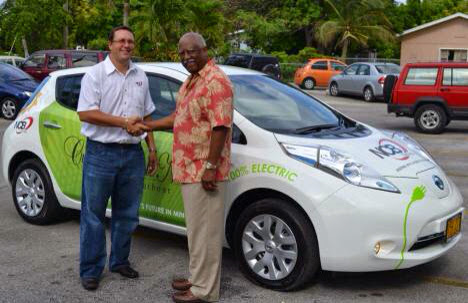
GEORGE TOWN, Cayman Islands — The NCB group in the Cayman Islands has purchased the very first new all-electric Nissan LEAF in the Caribbean, reinforcing its commitment to environmental sustainability.

“NCB Group is proud to be a part of the innovative movement towards electric cars in the Cayman Islands,” said Matthew Wight, managing director.

Considered the premier residential developer in the Cayman Islands, the NCB group is seeking to further reduce its ecological footprint in an effort to protect the Caribbean and the planet from harmful greenhouse gasses.

Wight said that he drives electric vehicles because he knows that he is helping the environment.

“As a company, we strive to employ sustainable and green technologies when we build our residential and commercial projects and we wanted to carry this mission through to the vehicles we drive,” he explained.

Driving a Nissan LEAF – a 100% electric car — has been extremely rewarding “in the sense that the LEAF does not use a single drop of gas. It has no tailpipe, no fumes and produces zero emissions,” he said.

“As we build with Cayman’s future in mind we are also looking to alternative energy sources in everything we do with the goal to be as eco-conscious as possible,” Wight added.

For nearly a decade John Felder, president and CEO of Cayman Automotive Leasing, has been at the forefront of the burgeoning electric vehicle industry in the Caribbean.

His hope is to see electric vehicles being driven in every country in the Caribbean and eventually the world in years to come.

“I applaud Mr Matthew Wight and NCB for investing in the future for a cleaner and healthier environment. The energy generated to power the Nissan LEAF and the energy to move the car is 97% cleaner in terms of noxious pollutants,” Felder said.

The Nissan LEAF boasts one of the quietest and smoothest rides ever experienced. The vehicle does not have a gas tank and drivers will never have to pay at the pumps again. The motor is powered by an advanced lithium-ion battery, which is half the weight and twice the power of the nickel-metal hydride batteries used in hybrids, and can easily be charged at home, or at any solar panel charging station in Grand Cayman.

Felder is certain that electric cars are the cleanest, most efficient, and most cost effective form of transportation around.

“Electric cars are high performance vehicles that will continue to meet new challenges in the future,” he said. More


Small Caribbean Island Shows Bold Ocean Leadership: Barbuda Overhauls Reef and Fisheries Management for Sustainability

On August 12th, Barbuda Council signed into law a sweeping set of new ocean management regulations that zone their coastal waters, strengthen fisheries management, and establish a network of marine sanctuaries.

This comes after seventeen months of extensive community consultation and scientific research supported by the Waitt Institute. With these new policies, the small island of Barbuda has become a Caribbean ocean conservation leader and global role model. The regulations establish five marine sanctuaries, collectively protecting 33% (139 km2) of the coastal area, to enable fish populations to rebuild and habitats to recover. To restore the coral reefs, catching parrotfish and sea urchins has been completely prohibited, as those herbivores are critical to keeping algae levels on reefs low so coral can thrive. Barbuda is the first Caribbean island to put either of these bold and important measures in place.

“This will definitely benefit the people of Barbuda, and Antigua as well. No part of this is meant to hurt fishers. It’s the reverse – ensuring that they have a livelihood that will last in perpetuity,” said Arthur Nibbs, Chairman of the Barbuda Council and Antigua and Barbuda Minister of Fisheries.

Caribbean-wide, communities are seeing declines in the health of coastal ecosystems and fish populations. This negatively impacts economies, food security, and cultures. Visionary action like that shown in Barbuda is needed to manage the ocean sustainably, profitably, and enjoyably, for this and future generations. The coastal zones and fishing regulations reflect stakeholders’ priorities and are the outcome of a community-driven, science-based, and consensus-seeking process aiming to balance current and future needs to use ocean resources. More


For the Caribbean, a United Front Is Key to Weathering Climate Change

PHILIPSBURG, St. Maarten, Jul 2 2014 (IPS) – As the costs of climate change continue to mount, officials with the Commonwealth grouping say it is vital that Small Island Developing States (SIDS) stick together on issues such as per capita income classification.

Seawall in Dominica

Deputy Commonwealth Secretary General (Economic and Social Development) Deodat Maharaj told IPS the classification affects the ability of countries like Antigua and Barbuda, Grenada and others to access financing from the international financial institutions.

“To my mind, the international system has to take special consideration of countries such as Antigua and Barbuda, Grenada and others,” he said.

“The example I like to use is the example of Grenada. You would recall Hurricane Ivan about 10 years ago. It damaged about 70 percent of the housing stock in Grenada. It cost a billion U.S. dollars in damages, equivalent to two years GDP.

“So the countries in the Caribbean can move from high income or middle income to almost zero income with an economic shock or natural disaster,” Maharaj added.

Maharaj, whose appointment took effect earlier this year, said the Commonwealth is preparing “an analytical framework based on research, a case, so that countries such as Grenada when there is a natural disaster their international debt obligation for a particular period of time will be suspended so that they don’t have to continue to pay their debt when it is that they have suffered a natural disaster.”

On the issue of collaboration, one of only three female prime ministers in the Caribbean has reaffirmed her country’s commitment to dealing with climate change and all the issues associated with the global phenomena.

“I would like to reaffirm my strong belief in collaboration with other nations,” Sarah Wescot-Williams, the prime minister of St. Maarten, told IPS.

“Economic issues have forced us to look at ways and means of getting together and we are working collaboratively with other Caribbean nations to mitigate the effects of climate change as well as social issues of unemployment, crime and health.”

Prime Minister of St. Maarten Sarah Wescot-Williams (left)

St. Maarten recently developed and approved its National Energy Policy “and as such we have very specific goals and objectives to reach by 2020 in terms of reduction and promoting alternative, new green ideas, new green products,” Wescot-Williams explained.

She reiterated a point made while addressing regional leaders recently. “I told them we should not only look out for the bigger impacts of climate change or look at those developments as something that is far from us, far from our homes, but look at small things like beach erosion, something that St. Maarten is seeing.

“A report has been issued not very long ago indicating that unless specific measures are taken, a great part of what is now land will no longer be as far as the smaller islands, including St. Maarten, are concerned.”

How they are ranked by financial institutions such as the International Monetary Fund (IMF) and World Bank is a major issue for Caribbean countries.

Camillo Gonsalves, a former ambassador to the United Nations, says it affects these countries’ ability to secure the required funding to effectively deal with climate change.

He noted that most Caribbean countries are ranked as middle-income countries, and using that metric alone makes his country, St. Vincent and the Grenadines, with its one-billion-dollar Gross Domestic Product (GDP), “richer than China”.

“If that is the metric by which we determine economic health and access to concessionary financing, and our ability to borrow ourselves out of a crisis or to spend ourselves out of a crisis, it is clearly a flawed measure,” he said.

He noted that within three hours last Christmas Eve, a trough system left damage and loss in St. Vincent equal to 17 percent of GDP, while the country also suffered natural disasters in 2010, and 2011 – the loss and damage from each of which was in double digits.

This, however, is the measure by which the World Bank, the IMF determine the economic strength of Caribbean countries, Gonsalves said, adding that these international institutions do not consider the region’s vulnerabilities.

“The Caribbean small island developing states are among the most heavily indebted states in the world,” Gonsalves said, noting that the debt-to-GDP ratio in the region ranges from 20 percent in Haiti – which received significant debt forgiveness after the 2010 earthquake – to 139 percent in Jamaica, with St. Kitts and Nevis and Grenada at 105 and 115 per cent, respectively, even as the European Union has set itself a debt-to-GDP ratio of 65 per cent.

“If your debt-to-GDP ratio is 139 percent and you are struck by a natural disaster… how do you borrow yourself out of that crisis? Where do you find money immediately to build your roads, your houses, your bridges, your hospitals that have been damaged? How can you set money aside in preparation for the next climate event if you have a debt to GDP ratio of over 100 per cent or approaching 100 per cent, and your debt servicing charges are that high?” Gonsalves said.

Agreeing with Wescot-Williams and Maharaj that there is strength in unity, Gonsalves, who serves as foreign affairs minister for St. Vincent and the Grenadines, said the upcoming Third United Nations Conference on Small Island Developing States (SIDS) in Samoa is an ideal opportunity for regional countries to do more than just talk about collaboration.

“The issue of how we are ranked and classified has to be rectified – not addressed, not flagged, not considered. It has to be rectified in Samoa. That has to be one of our prime objectives going into this conference,” he said.

The Samoa conference will be held from Sep. 1-4 under the theme “The Sustainable Development of Small Island States Through Genuine and Durable Partnerships”.

It will seek to assess progress and remaining gaps; renew political commitment by focusing on practical and pragmatic actions for further implementation; identify new and emerging challenges and opportunities for the sustainable development of SIDS and means of addressing them; and identify priorities for the sustainable development of SIDS to be considered in the elaboration of the post-2015 U.N. development agenda.

Maharaj said “one big challenge” for his organisation is the advancement of the interest of small states.

“When I think about the Caribbean and I think about development…we need to think about development not only in terms of five years, 10 years or 15 years,” he said.

“I would like to think about and imagine what will the Caribbean be in the year 2050 at the time when our grand- and great-grandchildren will be around and many of us won’t be here,” Maharaj added. More


WMO Launches SIDS Website


WMOAugust 2014: The World Meteorological Organization (WMO) has launched a small island developing States (SIDS) website to highlight its work with SIDS, given that they are low-lying and vulnerable to weather- and climate-related hazards, such as tropical cyclones, floods and droughts.


The website features: a media corner, highlighting the most recent information on SIDS; links to WMO SIDS publications, including ‘Saving Paradise: Ensuring Sustainable Development' and ‘The SIDS Caribbean Project: Preparedness to Climate Variability and Global Change in SIDS of the Caribbean Region;' and information on WMO side events to be convened at the Third International Conference on SIDS, taking place in Apia, Samoa, from 1-4 September 2014.


WMO supports SIDS in developing: adequate structures and building capacity to ensure that information is available in a timely manner to address issues such as coastal zone management, energy, environmental degradation, tourism and climate change; and scientifically sound and culturally sensitive early warning systems. It further supports national meteorological and hydrological services (NMHSs) in SIDS to help access the most sophisticated products in real-time and forecasts of extreme weather events several days in advance. [WMO SIDS Website]


read more: http://sids-l.iisd.org/news/wmo-launches-sids-website/#more-254872


Has the era of the ‘climate change refugee’ begun?

A far-flung scattering of islands in a turquoise sea, Tuvalu is one of the planets' smallest and most remote nations, just west of the International Date Line, just south of the equator.

Funafuti, Tuvalu

Tuvalu's coastline consists of white and sandy beaches, green palm trees and mangroves. It is hard to imagine that anybody would want to leave this small island nation, located between Australia and Hawaii, voluntarily. But Tuvalu has become the epicenter of a landmark refugee ruling that could mark the beginning of a wave of similar cases: On June 4, a family was granted residency by the Immigration and Protection Tribunal in New Zealand after claiming to be threatened by climate change in its home country, Tuvalu. The news was first reported by the New Zealand Herald on Sunday.

The small Pacific island nation sits just two meters above sea level. If the current sea level rise continues, experts believe the island might disappear in approximately 30 to 50 years. Tuvalu shares this existential threat with many other island nations and coastal regions, which have struggled for years to raise international awareness about their tragic plight. Predictions for climate change-induced displacement range widely from 150 to 300 million people by 2050, with low-income countries having the far largest burden of disaster-induced migration, according to the Internal Displacement Monitoring Center.

Those threatened by sea-level rise, droughts or other natural catastrophes face an epochal problem: Victims of climate change are not recognized as refugees by the International Refugee Convention. In the Tuvalu case, Sigeo Alesana and his family reportedly left the island nation in 2007 and moved to New Zealand, where they lost their legal status in 2009. The family was not able to obtain work visas and had to apply for refugee and protected persons status in 2012. Although the claims were dismissed in March 2013 and an appeal was turned down, the family's case was finally approved. The case was closely followed by immigration and environmental lawyers all over the world.

Sigeo Alesana and his wife claimed before the tribunal that climate change had made life in Tuvalu more difficult due to much more frequently occurring inundations, that caused coastal erosion and made it difficult to grow crops. The tribunal explicitly mentioned climate change in its assessment saying that Alesana's children were particularly “vulnerable to natural disasters and the adverse impact of climate change.”

“I don't see it as delivering any kind of 'verdict' on climate change as such,” says Vernon Rive, a Senior Lecturer in Law at AUT Law School in Auckland. The New Zealand decision is very specific because the family based its application for residency on three arguments, Rive says. First, the family members claimed to be refugees; second, they argued to be “protected people“, and third, the family said its case fell under “exceptional humanitarian grounds.” Each of these arguments is based on an existing convention regarding refugees, but the family only succeeded because it claimed “exceptional humanitarian grounds,” which is a wording recognized in New Zealand's immigration legislation but not by many other governments.

In its judgment the New Zealand tribunal surprisingly acknowledged the humanitarian consequences of climate change among other factors, such as the presence of an elderly mother who required care. In its conclusion, however, the tribunal refrained from singling out climate change and stated that other factors would already have been sufficient to grant residency to the family. In other words: The tribunal avoided a clear decision on whether climate change can or cannot be reason enough for refugees to be granted residency. The mere fact that the tribunal mentioned the impacts of global warming as a contributing factor to the ruling is nevertheless remarkable. “What this decision will not do is open the gates to all people from places such as Kiribati, Tuvalu and Bangladesh who may suffer hardship because of the impacts of climate change,” Rive says.

While the tribunal's decision may not have the same impact everywhere, it could send a strong signal to a number of nations, such as Sweden and Finland, that often grant asylum to people affected by natural disasters. According to French climate change migration expert François Gemenne, governments need to get to grips with the reality of climate change refugees, irrespective of legal conventions. “I believe that bilateral or regional arrangements are going to become necessary,” says Gemenne, suggesting a raft of agreements will need to be put into place, between nations and among geopolitical blocs, that will ensure the protection of those displaced by rising waters.

But will there eventually be open doors for the victims of climate change? Some of the countries endangered by climate change fear that their citizens could effectively become “second class” citizens abroad. As a consequence, the island nation Kiribati – itself at risk from climate change – has set up a “Migration with Dignity” program which involves training its citizens as highly-skilled workers who are needed and welcomed in other countries if and when the residents of Kiribati are forced to move.

The recent New Zealand ruling could give smaller nations stronger leverage on the international stage. But do the world's leading statesmen, beset by a host of other crises, care? Michael Gerrard, Director for Climate Change Law at Columbia University, puts current progress in perspective: “The world community has not even begun to grapple with what is to come,” he tells WorldViews in an e-mail. More


UN Releases Six Briefs for SIDS Conference Partnership Dialogues

The UN Department of Economic and Social Affairs (DESA) has released a series of six briefing papers on priority themes for discussion during the Third International Conference on Small Island Development States (SIDS), set to take place in Apia, Samoa, from 1-4 September 2014.

August 2014: The SIDS conference will include six multi-stakeholder ‘Partnership Dialogues’ intended to strengthen existing partnerships and promote new ones. The UN briefing papers correspond to the partnership dialogue themes of: sustainable economic development; climate change and disaster risk management; social development in SIDS, health and non-communicable diseases (NCDs), youth and women; sustainable energy; oceans, seas and biodiversity; water and sanitation, food security and waste management. The papers suggest a wide range of opportunities that could be addressed through new or existing partnerships, especially public-private collaborations.

On sustainable economic development, the authors propose conducting investment impact monitoring, and establishing regional SIDS programmes to promote investment through public-private partnerships.

On climate change and disaster risk management, the authors suggest the adoption of risk financing instruments, such as contingency funds and insurance, as part of spatial and development planning initiatives.

On social development, they note that obesity and diabetes rates are “staggering” in the Pacific, and they aim to prevent premature morbidity and mortality from NCDs, including measures to protect SIDS from the negative impacts of bilateral and global trade agreements. They also aim to make education more relevant, and to improve labor market access and secure quality jobs for young people.

On sustainable energy, the authors recommend supporting an enabling environment for sustainable energy markets; facilitating access to modern, affordable and reliable energy services for rural households; decreasing reliance on fossil fuel imports; and improving women’s access to renewable and cost-effective energy.

On oceans, they recommend addressing the impacts of ocean acidification and climate change, promoting inclusive and sustainable development of local economies using the oceans, preventing marine and land-based pollution, and reversing the decline in fish stocks.

On water and sanitation, they propose strengthening regional mechanisms for managing hazardous wastes and ship-generated wastes; promoting resource efficiency as a means to reduce the generation of waste and wastewater, and incorporating climate information into practices and policies for supporting agriculture and food security. [Partnership Dialogue Briefs] [SIDS Conference Website] [SIDS Partnerships Platform]