Replacing the peace process with a civil rights struggle

What would happen if Israeli progressives and their supporters demanded an end to the military court system, or called for freedom of movement for Palestinians? The answer: a lot.

The two-state solution has long become a means (to solving the problem of the occupation) to an end. As I wrote here in the past, this change has had severe consequences as far as the Israeli political opposition is concerned. Those range from a de-facto acceptance of the status quo to a political alliance with the Right and support for all the latest rounds of violence. The excuses are always the same – that we are on the road to the two-state solution and “this is the only game in town.”

The truth is that we aren’t on the road to two states or to one state. We are deep in the status-quo solution. Israel directly controls the lives of some 4 million Palestinians (and indirectly almost two more million in Gaza), and only a minority of them have the rights of full citizens, and even then only formally. The debate over the correct term for this state of affairs (‘occupation’ or ‘apartheid’ or ‘status quo’) is not half as important as recognizing this reality itself, which is stable, institutionalized and not going to change in the foreseeable future.

As a matter of fact, a final status agreement seems as far off as I can remember. The two-state solution is highly unlikely to take place in the coming years, and there is no way of knowing what the more distant future holds. Regional events along with internal developments in Israeli society serve those who oppose an agreement. The occupation empowers those who support it.

The common wisdom in Israel today is that every territory that is evacuated will eventually become another hub for Middle Eastern anarchy. The security establishment believes that only the IDF can prevent forces such as Islamic State from crossing the Jordan River. Israel would also like to make sure that Hamas doesn’t take over the West Bank. In other words, even if a Palestinian “state” is formed, it won’t have even the minimal degree of independence. No credible Palestinian leadership can be expected to agree to that.

I also don’t see any form of international pressure that would force the two-state solution on Israel. Much of the international community is clearly unhappy with Israel’s policies of the last decade, but this is nowhere near the mobilization against South Africa in the 1980s or, more recently, Iran. In both cases the tipping point was the U.S. decision to support and impose sanctions. And while the U.S. might end up distancing itself from Jerusalem, it will continue to use its power to prevent sanctions against it. The EU is also unlikely to expend its measures beyond some steps against the settlements. So there is truly no end in sight.

Facing this new reality, Israeli progressives that supported the peace process are turning to one of a few options: There are those who join the Right in maintaining the status quo; those who continue to believe that some recent events – the war, the ceasefire, American elections, the lack of American elections, etc. – opened a “window of opportunity for peace;” while in fact there is no window, not even a crack. And there are also those who are crying, not without some perverse pleasure, that “all is lost.”

On a more positive note, I believe there is renewed recognition in Israel of the dominance of the occupation on all other political problems, in the long-term threat it presents before Israeli society. I used to hear people say that the Left should focus on social issues and leave the Palestinian problem aside, but not anymore. You even see conservatives voicing some concern over the failure to solve the Palestinian issue. In other words, there is some new recognition of the problem, but there is no political strategy to accompany it among progressives, except for continuing to bang one’s head against the peace process wall.

***

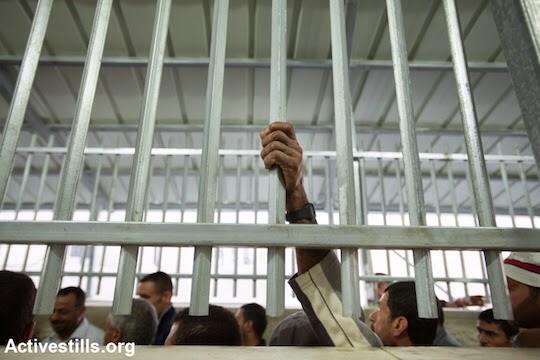
The solution is to replace the diplomatic process with a civil rights struggle, to break the occupation into pieces, and deal with each one of them: The fact that Palestinians do not enjoy freedom of movement. The fact that they have been tried in military courts for almost half a century. The limits on their freedom of speech and their right to freely assemble. The lack of proper detainee rights (including minors). The disrespect for their property rights, and, of course, their lack of political rights.

A civil rights struggle doesn’t necessarily mean a single-state solution, nor two states. Civilian rights for Palestinians can lead to any final status agreement. As I wrote here last week, there is little point in debating solutions right now.

A civil rights struggle is not a new idea, and many Palestinians have been engaging in it for a long time. But Israeli progressives and peaceniks have always placed it second only to the diplomatic process. In other words, instead of the Palestinian state becoming a means for the fulfillment of Palestinian rights, it was made the only desired political object; those rights no longer bared value once they were separated from the idea of statehood – as if because the Palestinians have no state they don’t deserve freedom of movement or a fair trial. Thus, progressives find themselves justifying an authoritarian regime in Ramallah in the name of Palestinians rights, and many other absurdities.

On a tactical level, a civil rights struggle opens the door for Arab-Jewish cooperation on both sides of the Green Line, and leaves aside the questions of statehood and historical narratives that people love to debate. Instead, it focuses on the lives of real people under occupation.

The equal rights of all men and women is such a simple and broadly accepted notion that it’s easy to explain and for everyone to understand. Israelis have adopted all sorts of revisionist readings of the conflict in recent years; for example the idea that the territories aren’t occupied because they were never claimed by any other state. But the most important problem with the occupation is the millions of people held under a military regime for decades, and not just the legal status of the land.

The target of a civil rights struggle is not the settlers, or any other Israeli community, but the state and its practices. It might not make progressives more popular with the Israeli public, but it could make their work more effective.

What could such a struggle look like? It should raise specific political demands that touch the basic liberties and rights of human beings; such as the right to a fair trial, to equality before the law, and to political representation.

The military court system is a good place to start. Military tribunals could be accepted in very specific contexts and for a limited period of time. They aren’t meant – nor could they be used – to run the lives of a civilian population for decades, as Israel does.

There is no way to justify military commanders ruling over civilian issues for half a century, the way they do in the West Bank. There is no way to justify administrative detentions. What prevents a “pro-peace” party or organization – say, Meretz or Labor or J Street – from right now demanding an end to the military court system, regardless of diplomatic developments? The fact that such an idea is not even debated demonstrates the degree to which even the “pro-peace” camp has adopted the mentality of the occupation.

What about freedom of movement? The Palestinians are held like Israel’s prisoners, not only in the West Bank but also in Gaza. It takes a permit from a military commander to allow a Palestinian to visit his or her family in Jordan. Why not demand turning this policy on its head, right now, and have the security authorities state who they forbid from traveling, and allow everybody else free passage? Surely this is a reasonable enough request?

Human rights groups have been monitoring and discussing these issues for decades, but they have yet to enter progressive politics, which is still chained to the endless peace process. Imagine what would happen if mobilization by the international community around Israeli relations with the PA or its settlement policies was directed at the rights of Palestinians.

To some this might seem like back-door annexation by Israel – an idea that most Israelis and Palestinians still oppose. But the fact of the matter is that de-facto annexation has already taken place, only without allowing the civilian population their basic human and civil rights. Recent cries over the appropriation of some 1,000 acres of land by Israel sound hollow compared to the massive human rights violations that have been taking place for decades. I actually believe that even if Israel was to hand the Palestinians full voting rights in the Knesset tomorrow we could end up with some version of a two-state solution or a confederative model, because both people here are interested in national sovereignty.

Make no mistake: Keeping the Palestinians without rights is not some temporary holding pattern on the way to a final status solution (or peace). For Israel, this is the solution. And giving Palestinians their rights will not postpone an agreement – quite the opposite. It would force Israelis to really think about the kind of future they want, alongside the Palestinians. More


Hamas does not equal ISIL, no matter what Israel says

An image speaks a thousand words – and that is presumably what Israel’s supporters hoped for with their latest ad in the New York Times.

Two photographs are presented side by side. One, titled ISIL, is the now-iconic image of a kneeling James Foley, guarded by a black-hooded executioner, awaiting his terrible fate. The other, titled Hamas, is a scene from Gaza, where a similarly masked killer stands over two victims, who cower in fear.

A headline stating “This is the face of radical Islam” tries, like the images, to equate the two organisations.

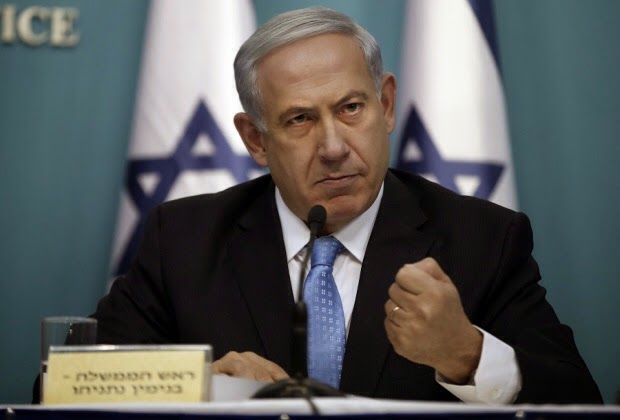
We have heard this line before from Israel’s prime minister, Benjamin Netanyahu, who tweeted “Hamas is ISIL” after the video of Foley’s beheading aired. In a recent speech he called Hamas and ISIL, “tentacles of a violent Islamist terrorism”.

Mr Netanyahu’s depiction of Hamas and ISIL as “branches of the same poisonous tree” is a travesty of the truth. The two have entirely different – in fact, opposed – political projects.

Members of Hamas may disagree on that state’s territorial limits but even the most ambitious expect no more than the historic borders of a Palestine that existed decades ago. ISIL, by contrast, aims to sweep away Palestine and every other Arab state.

That is the key to interpreting the very different, if equally brutal, events depicted in the two images.

ISIL killed Foley, dressed in Guantanamo-style orange jumpsuit, purely as spectacle – a graphic message to the world of its menacing intent. Hamas’s cruelty was directed at those in Gaza who collaborate with Israel, undermining hope of liberation from Israel’s occupation.

ISIL’s 20,000 foot soldiers have taken over large chunks of Iraq and Syria in a murderous and uncompromising campaign against anyone who rejects not only Islam but their specific interpretation of it.

According to reports last week, Hamas leader Khaled Meshal joined Mr Abbas in demanding the most diminutive Palestinian state possible, inside the 1967 borders.

Mr Netanyahu, meanwhile, refuses to negotiate with either Hamas or the Palestinian Authority (PA) of Mahmoud Abbas.

In casting Hamas as ISIL, Mr Netanyahu has tarred all Palestinians as bloodthirsty Islamic extremists. And here we reach Israel’s true goal in equating the two groups.

Mr Netanyahu’s comparison has a recent parallel. Immediately after the 9/11 attacks on the US, Ariel Sharon made a similar equivalence between Al Qaeda and the late Palestinian leader Yasser Arafat.

Israel’s intelligence officials even called the destruction of the Twin Towers a “Hanukkah miracle”, a view echoed by Mr Netanyahu years later. All understood that 9/11 reframed the Oslo-inspired debate about the Palestinians needing statehood to one about an evil axis of Middle East terror.

Sharon revelled in calling Arafat the head of an “infrastructure of terror”, justifying Israel’s crushing the uprising of the second intifada.

Similarly, Mr Netanyahu’s efforts are designed to discredit all – not just the Islamic variety of – Palestinian resistance to Israel’s occupation. He hopes to be the silent partner to Barack Obama’s new coalition against ISIL.

Aaron David Miller, an adviser to several US administrations on Israeli-Palestinian negotiations, warned in Foreign Policy last week that the rise of ISIL would pose a serious setback to Palestinian hopes of statehood – a point underscored by the far greater concerns about ISIL than the Palestinians’ plight expressed by Arab League delegates at this week’s meeting in Cairo.

How Mr Netanyahu plans to follow Sharon in exploiting this opportunity was demonstrated last week, when Israeli intelligence revealed a supposed Hamas plot to launch a coup against the PA.

The interrogation of Hamas officials, however, showed only that they had prepared for the possibility of the PA’s rule ending in the West Bank, either through its collapse under Israeli pressure or through a disillusioned Mr Abbas handing over the keys to Israel.

But talk of Hamas coups has melded with other, even wilder stories, such as the claims last week from foreign minister Avigdor Lieberman that ISIL cells had formed in the West Bank and inside Israel. Defence minister Moshe Yaalon underscored this narrative by hurriedly classifying ISIL as a “proscribed” organisation.

All this fear-mongering is designed both to undermine the Palestinian unity government between Hamas and Fatah, and to sanction Israel’s behaviours by painting a picture, as after 9/11, of an Israel on the front line of a war against global terror.

“Israel’s demands for a continued Israeli presence [in the West Bank] and a lengthy withdrawal period will only harden further,” wrote Mr Miller.

In reality, Israel should share common cause with Palestinian leaders, from Fatah and Hamas, against ISIL. But, as ever, Mr Netanyahu will forgo his country’s long-term interests for a short-term gain in his relentless war to keep the Palestinians stateless. More

Jonathan Cook is an independent journalist based in Nazareth


Shock and awe in Gaza

How the media and human rights groups cover for Israeli war crimes

Counterpunch magazine – Vol 21, No 7, August 2014

Jonathan Cook

On July 8, as Israel officially launched its most recent attack on Gaza, the BBC published an online report noting that some of the graphic images trending on social media were not in fact the result of the latest air and sea strikes battering the Palestinians’ besieged coastal enclave. Its analysis “found that some [images] date as far back as 2009 and others are from conflicts in Syria and Iraq.”

The implication, amplified by pro-Israeli websites, was that social media activists were trying to deceive the watching world into believing that Gaza was suffering a greater onslaught than was really the case. This was more “Pallywood”, as Israel’s supporters like to deride the increasing visual documentation of Israeli war crimes in an age of smartphone cameras.

Probably unthinkingly, the Huffington Post echoed these sentiments, arguing that the BBC report suggested “images shared across social media purportedly showing death and destruction caused by Israel in Gaza were fake.” But in truth, the images covered in the report were not “fake” in any meaningful sense of the word.

The misattributed explosions and crushed bodies showed the real suffering of Palestinians in Gaza during earlier Israeli attacks—Operations Cast Lead of winter 2008-09 and Pillar of Defence four years later—or of victims caught in recent fighting in Syria and Iraq.

Nor were the solidarity activists who shared these images resorting to them because there was a dearth of horrifying visual evidence from Israel’s latest bombardment of Gaza.

It was simply that Gaza’s “shock and awe” destruction by an almost invisible Israeli aerial presence, and the effects on Palestinian bodies of missile blasts and collapsing homes, looked much as it did in 2008 and 2012. The names of the operations may change—Israel dubbed this latest one “Protective Edge” in English, avoiding a literal translation of the more menacing Hebrew title “Solid Cliff”—but the toll on civilian lives were inevitably the same.

The images, however misattributed, were a far more honest record of Israel’s latest orgiastic bout of slaughter in Gaza than the media’s obfuscatory references to an ongoing “cycle of violence”.

Israel’s missing arsenal

There was a rich irony to the BBC, which has done so much to veil the realities of Israel’s ritual war-making, criticising social media users. To take just one example of many, the corporation’s diplomatic correspondent, Jonathan Marcus, promised in an online article to explain “What weapons are being used in the Israel-Gaza conflict”.

At length he enumerated the kinds of rockets in Hamas’ hands and their range. But what of Israel’s massive offensive arsenal? This was the extent of his disclosure: “The full panoply of Israeli air power has been used in a steadily escalating series of attacks against rocket launch sites, weapons stores, and the command elements of Hamas and other groups.” Note there was no mention, despite documentation, of strikes on civilians.

He then quickly switched to Israel’s “defensive” weapons. “As important in determining Israel’s strategic outlook as its offensive operations is the reliance that it places on missile defence—the Iron Dome system—to defend its civilian population.” The rest of the article continued in the same vein.

Marcus could hardly have done a better job of promoting the idea of the Palestinians as aggressors and Israelis as the victims had he been paid to do so by Israel’s ministry of hasbara (propaganda). The article concealed the fact that by the time of its publication, on July 10, dozens of Palestinians, including many children, had been killed by Israel’s “defensive” operation.

Meanwhile, Hamas’ fearsome arsenal had by this time killed precisely no Israelis—and barely any had been harmed, excepting the reports of numerous Israeli victims of “anxiety”, many of them presumably provoked by reports like Marcus’. (During these operations no one has the time or resources to record the vast number of Palestinians in Gaza suffering from anxiety.)

As the explosions and disfigured bodies from Gaza blurred into an almost indistinguishable collage of suffering for social media activists, I too watched the coverage and analysis of the past weeks’ events with a weary sense of deja vu.

When Hamas was not being presented as the aggressor, forcing Israel to “respond” and “retaliate”, it was apparently a military leviathan. With its lightly armed cadres and the off-the-back-of-a-truck rockets, Hamas “exchanged fire” and “traded blows” with one of the most powerful armies in the world. A headline on yet another “balanced” BBC story declared: “Israel under renewed Hamas attack”.

Dissembling by media

The dissembling, as ever, reached its apeothosis in the US media. The New York Times, for example, offered headlines that stripped Israeli atrocities of their horrific import while invariably removing Israel from the scene entirely. A missile strike on July 10 that wiped out a family of nine Palestinians watching the World Cup was titled “Missile at beachside Gaza cafe finds patrons poised for World Cup”, as if the missile itself took the decision to “find” them.

Similarly, when four children were hit by a missile on July 16, as they played football on a beach in full view of international correspondents in a hotel nearby, the Times editors changed an already weak headline—“Four young boys killed playing on a Gaza beach”—to the downright mendacious: “Boys Drawn to Gaza Beach, and Into Center of Mideast Strife”. No blast, no deaths or injuries and, of course, no Israeli responsibility in sight. All of it whitewashed with that weasel word “strife”.

And what was the seemingly innocuous word “drawn” supposed to convey? Did it not hint that the boys had gone somewhere forbidden; that, in short, it was their fault for being in the wrong place, as though in Gaza there was a right place to be under the rain of Israeli missiles? Or maybe the Times editors hoped we would infer that they had been lured there by a more sinister, local hand.

Interventions by US media organisations were not restricted to word games. NBC’s experienced Gaza reporter Ayman Mohyeldin, who has been the most even-handed of the US correspondents, was told by studio executives he was being pulled from Gaza because of “security” concerns. The decision happened the same day he landed possibly the biggest scoop of his career: he had been playing ball with the boys moments before they were slaughtered. He never got to file his horrifying exclusive.

Strangely, however, Gaza was safe enough for Richard Engel, NBC’s correspondent in Tel Aviv, who immediately took Mohyeldin’s place in the tiny enclave. A storm of protest from viewers forced NBC to relent a few days later, allowing him back as inexplicably as they had required him to leave.

Diana Magnay also felt the long arm of the executives at CNN. During a live link located on a hill in Israel overlooking the Gaza Strip on July 17, the CNN correspondent had talked to anchor Wolf Blitzer as a missile slammed into Gaza behind her. As the explosion lit up the night sky, loud cheers could be heard just off-camera. A visibly discomfited Magnay was forced to explain as delicately as she could that crowds of Israelis came to watch and celebrate Gaza’s suffering.

A short time later she tweeted behind-the-scenes information. The mob had threatened her and her crew if they broadcast “a word wrong”. She described them, not ungenerously, as “scum”. Her tweet survived 10 minutes, suggesting just how closely US correspondents were being policed by station executives. Shortly afterwards, CNN announced that she had been reassigned to Moscow, apparently the US media’s equivalent of a Siberian re-education camp.

But the treatment of Mohyeldin and Magnay doubtless served a larger purpose, reminding the US media corps of the limits of acceptable discourse when it comes to Israel.

Abductions set the scene

For much of the media, the starting-point for the latest “escalation” was the abduction on June 12 of three Israeli teenagers while hitch-hiking from a seminary located in a notoriously violent settler enclave in the Palestinian city of Hebron. For nearly three weeks, Israeli troops scoured the West Bank, raiding thousands of homes and making hundreds of arrests, on the pretext of searching for the youths. Their bodies were eventually found in a shallow grave near Hebron, on June 30.

(In turn, though largely ignored by the media, the inciting cause of the abductions was most likely the execution by Israeli soldiers of two unarmed Palestinian youths taking part in a protest on May 15, Nakba Day, near Ramallah. The moment of the boys’ deaths was caught on film from various angles, showing they had posed no threat to the soldiers stationed nearby. Israel again suggested that the video evidence—some of it provided by CNN—was faked.)

Opportunistic as ever, Israel’s prime minister, Benjamin Netanyahu, imposed a gag order on reporting a phone call made to the emergency services by one of the Israeli youths shortly after the abduction. Gunshots can be heard. The abandoned car, found the next day, had eight bullet holes and the teenagers’ blood on it. In short, Israeli officials knew from the outset that the three youngsters were dead.

Israel also quickly determined who they thought were the suspects: two or three young men from Hebron, who went underground almost immediately afterwards. They were from a family loosely affiliated with Hamas but also with a history of being, in the words of one Israeli analyst, “trouble-makers”. This tenuous link appears to have been the sole evidence for Netanyahu’s strident and oft-repeated claim that Hamas had ordered the abductions and that it alone would be held accountable—first in the West Bank, then in Gaza.

Mass raids across the West Bank, dubbed Operation Brother’s Keeper, rounded up hundreds of Hamas activists, most of them with no ties to the movement’s military wing. Netanyahu had good reason to wish to exploit the teenagers’ deaths as a way to eradicate Hamas’ infrastructure—from charities to newspapers—in the West Bank and turn the screws on the Islamic group in Gaza.

Scuppering Palestinian unity

After the collapse in late April of the US-imposed peace talks—for which Israel, unusually, had taken most blame—the endlessly accommodating Palestinian Authority of Mahmoud Abbas had partially reversed course, launching initiatives without Netanyahu and Washington’s prior approval.

It had applied to join a handful of international bodies, hinting that it might go so far as to join the International Criminal Court in the Hague, thereby exposing Israel to possible war crimes trials. Equally significantly, Abbas’ Fatah party, which dominates the West Bank, had signed a reconciliation agreement with Hamas, its chief political rival in Gaza, after seven years of bitter discord. The two groups set up a unity government of technocrats in early June and promised to arrange national elections for the first time since 2006.

Israel’s assault on Hamas in the West Bank—and, by stepping aside, the PA’s security forces’ implicit assent—were the first prong in Netanyahu’s plan to undermine the unity government. The attack on Gaza the second.

But the Israeli public’s thirst for revenge—stoked by incitement from the prime minister down—was not slaked by the ransacking of the West Bank. Israeli mobs patrolled the streets of Jerusalem seeking out Palestinians to attack. One group went a step further: on July 2, they grabbed a 16-year-old boy, Mohammed Abu Khdeir, close to his home in the Shuafat neighbourhood, and drove off with him to a forest. On the way, they beat him and made him drink flammable liquid. At their destination, they set him on fire.

Red Cross urges release

Into this medley of deceptions and bad faith stepped the guardians of our moral scruples: the international human rights organisations. They are beholden to the system of international humanitarian law that is supposed to govern the relations between states, and offer guidance in circumstances of war and occupation. Our politicians and media may not be trusted, but surely these exponents of an ethical global order can be.

The foundational statutes of international law—the Geneva Conventions—are upheld by the Swiss-based International Committee of the Red Cross (ICRC). It has been given the responsbility—at least by those states that have signed the conventions, which is the vast majority—to interpret and enforce as best it can their provisions on behalf of the victims of armed conflict.

Its role in the Israeli-Palestinian conflict has been notoriously difficult, given that Israel signed the conventions early on but has refused to accept that their provisions apply in the occupied Palestinian territories.

To the causal observer, an ICRC statement issued on June 15 appeared routine. It expressed concern for the three Israeli teenagers abducted three days earlier and called for their “immediate and unconditional release”, noting that international law prohibits abductions and the taking of hostages. The ICRC also offered to act as a “neutral intermediary” to achieve the youths’ release.

But in practice, the statement was an exceptional departure from the ICRC’s customary behaviour, at least towards Palestinians.

In the wake of the three youths’ abduction, as already noted, Israel launched a wave of raids in the West Bank, effectively kidnapping anyone with the faintest connection to Hamas, including journalists, charity workers, students and politicians. Within days, dozens of Palestinians had been seized and transferred out of Palestinian territory into Israel, in violation of international law. Soon the number would reach more than 500. Most were held without charge or access to lawyers.

These prisoners joined thousands of others in Israel’s jails, including some 200 inmates held without charge. Many of them were in the midst of a protracted hunger strike that was endangering their lives.

Further, Israel had in its jails a similar number of Palestinian children—all illegally held in Israel—who were rarely able to see their families. As groups like Defence for Children International had observed, these children were routinely abused. They were often seized from their beds in the middle of the night, and then once in detention subjected to torture and solitary confinement. What did the ICRC have to say about their condition? Had it called for their immediate release or offered to act as mediator?

Asked about this by Ali Abunimah of Electronic Intifada, an ICRC spokeswoman said: “ICRC doesn’t usually call for the release of detainees in general. We monitor their condition and if we have any concerns we discuss with the authorities issues regarding their treatment.”

That fitted with the kinds of statements more usually associated with the ICRC. Relating to Israel’s rampage through the West Bank and its mass arrests, ICRC tweeted dryly on June 18: “Military operations in the West Bank and Gaza: ICRC steps up its activities.” Regarding the hunger-strikers, the ICRC’s concern amounted to nothing more than a supremely disinterested humanitarianism. On June 17, the Red Cross offered a typical update: “We visited 27 hungerstrikers so far this week in Assaf Harofe, Poriya, Tel Hashomer and Wolfson hospitals.”

Secret prison comes to light

The ICRC’s traditional justification for such studied detachment was explained to me back in 2003, when I investigated a secret prison in Israel, known as Facility 1391.

The role of 1391 was to disappear Arab prisoners that were not covered by Israel’s responsibilities as an occupying power. Many of the inmates were from Lebanon, seized by Israel during its long occupation of the country that ended in 2000. It was Israel’s Abu Ghraib, and as in its Iraqi counterpart torture was common.

During my research I was told that the ICRC were aware of the prison. When I called the office in Jerusalem to find out what they knew, a spokesman refused to say anything on record. In fact, he refused to say anything apart from confirming that they knew of the prison’s existence and location, although he claimed they had not had any access.

The ICRC’s justification to me for refusing to speak further or to criticize Israel for what amounted to a gross violation of international law was that they believed it was essential to maintain a position of “absolute political neutrality”. I was told it was in the vital interests of the Palestinian prison population that the ICRC keep Israel’s trust so that Red Cross access would not be withdrawn.

But the principle of “absolute political neutrality” that was so crucial to the ICRC back in 2003—and has directed their policy for decades, given their almost complete silence on Israel’s belligerent occupation—had been jettisoned with shocking alacrity in defending the rights of the three Israeli teenagers. Did the ICRC not also owe “absolute political neutrality” towards the Palestinians?

Power-friendly humanitarians

The truth is that the ICRC’s role in safeguarding international humanitarian law is subject to its careful assessment of where power resides in the international system. Making an enemy of Israel is extremely risky for an organization that relies on the support of major western powers. Making an enemy of the Palestinian people, a nation-in-waiting that needs every scrap of help it can get from the international community, is cost-free. Moral scruples can go hang.

That was also presumably why Navi Pillay, the United Nations’ respected high commissioner for human rights, adopted the stale language of diplomacy rather than an expression of moral outrage over the attack on Gaza. An anaemic statement issued on July 11 carefully avoided identifying Israel’s actions as war crimes, as they clearly were.

Instead Pillay noted that the reports of civilian casualties “raise serious doubt about whether the Israeli strikes have been in accordance with international humanitarian law”. It was a familar soundtrack of muted disapproval, one that for decades has endorsed international inertia.

Human Rights Watch, based in New York, performed no better. It issued a statement on the fighting on July 9 that was barely distinguishable from press releases published by the organisation during Israel’s operations in 2009 and 2012.

I have had run-ins with HRW before, not least in 2006 when I took issue with its lead researcher Peter Bouckaert. In the immediate wake of Israel’s attack on Lebanon that year, Bouckaert opined to the New York Times:

I mean, it’s perfectly clear that Hezbollah is directly targeting civilians, and that their aim is to kill Israeli civilians. We don’t accuse the Israeli army of deliberately trying to kill civilians. Our accusation, clearly stated in the report, is that the Israeli army is not taking the necessary precautions to distinguish between civilian and military targets.

This seemed a grossly presumptious statement, as I observed at the time. Bouckaert made his claims, even though Israel’s precision strikes had killed many hundreds of Lebanese, a majority of them again civilians, while Hizbullah rocket attacks had killed only small numbers of Israelis, a majority of them soldiers. This is what I wrote:

How does Bouckaert know that Israel’s failure to distinguish between civilian and military targets was simply a technical failure, a failure to take precautions, and not intentional? Was he or another HRW researcher sitting in one of the military bunkers in northern Israel when army planners pressed the button to unleash the missiles from their spy drones? Was he sitting alongside the air force pilots as they circled over Lebanon dropping their US-made bombs or tens of thousands of “cluster munitions”, tiny land mines that are now sprinkled over a vast area of south Lebanon? Did he have intimate conversations with the Israeli chiefs of staff about their war strategy? …

He has no more idea than you or me what Israel’s military planners and its politicians decided was necessary to achieve their war goals. In fact, he does not even know what those goals were.

In bed with the State Dept

In its July 9 statement, HRW trod the same ground, beginning: “Palestinian rocket attacks on Israel appear to be indiscriminate or targeted at civilian population centers, which are war crimes.” Meanwhile, the Israeli offensive was characterised in the following terms: “Israeli attacks targeting homes may amount to prohibited collective punishment.”

So for HRW, Palestinian rocket attacks that had at that stage killed no one were “war crimes”, while Israel’s massive assualt on Gaza, which quickly led to the deaths of dozens of Palestinians, many of them women and children, was simply “collective punishment”. Both were violations of international law, of course. Put another way, both were war crimes. But, as so often before in this conflict, HRW could only find the courage to articulate the accusation when it referred to Palestinians.

Similarly, in an outrageous mangling of international law, the statement also suggested that Hamas leaders were legitimate military targets even when not involved in combat. Israel, on this reckoning, was entitled to strike Hamas figures even as they slept or ate in their family homes. The problem was that, were such an interpretation to be consistently applied by HRW, it would sanction Hamas to target any home in Israel where a family member serves in the armed forces or is a reservist—that is, most Israeli homes.

As Helena Cobban, a Middle East expert, noted of a subsequent report by HRW, published on July 16, that made the same error:

How many times do we have to spell this out? The essential distinction in international law is not between ‘fighters’ and ‘civilians’—which are the categories used throughout this HRW report—but between “combatants” and “noncombatants”. A fighter who is not currently engaged in either the conduct, the command, or the planning of military operations is not a combatant. …It is quite illegal to target such an individual.

Dragging their heels

HRW’s July 16 report was at least an improvement on its earlier one, not least because it included actual case studies in Gaza, in which the evidence of war crimes was indisputable. But this is a pattern too: groups like HRW wade in at the beginning of an Israeli attack with equivocations, only finding their moral backbone later on, as the mounting evidence of Israeli war crimes starts to discomfort the international community. HRW does not lead the opposition to war crimes, as it should; it merely provides the excuse to seek a way out, but only after nearly everyone is agreed that it is time to bring things to an end.

In short, HRW is not the voice of a global moral conscience; it is an organisation keen to keep its access to, and credibility with, policy elites. That is hardly surprising given that HRW, while styling itself as “one of the world’s leading independent [human rights] organizations”, has a virtual revolving door policy with the foreign policy establishment, especially the US state department.

The cosy ties between the US administration and HRW have become so glaring that it prompted a recent letter of complaint signed by more than 100 public figures, including Nobel peace prize laureates Adolfo Perez Esquivel and Mairead Maguire, and the former UN Assistant Secretary General Hans von Sponeck.

They noted that HRW’s recently departed Washington advocacy director, Tom Malinowski, was a former special assistant to President Bill Clinton, and speechwriter to former Secretary of State Madeleine Albright. Last year, he left HRW to become an assistant to the current Secretary of State, John Kerry. But not before he had used his role at HRW to justify “under limited circumstances” the legitimacy of extraordinary renditions—the kidnapping and smuggling of individuals to torture sites out of official US oversight.

Meanwhile, the vice-chair of HRW’s board of directors is Susan Manilow, who describes herself as “a longtime friend to Bill Clinton”. Also, HRW’s Americas’ advisory committee includes Myles Frechette, a former US ambassador to Colombia, and Michael Shifter, a former director for the US government-funded National Endowment for Democracy. A recent member of the committee was Miguel Diaz, a CIA analyst in the 1990s who now works at the State Department.

Similarly, Suzanne Nossel, an exponent of pre-emptive war, left her senior position at HRW in the late 2000s to join the State Department. She later went on to join another leading human rights group, Amnesty International USA, this time as its executive director.

The rest of HRW’s board may not be so tainted by direct political connections, but most are hardly champions of the common man either. A significant number are millionaires who made their fortunes in the financial industries.

This incestuous relationship between the elite policy-makers and the elite human rights community is endemic. Consider Unicef, the humanitarian children’s fund of the UN. It has been virtually silent on the Israeli-Palestinian conflict, despite masses of evidence of systematic abuse of children by Israel. Local watchdogs have tried to raise a cry about Israel’s imprisonment and torture of children, and about the blockade of Gaza that has led to widespread and chronic malunitrition. Unicef has uttered barely a word in support.

Might that have anything to do with the fact that Anthony Lake is its executive director? That is the same Lake who served as National Security Advisor to Bill Clinton in the 1990s; and the same Clinton who has repeatedly declared his fealty to Israel.

International human rights monitors have adopted a bland, risk-averse “humanitarianism” in the Israeli-Palestinian conflict as a way to avoid engaging with the conflict’s more profound, and urgent, political dimensions. Like the media and the politicians, the great fear of international human rights groups is running foul of the Israel lobby.

Shaping the elite discourse

Nonetheless, Israel is in difficulty. It is gradually losing the battle for public opinion. Grandly, Israel calls this development “delegitimization”, but in truth it simply a growing popular awareness of the realities of Israeli occupation, fueled by the more plentiful opportunities for the public to bypass official sources of information.

The task of Israel’s lobbyists is to slow down this awakening as much as possible and to insulate policy-makers from its effects. That is the stated mission, for example, of Britain’s fledgling pro-Israel media lobby, known as BICOM or the Britain Israel Communications and Research Centre. BICOM is a product of Israel’s concern at the increasingly globalized nature of English-language media.

For decades, the Israel lobby focused its work almost exclusively on the United States, expecting its super-power patron to keep it out of diplomatic, military and financial trouble. It developed a political lobby—AIPAC, or the American Israel Public Affairs Committee—that worked to intimidate the US Congress and, alongside it, the White House. No US president, certainly not one up for re-election, dares turn down an invitation to speak at AIPAC’s annual conference.

Less visible but just as important are Israel’s lobbying organisations targeting the US media. The best known, the Anti-Defamation League, is led by Abraham Foxman, whose own bigotry should have discounted him from the job were the ADL really interested in defamation. But Foxman is an arch-exponent of defamation as long as it is directed at Israel’s opponents.

In early July, for example, he wrote a commentary for the Huffington Post berating Palestinians for a culture “that espouses pure hatred of Israelis, and often Jews, regardless of their actions, and is wholly uninterested in living at peace with its neighbors”.

But the ADL has two other major allies in its campaign of intimidation of the US media: Honest Reporting and Camera, the Committee for Accuracy in Middle East Reporting. The latter has a journalists’ “hall of shame” on its website that documents its run-ins with most of the major journalists who have covered the region for US audiences.

I should disclose that I have a small place of honor there too for my brief flirtation with the International Herald Tribune after it was taken over by the New York Times. My two entries for supposed “inaccuracy” pale next to the current 33 listings for Jodi Rudoren, the New York Times’ correspondent. Her appearances reflect neither a documented failure of accuracy (or rather, not in the way the lobby claims) nor a pro-Palestinian bias in her reporting. In fact, Rudoren has been almost as much of an Israel partisan as her predecessor, Ethan Bronner.

Rather, Camera’s relentless campaign against Rudoren is a measure of the New York Times’ critical role in shaping elite opinion. The lobbyists’ goal is either to hound her into submission—to encourage her to self-censor more effectively than she already does—or to pressure her editors into moving her elsewhere, on the assumption that her replacement will find their room for journalistic integrity even further circumscribed.

Breach in the dam

With the US Congress and media bullied into submission, Israel was largely able to shape elite opinion in the US. But a breach in the dam has grown over the past two decades. With the rise of the internet and social media, Americans enjoy access to a much more diverse media than they once did, including to liberal—at least by US standards—publications in Britain such as the BBC and the Guardian.

Israel’s lobbyists identified this danger early on, shortly after the outbreak of the second intifada in late 2000. Soon Israel had started to replicate the US lobby in Britain, creating BICOM in 2002. It and other Israel lobby groups have over the years battered the BBC into submission, turning it into another mouthpiece for Israeli propaganda.

The extent of the corporation’s capitulation became impossible to ignore in early 2009, when it refused for the first time in its history to broadcast adverts for the disaster emergencies committee’s appeal, because the selected charitable cause was Gaza, which had just been laid waste by Israeli bombing. Even British politicians lambasted the BBC for its craven decision.

The lessons learnt by BICOM were no doubt derived from the lobby’s long experience in the US. In 2010 BICOM staff joined Israeli strategists in drafting a paper called “Winning the Battle of the Narrative”. In it, they made the following observation:

The political elites in Europe and in the US are much more tolerant towards Israel’s policies then [sic] the wider public in those same countries; however, the public’s mood and the media’s coverage (especially in the UK) determine the government’s leeway to pursue a pro-Israeli foreign policy agenda.

Jonathan Cummings, the former director of BICOM’s Israel office, noted the same year that British media were influencing elites outside the UK, presumably a reference to the US. “With media outlets like the BBC, the Guardian, and the Financial Times playing an increasingly significant part in framing the issue well beyond its own borders, British attitudes carry far.”

He suggested that pro-Israel lobbyists should therefore reinvigorate their efforts to “create barriers to delegitimisation, insulating policy-making environments” from public opinion.

This activity is effective. It is the reason why the policymakers, the media and the most influential international human rights organisations still consistently fail to convey the shocking reality of what Israel is doing on the ground to Palestinians. It is why public opinion is still rarely reflected in foreign policy decisions affecting Israel.

This assault on Gaza, like the earlier ones, will leave hundreds of Palestinians dead, a majority of them civilians. It will end neither the siege nor the resistance to it. It will outrage public opinion around the globe. But our elites will carry on giving Israel financial, military and diplomatic cover, as they have now done for more than six decades. More


Israel’s Video Justifying Destruction of a Hospital Was From 2009

The video clip showing apparent firing from an annex to the hospital was actually shot during Israel's 2008-09 “Operation Cast Lead,” and the audio clip accompanying it was from an incident unrelated to Al Wafa. (Screengrab: The Times of Israel)

A video distributed by the Israeli military in July suggesting that Palestinian fighters had fired from the Al Wafa Rehabilitation and Geriatric Hospital in Gaza City was not shot during the recent Israeli attack on Gaza, and both audio and video clips were manipulated to cover up the fact that they were from entirely different incidents, a Truthout investigation has revealed.

The video, released by the Israel Defense Forces (IDF) on July 23, the same day Israeli airstrikes destroyed Al Wafa, was widely reported by pro-Israeli publications and websites as proving that the hospital was destroyed because Hamas had turned the hospital into a military facility. But the video clip showing apparent firing from an annex to the hospital was actually shot during Israel's 2008-09 “Operation Cast Lead,” and the audio clip accompanying it was from an incident unrelated to Al Wafa.

The misleading video was only the last in a series of IDF dissimulations about Al Wafa hospital that included false claims that Hamas rockets had been launched from the hospital grounds, or very near it, and that the hospital had been damaged by an attack on the launching site.

The IDF began to prepare the ground for the destruction of Al Wafa hospital well before Israeli ground troops entered Gaza on July 17. On July 11, the IDF fired four warning rockets on the fourth floor of Al Wafa, making a large hole in the ceiling – the standard IDF signal that a building was going to be destroyed by an airstrike.

On July 17, the hospital was hit by a total of 15 rockets, according to Dr. Basman Alashi, Al Wafa's director. After the first few rockets, a phone call from the IDF “asked how much time do you need to evacuate?” he told Truthout. After the second and third floors were largely destroyed, the patients' rooms were filled with smoke and the hospital lost electricity, he gave the order to evacuate the hospital.

An IDF spokesman told Allison Deger of Mondoweiss that Hamas rocket launches had come “from exactly near the hospital, 100 meters near.” A slide show released by the IDF August 19 includes an aerial view of Al Wafa Hospital with two alleged rocket launching sites marked that are clearly much farther from the hospital than the 100 meters.

Even if that IDF claim of 100 meters were accurate, however, it was more than sufficient to allow the IDF to hit the launch site with precision-guided munitions without damaging the hospital. Israeli air to ground missiles, especially those fired from drones, are known to be able to hit small targets without causing collateral damage to nearby buildings. An IDF video posted on August 9, for example, shows a missile destroying what is said to be a hidden rocket launch site without harming a mosque only a few meters away from the explosion.

IDF spokesman Captain Eytan Buchman nevertheless blandly suggested that it was collateral damage from striking the launch site. He said the IDF was “left with no choice” but to “target the launcher with the most precise munitions capable of ensuring its destruction.”

On July 21, the IDF Spokesman's Office pushed its propaganda line linking Al Wafa and rocket launching sites even further, claiming in a tweet and on its blog, “Hamas fires rockets from Wafa hospital in the Gaza neighborhood of Shujaiya.” Under that headline was an aerial photo enhanced to highlight what was said to be Al Wafa Hospital, along with a red dot representing an M-75 rocket launch site that was not on the hospital grounds, but appeared to be a few meters away.

But the building shown in the aerial photo was not Al Wafa hospital, as Dr. Alashi quickly pointed out. A Google map of Al Wafa hospital shows none of the buildings resemble the one the IDF identified as Al Wafa. The building in the IDF image belongs to the Right to Life Society.

After that prevarication had been revealed, the IDF added a new claim that “the hospital grounds” had been used by Hamas and the Palestinian Islamic Jihad as “a post enabling terrorists to open fire at soldiers.”

The IDF said that Hamas had “fired at Israel and at IDF forces from the hospital” despite warnings from the IDF, and the IDF had been forced to attack targets on the hospital site.

The statement was accompanied by a video purporting to document the firing at Israeli troops. Based on the camera angle and altitude, the video was taken by an Israeli drone, according to a former US intelligence officer, with experience in interpreting military-related images, who analyzed the video for Truthout.

The first segment of the video is a grainy, black-and-white aerial shot of a building that starts with the legend, “Terrorists Threaten IDF from inside Wafa Hospital.” The building shown is not Al Wafa hospital, however, but an annex to the hospital that had been empty, both Dr. Alashi and Charlie Andeasson, a Swedish activist who was in the hospital when it was attacked on July 16, told Truthout.

The eight-second video shows what could be two brief bursts of fire from one of the windows on the third floor and then a third flash in a fourth story window. The former US intelligence officer confirmed that the footage of the building was selected from two different times of day. After the first three seconds of the video, the camera angle and the amount of light both change perceptibly. Nevertheless an exchange between the two voices on the audiotape accompanying the video continues as though the scene were continuous during the entire eight seconds.

The first voice heard on the audio recording says, in Hebrew, “Do you see this firing? Have spotted fires from within the house.” The English subtitles accompanying the audio add “hospital” in parentheses after the word “house,” but Seattle-based blogger on Israeli affairs Richard Silverstein, who speaks Hebrew, confirmed to Truthout after listening to the audio clip that the speaker uses the word “bayit,” which can only mean “house.”

A second voice then says, according to the subtitles, “Positive, fire from within the house.” But the speaker actually uses the term “small house” (“bayit ha katan hazeh”), according to Silverstein.

Those references to firing from a small house indicate that the audio clip was taken from an entirely different incident at another location. That device was obviously used because there was no audio of an incident involving firing from the hospital.

Dr. Alashi said he believes the eight-second video clip portrays firing from the annex that occurred in the 2008-09 Israeli attack on Gaza. “People confirmed to me that there was firing from the building then,” he told Truthout. That building was, in fact, attacked on January 16, 2009, by Israeli tanks only 70 meters away from the hospital, damaging the third and fourth floors of the building – the very floors from which the flashes are shown in the video – as the UN Fact-Finding Mission noted in its September 2009 report.

The last segment of the video showing the bombing of the Al Wafa hospital, bears the legend “secondary explosion” – meaning explosions of weapons – as each building is shown being destroyed, in line with the Israeli argument throughout the operation that Hamas stored rockets and other weapons in hospitals, schools and mosques.

The video fist shows the hospital itself being blown up, followed by heavy billowing smoke covering the entire hospital and then another flash of fire. But the former intelligence official who viewed the video said that flash indicated another Israeli missile strike on the target rather than a secondary explosion.

The clip then cuts to the destruction of the annex, again with the “secondary explosion” legend. The billowing smoke from the initial bomb explosion covers the building, and then two or three small puffs of darker smoke appear. Those puffs of smoke would suggest a secondary explosion, according to the former US intelligence officer. But he also observed that a hospital would have flammable materials other than hidden weapons that could cause the darker smoke to appear.

Given the existence of Hamas' complex network of tunnels, which provided plenty of storage space for its rockets and other weaponry, it would have made no sense for Hamas to store rockets in a hospital that it knew had already been targeted by the IDF.

In its final seconds, the video focuses in to show a square which the legend describes as a “tunnel opening near Al Wafa.” But Dr. Alashi told Truthout that it is actually a water well.

The IDF real reason for the destruction of Al Wafa hospital appears to be related to the determination to raise the cost to the civilian population of Gaza for Palestinian resistance, in line with the approach represented by its “Dahiya doctrine,” named after the Beirut suburb dominated by Hezbollah, much of which the Israeli Air Force reduced to rubble in the 2006 war.

That strategy, recognized as a violation of the international laws of war, was pursued most obviously in the complete destruction of every house in several square blocks in three separate areas of the Shujaiya district of Gaza City July 19-20. But it was also evident in IDF attacks on Al Wafa and in the series of mortar and artillery attacks on six different UN shelters from July 21 though August 3. Those attacks killed a total of 47 civilians and wounded 341, according to a survey of the incidents by The Guardian.

In none of the six cases where UN shelters were hit by IDF mortar shells was the military able to offer a plausible explanation, and in three cases, it offered no explanation whatever. More

Gareth Porter (@GarethPorter) is an independent investigative journalist and historian writing about US national security policy, and the recipient of the Gellhorn Prize for Journalism in 2012. His investigation of the US entry into war in Vietnam, Perils of Dominance: Imbalance of Power and the Road to War in Vietnam, was published by University of California Press in 2005.


By Activestills |Published September 4, 2014 PHOTOS: Israeli forces damage youth centers in Nablus raid

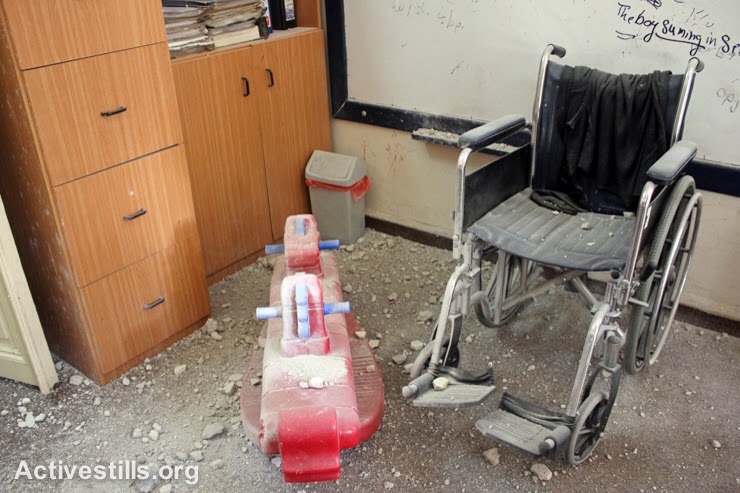
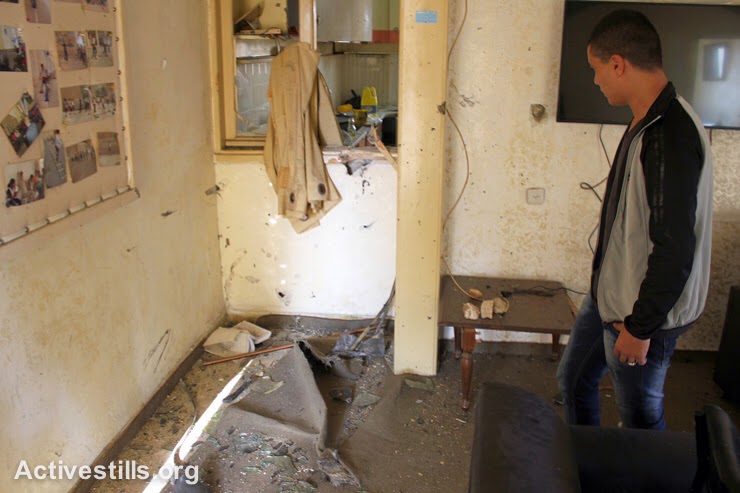
A youth sports club and center for children with disabilities in Nablus sustain serious damage after Israeli forces raid a multi-story building in search of wanted Palestinians.

As happens almost every night in Palestinian cities, towns and villages throughout the West Bank, Israeli forces raided Nablus neighborhoods at 1:30 a.m. on Wednesday. Military jeeps spread out to different areas of the city, especially to refugee camps.

The biggest military operation took place in the southern part of the city, where Israeli forces targeted six Palestinians who were sleeping in a local youth sports club. Their main target was Husam Al-Din Abu Riyala, 26, a Fatah activist who had been issued a summons order last month. Soldiers surrounded the building of the sport club, which was located on the third floor of an apartment building, while another group of soldiers occupied the roof of a neighboring house.

Locals reported that the military fired a heavy barrage of live ammunition towards the club while another group of soldiers used explosives to blow open the main door and enter the building.

Five youths managed to escape from windows, while Abu Riyala was shot in the foot with live bullets before being arrested, according to Ma’an News.

Following the arrest, the military operation ended with a raid on a health center for handicapped children and nursery school located in the same building. At 3:30 a.m., one of the workers from the health center managed to enter the building, discovering that doors had been bombed and other extensive damage.

In a nearby incident, Israeli forces raided Al-Ain Refugee Camp in Nablus in an attempt to arrest 77-year-old Palestinian legislative council member Ahmad Haj Ali of Hamas. Haj Ali was not in his house when the army arrived. Soldiers have stormed his house four times since May 2014, and sources close to his family told Ma’an News that they have threatened his family with killing him. According to Ma’an, Israeli authorities had issued orders to Haj Ali to turn himself in this summer as part of the massive arrest campaign launched against Hamas members, but that he had refused to comply.

Just a few weeks earlier, Zakaria Al-Aqra, 24, of Fatah, was killed by Israeli forces in a raid on his home in the West Bank village of Qabalan. According to the army, Al-Aqra was involved in multiple shooting incidents at Israeli soldiers and said it found arms in the building where he was killed. Six people in his family were wounded in the raid, in which part of the family house was demolished. More


Land grab shows Netanyahu unbowed after Gaza

With Israel and Hamas locked in military stalemate after their 50-day confrontation in Gaza, attention had returned to reviving a peace process between Israel and Palestinian president Mahmoud Abbas.

That is the context for assessing Israel’s decision to antagonise all its main partners against Hamas – the United States, Europe, Egypt, Jordan and, in practice, Abbas’ Palestinian Authority – by announcing plans this week for the biggest land grab in the West Bank in three decades.

In normal circumstances, this would look like an example of shooting oneself in the foot. But, as Israeli analyst Jeff Halper pointed out, Israel rarely abides by normal rules.

“What Netanyahu is doing looks completely counter-intuitive. It makes no sense. You would think he would want less criticism right now from the international community. He needs the Palestinian Authority and Mahmoud Abbas to help him take back control of Gaza.”

Yesterday, US secretary of state John Kerry phoned Israeli Prime Minister Benjamin Netanyahu, reportedly to demand he reverse his decision.

Barack Obama’s administration is said to have been angered not only by the decision itself – which seized 1,000 acres of Palestinian land near Bethlehem – but by Israel’s failure even to warn it in advance.

Confrontation with US

Israeli analysts have noted that the clash over the land expropriation – intended to build a fifth West Bank city for settlers, called Gvaot, south of Jerusalem – marks yet another downturn in increasingly fraught relations between Israel and Washington.

“This is a major embarrassment to the US. There it is trying to coax Abbas back into negotiations while Israel blatantly undermines its efforts,” Halper told Middle East Eye.

Israeli officials have tried to play down the seizure as nothing more than a technicality, though it has not helped their justifications that the move’s timing has been widely presented as “revenge” for the murder in June of three Israeli teenagers in a location close by in the West Bank.

Officials argue that Palestinians have no private claims on the land; that it is part of the Gush Etzion settlement bloc, which, they claim, will be awarded to Israel in a final peace agreement; and that the area has long been earmarked for Israeli settlement.

In addition to Israel’s violation of international law in seizing the land, observers note that there are already five Palestinian communities there, and that the new settlement will contribute to Jerusalem’s encirclement, sealing it off from the West Bank and further damaging the prospects of a viable Palestinian state emerging.

Yesterday, Dror Etkes, an expert on the settlements for the Israeli peace organisation Peace Now, noted that the swath of land would create a territorial corridor between Israel and the Gush Etzion bloc.

Nearly a fifth of the expropriated land actually lies beyond Israel’s separation barrier, sometimes assumed to be the demarcation of its territorial acquisitiveness.

Payback for the settlers

Daniel Seidemann, a Jerusalem lawyer who specialises in land issues, told Middle East Eye that this latest decision was payback for the settlers, who had helped Netanyahu during the seven weeks of Operation Protective Edge by not opening up another front with the international community.

“During the Gaza operation, the settlers kept silent. They were like the dog that didn’t bark in the night. That was intentional. Netanyahu told them “sit back during the operation and I’ll make it up to you afterwards.”

In many ways, Washington’s opposition to this move echoes its anger at Netanyahu’s attempt in late 2012 to annex the so-called E1 area, west of Jerusalem, which also threatened to cut off Jerusalem from its Palestinian hinterland.

It remains to be seen whether US pressure will force a climbdown this time from Netanyahu, as it eventually did when he agreed to “delay” his E1 plans.

But whatever the final decision, the reality is that plans for encircling Jerusalem are constantly on the drawing board, and are making slow, incremental progress, as a report by the International Crisis Group revealed. Israeli leaders simply seek the best moment to try to browbeat Washington into submission on any particular component of the plan.

Netanyahu’s reasons for taking on the US now are likely to be complex.

Plummeting popularity

Not least in his calculations, he needs to show an achievement in the West Bank to answer the many domestic critics of his performance in Gaza.

His popularity has plummeted since he signed a ceasefire agreement. A majority of the Israeli public, and especially his supporters on the right, expected him to crush Hamas, not to negotiate terms with it.

He has also been under fire from government coalition rivals further to the right, such as Avigdor Lieberman and Naftali Bennett, who have implied not so subtly that he demonstrated weakness in Gaza.

The crisis he has now provoked is undoubtedly designed to deflect a little the attention of the Israeli public and media from what are seen as his failures in Gaza and show that he is playing hardball with the Palestinians.

But possibly even more useful, Netanyahu has engineered a confrontation with the US that will remind the Israeli public of the international climate within which he must work, both in relation to Gaza and the West Bank.

Faced with another showdown with Washington, Netanyahu can claim both that he is a tough-guy and that, much better than his political rivals, he knows how to navigate the intricacies of such diplomatic entanglements. He has taken on the White House on several notable occasions before and won.

And by grabbing land near the Gush Etzion settlements, Netanyahu has also chosen an issue over which it will be difficult for local critics to berate him.

Lieberman, who is the most famous resident of Nokdim, one of Gush Etzion’s settlements, has pointed out correctly that the area Netanyahu has seized “reflects a wide-ranging consensus in Israeli society.”

Voices of dissent

Tzipi Livni and Yair Lapid have been the only notable voices of dissent in the cabinet, but neither is likely to threaten the coalition’s survival by resigning on this matter.

Livni, who has cultivated strong ties to the Obama administration, has indicated that she supports the seizure in principle. Her opposition is over the timing, when Israel is isolated and needs US support in international forums.

More significant is what the decision to seize such a large area of land reveals about Netanyahu’s attitude towards Abbas and the two-state solution, as well as his approach to the international community.

Yariv Oppenheimer, the head of Peace Now, has called the move a “stab in the back … proving again that violence delivers Israeli concessions while nonviolence results in settlement expansion.”

According to polls, Hamas has surged in popularity among Palestinians since the ceasefire, and Netanyahu’s move will do nothing to revive Abbas’ fortunes.

Israel is reported to want Abbas’ assistance in taking back whatever limited control of Gaza Israel will allow, presumably as a prelude to enforcing Hamas’ disarmament. Abbas wants Gaza too, because it will strengthen his claim to being the true representative of the Palestinian people. On paper at least, Netanyahu and Abbas should be on the same page on this issue.

But the price from Abbas, as he revealed this week, is Israel’s cooperation with his newly minted peace plan, which Palestinian negotiator Saeb Erekat presented to Kerry yesterday.

Reports suggest the plan will echo Kerry’s original timetable and framework for the talks that collapsed in April, with nine months for the two sides to reach an agreement. Israel would be expected to withdraw from the agreed area, based on the pre-1967 borders, within three years.

However, this time Abbas will insist on no settlement building for the duration of the negotiations and there will be a tangible Palestinian threat if the process fails: unilateral moves in international forums, including pursuing war crimes trials at the International Criminal Court (ICC).

Opposition to statehood

Neither option – conceding Palestinian statehood, or risking war crimes trials – will appeal to Netanyahu. But if forced to make a choice, he would probably much rather call Abbas’ bluff over the ICC than allow him a state, even a demilitarised, non-sovereign one.

Back in July, Netanyahu made clear his fundamental opposition to allowing the Palestinians the trappings of statehood in the West Bank. He stated that “there cannot be a situation, under any agreement, in which we relinquish security control” of the West Bank. Noting that the West Bank was 20 times the size of Gaza, he added that he was not prepared to “create another 20 Gazas”.

In doing so, he effectively equated Abbas with Hamas, which in turn he has equated with the Islamic extremist group ISIS.

As Gideon Levy, a columnist for the Haaretz daily, has concluded: “The settlers have won. The settlements have accomplished their goal. The two-state solution is dead.”

So where does that leave Israel and Abbas?

In Abbas’ case, with a few stark choices. He could mount a more forceful campaign to win statehood at the United Nations, or he could go down the ICC route. Both would lead to a serious confrontation with the United States.

The final choice would be to hand over the keys of the Palestinian Authority, leaving Israel to pick up the mess – and the considerable bill – afterwards. That is reportedly what he told the emir of Qatar this week. If there was no agreement, “we will take the following measure: cessation of the security coordination and transfer of responsibility for PA territory to Netanyahu.”

Catastrophic scenarios

In Israel’s case, analysts see things going in one of two directions.

One possibility is that Israel will find its isolation and pariah status growing. The comparisons with apartheid will deepen, as will the paradigm shift to a one-state solution. Early signs will be a rapid increase in various forms of boycotts, such as an imminent one from the European Union on settlement produce.

It was this scenario that presumably prompted the concerns expressed in an editorial in today’s Haaretz about the latest land grab: “This is an intolerable display of arrogance and impudence, and its price is liable to be catastrophic.”

The other possibility, set out by Jeff Halper, who has been studying Israel’s system of control over the occupied territories for many years, posits an even bleaker future.

He believes Netanyahu may assume he can hold on to international support as he crushes all Palestinian hopes – military and diplomatic – of resistance to Israel’s complete dominance.

“Israel is denying the Palestinians a moment to regroup. The pressure is on them all the time, wearing them down, exhausting them as Israel takes control inch by inch.

Netanyahu, he says, may think that he can “pacify” Abbas and the Palestinians, with them coming to understand both that there is no political process and that in practice there are no countervailing forces on Israel.

“Rather than being an outcast, Israel believes it can convince everyone – the US, Europe, the Arab states – that it has the solutions. It excels in a kind of security politics, and claims to know how to beat ‘the terrorists’. Ultimately, that may gain it more credit with other states than respecting peace and human rights.”

Halper concedes that Netanyahu may be mistaken in such assumptions, leaving himself with no exit strategy when things turn sour.

Whoever is right, this week’s land grab indicates that Netanyahu is unbowed after Gaza and in no mood for making concessions. More


Israel remorseless after military campaign that killed more than 500 children, destroyed 20,000 buildings and displaced as many as half a million Palestinians

Despite hailing as a victory the seven weeks of fighting that killed more than 2,100 Palestinians and destroyed large swathes of Gaza’s infrastructure, Israel’s prime minister, Benjamin Netanyahu, appears to have emerged as the main political casualty of Operation Protective Edge.

Jonathan Cook

Among Israeli Jews, polls continue to show strong backing for the army, the most revered of Israel’s national institutions.

Last week, a survey by the Jerusalem Post and Maariv newspapers revealed that 61 per cent of respondents agreed with the statement that the Israeli military – but not Israel – had won in Gaza.

“Israel”, in this case, is clearly understood as a synonym for Netanyahu, whose fortunes have taken a sharp downturn in the aftermath of the military campaign.

In late July, as Israel launched its ground offensive, Netanyahu’s approval ratings stood at 82 per cent. Days before the current ceasefire took effect on 26 August, that figure had slumped to 55 per cent.

Last week, as the ceasefire began, Channel 2 TV found that his popularity had plummeted even further, to 32 per cent. Half the country were reported to be positively dissatisfied with his performance.

No signs of remorse

Israelis’ unhappiness with their prime minister does not indicate, as elsewhere in the world, a backlash against a military campaign that killed more than 500 children, destroyed 20,000 buildings and displaced as many as half a million Palestinians. In Israel there are scant signs of remorse, even from the country’s last remaining self-declared liberals.

Netanyahu and his allies in the cabinet, including defence minister Moshe Yaalon, have been trying to play up Israel’s successes, arguing that the army scored an “impressive victory”. Yaalon noted that Hamas had used up most of its rockets, while Israel had destroyed Hamas’ tunnels, killed key leaders and wrecked its supporting infrastructure.

That assessment has been challenged not only by Palestinians in the occupied territories but by leaders of the Palestinian minority in Israel. At the weekend several Palestinian members of the Israeli parliamentattended a victory rally for Hamas near Acre.

One of them, Haneen Zoabi, told Middle East Eye: “This was the longest Israeli attack faced by Palestinians in modern times. It was longer even than the war against Lebanon in 2006. And yet the will of the Palestinian resistance was not broken, and the people of Gaza stood strong. Israel did not achieve any of its political or military aims. When bombarded by one of the strongest armies in the world, that is an undoubted victory.”

Even Netanyahu sounded barely convinced of Israel’s success at a “post-war” press conference. Comparing Hamas to Islamic extremist groups, he observed defensively that even the United States had been unable to defeat al-Qaeda. That refrain was repeated in a rash of interviews with Israeli TV at the weekend.

Herculean task

Few found the comparison persuasive. Settler leader Amiel Ungar noted disparagingly that Hamas’ “Gaza emirate occupies 360 square kilometers and is surrounded on all sides. A week earlier we were told that if the order came down, the IDF could overrun Gaza in seven days. Now a week's work had suddenly mushroomed into a herculean task that would last years.”

Netanyahu’s problem appears to stem from the fact that he has failed to convince his natural constituency on the right that he acted decisively in Gaza. They expected Hamas “smashed”, a term used by many on the right throughout the fighting, or at the very least that Israel would insist on the faction’s “demilitarisation”.

Many Israelis appear particularly incensed by televised scenes of Hamas in Gaza celebrating last week, following the ceasefire announcement. Under its terms, Israel agreed to allow in aid and building materials to ease the humanitarian situation and to extend the fishing zone for Gaza’s fishermen.

Among Israeli Jews, the celebrations in Gaza are widely seen as crowing at the relatively large death toll of Israeli soldiers in the Gaza fighting. Yesterday, it was reported that another soldier had died from wounds sustained in earlier fighting, bringing the total to 66 soldiers and seven civilians.

The high price in blood – even if small in comparison to the suffering of Palestinians in Gaza – placed an added burden on Netanyahu to show he had secured major achievements against Hamas, said Shlomo Bron, a retired general and analyst for the Institute for National Security Studies at Tel Aviv University.

Sacrifice for nothing

“The public is prepared to accept heavy losses if war aims are achieved,” he told Middle East Eye. “But if the sacrifice is seen as for nothing – and that is the view of those who bought into the narrative that Hamas could be destroyed – then Netanyahu is likely to get the blame.”

In addition, the military campaign’s costs to the Israeli economy are already becoming apparent. Yesterday, it was revealed that $560 million cuts were needed immediately, slashing 2 per cent off the budgets of every government department apart from the defence ministry.

To many Israelis, it looks as though the ceasefire has simply restored the status quo, with forthcoming negotiations in Cairo that, it is feared, may win Hamas bigger concessions.

Such concerns were underscored yesterday when an Israeli military source suggested to the Haaretz newspaper that the army’s preferred new approach, designed to prevent renewed confrontation with Hamas, was an easing of the seven-year siege on Gaza. Hamas’ main demand has long been an end to the blockade.

“If we can assist by expanding fishing grounds and easing restrictions on border crossings of people and goods into and from Israel, this will help maintain the quiet,” an unnamed official said.

Rather than making concessions, the Israeli public believes Netanyahu should have pressed on against Hamas. Such sentiments have been voiced by the Israeli prime minister’s rivals in the cabinet, such as Avigdor Lieberman and Naftali Bennett. They have called for the army to “finish the job”.

The Jerusalem Post poll found 58 per cent of Israelis believed the truce was a mistake and that the army should have pushed deeper into Gaza to degrade Hamas military capabilities.

Reflecting that mood, Lieberman’s told Channel 1 TV at the weekend: “The fact that a 20,000-strong terror group has endured for 50 days against the strongest army in the Middle East and has stayed in power – it bothers me very much.”

Confidence shaken

Yoav Bar, a leftwing activist and blogger from Haifa, noted that grand but misleading claims made early in the operation had undermined trust in the leadership’s competence. Early, on, he noted, “Israeli military commanders claimed that the resistance is running out of ammunition. By the end of the first week they declared that a third of the missiles were already used. After 51 days of war the only possible conclusion is that they didn’t have any idea how many rockets there were.”

Similar evasiveness over prior intelligence of Hamas’ extensive network of tunnels under Gaza, some of them leading into Israel, also shook Israelis’ confidence. How was it possible that the tunnels became the major justification for continuing the operation only after the ground invasion had begun?

David Horovitz, editor of the Times of Israel, said that, given the army’s near-sacred status in Israel, the blame was most likely to fall on Netanyahu.

The Israeli public, he pointed out, was “psychologically reliant on the assumption that its army can ultimately de-fang all threats, and that if the army fails to do so, that must be because it did not get the correct orders from the political leadership.”

Part of the disquiet, according to Moshe Arens, a former defence minister from Netanyahu’s Likud party, stems from a sense that Netanyahu lacks the political courage to deal with what is seen as a growing threat posed to Israel from Islamic extremism in the region.

That has not been helped by Netanyahu’s repeated efforts to equate Hamas with Islamic State, the jihadist group notorious for beheadings that has recently made major territorial gains across the region.

‘Al-Qaeda on the border’

At the weekend, Netanyahu told Channel 2 he had decided “not to invest all my resources” in Gaza at a time when “the Islamic State is galloping toward us, al-Qaeda is on the Golan borders.”

Arens wrote in the Haaretz newspaper yesterday that Israel’s operation in Gaza “could have been the beginning of a successful campaign against the fanatical Islamic terror spreading its tentacles through the Middle East, threatening not only Israel, but also many Arab countries.”

He and others have noted that the alignment of regional forces in Israel’s favour provided the best strategic environment Netanyahu could have hoped for. “Egypt, Jordan, Saudi Arabia and the Palestinian Authority were eager to see Israel defeat Hamas.”

Netanyahu’s approach to Gaza over the past two months has also risked exposing his own lack of a positive political vision. He appears afraid to destroy Hamas, but equally loath to make any concessions to bolster the position of Mahmoud Abbas.

Isaac Herzog, leader of the opposition Labour party, who had largely supported the operation, argued last week that the military offensive “could have been avoided” if Netanyahu had embraced diplomatic negotiations with Abbas.

Troubling inconsistency

That view may not be a majority one, but, as Horovitz notes, many Israeli Jews sense a troubling ambiguity in their prime minister’s attitude towards Abbas. Netanyahu has implied that Israel’s problems in Gaza could be solved by bringing in Abbas while at the same time also suggesting that the Palestinian leader is not a credible partner in the West Bank.

Bron said he had detected two trends among the Israeli public in the wake of Operation Protective Edge. The first group, Netanyahu’s natural constituency on the right, demanded Israel get even tougher with Hamas and the Palestinians.

The second trend – associated with those in the political centre and the left – believed the main lesson from Gaza was that there is no military solution to Israel’s conflict with the Palestinians and that Netanyahu must revive a diplomatic process.

Netanyahu has increasingly come to be identified with this latter view. At a cabinet meeting just before the ceasefire was agreed, Yaalon, his defence minister, observed: “There are no magic solutions.”

“This situation is full of political difficulties for Netanyahu. If there is no military solution, then he must engage in a diplomatic process. But if he does so, he will be seen as betraying his support base and this group will search for an alternative on the right who they feel better represents them.” More


New book reveals top-secret collusion between Israel, US during twenty years of “peace talks”

“I’ll back you and protect you, I’m your guy … it’s very upsetting … all the Arabs are the same,” US PresidentBill Clinton told Israeli Prime Minister Ehud Barak in a 19 July 2000 meeting during the failed Camp David summit with Palestinian Authority president Yasser Arafat.

Only months earlier, in March 2000, Clinton displayed the same kind of obeisance to Barak — albeit without the racist slur this time — when he explained, “I’ll do my best … I’ve gone through the script … I’ll do a good job.” He said this while he attempted to reassure Barak during another failed summit, this time with then-president of Syria Hafez al-Assad.

That the US government has acted as Israel’s attorney rather than an honest mediator in peace negotiations has been known for some time, ever since the disclosure of a secret 1975 letter from President Gerald Ford to Prime Minister Yitzhak Rabin.

But these quotes from Ahron Bregman’s Cursed Victory: A History of Israel and the Occupied Territories (2014), which includes the actual “script” agreed upon between Clinton and Barak, make graphically clear the extent of the collusion between the two governments.

Top secret disclosures

Bregman’s book breaks new ground with a number of leaked top secret disclosures from Israeli sources. It shows that the recent revelation that Israel eavesdropped on current US Secretary of State John Kerry is really nothing new.

Israel also secretly recorded conversations between Clinton and Assad back in 2000. The only question unanswered is why, given the extent of the collusion, the Israeli government believed it was necessary to eavesdrop on its counterpart.

Bregman is a British-Israeli political scientist who teaches in the War Studies Department of King’s College London. He served in the Israeli army during the 1982 invasion of Lebanon. But during the first intifada, he openly announced his refusal to serve in the “occupied territories,” in an interview with Israeli newspaperHaaretz.

Facing prison for his refusal, he emigrated to the UK where he obtained a doctoral degree, and subsequently began a career as a lecturer and journalist, eventually authoring four other books on Israel.

Bregman believes that Cursed Victory is the first chronological history of Israel’s occupation of the West Bank including East Jerusalem, Gaza, Syria’s Golan Heights, and Egypt’s Sinai Peninsula following the 1967 war. His book differs from other studies which he says take a more thematic or analytical approach to the post-1967 occupation.

Perspective

Bregman’s perspective is that of a liberal Zionist. He briefly describes the 1947-1948 Nakba — the forced expulsion of Palestinians from their homeland — as a “civil war,” and suggests that Israel emerged as a colonialist country only after the 1967 war, hence the book’s title.

This perspective eventually weakens his concluding chapter and mars his analysis of the failure of Clinton’s Camp David summit. Nevertheless, many Palestinian voices are heard in the course of his chronology, and he rigorously details how Israel implemented the “three main pillars” of its post-1967 occupation through military force, laws and bureaucratic regulations and settlements — in the process, trampling on international law and Palestinians’ human rights.

Bregman’s top secret material appears mostly in the later chapters, which cover the period between 1995 and 2007 when his chronology ends. Many of the documents are not surprising, and their contents could be deduced from both US and Israeli public policy and behavior.

Still, the documentation reinforces what Palestinians have long maintained. We get to read, for example, the actual text of US Secretary of State Madeleine Albright’s reaffirmation of the US pledge to consult first with Israel in peace talks.

In a secret 1998 letter to Israeli prime minister Benjamin Netanyahu, Albright promised: “Recognizing the desirability of avoiding putting forward proposals that Israel would consider unsatisfactory, the US will conduct a thorough consultation process with Israel in advance with respect to any ideas the US may wish to offer the parties for their consideration.” As Bregman notes, this effectively gave “Israel carte blanche to veto any American peace proposals” it didn’t like.

Arafat’s death

Many Palestinians have long suspected that Israel assassinated Arafat by poisoning him. Bregman’s revelations point to this conclusion as well, although he concedes that the information leaked to him to date does not contain the “smoking gun” proof.

The clearest indication, he writes, is a 15 October 2000, document prepared by the Shabak (or Shin Bet), Israel’s secret service, which describes Arafat “as a serious threat to the security of the state. His disappearance outweighs the benefits of his continuing existence.”

After noting that in 2004, US President George W. Bush appeared to release Israeli Prime Minister Ariel Sharon from an earlier commitment not to harm Arafat, Bregman states that the US government had given Sharon “if not a green light to proceed with the killing, then at least an amber” light.

Ignoring Palestinian response

Bregman’s liberal Zionism is apparent in several instances in this work, including his suggestion that if Israel had used greater force it might have avoided the first intifada in 1987. But the most obvious example is his acceptance of the notion that the so-called Clinton Parameters, outlined after the failure of Camp David, represented the best deal the Palestinians could have hoped to get.

The deal Clinton offered, he says, was Palestinian sovereignty over the Haram al-Sharif (Dome of the Rock), the principal Muslim holy site in Jerusalem, in exchange for giving up even a symbolic right of return for Palestinian refugees.

Whereas throughout most of the book Bregman is conscientious in representing Palestinian viewpoints, here he largely ignores the official response of the Palestinian negotiating team to the Clinton Parameters.

Nor does he suggest that Palestinian negotiators had little reason to trust Clinton after he had already broken two key promises: one, that Clinton would not blame Arafat if the summit failed (which Clinton did), and two, that Israel would continue to withdraw from the occupied West Bank if the summit failed (which Israel did not).

More to the point, Bregman effectively dismisses the Palestinian right of return as a fundamental human right central to their struggle and to a just peace.

The parameters guaranteed little more than limited autonomy for Palestinians in less than 22 percent of historic Palestine, not full state sovereignty, and the Palestinian Authority would have had to depend on Israeli goodwill to withdraw its military presence in the Jordan Valley twelve years from the agreement.

The result is a disappointing concluding chapter in which the author suggests that the post-1967 occupation will eventually end simply because history shows that occupations don’t last.

In his final paragraph, he distinguishes between “good” colonialists (the British) and “bad” colonialists (the Israelis), but his fixation on 1967 means he misses entirely that Israeli settler-colonialism began not in 1967, but in the years leading up to the founding of the state in 1948. More

Rod Such is a former editor for World Book and Encarta encyclopedias. He is active with Americans United for Palestinian Human Rights, Jewish Voice for Peace-Portland Chapter and the Seattle Mideast Awareness Campaign.