Britain ‘attempts to censor’ US report on torture sites

The government stands accused of seeking to conceal Britain’s role in extraordinary rendition, ahead of the release of a declassified intelligence report that exposes the use of torture at US secret prisons around the world.

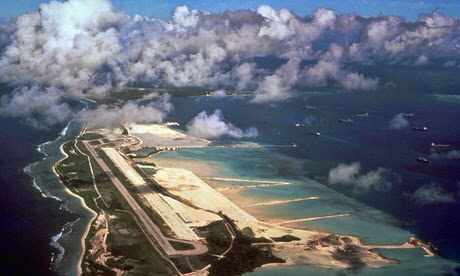
Diego Garcia

The Senate report on the CIA’s interrogation programme, due to be released in days, will confirm that the US tortured terrorist suspects after 9/11. In advance of the release, Barack Obama admitted on Friday: “We tortured some folks. We did some things that were contrary to our values.”

Now, in a letter to the human rights group Reprieve, former foreign secretary William Hague has confirmed that the UK government has held discussions with the US about what it intends to reveal in the report which, according to al-Jazeera, acknowledges that the British territory of Diego Garcia was used for extraordinary rendition.

“We have made representations to seek assurances that ordinary procedures for clearance of UK material will be followed in the event that UK material provide[d] to the Senate committee were to be disclosed,” Hague wrote.

Cori Crider, a director at Reprieve, accused the UK government of seeking to redact embarrassing information: “This shows that the UK government is attempting to censor the US Senate’s torture report. In plain English, it is a request to the US to keep Britain’s role in rendition out of the public domain.”

Lawyers representing a number of terrorist suspects held at Guantánamo Bay believe their clients were rendered via Diego Garcia. Papers found in Libya indicated that the US planned to transport Abdul-Hakim Belhaj, an opponent of Muammar Gaddafi, and his wife via the territory, an atoll in the Indian Ocean leased by Britain to the US. The government has denied Belhaj was rendered via Diego Garcia, but there are suspicions that others were held on the atoll.

Crider said the UK’s attempts to lobby the US into redacting parts of the report “turns the government’s defence in the Libyan renditions case of Abdul-Hakim Belhaj and his wife entirely on its head”.

The government has consistently sought to block Belhaj from bringing a case against it.

“The government protested America would be angered if this kidnap case ever went to trial – and now we learn the British government is leaning on the Americans not to air Britain’s dirty laundry. It exposes their litigation stance as mere posturing,” she added.

Confirmation that a British territory was involved in extraordinary rendition could leave the government vulnerable to legal action. Last month the European court of human rights ruled that the Polish government actively assisted the CIA’s European “black site” programme, which saw detainees interrogated in secret prisons across the continent.

The court concluded it was “established beyond reasonable doubt” that Abu Zubaydah, a Guantánamo detainee the US mistakenly believed to be a senior member of al-Qaida, was flown from a secret site in Thailand to another CIA prison in Stare Kiejkuty in northern Poland.

The judges concluded that not only was Poland “informed of and involved in the preparation and execution of the [High Value Detainee] Programme on its territory”, but also “for all practical purposes, facilitated the whole process, created the conditions for it to happen and made no attempt to prevent it”, prompting lawyers to ask what else it has been used for since. More


In Gaza, no one knows who will survive

GAZA CITY, Gaza Strip — No one feels the suffering of Gaza’s people except the actual victims. It seems that only the person who has been injured feels injury. Only the dead suffer in death. Only those who lose their homes experience the loss.

The images of children being killed by tons of iron and gunpowder has become a political goal. No matter the size of our grief, it remains small compared to that of the actual victims who have been injured, have lost loved ones or no longer have a home.

What Israel is doing to the civilians of Gaza is shocking — indiscriminate shelling and killing, destruction of entire residential buildings with occupants inside. They say that death by bombing is painless, but no one knows from where death will come. There is no safe place for you or your family. You wonder why planes and shells are trying to kill you as you sit with your family. Why are they killing your children in front of you? Killing you in front of them? Killing all of you, leaving no witness to your final moments?

Israel's intent to destroy the Dawud building, which is next to my family's house and has been bombed several times, was conveyed in a phone call to a building resident. Then the Israelis fired a warning rocket on the afternoon of July 21. Everyone in the neighborhood began screaming — nearby residents, the people in our house (from which the building can be seen), the owner of a nearby restaurant and shop.

We and the neighbors went outside and left the keys in the doors. The moment of horror is not when the missile pulverizes your body, but when you realize that it is on the way, whether after receiving notice or from the actual sound of the approaching shell.

We reached a safe place. The initial shock dissipated, and our thoughts turned to the pictures and memories we had left behind in the house: babies' first steps, the drawing on the wall, my sister’s wedding party in the living room.

You think that you are ready to start over as long as no one dies, but the sadness in your heart makes you go on with your life even after having lost your child or your mother to a shell that tore them to pieces. The shell disfigures a body to the point that it becomes unrecognizable. We try to console the orphans, but do we really know how someone who lost his father or mother feels?

My family sought shelter in my cousins’ home. Earlier, at the beginning of the war, my cousins had sought shelter in our home, but suddenly their home became safer than ours. In this war, it is hard to compare how safe different locations are. We ponder the mood of the fighter pilots as to which family they will target that night. For example, they warned the tower block next to us, but they bombed another one without warning, killing the al-Kilani family. There is a complete disregard for civilian life.

It is a war of religious ideologies. The bloodshed has come to be seen as for the sake of God or heaven or the Promised Land. Feelings are ignored as long as the political goal is being attained, and the religious reward is on the way. When this happens, ideology trumps humanity.

In the first week of the war, the media followed the story of Shaima al-Masri, 4. The only family she has left is her father Ibrahim al-Masri. Sitting next to his daughter, who lies in a bed in al-Shifa Hospital, he told Al-Monitor, “I thought that sending my wife to her sister’s home will make her safe. But minutes later, I heard the explosion. I ran down the street, then I received a phone call that my son had been martyred. At the hospital’s entrance, I was told that my wife was martyred. I found my eldest daughter, Asil, in critical condition. She woke up for a few seconds and asked me where her mother was, but then she died in the operating room … I later went to where they got martyred and found that a plane had targeted them 10 meters before they reached the house of my wife’s sister.” Shaima’s mother, Sahar, her brother, Mohammed, 14, and her sister, Asil, 17, all died in an Israeli air strike in the northern Gaza Strip on July 9.

Where can children be safe? That was the question I kept asking myself as I moved my children from house to house. I was separated from my family for the first time when they decided to remain in my uncle’s house. I preferred to take my son and daughter to another place until I could find an apartment where we could again gather. I learned that some people had left Gaza for Egypt. I don't think I can do the same. I found one apartment, but its Palestinian owner doesn’t accept Palestinians, only foreigners! Such is the racism and greed that the war brings out in some people.

If you listen to the partisan radio, you would think that our strength is equal to Israel’s. It is a high moment and the point of no return for the ideologues, whose stubbornness is equal to the blood being shed. In their opinion, what I am saying is defeatist, but it is simply natural fear for my family and sadness for the rest of the children. Words of regret can no longer heal the pain.

I finally found an apartment next to the port. I want my family to survive. I don’t know, no one knows, whether my family has survived or if we have only temporarily escaped death.

I returned to al-Shifa, looking for the wounded from the al-Salam residential building. I was informed, “There are no wounded. All of them arrived dead.” Less than a day later came the Khuza’a disaster and the indiscriminate shelling of Khan Yunis— a new Shajaiya.

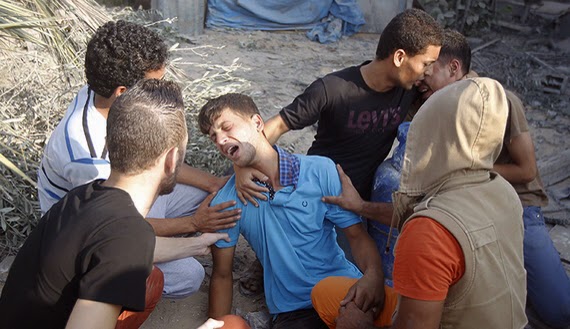
I entered the pediatric surgery room, where I found a child named Louay Siam, 9, entirely wrapped in bandages. His face and head were burned, but you could still see his tears. His brother Uday Siam, 12, lie in the next room with burns so severe his bones were exposed.

Their cousin Mohammed Siam told Al-Monitor, “His mother, grandmother and aunt were preparing pies on the roof of the house. The children were playing in front of them when the Israeli jet bombed them. Nine of them died.”

The Siam family had fled from the Zeitoun neighborhood east of Gaza to their relatives in the al-Rammal neighborhood in central Gaza, a supposedly “safe” area according to the Israeli army in the warning messages it sends so families can leave their homes for those areas. The planes followed them there.

Abu Zeid Abu Nasser, a neighbor of the Siams, said, “Uday and Louay's father is a seller of fruits and vegetables that come from Israel. He has nothing to do with any political party … I don’t know why the plane bombed them … They’ve [the Israelis] gone crazy.”

Abu Nasser pointed to the plastic tube in Louay’s nose that sucks the ash from his lungs. He said, “[Louay’s] condition prevents him from drinking water … He is crying because he’s thirsty.”

In our new apartment, you can hear the sound of the sea mixed with the sound of Israeli drones crossing the sky. Israel's warships fire shells. It’s dark everywhere. The electricity has been out since Israel hit the main station on July 23. On our battery-powered radio, we heard Khaled Meshaal, head of Hamas’ political bureau, saying, “We will not accept a truce without achieving our conditions.” My heart sank, and I got ready for another day of counting new casualties. More


Debunking Israel’s 11 Main Myths About Gaza, Hamas and War Crimes

You've got to hand it to Israeli spinners like Mark Regev. They are masters of PR. In fact, as the Independent's Patrick Cockburn revealed over the weekend, “the playbook they are using is a professional, well-researched and confidential study on how to influence the media and public opinion in America and Europe”.

Mark Regev

Let's be clear: I'm no fan of Hamas, a brutal and anti-Semitic group which has been accused by Amnesty International and other NGOs of human rights abuses against the people of Gaza and of war crimes against the people of Israel. Firing rockets into civilian areas isn't justified under international law, even if it is framed as part of a (legitimate) struggle against foreign military occupation.

Having said that, however, in recent days I've been debating supporters of Israel's latest assault on Gaza on radio and on Twitter and I've been astonished not just by the sheer number of fact-free claims made by those supporters, but also by their confidence, slickness and sheer message discipline. According to the pro-Israel, pro-IDF crowd, Hamas is to blame for everything.

This, of course, is utter nonsense. To quote the late US senator Daniel Patrick Moynihan: “You are entitled to your opinion. But you are not entitled to your own facts.”

So, in a Moynihanian spirit, here are fact-filled, evidence-based rebuttals to the 11 main myths, half-truths and self-serving 'talking points' that are repeatedly pushed by various Israeli spokespersons, both on the airwaves and on social media:

1) The Gaza Strip isn't occupied by Israel

Boston Globe: “Israeli-imposed buffer zones.. now absorb nearly 14 percent of Gaza's total land and at least 48 percent of total arable land. Similarly, the sea buffer zone covers 85 percent of the maritime area promised to Palestinians in the Oslo Accords, reducing 20 nautical miles to three.” Human Rights Watch: “Israel also continues to control the population registry for residents of the Gaza Strip, years after it withdrew its ground forces and settlements there.” B'Tselem, 2013: “Israel continues to maintain exclusive control of Gaza's airspace and the territorial waters, just as it has since it occupied the Gaza Strip in 1967.”

2) Israel wants a ceasefire but Hamas doesn't

Al Jazeera: “Meshaal said Hamas wants the 'aggression to stop tomorrow, today, or even this minute. But [Israel must] lift the blockade with guarantees and not as a promise for future negotiations'. He added 'we will not shut the door in the face of any humanitarian ceasefire backed by a real aid programme'.” Jerusalem Post: “One day after an Egyptian-brokered cease-fire accepted by Israel, but rejected by Hamas, fell through, the terrorist organization proposed a 10-year end to hostilitiesin return for its conditions being met by Israel, Channel 2 reported Wednesday.. Hamas's conditions were the release of re-arrested Palestinian prisoners who were let go in the Schalit deal, the opening of Gaza-Israel border crossings in order to allow citizens and goods to pass through, and international supervision of the Gazan seaport in place of the current Israeli blockade.” BBC: “Israel's security cabinet has rejected a week-long Gaza ceasefire proposal put forward by US Secretary of State John Kerry 'as it stands'.”

3) Israel, unlike Hamas, doesn't deliberately target civilians

The Guardian: “It was there that the second [Israeli] shell hit the beach, those firing apparently adjusting their fire to target the fleeing survivors. As it exploded, journalists standing by the terrace wall shouted: 'They are only children.'” UN high commissioner for human rights Navi Pillay: “A number of incidents, along with the high number of civilian deaths, belies the [Israeli] claim that all necessary precautions are being taken to protect civilian lives.” United Nations Fact Finding Mission on the Gaza Conflict, 2009: “The tactics used by the Israeli armed forces in the Gaza offensive are consistent with previous practices, most recently during the Lebanon war in 2006. A concept known as the Dahiya doctrine emerged then, involving the application of disproportionate force and the causing of great damage and destruction to civilian property and infrastructure, and suffering to civilian populations. The Mission concludes from a review of the facts on the ground that it.. appears to have been precisely what was put into practice.”

4) Only Hamas is guilty of war crimes, not Israel

Human Rights Watch: “Israeli forces may also have knowingly or recklessly attacked people who were clearly civilians, such as young boys, and civilian structures, including a hospital – laws-of-war violations that are indicative of war crimes.”Amnesty International: “Deliberately attacking a civilian home is a war crime, and the overwhelming scale of destruction of civilian homes, in some cases with entire families inside them, points to a distressing pattern of repeated violations of the laws of war.”

5) Hamas use the civilians of Gaza as 'human shields'

Jeremy Bowen, BBC Middle East editor: “I saw no evidence during my week in Gaza of Israel's accusation that Hamas uses Palestinians as human shields.” The Guardian: “In the past week, the Guardian has seen large numbers of people fleeing different neighbourhoods.. and no evidence that Hamas had compelled them to stay.” The Independent: “Some Gazans have admitted that they were afraid of criticizing Hamas, but none have said they had been forced by the organisation to stay in places of danger and become unwilling human-shields.” Reuters, 2013: “A United Nations human rights body accused Israeli forces on Thursday of mistreating Palestinian children, including by torturing those in custody and using others as human shields.”

6) This current Gaza conflict began with Hamas rocket fire on 30 June 2014

Times of Israel: “Hamas operatives were behind a large volley of rockets which slammed into Israel Monday morning, the first time in years the Islamist group has directly challenged the Jewish state, according to Israeli defense officials.. The security sources, who spoke on condition of anonymity, assessed that Hamas hadprobably launched the barrage in revenge for an Israeli airstrike several hours earlier which killed one person and injured three more.. Hamas hasn't fired rockets into Israel since Operation Pillar of Defense ended in November 2012.” The Nation: “During ten days of Operation Brother's Keeper in the West Bank [before the start of the Gaza conflict], Israel arrested approximately 800 Palestinians without charge or trial, killed nine civilians and raided nearly 1,300 residential, commercial and public buildings. Its military operation targeted Hamas members released during the Gilad Shalit prisoner exchange in 2011.”

7) Hamas has never stopped firing rockets into Israel

Jewish Daily Forward: “Hamas hadn't fired a single rocket since [2012 Gaza conflict], and had largely suppressed fire by smaller jihadi groups. Rocket firings, averaging 240 per month in 2007, dropped to five per month in 2013.” International Crisis Group: “Fewer rockets were fired from Gaza in 2013 than in any year since 2001, and nearly all those that were fired between the November 2012 ceasefire and the current crisis were launched by groups other than Hamas; the Israeli security establishment testified to the aggressive anti-rocket efforts made by the new police force Hamas established specifically for that purpose.. As Israel (and Egypt) rolled back the 2012 understandings – some of which were implemented spottily at best – so too did Hamas roll back its anti rocket efforts.”

8) Hamas provoked Israel by kidnapping and killing three Israeli teenagers

Jewish Daily Forward: “The [Israeli] government had known almost from the beginning that the boys were dead. It maintained the fiction that it hoped to find them alive as a pretext to dismantle Hamas' West Bank operations.. Nor was that the only fib. It was clear from the beginning that the kidnappers weren't acting on orders from Hamas leadership in Gaza or Damascus. Hamas' Hebron branch — more a crime family than a clandestine organization — had a history of acting without the leaders' knowledge, sometimes against their interests.” BBC correspondent Jon Donnison: “Israeli police MickeyRosenfeld tells me men who killed 3 Israeli teens def lone cell, hamas affiliated but not operating under leadership.. Seems to contradict the line from Netanyahu government.”

9) Hamas rule, not Israel's blockade, is to blame for the humanitarian crisis in the Gaza Strip

US State Department cable: “Israeli officials have confirmed to Embassy officials on multiple occasions that they intend to keep the Gazan economy functioning at the lowest level possible consistent with avoiding a humanitarian crisis.. Israeli officials have confirmed.. on multiple occasions that they intend to keep the Gazan economy on the brink of collapse without quite pushing it over the edge.” The Guardian: “The Israeli military made precise calculations of Gaza's daily calorie needs to avoid malnutrition during a blockade imposed on the Palestinian territory between 2007 and mid-2010, according to files the defence ministry released on Wednesday under a court order.. The Israeli advocacy group Gisha.. waged a long court battle to release the document. Its members say Israel calculated the calorie needs for Gaza's population so as to restrict the quantity of food it allowed in.”

10) The Israeli government, unlike Hamas, wants a two-state solution

Times of Israel: “[Netanyahu] made explicitly clear that he could never, ever, countenance a fully sovereign Palestinian state in the West Bank.. Amid the current conflict, he elaborated, 'I think the Israeli people understand now what I always say: that there cannot be a situation, under any agreement, in which we relinquish security control of the territory west of the River Jordan.'”

11) All serious analysts agree it was Hamas, and not Israel, that started this current conflict

Nathan Thrall, senior Mid East analyst at the International Crisis Group, writing in the New York Times: “The current escalation in Gaza is a direct result of the choice by Israel and the West to obstruct the implementation of the April 2014 Palestinian reconciliation agreement.” Henry Siegman, former national director, American Jewish Congress, writing for Politico: “Israel's assault on Gaza.. was not triggered by Hamas' rockets directed at Israel but by Israel's determination to bring down the Palestinian unity government that was formed in early June, even though that government was committed to honoring all of the conditions imposed by the international community for recognition of its legitimacy.” More


Chris Hedges on the Gaza Massacre

Hedges is currently a columnist for news website Truthdig, a senior fellow at The Nation Institute in New York City,[1] and a contributing author for OpEdNews.[2] He spent nearly two decades as a foreign correspondent in Central America, the Middle East, Africa and theBalkans. He has reported from more than fifty countries, and has worked for The Christian Science Monitor, NPR, The Dallas Morning News, and The New York Times,[3] where he was a foreign correspondent for fifteen years (1990–2005).

The cruel cease-fire charade

So far, the diplomatic effort to end the violence in Gaza has failed miserably, with Israel on Friday rejecting a cease-fire proposal from U.S. Secretary of State John Kerry. (On Saturday Israel and Hamas agreed to a 12-hour humanitarian pause in the fighting brokered by the United Nations.)

Washington’s attempt is representative of the overall failure of American policy toward the Israeli-Palestinian conflict, only on this occasion the consequences can be measured in the growing pile of dead bodies and the widespread devastation that includes numerous homes, public buildings and even artillery damage to several United Nations schools sheltering Palestinian civilians.

The U.S. approach fails because it exhibits extreme partisanship in a setting where trust, credibility and reciprocity are crucial. Kerry is undoubtedly dedicated to achieving a cease-fire, just as he demonstrated for most of the past year in pushing for a negotiated peace agreement between Israel and the Palestinian Authority. Yet the United States exhibited its tendency toward extreme partisanship when it designated Martin Indyk, a former staff member of the America Israel Public Affairs Committee (AIPAC) and former ambassador to Israel, as the U.S. special envoy to the peace talks.

The U.S. approach up to this point to achieving a cease-fire in Gaza has been undertaken in a manner that is either woefully ignorant of the real constraints or callously cynical about their relevance. This is especially clear from the attempt to garner a cease-fire by consulting only one side, Israel — the party bearing the major responsibility for causing massive casualties and damage — and leaving Hamas out in the cold. Even if this is a consequence of Hamas being treated as “a terrorist entity,” it still makes no sense. When Israel wanted to deal with Hamas in the past, it had no trouble doing so — for instance, when it arranged the prisoner exchange that led to the release of the single captured Israeli soldier Gilad Schalit back in 2011.

The basic facts are astounding: The U.S. relied on Egypt as the broker of a proposal it vetted, supposedly with the text delivered personally by Tony Blair to President Abdel Fattah El Sisi in Cairo, endorsed by the Netanyahu government, and then announced on July 15 via the media as a cease-fire proposal accepted by Israel, without Hamas even knowing the details. It’s a diplomatic analogue to the theater of the absurd. Last July, then-General Sisi was the Egyptian mastermind of a coup that brutally cracked down on the Muslim Brotherhood and criminalized the entire organization. The Sisi government has made no secret of its unrelenting hostility to Hamas, which it views as an offshoot of the Muslim Brotherhood. It destroyed the extensive tunnel network connecting Gaza with the outside world to circumvent the punitive Israeli blockade that has been maintained since 2007. Is there any reason for Hamas to go forward with such a cease-fire arrangement? As some respected Israeli commentators have suggested, most prominently Amira Hass, the “normalization” of the occupation is what the Israeli military operation Protective Edge is all about. Hass suggests that Israel seeks a compliant Palestinian response to an occupation that has for all intents and purposes become permanent. Such periodic shows of force aim to break once and for all the will to resist, associated with Hamas and its rockets.

Even more telling, the cease-fire’s terms were communicated to Hamas via the media, making the proposal “take it or leave it.” It also ignored the reasonable conditions Hamas had posited as the basis of a cease-fire it could accept. These conditions included ending the unlawful seven-year siege of Gaza, releasing prisoners arrested in the anti-Hamas campaign prior to launching the military operation on July 8, and stopping interference with the unity government that brought Hamas and the Palestinian Authority together on June 3. Kerry, by contrast, has urged restoring the cease-fire text that had been accepted by both sides in November 2012 after the previous major Israeli military attack upon Gaza.

Hamas’ chief leader, Khaled Meshaal, has been called “defiant” by Kerry because he would not go along with this tilted diplomacy. “Everyone wanted us to accept a cease-fire and then negotiate for our rights,” Meshaal said. This was tried by Hamas in 2012 and didn’t work. As soon as the violence ceased, Israel refused to follow through on the cease-fire agreement that had promised negotiations seeking an end of the blockade and an immediate expansion of Gazan fishing rights.

In the aftermath of Protective Edge is it not reasonable, even mandatory, for Hamas to demand a firm commitment to end the siege of Gaza? Israel as the occupying power has an obligation under the Geneva Conventions to protect the civilian population of an occupied people. Israel claims that its “disengagement” in 2005, involving the withdrawal of security forces and the dismantling of settlements, ended such obligations. Such a position is almost uniformly rejected in the international community, since the persistence of effective Israeli control of entry and exit, as well as air and sea, and violent incursions amounts to a shift in the form of occupation — not its end. Israel is certainly right to complain about the rockets, but it is wrong to impose an oppressive regime of collective punishment on the civilians of Gaza. More


Palestinian Recourse to the International Criminal Court: The Time has Come

Ever since this latest Israeli major military operation against Gaza started on July 8, there have been frequent suggestions that Israel is guilty of war crimes, and that Palestine should do its best to activate the International Criminal Court (ICC) on its behalf.

The evidence overwhelmingly supports basic Palestinian allegations—Israel is guilty either of aggression in violation of the UN Charter or is in flagrant violation of its obligations as the Occupying Power under the Geneva Convention to protect the civilian population of an Occupied People; Israel seems guilty of using excessive and disproportionate force against a defenseless society in the Gaza Strip; and Israel, among an array of other offenses, seems guilty of committing Crimes Against Humanity in the form of imposing an apartheid regime in the West Bank and through the transfer of population to an occupied territory as it has proceeded with its massive settlement project.

Considering this background of apparent Israeli criminality it would seem a no brainer for the Palestinian Authority to seek the help of the ICC in waging its struggle to win over world public opinion to their struggle. After all, the Palestinians are without military or diplomatic capabilities to oppose Israel, and it is on law and global solidarity must rest their hopes for eventually realizing their rights, particularly the right of self-determination and the right of return. Palestinian demonstrators in the West Bank are demanding that their leaders in the Palestinian Authority adhere to the Rome Statute, and become members of the ICC without further delay. It has become part of the message of Palestinian street politics that the Palestinians are being criminally victimized, and that the Palestinian Authority if it wants to retain the slightest shred of respect as representatives of the Palestinian people must join in this understanding of the Palestinian plight and stop ‘playing nice’ with Israeli authorities.

Such reasoning from a Palestinian perspective is reinforced by the May 8th letter sent by 17 respected human rights NGOs to President Mahmoud Abbas urging Palestine to become a member of the ICC, and act to end Israel’s impunity. This was not a grandstanding gesture dreamed up on the irresponsible political margins of liberal Western society. Among the signatories were such human rights stalwarts as Human Rights Watch, Amnesty International, Al Haq, and the International Commission of Jurists, entities known for their temporizing prudence in relation to the powers that be.

Adding further credence to the idea that the ICC option should be explored was the intense opposition by Israel and United States, ominously threatening the PA with dire consequences if it tried to join the ICC, much less to seek justice through its activating its investigative procedures. The American ambassador to the UN, Samantha Power, herself long ago prominent as a human rights advocate, revealed Washington’s nervous hand when she confessed that the ICC “is something that really poses a profound threat to Israel.” I am not sure that Power would like to live with the idea that because Israel is so vulnerable to mounting a legal challenge that its impunity must be upheld whatever the embarrassment to Washington of doing so. France and Germany have been more circumspect, saying absurdly that recourse to the ICC by Palestine should be avoided because it would disrupt ‘the final status negotiations,’ as if this pseudo-diplomacy was ever of any of value, a chimera if there ever was one, in the elusive quest for a just peace.

In a better world, the PA would not hesitate to invoke the authority of the ICC, but in the world as it is, the decision is not so simple. To begin with, is the question of access, which is limited to states. Back in 2009, the PA tried to adhere to the Rome Statute, which is the treaty governing the ICC, and was rebuffed by the prosecutor who turned the issue over to the Security Council, claiming a lack of authority to determined whether the PA represented a ‘state.’ Subsequently, on November 29th the UN General Assembly overwhelmingly recognized Palestine as ‘a nonmember observer state.’ Luis Moreno–Ocampo who had acted in 2009 for the ICC, and now speaking as the former prosecutor, asserted that in his opinion Palestine would now in view of the General Assembly action qualify as a state enjoying the option of becoming an ICC member. Normally, ICC jurisdiction is limited to crimes committed after the state becomes a member, but there is a provision that enables a declaration to be made accepting jurisdiction for crimes committed at any date in its territory so long as it is after the ICC itself was established in 2002.

Is this enough? Israel has never become a party to the Rome Statute setting up the ICC, and would certainly refuse to cooperate with a prosecutor who sought to investigate war crimes charges with the possible intention of prosecution. In this regard, recourse to ICC might appear to be futile as even if arrest warrants were to be issued by the court, as was done in relation to Qaddafi and his son in 2011, there would be no prospect that the accused Israeli political and military figures would be handed over, and without the presence of such defendants in the court at The Hague, a criminal trial cannot go forward. This illustrates a basic problem with the enforcement of international criminal law. It has been effective only against the losers in wars fought against the interests of the West and, to some extent, against those whose crimes are in countries located in sub-Saharan Africa. This biased form of international criminal law implementation has been the pattern since the first major effort was made after World War II at Nuremberg and Tokyo. Surviving German and Japanese leaders were prosecuted for their crimes while exempting the winners, despite Allied responsibility for the systematic bombing of civilian populations by way of strategic bombing and the American responsibility for dropping the atomic bombs on Hiroshima and Nagasaki. More


They call us now.

A Facebook friend shared the following remarkable poem by Lena Khalaf Tuffaha, who is a co-founder of the Institute for Middle East Understanding based in Seattle. It catches the nightmarish absurdity of the latest invasion of Gaza.

They call us now.

Before they drop the bombs.

The phone rings

and someone who knows my first name

calls and says in perfect Arabic

“This is David.”

And in my stupor of sonic booms and glass shattering symphonies

still smashing around in my head

I think “Do I know any Davids in Gaza?”

They call us now to say

Run.

You have 58 seconds from the end of this message.

Your house is next.

They think of it as some kind of

war time courtesy.

It doesn’t matter that

there is nowhere to run to.

It means nothing that the borders are closed

and your papers are worthless

and mark you only for a life sentence

in this prison by the sea

and the alleyways are narrow

and there are more human lives

packed one against the other

more than any other place on earth

Just run.

We aren’t trying to kill you.

It doesn’t matter that

you can’t call us back to tell us

the people we claim to want aren’t in your house

that there’s no one here

except you and your children

who were cheering for Argentina

sharing the last loaf of bread for this week

counting candles left in case the power goes out.

It doesn’t matter that you have children.

You live in the wrong place

and now is your chance to run

to nowhere.

It doesn’t matter

that 58 seconds isn’t long enough

to find your wedding album

or your son’s favorite blanket

or your daughter’s almost completed college application

or your shoes

or to gather everyone in the house.

It doesn’t matter what you had planned.

It doesn’t matter who you are

Prove you’re human.

Prove you stand on two legs.

Run.

– Running Orders, by Lena Khalaf Tuffaha


How US and Blair plotted ‘ceasefire’ scam

We now have confirmation from the Israeli daily Haaretz of what we should have suspected: that the idea for the so-called Egyptian “ceasefire proposal” was actually hatched in Washington, the messenger boy was arch-war criminal Tony Blair, and the terms were drafted by Israel.

Click to Enlarge


The intention was either to corner Hamas into surrendering – and thereby keep the savage blockade of Gaza in place – or force Hamas to reject the proposal and confirm the Israeli narrative that it is a terrorist organisation with which Israel cannot make peace.

According to Haaretz, Blair secretly initiated his “ceasefire” activity after “coordinating” with US Secretary of State John Kerry. On Saturday he headed off to Cairo to meet with the US-backed Egyptian dictator Abdel Fattah al-Sisi to persuade him to put his name to the proposal.

Immediately afterwards, he travelled to Israel to meet Benjamin Netanyahu on Saturday afternoon. Sisi and Netanyahu were then supposed to thrash out the details. When they failed to do so, Blair intervened again on behalf of the Americans and the pair spoke by phone on Saturday evening.

Here’s the key paragraph from Haaretz:

Senior Israeli officials and Western diplomats said the reason the Egyptian cease-fire initiative was so short-lived is that it was prepared hastily and was not coordinated with all the relevant parties, particularly Hamas.

Wonderful that throw-away last line. In all this activity, it never occurred to the US, Blair, Sisi or Netanyahu – and no doubt Mahmoud Abbas, who is strangely absent from this account – that it might be necessary to sound out Hamas on the terms of a ceasefire it would need to abide by.

Now it seems Kerry is using US muscle to get Egypt, Qatar and Turkey to strong-arm Hamas into surrendering.


It’s depressingly predictable that the corporate media have swallowed the line of Israel accepting the “ceasefire proposal” and Hamas rejecting it. What Hamas did was reject a US-Israeli diktat to sign away the rights of the people of Gaza to end a siege that cuts them off from the rest of the world.

But there is a long pedigree to such deceptions. It is reminiscent of a hasbara favourite: that the Jews accepted the UN partition plan of 1947 while the Palestinians rejected it. The reality – then, as now – is that the the colonial powers sought to strip the Palestinians of their rights and their homeland without even consulting them.


www.haaretz.com/news/diplomacy-defense/.premium-1.605499

– See more at: http://www.jonathan-cook.net/blog/2014-07-16/how-us-and-blair-plotted-ceasefire-scam/#sthash.ZXcEXokj.dpuf


Edward Snowden should not face trial, says UN human rights commissioner

The United Nations's top human rights official has suggested that the United States should abandon its efforts to prosecute Edward Snowden, saying his revelations of massive state surveillance had been in the public interest.

Navi Pillay

The UN high commissioner for human rights, Navi Pillay, credited Snowden, a former US National Security Agency contractor, with opening a global debate that has led to calls for the curtailing of state powers to snoop on citizens online and store their data.

“Those who disclose human rights violations should be protected: we need them,” Pillay told a news conference.

“I see some of it here in the case of Snowden, because his revelations go to the core of what we are saying about the need for transparency, the need for consultation,” she said. “We owe a great deal to him for revealing this kind of information.”

The United States has filed espionage charges against Snowden, charging him with theft of government property, unauthorised communication of national defence information and wilful communication of classified communications intelligence to an unauthorised person.

Pillay declined to be drawn on whether President Barack Obama should pardon Snowden, saying he had not yet been convicted. “As a former judge I know that if he is facing judicial proceedings we should wait for that outcome,” she said. But she added that Snowden should be seen as a “human rights defender”.

“I am raising right here some very important arguments that could be raised on his behalf so that these criminal proceedings are averted,” she said.

Pillay was speaking after issuing a report on government surveillance, The Right to Privacy in the Digital Age (pdf), which says governments must accept stronger checks on their data surveillance powers and companies must do more to stand up to the state's demands for data.

Revelations of mass US surveillance based on documents leaked by Snowden sparked outrage among American allies including Germany, Brazil and Mexico. He has sought asylum in Russia.

The leaked documents revealed massive programmes run by the NSA that gathered information on emails, phone calls and internet use by hundreds of millions of Americans.

Mona Rishmawi, head of the rule of law branch of Pillay's office, said: “In this particular case, the way we see the situation of Snowden is he really revealed information which is very, very important for human rights. We would like this to be taken into account in assessing his situation.”

All branches of government must be involved in the oversight of surveillance programmes, and completely independent civilian institutions must also monitor surveillance, Pillay says in her report. Checks on government must also be clearly understandable by the public.

The report, which will be debated at the UN general assembly later this year, says any collection of communications data or metadata is potentially a breach of privacy.

Governments often force internet and telecoms firms to store metadata about their customers, which was neither necessary nor proportionate, Pillay said, adding that companies should always be ready to challenge government requests.

“This can mean interpreting government demands as narrowly as possible or seeking clarification from a government with regard to the scope and legal foundation for the demand; requiring a court order before meeting government requests for data; and communicating transparently with users about risks and compliance with government demands,” she told reporters.

She added: “I would say there are serious questions over the extent to which consumers are truly aware of what data they are sharing, how, and with whom, and to what use they will be put.

“And for how long is this data going to be out there? I would say that the same rights that people have offline must be protected online.”

An emergency data collection law being rushed through the British parliament may not address concerns raised by the European Court of Justice and is difficult to justify, Pillay said. More


Palestinian factions reportedly set 10 conditions for 10-year truce with Israel

Reports in Israeli and Palestinian media say that the two Palestinian resistance groups Hamas and Islamic Jihad have set forth ten conditions for a ceasefire and ten-year truce with Israel.

Israel’s Maariv said that an unnamed “senior Palestinian official” passed it a copy of the demands, which have been transmitted by the factions to Egypt.

They include an end to all armed hostilities, the end of the siege of Gaza, and the construction of internationally supervised air and seaports.

Palestinians sleep in UN school

While Hamas has not as yet officially stated these demands, they are in line with the group’s long-standing policy of offering Israel a multi-year truce.

The reported conditions come after nine days of Israeli bombardment of the Gaza Strip that has killed more than 200 people, injured close to 1,400, and destroyed the homes of 8,200 others. Almost 80 percent of the dead, who include more than thirty children, are civilians, according to the UN.

Yesterday, Hamas refused to respond to a unilateral “ceasefire” declared by Israel that would have left the situation of siege on the Gaza Strip unchanged.

Airport, seaport and an end to violence

The ten conditions were translated by The Electronic Intifada from an Arabic version published by Ma’an News Agency:

  • Mutual cessation of the war and withdrawal of tanks to previous locations and the return of farmers to work their land in the agricultural border areas.
  • Release of all the Palestinians detained since 23 June 2014 and improvement of the conditions of Palestinian prisoners, especially the prisoners from Jerusalem, Gaza and Palestinians of the interior [present-day Israel].
  • Total lifting of the siege of Gaza and opening the border crossings to goods and people and allowing in all food and industrial supplies and construction of a power plant sufficient to supply all of Gaza.
  • Construction of an international seaport and an international airport supervised by the UN and non-biased countries.
  • Expansion of the maritime fishing zone to 10 kms and supplying fishermen with larger fishing and cargo vessels.
  • Converting the Rafah crossing into an international crossing under supervision of the UN and Arab and friendly countries.
  • Signing a 10-year truce agreement and deployment of international monitors to the borders.
  • A commitment by the occupation government not to violate Palestinian airspace and easing of conditions for worshipers in Al-Aqsa Mosque.
  • The occupation will not interfere in the affairs of the Palestinian government and will not hinder national reconciliation.
  • Restoration of the border industrial areas and their protection and development.

“Should have been met years ago”


Dr. Ramy Abdu, chair of the independent group Euro-Mid Observer for Human Rights (euromid.org, told The Electronic Intifada from Gaza City this morning:

I believe that these requirements should have been met years ago. The core of these requirements are not political but purely humanitarian and legally binding. The international community has called many times for their implementation. Palestinians have the right to move in and out freely like others in the world. They have the right to import and export, to control their borders and airspace. Israel argues that it left Gaza, so it should stop controlling the lives of Palestinians.

Abdu noted that his organization recently published a detailed proposal to establish a maritime link from Gaza to the rest of the world with an international role that could “alleviate security concerns.” More