The state of the climate — and what we might do about it

Today, the UN begins its Climate Summit, enlisting the world to work together on a problem that’s too big for any one country to solve. Lord Nicholas Stern helped write the delegates’ report that outlines where we are now — and what we could do next. It’s a big vision for cooperation, with a payoff that goes far beyond averting disaster. He asks: How can we use this crisis to spur better lives for all?


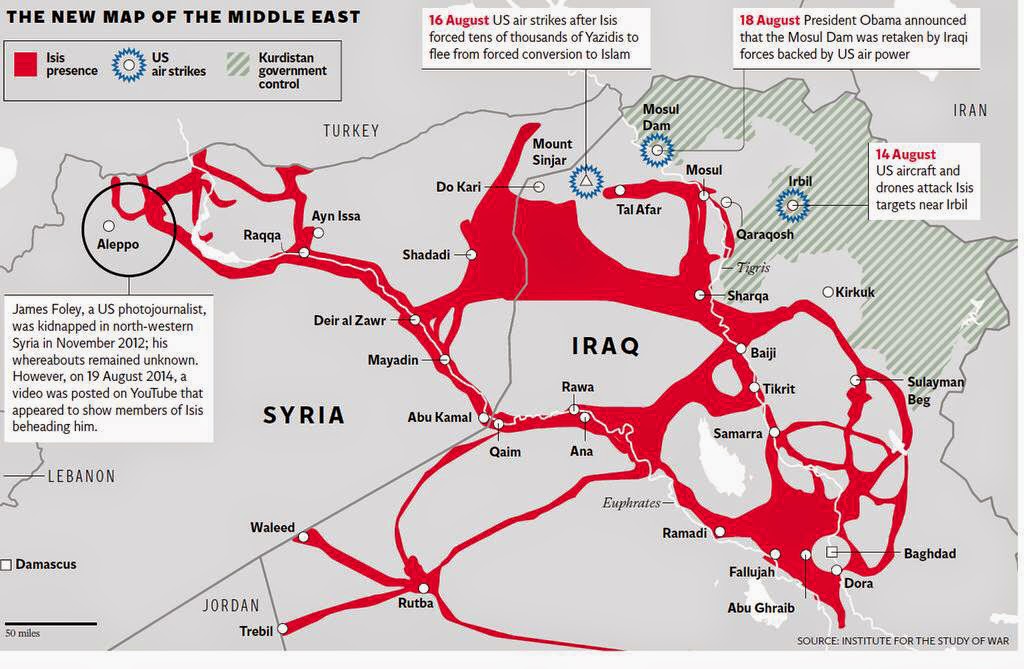
Peter Van Buren, Back to the Future in Iraq

On April 4, 1967, Martin Luther King delivered a speech at Riverside Church in New York City titled “Beyond Vietnam: A Time to Break Silence.” In it, he went after the war of that moment and the money that the U.S. was pouring into it as symptoms of a societal disaster.

President Lyndon Johnson’s poverty program was being “broken and eviscerated,” King said from the pulpit of that church, “as if it were some idle political plaything on a society gone mad on war… We were taking the black young men who had been crippled by our society and sending them eight thousand miles away to guarantee liberties in Southeast Asia which they had not found in southwest Georgia and East Harlem. I could not be silent in the face of such cruel manipulation of the poor.” Twice more in that ringing speech he spoke of “the madness of Vietnam” and called for it to cease.

Don’t think of that as just a preacher’s metaphor. There was a genuine madness on the loose — and not just in the “free-fire zones” of Vietnam but in policy circles here in the United States, in the frustration of top military and civilian officials who felt gripped by an eerie helplessness as they widened a terrible war on the ground and in the air. They were, it seemed, incapable of imagining any other path than escalation in the face of disaster and possible defeat. Even in the years of Ronald Reagan’s presidency, when there was a brief attempt to paint that lost war in a more heroic hue (“a noble cause,” the president called it), that sense of madness, or at least of resulting mental illness, lingered. It remained embedded in a phrase then regularly applied to Americans who were less than willing to once again head aggressively into the world. They were suffering from, it was said, “Vietnam syndrome.”

Today, almost 25 years into what someday might simply be called America’s Iraq War (whose third iteration we’ve recently entered), you can feel that a similar “madness” has Washington by the throat. Just as King noted of the Vietnam era, since 9/11 American domestic programs and agencies have been starved while money poured into the coffers of the Pentagon and an increasingly bloated national security state. The results have been obvious. In the face of the spreading Ebola virus in West Africa, for instance, the president can no longer turn to civilian agencies or organizations for help, but has to call on the U.S. military in an “Ebola surge” — even our language has been militarized — although its forces are not known for their skills, successes, or spendthrift ways when it comes to civilian “humanitarian” or nation-building operations.

We’ve already entered the period when strategy, such as it is, falls away, and our leaders feel strangely helpless before the drip, drip, drip of failure and the unbearable urge for further escalation. At this point, in fact, the hysteria in Washington over the Islamic State seems a pitch or two higher than anything experienced in the Vietnam years. A fiercely sectarian force in the Middle East has captured the moment and riveted attention, even though its limits in a region full of potential enemies seem obvious and its “existential threat” to the U.S. consists of the possibility that some stray American jihadi might indeed try to harm a few of us. Call it emotional escalation in a Washington that seems remarkably unhinged.

It took Osama bin Laden $400,000 to $500,000, 19 hijackers, and much planning to produce the fallen towers of 9/11 and the ensuing hysteria in this country that launched the disastrous, never-ending Global War on Terror. It took the leaders of the Islamic State maybe a few hundred bucks and two grim videos, featuring three men on a featureless plain in Syria, to create utter, blind hysteria here. Think of this as confirmation of Karl Marx’s famous comment that the first time is tragedy, but the second is farce.

One clear sign of the farcical nature of our moment is the inability to use almost any common word or phrase in an uncontested way if you put “Iraq” or “Islamic State” or “Syria” in the same sentence. Remember when the worst Washington could come up with in contested words was the meaning of “is” in Bill Clinton’s infamous statement about his relationship with a White House intern? Linguistically speaking, those were the glory days, the utopian days of official Washington.

Just consider three commonplace terms of the moment: “war,” “boots on the ground,” and “combat.” A single question links them all: Are we or aren’t we? And to that, in each case, Washington has no acceptable answer. On war, the secretary of state said no, we weren’t; the White House and Pentagon press offices announced that yes, we were; and the president fudged. He called it “targeted action” and spoke of America’s “unique capability to mobilize against an organization like ISIL,” but God save us, what it wasn't and wouldn't be was a “ground war.”

Only with Congress did a certain clarity prevail. Nothing it did really mattered. Whatever Congress decided or refused to decide when it came to going to war would be fine and dandy, because the White House was going to do “it” anyway. “It,” of course, was the Clintonesque “is” of present-day Middle Eastern policy. Who knew what it was, but here was what it wasn’t and would never be: “boots on the ground.” Admittedly, the president has already dispatched 1,600 booted troops to Iraq’s ground (with more to come), but they evidently didn’t qualify as boots on the ground because, whatever they were doing, they would not be going into “combat” (which is evidently the only place where military boots officially hit the ground). The president has been utterly clear on this. There would be no American “combat mission” in Iraq. Unfortunately, “combat” turns out to be another of those dicey terms, since those non-boots had barely landed in Iraq when Chairman of the Joint Chiefs Martin Dempsey started to raise the possibility that some of them, armed, might one day be forward deployed with Iraqi troops as advisers and spotters for U.S. air power in future battles for Iraq’s northern cities. This, the White House now seems intent on defining as not being a “combat mission.”

And we’re only weeks into an ongoing operation that could last years. Imagine the pretzeling of the language by then. Perhaps it might be easiest if everyone — Congress, the White House, the Pentagon, and Washington’s pundits — simply agreed that the United States is at “war-ish” in Iraq, with boots on the ground-ish in potentially combat-ish situations. Former State Department whistleblower and TomDispatch regular Peter Van Buren spent his own time in Iraq and wrote We Meant Well: How I Helped Lose the Battle for the Hearts and Minds of the Iraqi People about it. Now, he considers the mind-boggling strangeness of Washington doing it all over again, this time as the grimmest of farces. Tom

Apocalypse Now, Iraq Edition
Fighting in Iraq Until Hell Freezes Over
By Peter Van Buren

I wanted to offer a wry chuckle before we headed into the heavy stuff about Iraq, so I tried to start this article with a suitably ironic formulation. You know, a déjà-vu-all-over-again kinda thing. I even thought about telling you how, in 2011, I contacted a noted author to blurb my book, We Meant Well: How I Helped Lose the Battle for the Hearts and Minds of the Iraqi People, and he presciently declined, saying sardonically, “So you're gonna be the one to write the last book on failure in Iraq?”

I couldn't do any of that. As someone who cares deeply about this country, I find it beyond belief that Washington has again plunged into the swamp of the Sunni-Shia mess in Iraq. A young soldier now deployed as one of the 1,600 non-boots-on-the-ground there might have been eight years old when the 2003 invasion took place. He probably had to ask his dad about it. After all, less than three years ago, when dad finally came home with his head “held high,” President Obama assuredAmericans that “we’re leaving behind a sovereign, stable and self-reliant Iraq.” So what happened in the blink of an eye?

The Sons of Iraq

Sometimes, when I turn on the TV these days, the sense of seeing once again places in Iraq I'd been overwhelms me. After 22 years as a diplomat with the Department of State, I spent 12 long months in Iraq in 2009-2010 as part of the American occupation. My role was to lead two teams in “reconstructing” the nation. In practice, that meant paying for schools that would never be completed, setting up pastry shops on streets without water or electricity, and conducting endless propaganda events on Washington-generated themes of the week (“small business,” “women's empowerment,” “democracy building.”)

We even organized awkward soccer matches, where American taxpayer money was used to coerce reluctant Sunni teams into facing off against hesitant Shia ones in hopes that, somehow, the chaos created by the American invasion could be ameliorated on the playing field. In an afternoon, we definitively failed to reconcile the millennium-old Sunni-Shia divide we had sparked into ethnic-cleansing-style life in 2003-2004, even if the score was carefully stage managed into a tie by the 82nd Airborne soldiers with whom I worked.

In 2006, the U.S. brokered the ascension to power of Prime Minister Nouri al-Maliki, a Shia politician handpicked to unite Iraq. A bright, shining lie of a plan soon followed. Applying vast amounts of money, Washington’s emissaries created the Sahwa, or Sons of Iraq, a loose grouping of Sunnis anointed as “moderates” who agreed to temporarily stop killing in return for a promised place at the table in the New(er) Iraq. The “political space” for this was to be created by a massive escalation of the American military effort, which gained a particularly marketable name: the surge.

I was charged with meeting the Sahwa leaders in my area. My job back then was to try to persuade them to stay on board just a little longer, even as they came to realize that they'd been had. Maliki’s Shia government in Baghdad, which was already ignoring American entreaties to be inclusive, was hell-bent on ensuring that there would be no Sunni “sons” in its Iraq.

False alliances and double-crosses were not unfamiliar to the Sunni warlords I engaged with. Often, our talk — over endless tiny glasses of sweet, sweet tea stirred with white-hot metal spoons — shifted from the Shia and the Americans to their great-grandfathers' struggle against the British. Revenge unfolds over generations, they assured me, and memories are long in the Middle East, they warned.

When I left in 2010, the year before the American military finally departed, the truth on the ground should have been clear enough to anyone with the vision to take it in. Iraq had already been tacitly divided into feuding state-lets controlled by Sunnis, Shias, and Kurds. The Baghdad government had turned into a typical, gleeful third-world kleptocracy fueled by American money, but with a particularly nasty twist: they were also a group of autocrats dedicated to persecuting, marginalizing, degrading, and perhaps one day destroying the country’s Sunni minority.

U.S. influence was fading fast, leaving the State Department, a small military contingent, various spooks, and contractors hidden behind the walls of the billion-dollar embassy (the largest in the world!) that had been built in a moment of imperial hubris. The foreign power with the most influence over events was by then Iran, the country the Bush administration had once been determined to take down alongside Saddam Hussein as part of the Axis of Evil.

The Grandsons of Iraq

The staggering costs of all this — $25 billion to train the Iraqi Army, $60 billion for the reconstruction-that-wasn’t, $2 trillion for the overall war, almost 4,500 Americans dead and more than 32,000 wounded, and an Iraqi death toll of more than190,000 (though some estimates go as high as a million) — can now be measured against the results. The nine-year attempt to create an American client state in Iraq failed, tragically and completely. The proof of that is on today's front pages. More


Perpetual War, Indefinite Detention, And Torture: The U.S. And Israel’s Shared Values

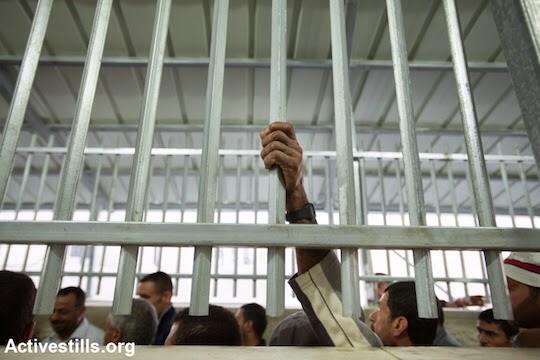
The United States and Israel have “shared values” but not when it comes to upholding democracy and the rule of law. Their shared values are perpetual war, torture, indefinite detention, and military courts.

Israeli soldiers arrest Palestinian
minors in the West Bank city of Jenin

Guantanamo is a perfect example of this. Both states have been in a state of perpetual war for quite some time with Israel against the Palestinians since its founding in 1948 while the U.S. can trace back its war to its founding in 1776 and the colonization of Native American lands. Today’s global war on terror is the latest chapter in that saga. Under perpetual war, the United States and Israel can justify a litany of draconian policies, such as indefinite detention, torture, and extrajudicial killing.

International human rights law prohibits torture and detention without charge or trial. The UN Convention Against Torture strictly forbids torture, even in “exceptional circumstances” like “a state of war or threat of war, internal political instability or any other public emergency.” Meanwhile, article 9 of the International Covenant on Civil and Political Rights states, “No one shall be subjected to arbitrary arrest or detention.” The rights to a fair trial, due process, and to be free from torture and inhumane treatment are basic human rights that governments are obliged to uphold. Yet, both the United States and Israel practice indefinite detention – also known as “administrative detention” in Israel – and torture.

Administrative detention and torture in Israel

Israel has detained thousands of Palestinians in the occupied territories without charge or trial over the years “for periods ranging from several months to several years,” according to Israeli human rights group B’Tselem. B’Tselem figures also report that, “At the end of May 2014, 196 Palestinian administrative detainees were held in facilities run by the Israel Prison Service (IPS).” Israel recently locked up over 250 Palestinians in administrative detention as part of its operation to find the three missing but killed Israeli settlers, putting the current population at around 450.

Three Israeli laws allow and regulate Israel’s administrative detention powers – the Administrative Detention Order, theEmergency Powers (Detention) Law, and the Internment of Unlawful Combatants Law.

The Administrative Detention Order, which applies to the West Bank except East Jerusalem, allows military commanders to detain a person for a maximum of six months “for reasons to do with regional security or public security.” Commanders can repeatedly add six months of administrative detention, since there is no limit on extensions. The 1979 Emergency Powers Law allows the defense minister to detain a person for up to six months, like the Order, and extend the detention repeatedly six months at a time. It applies to Israeli residents, residents living in Israeli occupied territories, and residents of other countries, such as Lebanon. However, this law grants detainees more protections than the Order does. The 2002 Internment of Unlawful Combatants Law allows for the administrative detention of a civilian who directly or indirectly participates in hostilities against Israel or is a member of a force that does so. Under this law, persons can be detained for an unlimited period of time. This law is used to detain Palestinians living in the Gaza Strip.

While the occupation is illegal and unjust, Israel, as an occupying power, has an international legal responsibility to uphold the welfare of Palestinians living under its control. International humanitarian law permitssome internment (or detention without charge or trial) in wartime but only “for imperative reasons of security,” according to Article 78 of the Fourth Geneva Convention. Internment [detention] also has to be done on a case-by-case basis rather than implemented widely.

B’Tselem names the numerous ways in which Israel’s use of administrative detention violates its international legal responsibilities as an occupying power. One is its “[e]xtremely extensive use” in contravention of international law. “Administrative detention has become routine practice, rather than an exceptional measure,” according to B’Tselem. Relatedly, administrative detention is used as “an alternative to criminal proceedings” with authorities using it “as a quick and efficient alternative to criminal trial, primarily when they do not have sufficient evidence to charge the individual, or when they do not want to reveal their evidence.” Administrative detention also lacks due process as detainees “are not provided meaningful information on the reasons for their detention and are not given an opportunity to refute the suspicions against them.” Additionally, detention periods are repeatedly extended, which leaves Palestinians detained for several months to years without charge or trial. Israel has also used administrative detention against political opponents, including non-violent political activists. Finally, many Palestinian administrative detainees are held inside Israel.

In 1999, Israel’s High Court of Justice issued a ruling that prohibited interrogators from using methods of torture as a means of interrogation. Before that ruling, Israeli security forces regularly “tortured thousands of Palestinian detainees each year,” according to the Public Committee Against Torture in Israel. In 1987, an Israeli government commission, headed by former Supreme Court President Moshe Landau, issued a report that provided a framework for Israel’s torture regime. The Landau Commission recommended Shin Bet interrogators utilize torture methods, namely “psychological pressure” and a “moderate degree of physical pressure,” against people suspected of “hostile terrorist activity.” It argued that “an effective interrogation is impossible” without some physical force.

Despite the High Court’s 1999 ban on torture, rights groups like the Public Committee Against Torture in Israel (PCATI) point out that the Israeli intelligence agency Shin Bet and other law enforcement agencies still commit acts of torture. The PCATI largely relied on testimonies from Palestinian prisoners and forensic evaluations. In response, the Shin Bet denies it commits torture and argues that its interrogation methods are not only lawful but save lives.

Methods of torture and ill treatment of Palestinian prisoners since 1999, according to the PCATI, include “sleep deprivation, binding to a chair in painful positions, beatings, slapping, kicking, threats, verbal abuse and degradation,” special methods like “bending the body into painful positions,” “forcing the interrogee to crouch in a frog-like position (‘kambaz’), choking, shaking and other violent and degrading acts (hair-pulling, spitting, etc.),” and psychological torture. Prisoners, some of whom are children, in solitary confinement often face “sleep deprivation, exposure to extreme heat and cold, permanent exposure to artificial light, detention in sub-standard conditions.”

The High Court’s ruling has loopholes for Israeli intelligence to circumvent the torture ban. One is the “necessity defense”, which, according to PCATI, “under certain circumstances, exempts interrogators who employ illegal interrogation techniques, including physical violence, from criminal responsibility.” Another is well-known the “ticking bomb” scenario, where torture is allowed to prevent an imminent threat, such as a bomb about to explode. PCATI argues that the government exploited this loophole to declare more detainees ticking time bombs and overstepping the court’s intended scope. PCATI also accused the Shin Bet “taking advantage of the fact that only sleep deprivation for the sake of deprivation is illegal, not sleep deprivation indirectly caused from an extended interrogation,” according to the Jerusalem Post.

Guantanamo, U.S. global war on terror

The 2001 Authorization for Use of Military Force, passed shortly after 9/11, authorizes the President of the United States “to use all necessary and appropriate force against those nations, organizations, or persons” who “planned, authorized, committed, or aided” the 9/11 terrorist attacks “or harbored such organizations or persons.” This bill gives the United States wide power to wage perpetual war around the world against alleged terrorist groups.

When the Obama administration entered office, it not only kept the AUMF in place, but expanded the bill’s scope to continue the global war on terror. The Obama administration interprets the AUMF to include “associated forces” – essentially co-belligerents – of al-Qaeda, even though the bill does not include those words. Last year, the Washington Post reportedthat Obama administration officials were debating whether the AUMF could be stretched to include “associates of associates” of al-Qaeda, including groups like al-Nusra Front in Syria or Ansar al-Sharia in North Africa. Thus, Obama has shifted the war on terror’s goalposts and continued its perpetuity.

The AUMF is the legal linchpin for the United States’ global war on terror. It justifies the U.S. detention facility at Guantanamo Bay, indefinite detention, kill-or-capture raids, extraordinary rendition, and drone strikes. But it is not the only legal measure for doing so. Last year, a week before President Obama’s national security speech, Obama administration officials told the Senate that even without AUMF, the government could use other laws to continue lethal operations against suspected terrorists, such as self-defense under international law. While both states engage in perpetual war under the language of “fighting terror,” Israel’s battlefield mostly extends to the West Bank and Gaza Strip, while the United States’ is the entire world.

The Guantanamo Bay detention facility was opened in 2002, as the global war on terror began. When the U.S. invaded Afghanistan, it provided bounties to tribal allies and Pakistani security forces to capture anyone believed to be connected with al-Qaeda or the Taliban and send them to American forces. This led to large swaths of low-level fightersand guys at the wrong place at the wrong timegetting snatched up thanks to informants looking for money or scores to settle with their enemies. ASeton Hall study pointed out that only 5 percent of Guantanamo detainees were captured by U.S. forces, while 86 percent were captured by Pakistan or the Northern Alliance and handed to the United States.

Presently, there are 149 men detained in Guantanamo. Of those, 79 are cleared for release, 37 are designated for indefinite detention without charge or trial, 6 currently being tried in military commissions, and 36 who could go to trial. However, Guantanamo chief prosecutor Brig. Gen. Mark Martins told reporters last summer that 20 could be “realistically prosecuted.”

Recently, Defense Secretary Chuck Hagel told Congress that the military intends to release six Guantanamo detainees to Uruguay – four of whom are Syrian, one is Palestinian, and the other is Tunisian. All six have been cleared for release for over four years. This would bring the number of detainees cleared for release down to 73 and total Guantanamo inmate population to 143. Meanwhile, the U.S. government deems the indefinite detainees too difficult to prosecute, as there is little to no admissible evidence against them (some was obtained through torture), but too dangerous to release. According to Martins, these indefinite detainees will remain in Guantanamo “until the end of hostilities” against al-Qaeda, the Taliban, and “associated forces.” Thus making them prisoners of war in an endless war.

In 2012, President Obama signed the National Defense Authorization Act (NDAA), sections of which allow the military to indefinitely detain American citizens on US soil who allegedly “substantially supported al Qaeda, the Taliban, and associated forces.” When Obama stepped into office, he pledged to close the U.S. prison in Guantanamo. But the other half of his plan was less advertised. In order to close Guantanamo, Obama’s original plan was to to move some Guantanamo detainees to an Illinois prison. Moreover, his administration decided, early on, to continue utilizing indefinite detention, much to the chagrin of civil liberties groups. However, Congress, particularly members of the Republican Party, fought against this plan not out of opposition to indefinite detention but because they did not want “terrorists” on American soil. This past May, the Obama administration’s legal team told Congress that if Guantanamo detainees “were relocated to a prison inside the United States, it is unlikely that a court would order their release onto domestic soil,” reported The New York Times.

Despite the fear-mongering of releasing “terrorist” from Guantanamo, according to a New America Foundation study, only 4 percent of released Guantanamo detainees engage in “militant activities against U.S. targets.”

Abuses in Guantanamo, according to a 2006 Center for Constitutional Rights report, include beatings, shackling, solitary confinement, sexual harassment and rape, sleep deprivation, medical abuse, and religious and cultural humiliation. Some Guantanamo detainees were detained in secret CIA prisons before arriving at the U.S. military prison in Cuba. An ICRC report on the treatment of 14 “high value” detainees held in CIA black sites revealed that torture techniques in the secret prisons included sleep and food deprivation, playing of loud music, waterboarding, beatings, stress positions, cold temperatures and water, prolonged shackling, threats, and forced shaving. Around 100 detainees were held in CIA black sites and themajority of them were tortured. More


Israeli officer admits ordering lethal strike on own soldier during Gaza massacre

The civilian population in Gaza is “a partner of terror” that “gets what they choose,” the top commander of the Israeli army’s Givati Brigade told the Israeli press recently, after orchestrating some of the deadliest episodes of butchery visited upon the Gaza Strip this summer.

Colonel Ofer Winter

Colonel Ofer Winter also admitted to ordering the mass-bombardment of an area where an Israeli soldier was know to be in order to prevent his capture alive by Palestinian resistance fighters — an army policy known as the Hannibal Directive.

These are just two of the many incriminating comments made by Winter in a lengthy and candid interview published in a paper-only edition of the Hebrew-language Israeli newspaper Yediot Ahronot on 15 August.

The interview took place near the end of Israel’s 51-day bombing campaign which killed more than 2,100 people in Gaza, the vast majority of them civilians — including more than 500 children. Israel expert Dena Shunra translated the interview for The Electronic Intifada.

In addition to justifying the mass killing of civilians in Gaza, Winter applauded the carpet bombing he ordered in Rafah as a necessary punishment and repeatedly invoked religious supremacy as a leading factor in what he views as a Jewish victory in Gaza.

Rafah massacre

Just as a temporary three-day humanitarian ceasefire negotiated by Egypt and the United States went into effect on the morning of Friday 1 August, a unit of soldiers from the Israeli army’s Givati Brigade conducted a tunnel incursion in Rafah, provoking fire from Palestinian resistance fighters.

Two Israeli soldiers were killed in the ensuing firefight and another, Hadar Goldin, went missing. It was later determined that Goldin died in the battle, but in the immediate aftermath the Israeli army operated under the assumption that he had been captured.

Ofer Winter was napping when he woke up to news of Goldin’s possible capture. He told Yediot Ahronot’sYossi Yehoshua:

At 9 am, half an hour after I put my head down, the Deputy Brigade Commander woke me up: “come quickly, it’s best you be here.” We asked for a snapshot, we wanted information. We didn’t think there was an abduction yet. While inquiring if everyone was there, I commanded Sagiv, the Armored Forces Commander operating under my orders, to start moving from Hirbat Hiza’a, which was where he was, toward Rafah. Just then I got the message “it’s not green in our eyes” – in other words, not everyone had been found. We were missing a soldier. At 9:36, after inquiries with the battalion commander on site, I announced on the communication system the word that no one wants to say – “Hannibal.” In other words, there had been an abduction. I instructed all the forces to move forward, to occupy space, so the abductors would not be able to move.

The Hannibal Directive is an unwritten Israeli military protocol for executing captured Israeli soldiers to avoid politically painful prisoner swaps. Although its existence has been reported in the Israeli press since the 1980s, this interview with Winter appears to be the most frank acknowledgement of its use.

The idea is to prevent the captors from taking the soldier alive, effectively denying Palestinian or other Arab resistance groups a bargaining chip down the line and relieving Israeli leaders of the political fallout from having to make concessions (such as prisoner swaps) to secure the soldier’s release.

Executing their own

According to blogger Richard Silverstein, the Israeli army has implemented the Hannibal Directive on at least three occasions during this latest war on Gaza, deploying massive firepower with the intention of executing three of their own.

For the following several hours, residents of Rafah, many having just returned to their homes for what they were told would be a three-day ceasefire, were subjected to a carpet bombing campaign that left the town in ruins and 190 people dead.

An Israeli army officer told the Associated Press that soldiers pounded Rafah with 500 artillery shells in just eight hours and launched an estimated 100 airstrikes within two days.

Acting on Winter’s “Hannibal” order, the Israeli army sealed off Rafah to prevent the alleged captors from escaping with Goldin alive. Homes were flattened on top of families sheltering inside. Civilians who attempted to flee the inferno were torn to shreds by artillery. Vehicles trying desperately to evacuate the wounded were fired upon.

By 2 August, the Israeli army had killed 190 Palestinians in Rafah, including 55 children. With the morgues full to capacity, medical workers were forced to store corpses in vegetable refrigerators to accommodate the high volume of dead bodies.

As Israel laid waste to Rafah, the Obama administration called the alleged capture of Goldin, an invading Israeli soldier engaged in armed hostilities against Gaza, a “barbaric” and “outrageous” act.

“They messed with the wrong brigade”

“A lot of criticism was heard about the force you employed in Rafah, directly after the abduction,” said interviewer Yossi Yehoshua to Winter.

“Everything we did was from the understanding that we could return Hadar Goldin alive,” responded Winter. “Stop the abduction event. Come from above to the places he could come out of. That’s what we employed all the force for,” he insisted.

These claims are totally inconsistent with the reality on the ground, where the only possible intended outcome of bombing everything was to kill Goldin and his captors while collectively punishing the surrounding population in the process.

Winter continued with an even more contradictory remark, hinting that the response in Rafah was partly an act of retribution. “Anyone who abducts should know that he will pay a price. This was not revenge. They simply messed with the wrong brigade,” he said.

Then, in a stunning display of hypocrisy, Winter (who relies on airstrikes and indiscriminate artillery fire to avoid face to face confrontations with the supposed enemy and who had to be woken up from a nap to be informed that his soldiers were killed in Rafah) tried to portray Palestinian resistance fighters as cowards.

“We fought against two Hamas brigades. Where were their brigade commanders?” he asked indignantly. “I hoped they would come face to face with us, but they chickened out. They sent their men forward, causing more evil and killing. That’s not combat. There were very few places where there were fighting retreats. They left everything and escaped.”

Divine intervention

As an orthodox Jew firmly in Israel’s religious nationalist camp, Winter is making a career of mixing his brand of messianic Zionism with military aggression.

As a graduate of Bnei David, a religious pre-military academy located in Eli, an illegal Jewish-only settlement in the occupied West Bank, Winter epitomizes the mainstreaming of religiously motivated brutalityin the Israeli army. Bnei David’s goal is to replace Israel’s largely secular military elite with religious Zionists, like Winter.

On the eve of Israel’s ground invasion, Winter declared in a letter to his troops that they were fighting a Jewish holy war to punish the blasphemous Palestinians of Gaza.

Responding to criticism of the letter, Winter doubled down, telling Yediot Ahronot, “if I had to do so, I would write the same letter again, without batting an eyelid.”

The impact of Winter’s fanaticism on Palestinians in Gaza was nothing short of catastrophic.

Soldiers from the Givati Brigade under Winter’s command made up the majority of ground troops that thundered into Khuzaa, a farming community near the Israeli boundary line. With massive artillery shelling accompanied by airstrikes, the Israeli army reduced all of Khuzaa to rubble to secure a path for columns of invading tanks, jeeps and soldiers.

Cut off from the outside world for days, the residents of Khuzaa were at the mercy of Winter’s religiously-guided soldiers who carried out summary executions of both fighters and civilians and mowed down anyone trying to flee, including a wheelchair-using 16-year-old girl with epilepsy and a wounded elderly women crawling on the ground desperate for help.

Speaking about his brigade’s reign of terror in Khuzaa, Winter is cited by Yediot Ahronot as telling the ultra-Orthodox weekly newspaper Mishpacha that as the sun rose during the ground invasion, the movement of his troops remained hidden by “clouds of divine honor.”

“It was only when the homes that were supposed to be exploded were exploded and there was no longer any danger to our lives, the fog suddenly dispersed,” said Winter, insisting that the clouds were a direct intervention from God to protect the Jewish people.

Winter offered further religious explanations for his “victory” in Gaza to Yediot Ahronot.

Noting that the ground invasion coincided with “The Between the Straits Days” — a three-week mourning period observed by orthodox Jews to commemorate the ancient siege on Jerusalem and the loss of Jewish statehood — Winter opined that the overlap “was not just a coincidence.”

The Between the Straits Days end on the 9th of Av, also known as Tisha B’Av [observed on 5 August of this year], the very day that the fighting ended. It was especially on this day, a day of national mourning, that the decision was made: the IDF [Israeli military], the Nation of Israel – they won. We proved that we are a unified, determined nation and that we will not be beaten. Unitedness won. No ill words were spoken. Even the ultra-orthodox public – which cannot be taken for granted – fought with all its might from the place where it stands [meaning they prayed very hard]. I received lots of messages during the war. This is a tikun – repair – for what our ancestors have hurt. It enhanced the victory.

“The terrorists are the children” of Gaza

Despite the Palestinian blood on his hands, or more likely because of it, Winter has emerged as a hero in Israel, completely revered within the military and adored by the public.

Asked about his earlier complaints that the political and military establishment was holding him back from finishing the job in Gaza, Winter told Yediot Ahronot that he is ultimately satisfied with the outcome of the onslaught and then proceeded to brag about the carnage.

“There are hundreds of terrorists who were killed,” he boasted. “That is the message – no matter what we do, we’ll go in wherever we want to go. It is important that the enemy know this.”

“We shredded them. We can do it much worse, and it’s best for them that we not do it,” added Winter. “We gave them a much stronger beating than in Cast Lead.”

“When the Palestinians return to their home they will understand the scope of the damage Hamas has inflicted on them. Hamas used them,” he said.

Winter clarified that the enemy is not just Hamas but all of Gaza.

“This population is a hostage, but I think it is also a partner. I don’t exonerate them of responsibility so quickly,” said Winter of the 1.8 million Palestinians who inhabit the besieged coastal enclave, half of whom are children.

“True, there are some pitiable people there, but in many cases the terrorists are the children or relatives of the people who live there. In almost every home there is a son or other relative that is a partner in terror. How do you raise children in a home with explosives? In the end, everyone gets what they choose.”

“Forces of darkness”

He went on to call the Israeli assault “A just war against a cruel enemy. We, who sanctify life, fought against an enemy who sanctifies death. The forces of light against the forces of darkness.”

“This is an important statement due to the absolutism of it,” explains Israel expert Dena Shunra, who translated the article for The Electronic Intifada. “If Hamas (or Gaza as a whole) are the forces of darkness, any action is absolved. It is a Manichean sentiment similar to what we hear from the US military, and does not leave any room for ending hostilities – a war to the death.”

Winter’s warped vision of a civilian population in Gaza complicit in the “forces of darkness” essentially justifies killing them en masse, which is exactly what he did in Rafah and Khuzaa.

As a result, “[Winter] cannot walk around today without being halted, hugged, asked for a photo opportunity,” according to Yediot.

In a final address to his troops following the Gaza slaughter, Winter alluded to the next round of massacres.

“I am proud of you for everything that you have done. It is all thanks to you,” he told the soldiers. “I cannot promise you, like the song does, that this will be the last war, but I promise that this war, which is so just, will push the next war a good few years away.” More


Replacing the peace process with a civil rights struggle

What would happen if Israeli progressives and their supporters demanded an end to the military court system, or called for freedom of movement for Palestinians? The answer: a lot.

The two-state solution has long become a means (to solving the problem of the occupation) to an end. As I wrote here in the past, this change has had severe consequences as far as the Israeli political opposition is concerned. Those range from a de-facto acceptance of the status quo to a political alliance with the Right and support for all the latest rounds of violence. The excuses are always the same – that we are on the road to the two-state solution and “this is the only game in town.”

The truth is that we aren’t on the road to two states or to one state. We are deep in the status-quo solution. Israel directly controls the lives of some 4 million Palestinians (and indirectly almost two more million in Gaza), and only a minority of them have the rights of full citizens, and even then only formally. The debate over the correct term for this state of affairs (‘occupation’ or ‘apartheid’ or ‘status quo’) is not half as important as recognizing this reality itself, which is stable, institutionalized and not going to change in the foreseeable future.

As a matter of fact, a final status agreement seems as far off as I can remember. The two-state solution is highly unlikely to take place in the coming years, and there is no way of knowing what the more distant future holds. Regional events along with internal developments in Israeli society serve those who oppose an agreement. The occupation empowers those who support it.

The common wisdom in Israel today is that every territory that is evacuated will eventually become another hub for Middle Eastern anarchy. The security establishment believes that only the IDF can prevent forces such as Islamic State from crossing the Jordan River. Israel would also like to make sure that Hamas doesn’t take over the West Bank. In other words, even if a Palestinian “state” is formed, it won’t have even the minimal degree of independence. No credible Palestinian leadership can be expected to agree to that.

I also don’t see any form of international pressure that would force the two-state solution on Israel. Much of the international community is clearly unhappy with Israel’s policies of the last decade, but this is nowhere near the mobilization against South Africa in the 1980s or, more recently, Iran. In both cases the tipping point was the U.S. decision to support and impose sanctions. And while the U.S. might end up distancing itself from Jerusalem, it will continue to use its power to prevent sanctions against it. The EU is also unlikely to expend its measures beyond some steps against the settlements. So there is truly no end in sight.

Facing this new reality, Israeli progressives that supported the peace process are turning to one of a few options: There are those who join the Right in maintaining the status quo; those who continue to believe that some recent events – the war, the ceasefire, American elections, the lack of American elections, etc. – opened a “window of opportunity for peace;” while in fact there is no window, not even a crack. And there are also those who are crying, not without some perverse pleasure, that “all is lost.”

On a more positive note, I believe there is renewed recognition in Israel of the dominance of the occupation on all other political problems, in the long-term threat it presents before Israeli society. I used to hear people say that the Left should focus on social issues and leave the Palestinian problem aside, but not anymore. You even see conservatives voicing some concern over the failure to solve the Palestinian issue. In other words, there is some new recognition of the problem, but there is no political strategy to accompany it among progressives, except for continuing to bang one’s head against the peace process wall.

***

The solution is to replace the diplomatic process with a civil rights struggle, to break the occupation into pieces, and deal with each one of them: The fact that Palestinians do not enjoy freedom of movement. The fact that they have been tried in military courts for almost half a century. The limits on their freedom of speech and their right to freely assemble. The lack of proper detainee rights (including minors). The disrespect for their property rights, and, of course, their lack of political rights.

A civil rights struggle doesn’t necessarily mean a single-state solution, nor two states. Civilian rights for Palestinians can lead to any final status agreement. As I wrote here last week, there is little point in debating solutions right now.

A civil rights struggle is not a new idea, and many Palestinians have been engaging in it for a long time. But Israeli progressives and peaceniks have always placed it second only to the diplomatic process. In other words, instead of the Palestinian state becoming a means for the fulfillment of Palestinian rights, it was made the only desired political object; those rights no longer bared value once they were separated from the idea of statehood – as if because the Palestinians have no state they don’t deserve freedom of movement or a fair trial. Thus, progressives find themselves justifying an authoritarian regime in Ramallah in the name of Palestinians rights, and many other absurdities.

On a tactical level, a civil rights struggle opens the door for Arab-Jewish cooperation on both sides of the Green Line, and leaves aside the questions of statehood and historical narratives that people love to debate. Instead, it focuses on the lives of real people under occupation.

The equal rights of all men and women is such a simple and broadly accepted notion that it’s easy to explain and for everyone to understand. Israelis have adopted all sorts of revisionist readings of the conflict in recent years; for example the idea that the territories aren’t occupied because they were never claimed by any other state. But the most important problem with the occupation is the millions of people held under a military regime for decades, and not just the legal status of the land.

The target of a civil rights struggle is not the settlers, or any other Israeli community, but the state and its practices. It might not make progressives more popular with the Israeli public, but it could make their work more effective.

What could such a struggle look like? It should raise specific political demands that touch the basic liberties and rights of human beings; such as the right to a fair trial, to equality before the law, and to political representation.

The military court system is a good place to start. Military tribunals could be accepted in very specific contexts and for a limited period of time. They aren’t meant – nor could they be used – to run the lives of a civilian population for decades, as Israel does.

There is no way to justify military commanders ruling over civilian issues for half a century, the way they do in the West Bank. There is no way to justify administrative detentions. What prevents a “pro-peace” party or organization – say, Meretz or Labor or J Street – from right now demanding an end to the military court system, regardless of diplomatic developments? The fact that such an idea is not even debated demonstrates the degree to which even the “pro-peace” camp has adopted the mentality of the occupation.

What about freedom of movement? The Palestinians are held like Israel’s prisoners, not only in the West Bank but also in Gaza. It takes a permit from a military commander to allow a Palestinian to visit his or her family in Jordan. Why not demand turning this policy on its head, right now, and have the security authorities state who they forbid from traveling, and allow everybody else free passage? Surely this is a reasonable enough request?

Human rights groups have been monitoring and discussing these issues for decades, but they have yet to enter progressive politics, which is still chained to the endless peace process. Imagine what would happen if mobilization by the international community around Israeli relations with the PA or its settlement policies was directed at the rights of Palestinians.

To some this might seem like back-door annexation by Israel – an idea that most Israelis and Palestinians still oppose. But the fact of the matter is that de-facto annexation has already taken place, only without allowing the civilian population their basic human and civil rights. Recent cries over the appropriation of some 1,000 acres of land by Israel sound hollow compared to the massive human rights violations that have been taking place for decades. I actually believe that even if Israel was to hand the Palestinians full voting rights in the Knesset tomorrow we could end up with some version of a two-state solution or a confederative model, because both people here are interested in national sovereignty.

Make no mistake: Keeping the Palestinians without rights is not some temporary holding pattern on the way to a final status solution (or peace). For Israel, this is the solution. And giving Palestinians their rights will not postpone an agreement – quite the opposite. It would force Israelis to really think about the kind of future they want, alongside the Palestinians. More


Shock and awe in Gaza

How the media and human rights groups cover for Israeli war crimes

Counterpunch magazine – Vol 21, No 7, August 2014

Jonathan Cook

On July 8, as Israel officially launched its most recent attack on Gaza, the BBC published an online report noting that some of the graphic images trending on social media were not in fact the result of the latest air and sea strikes battering the Palestinians’ besieged coastal enclave. Its analysis “found that some [images] date as far back as 2009 and others are from conflicts in Syria and Iraq.”

The implication, amplified by pro-Israeli websites, was that social media activists were trying to deceive the watching world into believing that Gaza was suffering a greater onslaught than was really the case. This was more “Pallywood”, as Israel’s supporters like to deride the increasing visual documentation of Israeli war crimes in an age of smartphone cameras.

Probably unthinkingly, the Huffington Post echoed these sentiments, arguing that the BBC report suggested “images shared across social media purportedly showing death and destruction caused by Israel in Gaza were fake.” But in truth, the images covered in the report were not “fake” in any meaningful sense of the word.

The misattributed explosions and crushed bodies showed the real suffering of Palestinians in Gaza during earlier Israeli attacks—Operations Cast Lead of winter 2008-09 and Pillar of Defence four years later—or of victims caught in recent fighting in Syria and Iraq.

Nor were the solidarity activists who shared these images resorting to them because there was a dearth of horrifying visual evidence from Israel’s latest bombardment of Gaza.

It was simply that Gaza’s “shock and awe” destruction by an almost invisible Israeli aerial presence, and the effects on Palestinian bodies of missile blasts and collapsing homes, looked much as it did in 2008 and 2012. The names of the operations may change—Israel dubbed this latest one “Protective Edge” in English, avoiding a literal translation of the more menacing Hebrew title “Solid Cliff”—but the toll on civilian lives were inevitably the same.

The images, however misattributed, were a far more honest record of Israel’s latest orgiastic bout of slaughter in Gaza than the media’s obfuscatory references to an ongoing “cycle of violence”.

Israel’s missing arsenal

There was a rich irony to the BBC, which has done so much to veil the realities of Israel’s ritual war-making, criticising social media users. To take just one example of many, the corporation’s diplomatic correspondent, Jonathan Marcus, promised in an online article to explain “What weapons are being used in the Israel-Gaza conflict”.

At length he enumerated the kinds of rockets in Hamas’ hands and their range. But what of Israel’s massive offensive arsenal? This was the extent of his disclosure: “The full panoply of Israeli air power has been used in a steadily escalating series of attacks against rocket launch sites, weapons stores, and the command elements of Hamas and other groups.” Note there was no mention, despite documentation, of strikes on civilians.

He then quickly switched to Israel’s “defensive” weapons. “As important in determining Israel’s strategic outlook as its offensive operations is the reliance that it places on missile defence—the Iron Dome system—to defend its civilian population.” The rest of the article continued in the same vein.

Marcus could hardly have done a better job of promoting the idea of the Palestinians as aggressors and Israelis as the victims had he been paid to do so by Israel’s ministry of hasbara (propaganda). The article concealed the fact that by the time of its publication, on July 10, dozens of Palestinians, including many children, had been killed by Israel’s “defensive” operation.

Meanwhile, Hamas’ fearsome arsenal had by this time killed precisely no Israelis—and barely any had been harmed, excepting the reports of numerous Israeli victims of “anxiety”, many of them presumably provoked by reports like Marcus’. (During these operations no one has the time or resources to record the vast number of Palestinians in Gaza suffering from anxiety.)

As the explosions and disfigured bodies from Gaza blurred into an almost indistinguishable collage of suffering for social media activists, I too watched the coverage and analysis of the past weeks’ events with a weary sense of deja vu.

When Hamas was not being presented as the aggressor, forcing Israel to “respond” and “retaliate”, it was apparently a military leviathan. With its lightly armed cadres and the off-the-back-of-a-truck rockets, Hamas “exchanged fire” and “traded blows” with one of the most powerful armies in the world. A headline on yet another “balanced” BBC story declared: “Israel under renewed Hamas attack”.

Dissembling by media

The dissembling, as ever, reached its apeothosis in the US media. The New York Times, for example, offered headlines that stripped Israeli atrocities of their horrific import while invariably removing Israel from the scene entirely. A missile strike on July 10 that wiped out a family of nine Palestinians watching the World Cup was titled “Missile at beachside Gaza cafe finds patrons poised for World Cup”, as if the missile itself took the decision to “find” them.

Similarly, when four children were hit by a missile on July 16, as they played football on a beach in full view of international correspondents in a hotel nearby, the Times editors changed an already weak headline—“Four young boys killed playing on a Gaza beach”—to the downright mendacious: “Boys Drawn to Gaza Beach, and Into Center of Mideast Strife”. No blast, no deaths or injuries and, of course, no Israeli responsibility in sight. All of it whitewashed with that weasel word “strife”.

And what was the seemingly innocuous word “drawn” supposed to convey? Did it not hint that the boys had gone somewhere forbidden; that, in short, it was their fault for being in the wrong place, as though in Gaza there was a right place to be under the rain of Israeli missiles? Or maybe the Times editors hoped we would infer that they had been lured there by a more sinister, local hand.

Interventions by US media organisations were not restricted to word games. NBC’s experienced Gaza reporter Ayman Mohyeldin, who has been the most even-handed of the US correspondents, was told by studio executives he was being pulled from Gaza because of “security” concerns. The decision happened the same day he landed possibly the biggest scoop of his career: he had been playing ball with the boys moments before they were slaughtered. He never got to file his horrifying exclusive.

Strangely, however, Gaza was safe enough for Richard Engel, NBC’s correspondent in Tel Aviv, who immediately took Mohyeldin’s place in the tiny enclave. A storm of protest from viewers forced NBC to relent a few days later, allowing him back as inexplicably as they had required him to leave.

Diana Magnay also felt the long arm of the executives at CNN. During a live link located on a hill in Israel overlooking the Gaza Strip on July 17, the CNN correspondent had talked to anchor Wolf Blitzer as a missile slammed into Gaza behind her. As the explosion lit up the night sky, loud cheers could be heard just off-camera. A visibly discomfited Magnay was forced to explain as delicately as she could that crowds of Israelis came to watch and celebrate Gaza’s suffering.

A short time later she tweeted behind-the-scenes information. The mob had threatened her and her crew if they broadcast “a word wrong”. She described them, not ungenerously, as “scum”. Her tweet survived 10 minutes, suggesting just how closely US correspondents were being policed by station executives. Shortly afterwards, CNN announced that she had been reassigned to Moscow, apparently the US media’s equivalent of a Siberian re-education camp.

But the treatment of Mohyeldin and Magnay doubtless served a larger purpose, reminding the US media corps of the limits of acceptable discourse when it comes to Israel.

Abductions set the scene

For much of the media, the starting-point for the latest “escalation” was the abduction on June 12 of three Israeli teenagers while hitch-hiking from a seminary located in a notoriously violent settler enclave in the Palestinian city of Hebron. For nearly three weeks, Israeli troops scoured the West Bank, raiding thousands of homes and making hundreds of arrests, on the pretext of searching for the youths. Their bodies were eventually found in a shallow grave near Hebron, on June 30.

(In turn, though largely ignored by the media, the inciting cause of the abductions was most likely the execution by Israeli soldiers of two unarmed Palestinian youths taking part in a protest on May 15, Nakba Day, near Ramallah. The moment of the boys’ deaths was caught on film from various angles, showing they had posed no threat to the soldiers stationed nearby. Israel again suggested that the video evidence—some of it provided by CNN—was faked.)

Opportunistic as ever, Israel’s prime minister, Benjamin Netanyahu, imposed a gag order on reporting a phone call made to the emergency services by one of the Israeli youths shortly after the abduction. Gunshots can be heard. The abandoned car, found the next day, had eight bullet holes and the teenagers’ blood on it. In short, Israeli officials knew from the outset that the three youngsters were dead.

Israel also quickly determined who they thought were the suspects: two or three young men from Hebron, who went underground almost immediately afterwards. They were from a family loosely affiliated with Hamas but also with a history of being, in the words of one Israeli analyst, “trouble-makers”. This tenuous link appears to have been the sole evidence for Netanyahu’s strident and oft-repeated claim that Hamas had ordered the abductions and that it alone would be held accountable—first in the West Bank, then in Gaza.

Mass raids across the West Bank, dubbed Operation Brother’s Keeper, rounded up hundreds of Hamas activists, most of them with no ties to the movement’s military wing. Netanyahu had good reason to wish to exploit the teenagers’ deaths as a way to eradicate Hamas’ infrastructure—from charities to newspapers—in the West Bank and turn the screws on the Islamic group in Gaza.

Scuppering Palestinian unity

After the collapse in late April of the US-imposed peace talks—for which Israel, unusually, had taken most blame—the endlessly accommodating Palestinian Authority of Mahmoud Abbas had partially reversed course, launching initiatives without Netanyahu and Washington’s prior approval.

It had applied to join a handful of international bodies, hinting that it might go so far as to join the International Criminal Court in the Hague, thereby exposing Israel to possible war crimes trials. Equally significantly, Abbas’ Fatah party, which dominates the West Bank, had signed a reconciliation agreement with Hamas, its chief political rival in Gaza, after seven years of bitter discord. The two groups set up a unity government of technocrats in early June and promised to arrange national elections for the first time since 2006.

Israel’s assault on Hamas in the West Bank—and, by stepping aside, the PA’s security forces’ implicit assent—were the first prong in Netanyahu’s plan to undermine the unity government. The attack on Gaza the second.

But the Israeli public’s thirst for revenge—stoked by incitement from the prime minister down—was not slaked by the ransacking of the West Bank. Israeli mobs patrolled the streets of Jerusalem seeking out Palestinians to attack. One group went a step further: on July 2, they grabbed a 16-year-old boy, Mohammed Abu Khdeir, close to his home in the Shuafat neighbourhood, and drove off with him to a forest. On the way, they beat him and made him drink flammable liquid. At their destination, they set him on fire.

Red Cross urges release

Into this medley of deceptions and bad faith stepped the guardians of our moral scruples: the international human rights organisations. They are beholden to the system of international humanitarian law that is supposed to govern the relations between states, and offer guidance in circumstances of war and occupation. Our politicians and media may not be trusted, but surely these exponents of an ethical global order can be.

The foundational statutes of international law—the Geneva Conventions—are upheld by the Swiss-based International Committee of the Red Cross (ICRC). It has been given the responsbility—at least by those states that have signed the conventions, which is the vast majority—to interpret and enforce as best it can their provisions on behalf of the victims of armed conflict.

Its role in the Israeli-Palestinian conflict has been notoriously difficult, given that Israel signed the conventions early on but has refused to accept that their provisions apply in the occupied Palestinian territories.

To the causal observer, an ICRC statement issued on June 15 appeared routine. It expressed concern for the three Israeli teenagers abducted three days earlier and called for their “immediate and unconditional release”, noting that international law prohibits abductions and the taking of hostages. The ICRC also offered to act as a “neutral intermediary” to achieve the youths’ release.

But in practice, the statement was an exceptional departure from the ICRC’s customary behaviour, at least towards Palestinians.

In the wake of the three youths’ abduction, as already noted, Israel launched a wave of raids in the West Bank, effectively kidnapping anyone with the faintest connection to Hamas, including journalists, charity workers, students and politicians. Within days, dozens of Palestinians had been seized and transferred out of Palestinian territory into Israel, in violation of international law. Soon the number would reach more than 500. Most were held without charge or access to lawyers.

These prisoners joined thousands of others in Israel’s jails, including some 200 inmates held without charge. Many of them were in the midst of a protracted hunger strike that was endangering their lives.

Further, Israel had in its jails a similar number of Palestinian children—all illegally held in Israel—who were rarely able to see their families. As groups like Defence for Children International had observed, these children were routinely abused. They were often seized from their beds in the middle of the night, and then once in detention subjected to torture and solitary confinement. What did the ICRC have to say about their condition? Had it called for their immediate release or offered to act as mediator?

Asked about this by Ali Abunimah of Electronic Intifada, an ICRC spokeswoman said: “ICRC doesn’t usually call for the release of detainees in general. We monitor their condition and if we have any concerns we discuss with the authorities issues regarding their treatment.”

That fitted with the kinds of statements more usually associated with the ICRC. Relating to Israel’s rampage through the West Bank and its mass arrests, ICRC tweeted dryly on June 18: “Military operations in the West Bank and Gaza: ICRC steps up its activities.” Regarding the hunger-strikers, the ICRC’s concern amounted to nothing more than a supremely disinterested humanitarianism. On June 17, the Red Cross offered a typical update: “We visited 27 hungerstrikers so far this week in Assaf Harofe, Poriya, Tel Hashomer and Wolfson hospitals.”

Secret prison comes to light

The ICRC’s traditional justification for such studied detachment was explained to me back in 2003, when I investigated a secret prison in Israel, known as Facility 1391.

The role of 1391 was to disappear Arab prisoners that were not covered by Israel’s responsibilities as an occupying power. Many of the inmates were from Lebanon, seized by Israel during its long occupation of the country that ended in 2000. It was Israel’s Abu Ghraib, and as in its Iraqi counterpart torture was common.

During my research I was told that the ICRC were aware of the prison. When I called the office in Jerusalem to find out what they knew, a spokesman refused to say anything on record. In fact, he refused to say anything apart from confirming that they knew of the prison’s existence and location, although he claimed they had not had any access.

The ICRC’s justification to me for refusing to speak further or to criticize Israel for what amounted to a gross violation of international law was that they believed it was essential to maintain a position of “absolute political neutrality”. I was told it was in the vital interests of the Palestinian prison population that the ICRC keep Israel’s trust so that Red Cross access would not be withdrawn.

But the principle of “absolute political neutrality” that was so crucial to the ICRC back in 2003—and has directed their policy for decades, given their almost complete silence on Israel’s belligerent occupation—had been jettisoned with shocking alacrity in defending the rights of the three Israeli teenagers. Did the ICRC not also owe “absolute political neutrality” towards the Palestinians?

Power-friendly humanitarians

The truth is that the ICRC’s role in safeguarding international humanitarian law is subject to its careful assessment of where power resides in the international system. Making an enemy of Israel is extremely risky for an organization that relies on the support of major western powers. Making an enemy of the Palestinian people, a nation-in-waiting that needs every scrap of help it can get from the international community, is cost-free. Moral scruples can go hang.

That was also presumably why Navi Pillay, the United Nations’ respected high commissioner for human rights, adopted the stale language of diplomacy rather than an expression of moral outrage over the attack on Gaza. An anaemic statement issued on July 11 carefully avoided identifying Israel’s actions as war crimes, as they clearly were.

Instead Pillay noted that the reports of civilian casualties “raise serious doubt about whether the Israeli strikes have been in accordance with international humanitarian law”. It was a familar soundtrack of muted disapproval, one that for decades has endorsed international inertia.

Human Rights Watch, based in New York, performed no better. It issued a statement on the fighting on July 9 that was barely distinguishable from press releases published by the organisation during Israel’s operations in 2009 and 2012.

I have had run-ins with HRW before, not least in 2006 when I took issue with its lead researcher Peter Bouckaert. In the immediate wake of Israel’s attack on Lebanon that year, Bouckaert opined to the New York Times:

I mean, it’s perfectly clear that Hezbollah is directly targeting civilians, and that their aim is to kill Israeli civilians. We don’t accuse the Israeli army of deliberately trying to kill civilians. Our accusation, clearly stated in the report, is that the Israeli army is not taking the necessary precautions to distinguish between civilian and military targets.

This seemed a grossly presumptious statement, as I observed at the time. Bouckaert made his claims, even though Israel’s precision strikes had killed many hundreds of Lebanese, a majority of them again civilians, while Hizbullah rocket attacks had killed only small numbers of Israelis, a majority of them soldiers. This is what I wrote:

How does Bouckaert know that Israel’s failure to distinguish between civilian and military targets was simply a technical failure, a failure to take precautions, and not intentional? Was he or another HRW researcher sitting in one of the military bunkers in northern Israel when army planners pressed the button to unleash the missiles from their spy drones? Was he sitting alongside the air force pilots as they circled over Lebanon dropping their US-made bombs or tens of thousands of “cluster munitions”, tiny land mines that are now sprinkled over a vast area of south Lebanon? Did he have intimate conversations with the Israeli chiefs of staff about their war strategy? …

He has no more idea than you or me what Israel’s military planners and its politicians decided was necessary to achieve their war goals. In fact, he does not even know what those goals were.

In bed with the State Dept

In its July 9 statement, HRW trod the same ground, beginning: “Palestinian rocket attacks on Israel appear to be indiscriminate or targeted at civilian population centers, which are war crimes.” Meanwhile, the Israeli offensive was characterised in the following terms: “Israeli attacks targeting homes may amount to prohibited collective punishment.”

So for HRW, Palestinian rocket attacks that had at that stage killed no one were “war crimes”, while Israel’s massive assualt on Gaza, which quickly led to the deaths of dozens of Palestinians, many of them women and children, was simply “collective punishment”. Both were violations of international law, of course. Put another way, both were war crimes. But, as so often before in this conflict, HRW could only find the courage to articulate the accusation when it referred to Palestinians.

Similarly, in an outrageous mangling of international law, the statement also suggested that Hamas leaders were legitimate military targets even when not involved in combat. Israel, on this reckoning, was entitled to strike Hamas figures even as they slept or ate in their family homes. The problem was that, were such an interpretation to be consistently applied by HRW, it would sanction Hamas to target any home in Israel where a family member serves in the armed forces or is a reservist—that is, most Israeli homes.

As Helena Cobban, a Middle East expert, noted of a subsequent report by HRW, published on July 16, that made the same error:

How many times do we have to spell this out? The essential distinction in international law is not between ‘fighters’ and ‘civilians’—which are the categories used throughout this HRW report—but between “combatants” and “noncombatants”. A fighter who is not currently engaged in either the conduct, the command, or the planning of military operations is not a combatant. …It is quite illegal to target such an individual.

Dragging their heels

HRW’s July 16 report was at least an improvement on its earlier one, not least because it included actual case studies in Gaza, in which the evidence of war crimes was indisputable. But this is a pattern too: groups like HRW wade in at the beginning of an Israeli attack with equivocations, only finding their moral backbone later on, as the mounting evidence of Israeli war crimes starts to discomfort the international community. HRW does not lead the opposition to war crimes, as it should; it merely provides the excuse to seek a way out, but only after nearly everyone is agreed that it is time to bring things to an end.

In short, HRW is not the voice of a global moral conscience; it is an organisation keen to keep its access to, and credibility with, policy elites. That is hardly surprising given that HRW, while styling itself as “one of the world’s leading independent [human rights] organizations”, has a virtual revolving door policy with the foreign policy establishment, especially the US state department.

The cosy ties between the US administration and HRW have become so glaring that it prompted a recent letter of complaint signed by more than 100 public figures, including Nobel peace prize laureates Adolfo Perez Esquivel and Mairead Maguire, and the former UN Assistant Secretary General Hans von Sponeck.

They noted that HRW’s recently departed Washington advocacy director, Tom Malinowski, was a former special assistant to President Bill Clinton, and speechwriter to former Secretary of State Madeleine Albright. Last year, he left HRW to become an assistant to the current Secretary of State, John Kerry. But not before he had used his role at HRW to justify “under limited circumstances” the legitimacy of extraordinary renditions—the kidnapping and smuggling of individuals to torture sites out of official US oversight.

Meanwhile, the vice-chair of HRW’s board of directors is Susan Manilow, who describes herself as “a longtime friend to Bill Clinton”. Also, HRW’s Americas’ advisory committee includes Myles Frechette, a former US ambassador to Colombia, and Michael Shifter, a former director for the US government-funded National Endowment for Democracy. A recent member of the committee was Miguel Diaz, a CIA analyst in the 1990s who now works at the State Department.

Similarly, Suzanne Nossel, an exponent of pre-emptive war, left her senior position at HRW in the late 2000s to join the State Department. She later went on to join another leading human rights group, Amnesty International USA, this time as its executive director.

The rest of HRW’s board may not be so tainted by direct political connections, but most are hardly champions of the common man either. A significant number are millionaires who made their fortunes in the financial industries.

This incestuous relationship between the elite policy-makers and the elite human rights community is endemic. Consider Unicef, the humanitarian children’s fund of the UN. It has been virtually silent on the Israeli-Palestinian conflict, despite masses of evidence of systematic abuse of children by Israel. Local watchdogs have tried to raise a cry about Israel’s imprisonment and torture of children, and about the blockade of Gaza that has led to widespread and chronic malunitrition. Unicef has uttered barely a word in support.

Might that have anything to do with the fact that Anthony Lake is its executive director? That is the same Lake who served as National Security Advisor to Bill Clinton in the 1990s; and the same Clinton who has repeatedly declared his fealty to Israel.

International human rights monitors have adopted a bland, risk-averse “humanitarianism” in the Israeli-Palestinian conflict as a way to avoid engaging with the conflict’s more profound, and urgent, political dimensions. Like the media and the politicians, the great fear of international human rights groups is running foul of the Israel lobby.

Shaping the elite discourse

Nonetheless, Israel is in difficulty. It is gradually losing the battle for public opinion. Grandly, Israel calls this development “delegitimization”, but in truth it simply a growing popular awareness of the realities of Israeli occupation, fueled by the more plentiful opportunities for the public to bypass official sources of information.

The task of Israel’s lobbyists is to slow down this awakening as much as possible and to insulate policy-makers from its effects. That is the stated mission, for example, of Britain’s fledgling pro-Israel media lobby, known as BICOM or the Britain Israel Communications and Research Centre. BICOM is a product of Israel’s concern at the increasingly globalized nature of English-language media.

For decades, the Israel lobby focused its work almost exclusively on the United States, expecting its super-power patron to keep it out of diplomatic, military and financial trouble. It developed a political lobby—AIPAC, or the American Israel Public Affairs Committee—that worked to intimidate the US Congress and, alongside it, the White House. No US president, certainly not one up for re-election, dares turn down an invitation to speak at AIPAC’s annual conference.

Less visible but just as important are Israel’s lobbying organisations targeting the US media. The best known, the Anti-Defamation League, is led by Abraham Foxman, whose own bigotry should have discounted him from the job were the ADL really interested in defamation. But Foxman is an arch-exponent of defamation as long as it is directed at Israel’s opponents.

In early July, for example, he wrote a commentary for the Huffington Post berating Palestinians for a culture “that espouses pure hatred of Israelis, and often Jews, regardless of their actions, and is wholly uninterested in living at peace with its neighbors”.

But the ADL has two other major allies in its campaign of intimidation of the US media: Honest Reporting and Camera, the Committee for Accuracy in Middle East Reporting. The latter has a journalists’ “hall of shame” on its website that documents its run-ins with most of the major journalists who have covered the region for US audiences.

I should disclose that I have a small place of honor there too for my brief flirtation with the International Herald Tribune after it was taken over by the New York Times. My two entries for supposed “inaccuracy” pale next to the current 33 listings for Jodi Rudoren, the New York Times’ correspondent. Her appearances reflect neither a documented failure of accuracy (or rather, not in the way the lobby claims) nor a pro-Palestinian bias in her reporting. In fact, Rudoren has been almost as much of an Israel partisan as her predecessor, Ethan Bronner.

Rather, Camera’s relentless campaign against Rudoren is a measure of the New York Times’ critical role in shaping elite opinion. The lobbyists’ goal is either to hound her into submission—to encourage her to self-censor more effectively than she already does—or to pressure her editors into moving her elsewhere, on the assumption that her replacement will find their room for journalistic integrity even further circumscribed.

Breach in the dam

With the US Congress and media bullied into submission, Israel was largely able to shape elite opinion in the US. But a breach in the dam has grown over the past two decades. With the rise of the internet and social media, Americans enjoy access to a much more diverse media than they once did, including to liberal—at least by US standards—publications in Britain such as the BBC and the Guardian.

Israel’s lobbyists identified this danger early on, shortly after the outbreak of the second intifada in late 2000. Soon Israel had started to replicate the US lobby in Britain, creating BICOM in 2002. It and other Israel lobby groups have over the years battered the BBC into submission, turning it into another mouthpiece for Israeli propaganda.

The extent of the corporation’s capitulation became impossible to ignore in early 2009, when it refused for the first time in its history to broadcast adverts for the disaster emergencies committee’s appeal, because the selected charitable cause was Gaza, which had just been laid waste by Israeli bombing. Even British politicians lambasted the BBC for its craven decision.

The lessons learnt by BICOM were no doubt derived from the lobby’s long experience in the US. In 2010 BICOM staff joined Israeli strategists in drafting a paper called “Winning the Battle of the Narrative”. In it, they made the following observation:

The political elites in Europe and in the US are much more tolerant towards Israel’s policies then [sic] the wider public in those same countries; however, the public’s mood and the media’s coverage (especially in the UK) determine the government’s leeway to pursue a pro-Israeli foreign policy agenda.

Jonathan Cummings, the former director of BICOM’s Israel office, noted the same year that British media were influencing elites outside the UK, presumably a reference to the US. “With media outlets like the BBC, the Guardian, and the Financial Times playing an increasingly significant part in framing the issue well beyond its own borders, British attitudes carry far.”

He suggested that pro-Israel lobbyists should therefore reinvigorate their efforts to “create barriers to delegitimisation, insulating policy-making environments” from public opinion.

This activity is effective. It is the reason why the policymakers, the media and the most influential international human rights organisations still consistently fail to convey the shocking reality of what Israel is doing on the ground to Palestinians. It is why public opinion is still rarely reflected in foreign policy decisions affecting Israel.

This assault on Gaza, like the earlier ones, will leave hundreds of Palestinians dead, a majority of them civilians. It will end neither the siege nor the resistance to it. It will outrage public opinion around the globe. But our elites will carry on giving Israel financial, military and diplomatic cover, as they have now done for more than six decades. More


By Activestills |Published September 4, 2014 PHOTOS: Israeli forces damage youth centers in Nablus raid

A youth sports club and center for children with disabilities in Nablus sustain serious damage after Israeli forces raid a multi-story building in search of wanted Palestinians.

As happens almost every night in Palestinian cities, towns and villages throughout the West Bank, Israeli forces raided Nablus neighborhoods at 1:30 a.m. on Wednesday. Military jeeps spread out to different areas of the city, especially to refugee camps.

The biggest military operation took place in the southern part of the city, where Israeli forces targeted six Palestinians who were sleeping in a local youth sports club. Their main target was Husam Al-Din Abu Riyala, 26, a Fatah activist who had been issued a summons order last month. Soldiers surrounded the building of the sport club, which was located on the third floor of an apartment building, while another group of soldiers occupied the roof of a neighboring house.

Locals reported that the military fired a heavy barrage of live ammunition towards the club while another group of soldiers used explosives to blow open the main door and enter the building.

Five youths managed to escape from windows, while Abu Riyala was shot in the foot with live bullets before being arrested, according to Ma’an News.

Following the arrest, the military operation ended with a raid on a health center for handicapped children and nursery school located in the same building. At 3:30 a.m., one of the workers from the health center managed to enter the building, discovering that doors had been bombed and other extensive damage.

In a nearby incident, Israeli forces raided Al-Ain Refugee Camp in Nablus in an attempt to arrest 77-year-old Palestinian legislative council member Ahmad Haj Ali of Hamas. Haj Ali was not in his house when the army arrived. Soldiers have stormed his house four times since May 2014, and sources close to his family told Ma’an News that they have threatened his family with killing him. According to Ma’an, Israeli authorities had issued orders to Haj Ali to turn himself in this summer as part of the massive arrest campaign launched against Hamas members, but that he had refused to comply.

Just a few weeks earlier, Zakaria Al-Aqra, 24, of Fatah, was killed by Israeli forces in a raid on his home in the West Bank village of Qabalan. According to the army, Al-Aqra was involved in multiple shooting incidents at Israeli soldiers and said it found arms in the building where he was killed. Six people in his family were wounded in the raid, in which part of the family house was demolished. More


Land grab shows Netanyahu unbowed after Gaza

With Israel and Hamas locked in military stalemate after their 50-day confrontation in Gaza, attention had returned to reviving a peace process between Israel and Palestinian president Mahmoud Abbas.

That is the context for assessing Israel’s decision to antagonise all its main partners against Hamas – the United States, Europe, Egypt, Jordan and, in practice, Abbas’ Palestinian Authority – by announcing plans this week for the biggest land grab in the West Bank in three decades.

In normal circumstances, this would look like an example of shooting oneself in the foot. But, as Israeli analyst Jeff Halper pointed out, Israel rarely abides by normal rules.

“What Netanyahu is doing looks completely counter-intuitive. It makes no sense. You would think he would want less criticism right now from the international community. He needs the Palestinian Authority and Mahmoud Abbas to help him take back control of Gaza.”

Yesterday, US secretary of state John Kerry phoned Israeli Prime Minister Benjamin Netanyahu, reportedly to demand he reverse his decision.

Barack Obama’s administration is said to have been angered not only by the decision itself – which seized 1,000 acres of Palestinian land near Bethlehem – but by Israel’s failure even to warn it in advance.

Confrontation with US

Israeli analysts have noted that the clash over the land expropriation – intended to build a fifth West Bank city for settlers, called Gvaot, south of Jerusalem – marks yet another downturn in increasingly fraught relations between Israel and Washington.

“This is a major embarrassment to the US. There it is trying to coax Abbas back into negotiations while Israel blatantly undermines its efforts,” Halper told Middle East Eye.

Israeli officials have tried to play down the seizure as nothing more than a technicality, though it has not helped their justifications that the move’s timing has been widely presented as “revenge” for the murder in June of three Israeli teenagers in a location close by in the West Bank.

Officials argue that Palestinians have no private claims on the land; that it is part of the Gush Etzion settlement bloc, which, they claim, will be awarded to Israel in a final peace agreement; and that the area has long been earmarked for Israeli settlement.

In addition to Israel’s violation of international law in seizing the land, observers note that there are already five Palestinian communities there, and that the new settlement will contribute to Jerusalem’s encirclement, sealing it off from the West Bank and further damaging the prospects of a viable Palestinian state emerging.

Yesterday, Dror Etkes, an expert on the settlements for the Israeli peace organisation Peace Now, noted that the swath of land would create a territorial corridor between Israel and the Gush Etzion bloc.

Nearly a fifth of the expropriated land actually lies beyond Israel’s separation barrier, sometimes assumed to be the demarcation of its territorial acquisitiveness.

Payback for the settlers

Daniel Seidemann, a Jerusalem lawyer who specialises in land issues, told Middle East Eye that this latest decision was payback for the settlers, who had helped Netanyahu during the seven weeks of Operation Protective Edge by not opening up another front with the international community.

“During the Gaza operation, the settlers kept silent. They were like the dog that didn’t bark in the night. That was intentional. Netanyahu told them “sit back during the operation and I’ll make it up to you afterwards.”

In many ways, Washington’s opposition to this move echoes its anger at Netanyahu’s attempt in late 2012 to annex the so-called E1 area, west of Jerusalem, which also threatened to cut off Jerusalem from its Palestinian hinterland.

It remains to be seen whether US pressure will force a climbdown this time from Netanyahu, as it eventually did when he agreed to “delay” his E1 plans.

But whatever the final decision, the reality is that plans for encircling Jerusalem are constantly on the drawing board, and are making slow, incremental progress, as a report by the International Crisis Group revealed. Israeli leaders simply seek the best moment to try to browbeat Washington into submission on any particular component of the plan.

Netanyahu’s reasons for taking on the US now are likely to be complex.

Plummeting popularity

Not least in his calculations, he needs to show an achievement in the West Bank to answer the many domestic critics of his performance in Gaza.

His popularity has plummeted since he signed a ceasefire agreement. A majority of the Israeli public, and especially his supporters on the right, expected him to crush Hamas, not to negotiate terms with it.

He has also been under fire from government coalition rivals further to the right, such as Avigdor Lieberman and Naftali Bennett, who have implied not so subtly that he demonstrated weakness in Gaza.

The crisis he has now provoked is undoubtedly designed to deflect a little the attention of the Israeli public and media from what are seen as his failures in Gaza and show that he is playing hardball with the Palestinians.

But possibly even more useful, Netanyahu has engineered a confrontation with the US that will remind the Israeli public of the international climate within which he must work, both in relation to Gaza and the West Bank.

Faced with another showdown with Washington, Netanyahu can claim both that he is a tough-guy and that, much better than his political rivals, he knows how to navigate the intricacies of such diplomatic entanglements. He has taken on the White House on several notable occasions before and won.

And by grabbing land near the Gush Etzion settlements, Netanyahu has also chosen an issue over which it will be difficult for local critics to berate him.

Lieberman, who is the most famous resident of Nokdim, one of Gush Etzion’s settlements, has pointed out correctly that the area Netanyahu has seized “reflects a wide-ranging consensus in Israeli society.”

Voices of dissent

Tzipi Livni and Yair Lapid have been the only notable voices of dissent in the cabinet, but neither is likely to threaten the coalition’s survival by resigning on this matter.

Livni, who has cultivated strong ties to the Obama administration, has indicated that she supports the seizure in principle. Her opposition is over the timing, when Israel is isolated and needs US support in international forums.

More significant is what the decision to seize such a large area of land reveals about Netanyahu’s attitude towards Abbas and the two-state solution, as well as his approach to the international community.

Yariv Oppenheimer, the head of Peace Now, has called the move a “stab in the back … proving again that violence delivers Israeli concessions while nonviolence results in settlement expansion.”

According to polls, Hamas has surged in popularity among Palestinians since the ceasefire, and Netanyahu’s move will do nothing to revive Abbas’ fortunes.

Israel is reported to want Abbas’ assistance in taking back whatever limited control of Gaza Israel will allow, presumably as a prelude to enforcing Hamas’ disarmament. Abbas wants Gaza too, because it will strengthen his claim to being the true representative of the Palestinian people. On paper at least, Netanyahu and Abbas should be on the same page on this issue.

But the price from Abbas, as he revealed this week, is Israel’s cooperation with his newly minted peace plan, which Palestinian negotiator Saeb Erekat presented to Kerry yesterday.

Reports suggest the plan will echo Kerry’s original timetable and framework for the talks that collapsed in April, with nine months for the two sides to reach an agreement. Israel would be expected to withdraw from the agreed area, based on the pre-1967 borders, within three years.

However, this time Abbas will insist on no settlement building for the duration of the negotiations and there will be a tangible Palestinian threat if the process fails: unilateral moves in international forums, including pursuing war crimes trials at the International Criminal Court (ICC).

Opposition to statehood

Neither option – conceding Palestinian statehood, or risking war crimes trials – will appeal to Netanyahu. But if forced to make a choice, he would probably much rather call Abbas’ bluff over the ICC than allow him a state, even a demilitarised, non-sovereign one.

Back in July, Netanyahu made clear his fundamental opposition to allowing the Palestinians the trappings of statehood in the West Bank. He stated that “there cannot be a situation, under any agreement, in which we relinquish security control” of the West Bank. Noting that the West Bank was 20 times the size of Gaza, he added that he was not prepared to “create another 20 Gazas”.

In doing so, he effectively equated Abbas with Hamas, which in turn he has equated with the Islamic extremist group ISIS.

As Gideon Levy, a columnist for the Haaretz daily, has concluded: “The settlers have won. The settlements have accomplished their goal. The two-state solution is dead.”

So where does that leave Israel and Abbas?

In Abbas’ case, with a few stark choices. He could mount a more forceful campaign to win statehood at the United Nations, or he could go down the ICC route. Both would lead to a serious confrontation with the United States.

The final choice would be to hand over the keys of the Palestinian Authority, leaving Israel to pick up the mess – and the considerable bill – afterwards. That is reportedly what he told the emir of Qatar this week. If there was no agreement, “we will take the following measure: cessation of the security coordination and transfer of responsibility for PA territory to Netanyahu.”

Catastrophic scenarios

In Israel’s case, analysts see things going in one of two directions.

One possibility is that Israel will find its isolation and pariah status growing. The comparisons with apartheid will deepen, as will the paradigm shift to a one-state solution. Early signs will be a rapid increase in various forms of boycotts, such as an imminent one from the European Union on settlement produce.

It was this scenario that presumably prompted the concerns expressed in an editorial in today’s Haaretz about the latest land grab: “This is an intolerable display of arrogance and impudence, and its price is liable to be catastrophic.”

The other possibility, set out by Jeff Halper, who has been studying Israel’s system of control over the occupied territories for many years, posits an even bleaker future.

He believes Netanyahu may assume he can hold on to international support as he crushes all Palestinian hopes – military and diplomatic – of resistance to Israel’s complete dominance.

“Israel is denying the Palestinians a moment to regroup. The pressure is on them all the time, wearing them down, exhausting them as Israel takes control inch by inch.

Netanyahu, he says, may think that he can “pacify” Abbas and the Palestinians, with them coming to understand both that there is no political process and that in practice there are no countervailing forces on Israel.

“Rather than being an outcast, Israel believes it can convince everyone – the US, Europe, the Arab states – that it has the solutions. It excels in a kind of security politics, and claims to know how to beat ‘the terrorists’. Ultimately, that may gain it more credit with other states than respecting peace and human rights.”

Halper concedes that Netanyahu may be mistaken in such assumptions, leaving himself with no exit strategy when things turn sour.

Whoever is right, this week’s land grab indicates that Netanyahu is unbowed after Gaza and in no mood for making concessions. More


How the Brutalized Become Brutal

The horrific pictures of the beheading of American reporter James Foley, the images of executions of alleged collaborators in Gaza and the bullet-ridden bodies left behind in Iraq by the Islamic State of Iraq and the Levant are the end of a story, not the beginning.

A Palestinian youth wears a bandoleer
of cartridge casings left by the Israeli army
next to his destroyed home in Beit Hanoun,
Gaza Strip, earlier this month. AP/Hatem Moussa

They are the result of years, at times decades, of the random violence, brutal repression and collective humiliation the United States has inflicted on others.

Our terror is delivered to the wretched of the earth with industrial weapons. It is, to us, invisible. We do not stand over the decapitated and eviscerated bodies left behind on city and village streets by our missiles, drones and fighter jets. We do not listen to the wails and shrieks of parents embracing the shattered bodies of their children. We do not see the survivors of air attacks bury their mothers, fathers, brothers and sisters. We are not conscious of the long night of collective humiliation, repression and powerlessness that characterizes existence in Israel’s occupied territories, Iraq and Afghanistan. We do not see the boiling anger that war and injustice turn into a caldron of hate over time. We are not aware of the very natural lust for revenge against those who carry out or symbolize this oppression. We see only the final pyrotechnics of terror, the shocking moment when the rage erupts into an inchoate fury and the murder of innocents. And, willfully ignorant, we do not understand our own complicity. We self-righteously condemn the killers as subhuman savages who deserve more of the violence that created them. This is a recipe for endless terror.

Chaim Engel, who took part in the uprising at the Nazis’ Sobibor death camp in Poland, described what happened when he obtained a knife and confronted a German in an office. The act he carried out was no less brutal than the beheading of Foley or the executions in Gaza. Isolated from the reality he and the other inmates endured at the camp, his act was savage. Set against the backdrop of the extermination camp it was understandable.

“It’s not a decision,” Engel said. “You just react, instinctively you react to that, and I figured, ‘Let us to do, and go and do it.’ And I went. I went with the man in the office, and we killed this German. With every jab, I said, ‘That is for my father, for my mother, for all these people, all the Jews you killed.’ ”

Any good cop, like any good reporter, knows that every criminal has a story. No one, except for perhaps a few psychopaths, wakes up wanting to cut off another person’s head. Murder and other violent crimes almost always grow out of years of abuse of some kind suffered by the perpetrator. Even the most “civilized” among us are not immune to dehumanization.

The enemies on the modern battlefield seem elusive because death is usually delivered by industrial weapons such as aerial drones or fighter jets that are impersonal, or by insurgent forces that leave behind roadside bombs or booby traps or carry out hit-and-run ambushes. This elusiveness is the curse of modern warfare. The inability of Sunni fighters in Iraq to strike back at jets and drones has resulted in their striking a captured journalist and Shiite and Kurdish civilians.

U.S. soldiers and Marines in the occupations of Iraq and Afghanistan, and Israeli soldiers in assaults on Gaza, have been among those who committed senseless acts of murder. They routinely have gunned down unarmed civilians to revenge killings of members of their units. This is a reaction I saw in several wars. It is not rational. Those murdered were not responsible, even indirectly, for the deaths of their killers’ comrades, just as Foley and the Shiites and Kurds executed in Iraq were not responsible for the deaths of Sunni militants hit by the U.S. Air Force.

J. Glenn Gray, who fought in World War II, wrote about the peculiar nature of vengeance in “The Warriors: Reflections on Men in Battle”:

When the soldier has lost a comrade to this enemy or possibly had his family destroyed by them through bombings or through political atrocities, so frequently the case in World War II, his anger and resentment deepen into hatred. Then the war for him takes on the character of a vendetta. Until he has himself destroyed as many of the enemy as possible, his lust for vengeance can hardly be appeased. I have known soldiers who were avid to exterminate every last one of the enemy, so fierce was their hatred. Such soldiers took great delight in hearing or reading of mass destruction through bombings. Anyone who has known or been a soldier of this kind is aware of how hatred penetrates every fiber of his being. His reason for living is to seek revenge; not an eye for an eye and a tooth for a tooth, but a tenfold retaliation.

Those killed are not, to the killers, human beings but representations of what they fear and hate. The veneer of the victim’s humanity, they believe, is only a mask for an evil force. The drive for vengeance, for “tenfold retaliation,” among those who are deformed by violence cannot be satiated without rivers of blood—even innocent blood. And Americans do as much of this type of revenge killing as those we fight. Our instruments of war allow us to kill from a distance. We therefore often lack any real consciousness of killing. But this does not make us any less depraved. More


Brazil Vows Water Supply Is Under Control as Basins Dry

The state of Sao Paulo is facing its worst drought in eight decades, threatening the water supplies for 20 million people — but you wouldn’t know that by asking Brazil’s elected officials.

Sao Paulo Governor Geraldo Alckmin, who is seeking re-election in October, has been minimizing the crisis for the region, which includes South America’s largest city. The reaction is a far cry from the response in drought-stricken California, where Governor Jerry Brown has declared a state of emergency and residents are being fined for watering their lawns.

Sao Paulo state is already rationing water for more than 2 million people in 18 cities. The capital city’s main reservoir is now at only 12 percent of capacity, according to the water utility Cia. de Saneamento Basico do Estado de Sao Paulo, known as Sabesp. While the utility received a warning at the end of July that it risks running out of drinking water in 100 days, officials vow the situation is under control.

“Sao Paulo is denying this crisis because we are in the middle of the political campaign,” said Joao Simanke, a hydrogeologist consultant who worked for Sabesp for more than two decades. “The crisis is already in place and it is getting worse, but until now it has been possible to mask it.”

Blaming unusual weather in a city traditionally known as “drizzly Sao Paulo,” Alckmin denied last week he was slow to respond to the drop in the city’s main reservoir, which began in May 2013, because of the political cost of rationing.

“The situation in Sao Paulo is serious, but it is under control,” Mauro Arce, water resources secretary for the state, said in a telephone interview.

Reduced Flow

While Brazil’s largest city isn’t rationing water, thousands of residents are already complaining of reduced flow from their taps in the past two months.

In February, Sabesp began offering 30 percent discounts to customers who cut consumption by at least 20 percent of their 12-month average. The utility is spending money on special equipment to pull water known as “dead volume” from the very bottom of the Cantareira reservoir and to get supplies from other reservoirs.

In California, an estimated 82 percent of the state is experiencing extreme drought. Most of its major reservoirs are at less than half of capacity, state records show, as residents face restrictions on car washes and restaurants only serve water to customers who request it.

Spring Rains

Relief may be slow to come before more Sao Paulo residents have to contend with water limits. According to weather forecaster Climatempo, the spring season that starts in September will bring rains at or below historical averages — not enough to refill basins. The drenching El Nino rains that caused floods in southern Brazil won’t travel far enough north to help refill reservoirs in Sao Paulo.

Sao Paulo’s water situation is “scary,” given the historical humid weather condition of the region, said Benedito Braga, president of World Water Council, an international organization that promotes awareness of water issues.

“Sao Paulo’s situation is not devastating such as the California’s situation, because the American state has experienced droughts many times,” he said. “We have never seen anything similar in Sao Paulo, so we are in an uncomfortable situation.”

Sao Paulo should be already adopting more measures in an attempt to reduce water usage, such as a progressive water rate in which consumers pay more for exceeding a certain level of water consumption, said Braga, who was on the board of Brazil’s national water agency from 2001 to 2009.

‘Serious’ Situation

Sao Paulo’s water resources secretary said there’s no need to adopt more measures to reduce demand and pressure on the city’s water reservoirs. The government isn’t minimizing the crisis and it’s reaching out to increase awareness of the issue, Arce said. Irrigation in the upper reaches of rivers is already being limited, he said.

“The situation is serious and we are dealing with it with the seriousness it deserves,” Arce said. Sabesp says its voluntary demand reduction programs are working and some, including Gesner Oliveira, a consultant who served as Sabesp’s president from 2007 to 2010, agree.

“The set of measures adopted were correct to manage the situation of water scarcity,” said Oliveira.

But reductions in demand haven’t held steady. In July, water consumption in Sao Paulo rose as tourists filled the city for the World Cup soccer tournament and fewer people joined the consumption reduction program, Sabesp executives said on an Aug. 19 conference call.

Water Fines?

“The water saving campaign is not enough to avoid a bigger problem and people don’t exactly know what is going on,” said Samuel Barreto, a coordinator with the Nature Conservancy. “The government must better inform the population.”

Sao Paulo’s governor press office didn’t respond to a phone call seeking comment.

Marco Antonio Barros, superintendent of water production of Sabesp, downplayed the possibility the company would fine customers for excessive water use, saying such penalties took a long time to be established in California. Limiting secondary uses of water, for washing cars and other non-drinking consumption, is possible, he said.

According to a July report by Citigroup Inc., if the water flow remains below average for the remainder of the year, the Cantareira reservoir “will dry up by December in spite of the use of dead-storage volume.”

Sabesp expects to be able to supply water until the rainy season ends in March and says the chance of rationing in the capital by the end of the year is zero. Recovery of its reservoirs in the first months of the next season is unlikely “even if it rains a lot,” Sabesp Chief Financial Officer Rui Affonso said on the conference call. “The constancy of the rains is what matters.” More

To contact the reporter on this story: Vanessa Dezem in Sao Paulo at vdezem@bloomberg.net

To contact the editors responsible for this story: Reed Landberg at landberg@bloomberg.net Tina Davis, Randall Hackley