For More Information Click Here

As I have been warning people about for a number of years: Potential oil price spike in Middle East; What could this do to the Cayman Islands?

Open warfare between the government and rebels in Iraq would pose a threat to the global economic recovery should oil production from the war-torn Middle East state suffer a serious disruption, analysts have warned.
As violence threatens Iraq’s oil industry, experts fear crude at $130 per barrel would damage the global economy
Open warfare between the government and rebels in Iraq would pose a threat to the global economic recovery should oil production from the war-torn Middle East state suffer a serious disruption, analysts have warned.
Brent oil prices climbed as high as $110.25 (£65.59) on Wednesday amid concerns that 3.5m barrels per day of Iraqi exports could be knocked out of the market by the violence that has seen al-Qaeda forces seize control of Mosul, Tikrit and Samarra.
“The worst case scenario is that we see production from Iraq slip down to levels in the last Gulf war, then oil could spike $20 a barrel very quickly,” Ole Hansen, vice-president and head of commodity strategy at Saxo Bank told The Telegraph. “In that scenario, the entire economic recovery, which is still fragile, could stall and we could even slip back into recession in some regions.”
Iraq’s oil minister, Abdul Kareem Luaibi, who was attending a gathering of the 12-member Organisation of Petroleum Exporting Countries (Opec) in Vienna on Wednesday, tried to ease concerns by stressing that most of the country’s crude was pumped from fields in the Shia-Muslim dominated South, where export facilities are “very, very safe”.
Despite the deteriorating political situation in Iraq, where government forces have been seen fleeing from the Sunni-Muslim al-Qaeda insurgents, Opec decided to leave its production quotas unchanged. The cartel limits the output of its members to 30m barrels per day (bpd) of crude, roughly a third of the world’s supply.
However, the group’s ability to react to shocks to the oil market is limited, with Saudi Arabia the only producer with enough spare production capacity to cover any shortfalls. Riyadh maintains about 12.5m barrles per day (bpd) of production capacity, with 2.5m bpd – three-times Britain’s output from the North Sea – lying idle at any one time.
Although Saudi’s oil officials told reporters in Vienna on Wednesday that the kingdom and Opec could compensate for any Iraqi shortfalls, oil traders remain concerned.
In a note to Bloomberg, Helima Croft, Barclays’ head of North American commodities research, said: “The shocking escalation in violence in Iraq raises the prospect of potential output losses. It comes as other key producers, like Libya, have also seen exports ‘evaporate’ amid rising unrest.”
Helped by investment from international oil companies such as Royal Dutch Shell, BP and Lukoil, Iraq has increased its importance in the world oil market since recovering from the 2003 war.
The opening of the giant West Qurna-2 oilfield near Basra in March would allow Iraq to pump 4m bpd by the end of the year. Already the second-largest producer in Opec after Saudi Arabia, according to Reuters, Iraq has pumped an average of 3.5m bpd since the beginning of the year.
UK oil companies working in Iraq are understood to be closely monitoring the situation but at this point have no plans to withdraw workers from their fields.
Brent oil prices climbed as high as $110.25 (£65.59) on Wednesday amid concerns that 3.5m barrels per day of Iraqi exports could be knocked out of the market by the violence that has seen al-Qaeda forces seize control of Mosul, Tikrit and Samarra.
“The worst case scenario is that we see production from Iraq slip down to levels in the last Gulf war, then oil could spike $20 a barrel very quickly,” Ole Hansen, vice-president and head of commodity strategy at Saxo Bank told The Telegraph. “In that scenario, the entire economic recovery, which is still fragile, could stall and we could even slip back into recession in some regions.”
Iraq’s oil minister, Abdul Kareem Luaibi, who was attending a gathering of the 12-member Organisation of Petroleum Exporting Countries (Opec) in Vienna on Wednesday, tried to ease concerns by stressing that most of the country’s crude was pumped from fields in the Shia-Muslim dominated South, where export facilities are “very, very safe”.
Despite the deteriorating political situation in Iraq, where government forces have been seen fleeing from the Sunni-Muslim al-Qaeda insurgents, Opec decided to leave its production quotas unchanged. The cartel limits the output of its members to 30m barrels per day (bpd) of crude, roughly a third of the world’s supply.
However, the group’s ability to react to shocks to the oil market is limited, with Saudi Arabia the only producer with enough spare production capacity to cover any shortfalls. Riyadh maintains about 12.5m barrles per day (bpd) of production capacity, with 2.5m bpd – three-times Britain’s output from the North Sea – lying idle at any one time.
Although Saudi’s oil officials told reporters in Vienna on Wednesday that the kingdom and Opec could compensate for any Iraqi shortfalls, oil traders remain concerned.
In a note to Bloomberg, Helima Croft, Barclays’ head of North American commodities research, said: “The shocking escalation in violence in Iraq raises the prospect of potential output losses. It comes as other key producers, like Libya, have also seen exports ‘evaporate’ amid rising unrest.”
Helped by investment from international oil companies such as Royal Dutch Shell, BP and Lukoil, Iraq has increased its importance in the world oil market since recovering from the 2003 war.
The opening of the giant West Qurna-2 oilfield near Basra in March would allow Iraq to pump 4m bpd by the end of the year. Already the second-largest producer in Opec after Saudi Arabia, according to Reuters, Iraq has pumped an average of 3.5m bpd since the beginning of the year.
UK oil companies working in Iraq are understood to be closely monitoring the situation but at this point have no plans to withdraw workers from their fields. More
Furthermore, if the insurgencies drag Iran into the fray will Kingdom of Saudi Arabia (KSA) be tempted to respond on the side of the Wahabi / Salafi axis? Remember that KSA recently spent 60 Billion or armaments. Where may any of this leave the Cayman Islands? Editor
Surviving the 21st Century
Published on May 28, 2014 • Professor Noam Chomsky Institute Professor & Professor of Linguistics (Emeritus), Massachusetts Institute of Technology addressed this question of global significance in a special Durham Castle Lecture on 22nd May.
How large is a cubic kilometer? Think of something the size of a mountain. Now multiply that by ten and you end up with a veritable mountain range. Think of it. An entire mountain range of ice. That’s a good rough comparison to the volume of ice lost from just a single Greenland glacier over the course of a mere 26 days from May 7 to June 1 of 2014.

(Massive ice loss from Jakobsbavn glacier captured by Espen Olsen. Image source: The Arctic Ice Blog.)
For according to reports from expert sea ice observer Espen over at the scientist and ice researcher camp that is Neven’s Arctic Ice Blog, about 7.5 square kilometers over an ice face about 1,300 meters tall (when including the above and below sea level ice front) shoved off from the great Jakobshavn Ibrae glacier during the past month. It was a period…
View original post 696 more words
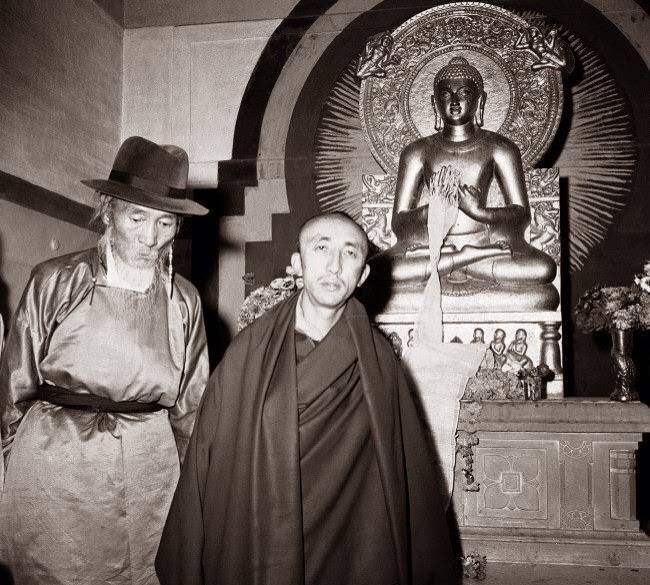
Kushog Lukhangwa former Prime Minister of Tibet and Bakula Rinpoche MP from Ladakh
Lukhangwa. former Prime Minister of Tibet and Kushog Bakula Rimpoche, MP from Ladakh
THE SAGAN SERIES – The Pale Blue Dot
================================
Playing in the Major Leagues.
George Town, Cayman Islands – 19 October 2009
Climate change is the most serious peril that has faced humanity in its long history. However, we are faced with more than climate change, there is peak oil and an out of control population, as well as concerns for water and food security in the years to come.
As I said to a colleague earlier today “failing to plan is planning to fail”.
Humanity is today playing in the major leagues. We are in a sink or swim situation. If we can keep the planet habitable by mitigating and adapting to the changing climate, switching to alternative sources of energy such as solar, wind, geothermal, wave, ocean thermal and nuclear, sequester CO2 and provide the population with adequate supplies of water and food and bring the population under control, humanity may survive .
Warfare and conflict will also need to become a thing of the past as climate change and energy may well exacerbate conflict situations. With a 9.5 billion global population by 2050 ensuring that everyone has adequate food and water could be problematic.
There is however, no ‘Plan B’ if we fail to resolve all the problems facing us.
When playing in the major leagues there is no time out, there is no one that is going to offer help, let alone rescue us. Look around, the neighbourhood is somewhat sparsely populated and there are no other worlds on which humanity can survive. Even if there were other habitable worlds nearby they would in all probability belong to someone else.
There are, in all likelihood, other intelligent races out there somewhere, however in the major leagues one survives on ones own. As a young civilisation it is up to us to solve all our problems, to make peace among ourselves, to bring the population under control, to implement the Millennium Development Goals (MDG). We must solve our own problems. As a young race we are as children, and as such we may not be able to solve our own problems. But solve them we must.
If we are able to solve the situation facing us and make it to adulthood, in the galactic meaning of the world, we may then be introduced to the neighbours.
One of the most hopeful initiatives that has been started is the Eradicating Ecocide Initiative. Ecocide is the extensive damage to , destruction of or loss of ecosystems. It is happening on a mass scale, every day and it is getting worse. We can change this. Our aim is to stop the destruction of the Earth by making ecocide the 5th Crime Against Peace. Ecocide is a crime against nature, humanity and future generations. See http://www.thisisecocide.com/
An international law of Ecocide would make CEOs and our Heads of State legally responsible for protecting the Earth. People and planet will become the number one priority.
If we do not make it to adulthood we will be just another minor statistic, a failure, a insignificant footnote in the universal history book.
For all these reasons we have to come together and produce a new global climate change deal to replace the ageing Kyoto treaty. Unless we can do so, we are ‘planning to fail‘.
Posted by Nick Robson at 3:36 PM
Labels: catastrophe, climate
==========================
Published on Oct 21, 2013 • Facebook – http://www.facebook.com/thesaganseries
Twitter – http://twitter.com/reidgower
G+ – http://bit.lyA/pHzQh
The Sagan Series is an educational project working in the hopes of promoting scientific literacy in the general population. Created by ©ReidGower http://twitter.com/reidgower
Copyright Disclaimer Under Section 1 07 of the Copyright Act 1976, allowance is made for “fair use” for purposes such as criticism, comment, news reporting, teaching, scholarship, and research. Fair use is a use permitted by copyright statute that might otherwise be infringing. Non-profit, educational or personal use tips the balance in favor of fair use.
All copyrighted materials contained herein belong to their respective copyright holders, I do not claim ownership over any of these materials. I realize no profit, monetary or otherwise, from the exhibition of these videos.
Applications are now being accepted for The United Nations Framework Convention on Climate Change (UNFCCC) Fellowship Programme for SIDS.

In celebration of today's World Environment Day 2014 and in support of the International Year of SIDS, the UNFCCC secretariat is calling for applications for two five months fellowships to support the secretariat’s work on adaptation and youth/gender and climate change.

Read more: http://unfccc.int/4429
The white, reflective barrier protecting our northern polar region from the heat-amplifying effects of human-caused warming took a severe blow today. The National Snow and Ice Data Center’s sea ice area measure essentially fell off a cliff as values plummeted by more than 286,000 square kilometers. That’s an area of ice the size of Nevada lost in a single 24 hour period. A state-sized region flipping from white, reflective, cooling ice, to dark, heat-absorptive water.
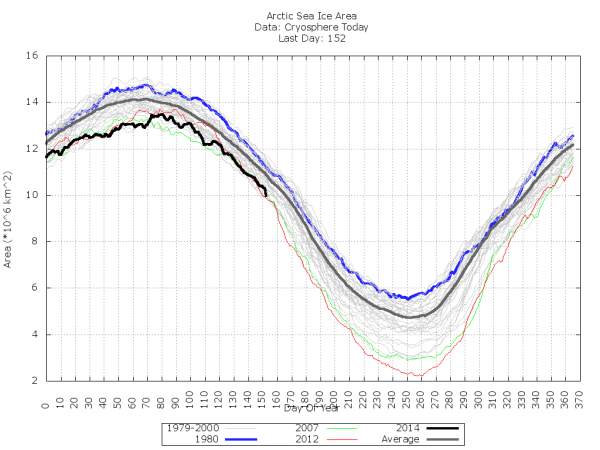
(Most recent day’s sea ice area measure shows vertical drop for the most recent 24 hour period. Data source: Cryosphere Today/NSIDC. Image source: Pogoda i Klimat.)
Overall, the sprawl of sea ice fell to 9,984,000 square kilometers or a negative 907,000 square kilometer anomaly vs the already low 1979 to 2008 mean. The fall was rapid enough to bring sea ice area to within striking distance of new record lows for the date…
View original post 2,104 more words
|
||||||||||||||||||||||||||||||||||||||||||||||||||||||||||||||||||||||
|
 © 2014