Who Will Feed China

Twenty years ago, Lester Brown published an article in World Watch magazine entitled “Who Will Feed China?” A year later, he followed with a book of the same name.
The article and book generated an enormous outcry from China and dozens of conferences, seminars, and studies, as he writes in his autobiography, Breaking New Ground.

“In 1994 I wrote an article for the September/October issue of World Watch magazine entitled “Who Will Feed China?” The late August press conference releasing it generated only moderate coverage. But when the article was reprinted that weekend on the front of the Washington Post’s Outlook section with the title “How China Could Starve the World,” it unleashed a political firestorm in Beijing. …

The World Watch article attracted more attention than anything I have ever written. In addition to appearing in our magazine’s five language editions—English, Japanese, Chinese (Taiwan), German, and Italian—it also appeared in abridged form in many of the world’s leading newspapers, including the Washington Post, Los Angeles Times, and the International Herald Tribune. It was syndicated internationally by both the Los Angeles Times and The New York Times. Among the other major news organizations covering the analysis were the Associated Press and The Wall Street Journal, including the Asian edition. …

One of the most interesting responses was in Washington, DC, where the National Intelligence Council, the umbrella over all the U.S. intelligence agencies, analyzed the effect of China’s growing demand for grain on world agriculture and any security threats that it might pose. A panel of prominent researchers, led by Michael McElroy, then head of the Department of Earth and Planetary Sciences at Harvard, produced a first-rate study of several hundred pages. …

Meanwhile, within China, every few weeks another study was released attempting to demonstrate why my analysis was wrong. These critiques came from such disparate sources as a scientist from the Chinese Academy of Sciences, an official from the Ministry of Agriculture, and an independent academic scholar. Not long after, an enterprising Chinese publisher took a copy of the original World Watch magazine article and a collection of the critiques of it and published them in a book entitled The Great Debate Between Lester Brown and China. …

Over time, China’s leaders came to both appreciate and acknowledge how Who Will Feed China? had helped change their thinking. A late 1998 issue of Feedstuffs, a weekly agribusiness newspaper, quotes Lu Mai, an agricultural economist and senior fellow at a government think tank in Beijing, as saying, “Brown seems to have been accorded guru status in high places. ‘He’s like the monk from outside who knows how to read the Bible.’” …

Lester proved prescient in his analysis. China is a leading importer of grain and it imports a staggering 60 percent of all soybeans entering world trade—and it looks like it will continue. The problem is not so much population growth, but China’s rising affluence, which is allowing its population to move up the food chain, consuming more grain-intensive livestock, poultry, and farmed fish.

Janet Larsen, EPI’s director of research, wrote last year on the Chinese purchase of Smithfield, the world’s leading pork producer. She has also written on how China’s meat consumption has grown to double that of the United States where meat consumption is falling.

Essentially, twenty years later, we are still wondering who will feed China?

Lester has written a number of articles over the last dozen years about China, which are available on Earth Policy Institute’s website. Below are some highlights. More


The state of the climate — and what we might do about it

Today, the UN begins its Climate Summit, enlisting the world to work together on a problem that’s too big for any one country to solve. Lord Nicholas Stern helped write the delegates’ report that outlines where we are now — and what we could do next. It’s a big vision for cooperation, with a payoff that goes far beyond averting disaster. He asks: How can we use this crisis to spur better lives for all?


Peter Van Buren, Back to the Future in Iraq

On April 4, 1967, Martin Luther King delivered a speech at Riverside Church in New York City titled “Beyond Vietnam: A Time to Break Silence.” In it, he went after the war of that moment and the money that the U.S. was pouring into it as symptoms of a societal disaster.

President Lyndon Johnson’s poverty program was being “broken and eviscerated,” King said from the pulpit of that church, “as if it were some idle political plaything on a society gone mad on war… We were taking the black young men who had been crippled by our society and sending them eight thousand miles away to guarantee liberties in Southeast Asia which they had not found in southwest Georgia and East Harlem. I could not be silent in the face of such cruel manipulation of the poor.” Twice more in that ringing speech he spoke of “the madness of Vietnam” and called for it to cease.

Don’t think of that as just a preacher’s metaphor. There was a genuine madness on the loose — and not just in the “free-fire zones” of Vietnam but in policy circles here in the United States, in the frustration of top military and civilian officials who felt gripped by an eerie helplessness as they widened a terrible war on the ground and in the air. They were, it seemed, incapable of imagining any other path than escalation in the face of disaster and possible defeat. Even in the years of Ronald Reagan’s presidency, when there was a brief attempt to paint that lost war in a more heroic hue (“a noble cause,” the president called it), that sense of madness, or at least of resulting mental illness, lingered. It remained embedded in a phrase then regularly applied to Americans who were less than willing to once again head aggressively into the world. They were suffering from, it was said, “Vietnam syndrome.”

Today, almost 25 years into what someday might simply be called America’s Iraq War (whose third iteration we’ve recently entered), you can feel that a similar “madness” has Washington by the throat. Just as King noted of the Vietnam era, since 9/11 American domestic programs and agencies have been starved while money poured into the coffers of the Pentagon and an increasingly bloated national security state. The results have been obvious. In the face of the spreading Ebola virus in West Africa, for instance, the president can no longer turn to civilian agencies or organizations for help, but has to call on the U.S. military in an “Ebola surge” — even our language has been militarized — although its forces are not known for their skills, successes, or spendthrift ways when it comes to civilian “humanitarian” or nation-building operations.

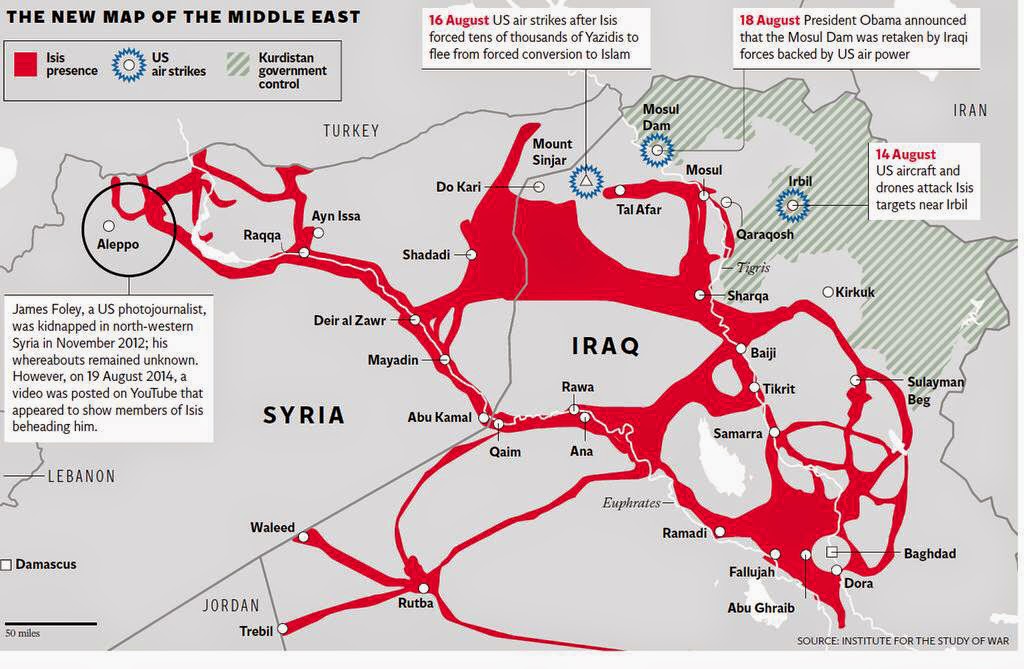
We’ve already entered the period when strategy, such as it is, falls away, and our leaders feel strangely helpless before the drip, drip, drip of failure and the unbearable urge for further escalation. At this point, in fact, the hysteria in Washington over the Islamic State seems a pitch or two higher than anything experienced in the Vietnam years. A fiercely sectarian force in the Middle East has captured the moment and riveted attention, even though its limits in a region full of potential enemies seem obvious and its “existential threat” to the U.S. consists of the possibility that some stray American jihadi might indeed try to harm a few of us. Call it emotional escalation in a Washington that seems remarkably unhinged.

It took Osama bin Laden $400,000 to $500,000, 19 hijackers, and much planning to produce the fallen towers of 9/11 and the ensuing hysteria in this country that launched the disastrous, never-ending Global War on Terror. It took the leaders of the Islamic State maybe a few hundred bucks and two grim videos, featuring three men on a featureless plain in Syria, to create utter, blind hysteria here. Think of this as confirmation of Karl Marx’s famous comment that the first time is tragedy, but the second is farce.

One clear sign of the farcical nature of our moment is the inability to use almost any common word or phrase in an uncontested way if you put “Iraq” or “Islamic State” or “Syria” in the same sentence. Remember when the worst Washington could come up with in contested words was the meaning of “is” in Bill Clinton’s infamous statement about his relationship with a White House intern? Linguistically speaking, those were the glory days, the utopian days of official Washington.

Just consider three commonplace terms of the moment: “war,” “boots on the ground,” and “combat.” A single question links them all: Are we or aren’t we? And to that, in each case, Washington has no acceptable answer. On war, the secretary of state said no, we weren’t; the White House and Pentagon press offices announced that yes, we were; and the president fudged. He called it “targeted action” and spoke of America’s “unique capability to mobilize against an organization like ISIL,” but God save us, what it wasn't and wouldn't be was a “ground war.”

Only with Congress did a certain clarity prevail. Nothing it did really mattered. Whatever Congress decided or refused to decide when it came to going to war would be fine and dandy, because the White House was going to do “it” anyway. “It,” of course, was the Clintonesque “is” of present-day Middle Eastern policy. Who knew what it was, but here was what it wasn’t and would never be: “boots on the ground.” Admittedly, the president has already dispatched 1,600 booted troops to Iraq’s ground (with more to come), but they evidently didn’t qualify as boots on the ground because, whatever they were doing, they would not be going into “combat” (which is evidently the only place where military boots officially hit the ground). The president has been utterly clear on this. There would be no American “combat mission” in Iraq. Unfortunately, “combat” turns out to be another of those dicey terms, since those non-boots had barely landed in Iraq when Chairman of the Joint Chiefs Martin Dempsey started to raise the possibility that some of them, armed, might one day be forward deployed with Iraqi troops as advisers and spotters for U.S. air power in future battles for Iraq’s northern cities. This, the White House now seems intent on defining as not being a “combat mission.”

And we’re only weeks into an ongoing operation that could last years. Imagine the pretzeling of the language by then. Perhaps it might be easiest if everyone — Congress, the White House, the Pentagon, and Washington’s pundits — simply agreed that the United States is at “war-ish” in Iraq, with boots on the ground-ish in potentially combat-ish situations. Former State Department whistleblower and TomDispatch regular Peter Van Buren spent his own time in Iraq and wrote We Meant Well: How I Helped Lose the Battle for the Hearts and Minds of the Iraqi People about it. Now, he considers the mind-boggling strangeness of Washington doing it all over again, this time as the grimmest of farces. Tom

Apocalypse Now, Iraq Edition
Fighting in Iraq Until Hell Freezes Over
By Peter Van Buren

I wanted to offer a wry chuckle before we headed into the heavy stuff about Iraq, so I tried to start this article with a suitably ironic formulation. You know, a déjà-vu-all-over-again kinda thing. I even thought about telling you how, in 2011, I contacted a noted author to blurb my book, We Meant Well: How I Helped Lose the Battle for the Hearts and Minds of the Iraqi People, and he presciently declined, saying sardonically, “So you're gonna be the one to write the last book on failure in Iraq?”

I couldn't do any of that. As someone who cares deeply about this country, I find it beyond belief that Washington has again plunged into the swamp of the Sunni-Shia mess in Iraq. A young soldier now deployed as one of the 1,600 non-boots-on-the-ground there might have been eight years old when the 2003 invasion took place. He probably had to ask his dad about it. After all, less than three years ago, when dad finally came home with his head “held high,” President Obama assuredAmericans that “we’re leaving behind a sovereign, stable and self-reliant Iraq.” So what happened in the blink of an eye?

The Sons of Iraq

Sometimes, when I turn on the TV these days, the sense of seeing once again places in Iraq I'd been overwhelms me. After 22 years as a diplomat with the Department of State, I spent 12 long months in Iraq in 2009-2010 as part of the American occupation. My role was to lead two teams in “reconstructing” the nation. In practice, that meant paying for schools that would never be completed, setting up pastry shops on streets without water or electricity, and conducting endless propaganda events on Washington-generated themes of the week (“small business,” “women's empowerment,” “democracy building.”)

We even organized awkward soccer matches, where American taxpayer money was used to coerce reluctant Sunni teams into facing off against hesitant Shia ones in hopes that, somehow, the chaos created by the American invasion could be ameliorated on the playing field. In an afternoon, we definitively failed to reconcile the millennium-old Sunni-Shia divide we had sparked into ethnic-cleansing-style life in 2003-2004, even if the score was carefully stage managed into a tie by the 82nd Airborne soldiers with whom I worked.

In 2006, the U.S. brokered the ascension to power of Prime Minister Nouri al-Maliki, a Shia politician handpicked to unite Iraq. A bright, shining lie of a plan soon followed. Applying vast amounts of money, Washington’s emissaries created the Sahwa, or Sons of Iraq, a loose grouping of Sunnis anointed as “moderates” who agreed to temporarily stop killing in return for a promised place at the table in the New(er) Iraq. The “political space” for this was to be created by a massive escalation of the American military effort, which gained a particularly marketable name: the surge.

I was charged with meeting the Sahwa leaders in my area. My job back then was to try to persuade them to stay on board just a little longer, even as they came to realize that they'd been had. Maliki’s Shia government in Baghdad, which was already ignoring American entreaties to be inclusive, was hell-bent on ensuring that there would be no Sunni “sons” in its Iraq.

False alliances and double-crosses were not unfamiliar to the Sunni warlords I engaged with. Often, our talk — over endless tiny glasses of sweet, sweet tea stirred with white-hot metal spoons — shifted from the Shia and the Americans to their great-grandfathers' struggle against the British. Revenge unfolds over generations, they assured me, and memories are long in the Middle East, they warned.

When I left in 2010, the year before the American military finally departed, the truth on the ground should have been clear enough to anyone with the vision to take it in. Iraq had already been tacitly divided into feuding state-lets controlled by Sunnis, Shias, and Kurds. The Baghdad government had turned into a typical, gleeful third-world kleptocracy fueled by American money, but with a particularly nasty twist: they were also a group of autocrats dedicated to persecuting, marginalizing, degrading, and perhaps one day destroying the country’s Sunni minority.

U.S. influence was fading fast, leaving the State Department, a small military contingent, various spooks, and contractors hidden behind the walls of the billion-dollar embassy (the largest in the world!) that had been built in a moment of imperial hubris. The foreign power with the most influence over events was by then Iran, the country the Bush administration had once been determined to take down alongside Saddam Hussein as part of the Axis of Evil.

The Grandsons of Iraq

The staggering costs of all this — $25 billion to train the Iraqi Army, $60 billion for the reconstruction-that-wasn’t, $2 trillion for the overall war, almost 4,500 Americans dead and more than 32,000 wounded, and an Iraqi death toll of more than190,000 (though some estimates go as high as a million) — can now be measured against the results. The nine-year attempt to create an American client state in Iraq failed, tragically and completely. The proof of that is on today's front pages. More


Commentary: Christopher Jorebon Loeak – President of the Republic of the Marshall Islands


This is the transcript of a video “address to the world” released by President Loeak on 18 September 2014 ahead of the UN Secretary-General's Climate Summit. The full video can be viewed here.https://www.youtube.com/watch?v=i8t7ElMPS_8

Out here in the middle of the Pacific Ocean, climate change has arrived.

In the last year alone, my country has suffered through unprecedented droughts in the north, and the biggest ever king tides in the south; and we have watched the most devastating typhoons in history leave a trail of death and destruction across the region.

Lying just two meters above sea level, my atoll nation stands at the frontline in the battle against climate change. The beaches of Buoj where I use to fish as a boy are already under water, and the fresh water we need to grow our food gets saltier every day. As scientists had predicted, some of our islands have already completely disappeared, gone forever under the ever-rising waves. For the Marshall Islands and our friends in the Pacific, this is already a full-blown climate emergency.

Some tell us that we should begin planning to leave. But how can we? And why should we? These islands are our home. They hold our history, our heritage and our hopes for the future. Are the world's polluters asking us to give up our language, our culture, and our national identity? We are not prepared to do that – we will stay and fight. If the water comes, it comes.

Brick by brick, I built the seawall behind me with my own hands. But even this is barely enough to protect my family from the encroaching waves. Last year, after returning from a visit to the United Nations in New York, I was so shocked by the damage from the rising tides that I added another foot of bricks to the wall.

In the Marshall Islands we have a saying – “Wa kuk wa jimer”. It means that we are all in the same boat together. What is happening here is a mere preview of the havoc that awaits if we continue with our polluting ways. If my country goes, others will surely follow. We are the canary in the coalmine.

The climate crisis is forcing us to take matters into our own hands, both at home and on the international stage. Last year the Marshall Islands hosted the largest-ever Pacific Islands Forum Leaders' meeting in Majuro and it remains one of the proudest moments of my Presidency.

The big outcome was the Majuro Declaration for Climate Leadership, a powerful message from the world's most vulnerable countries to the big emitters that surround us that the time for talk is over, and the time for action is now. Our efforts had an impact with the United States, the European Union, the United Kingdom, Mexico and Japan all committing to be climate leaders, and to do more to tackle climate change. At this time last year, I presented the Declaration to UN Secretary-General Ban Ki-moon, and promised to bring the spirit of Majuro to his Climate Change Leaders' Summit in New York, which is now less than a week away.

The Summit comes not a moment too soon. It is the first gathering of world leaders on climate change in nearly five years, and just over a year before our deadline to sign a new global treaty on climate change in Paris at the end of 2015.

Paris cannot be another Copenhagen. The world has changed too much. The science is more alarming, the impacts more severe, the economics more compelling, and the politics more potent. Even the world's two biggest polluters – China and the United States – are working together to find a pathway to a new global agreement.

But there are still some that seek to slow us down.

To my fellow world leaders I say “next week's Summit is a chance for all of us to be the leaders we were elected to be”. We must send a strong and united message to the world – and to the people that we represent – that we are ready to do a deal next year. And to avoid the worst impacts of a warmer world, this new deal must capture a vision for a carbon-free world by the middle of the century. Without it, no seawall will be high enough to save my country. Together, we must find the courage to rise to this challenge. It is time to build the greatest climate change alliance the world has ever seen.

My people are counting on it, as is all of humanity.

Christopher J. Loeak is the President of the Republic of the Marshall Islands


Whether We Engage or Do Nothing… This Changes Everything

The following is an excerpt taken from the introduction of Naomi Klein's newly published book, This Changes Everything: Capitalism vs. the Climate, and appears at Common Dreams with permission from the book's publisher Simon & Shuster. All rights reserved.

“Most projections of climate change presume that future changes—greenhouse gas emissions, temperature increases and effects such as sea level rise—will happen incrementally. A given amount of emission will lead to a given amount of temperature increase that will lead to a given amount of smooth incremental sea level rise. However, the geological record for the climate reflects instances where a relatively small change in one element of climate led to abrupt changes in the system as a whole. In other words, pushing global temperatures past certain thresholds could trigger abrupt, unpredictable and potentially irreversible changes that have massively disruptive and large-scale impacts. At that point, even if we do not add any additional CO2 to the atmosphere, potentially unstoppable processes are set in motion. We can think of this as sudden climate brake and steering failure where the problem and its consequences are no longer something we can control.” —Report by the American Association for the Advancement of Science, the world’s largest general scientific society, 2014

“I love that smell of the emissions.” — Sarah Palin, 2011

I denied climate change for longer than I care to admit. I knew it was happening, sure. Not like Donald Trump and the Tea Partiers going on about how the continued existence of winter proves it’s all a hoax. But I stayed pretty hazy on the details and only skimmed most of the news stories, especially the really scary ones. I told myself the science was too complicated and that the environmentalists were dealing with it. And I continued to behave as if there was nothing wrong with the shiny card in my wallet attesting to my “elite” frequent flyer status

Climate change is… hard to keep it in your head for very long. We engage in this odd form of on-again-off-again ecological amnesia for perfectly rational reasons. We deny because we fear that letting in the full reality of this crisis will change everything. And we are right.”

A great many of us engage in this kind of climate change denial. We look for a split second and then we look away. Or we look but then turn it into a joke (“more signs of the Apocalypse!”). Which is another way of looking away.

Or we look but tell ourselves comforting stories about how humans are clever and will come up with a technological miracle that will safely suck the carbon out of the skies or magically turn down the heat of the sun. Which, I was to discover while researching this book, is yet another way of looking away.

“Climate change is… hard to keep it in your head for very long. We engage in this odd form of on-again-off-again ecological amnesia for perfectly rational reasons. We deny because we fear that letting in the full reality of this crisis will change everything. And we are right.”

Or we look but try to be hyper-rational about it (“dollar for dollar it’s more efficient to focus on economic development than climate change, since wealth is the best protection from weather extremes”)—as if having a few more dollars will make much difference when your city is underwater. Which is a way of looking away if you happen to be a policy wonk. Or we look but tell ourselves we are too busy to care about something so distant and abstract—even though we saw the water in the subways in New York City, and the people on their rooftops in New Orleans, and know that no one is safe, the most vulnerable least of all. And though perfectly understandable, this too is a way of looking away.

Or we look but tell ourselves that all we can do is focus on ourselves. Meditate and shop at farmers’ markets and stop driving—but forget trying to actually change the systems that are making the crisis inevitable because that’s too much “bad energy” and it will never work. And at first it may appear as if we are looking, because many of these lifestyle changes are indeed part of the solution, but we still have one eye tightly shut.

Or maybe we do look—really look—but then, inevitably, we seem to forget. Remember and then forget again. Climate change is like that; it’s hard to keep it in your head for very long. We engage in this odd form of on-again-off-again ecological amnesia for perfectly rational reasons. We deny because we fear that letting in the full reality of this crisis will change everything. And we are right.

We know that if we continue on our current path of allowing emissions to rise year after year, climate change will change everything about our world. Major cities will very likely drown, ancient cultures will be swallowed by the seas, and there is a very high chance that our children will spend a great deal of their lives fleeing and recovering from vicious storms and extreme droughts. And we don’t have to do anything to bring about this future. All we have to do is nothing. Just continue to do what we are doing now, whether it’s counting on a techno-fix or tending to our gardens or telling ourselves we’re unfortunately too busy to deal with it.

All we have to do is not react as if this is a full-blown crisis. All we have to do is keep on denying how frightened we actually are. And then, bit by bit, we will have arrived at the place we most fear, the thing from which we have been averting our eyes. No additional effort required.

There are ways of preventing this grim future, or at least making it a lot less dire. But the catch is that these also involve changing everything. For us high consumers, it involves changing how we live, how our economies function, even the stories we tell about our place on earth. The good news is that many of these changes are distinctly un-catastrophic. Many are downright exciting. But I didn’t discover this for a long while.

“All we have to do is not react as if this is a full-blown crisis. All we have to do is keep on denying how frightened we actually are. And then, bit by bit, we will have arrived at the place we most fear, the thing from which we have been averting our eyes. No additional effort required.”

I remember the precise moment when I stopped averting my eyes to the reality of climate change, or at least when I first allowed my eyes to rest there for a good while. It was in Geneva, in April 2009, and I was meeting with Bolivia’s ambassador to the World Trade Organization (WTO), who was then a surprisingly young woman named Angélica Navarro Llanos. Bolivia being a poor country with a small international budget, Navarro Llanos had recently taken on the climate portfolio in addition to her trade responsibilities. Over lunch in an empty Chinese restaurant, she explained to me (using chopsticks as props to make a graph of the global emission trajectory) that she saw climate change both as a terrible threat to her people—but also an opportunity.

A threat for the obvious reasons: Bolivia is extraordinarily dependent on glaciers for its drinking and irrigation water and those white-capped mountains that tower over its capital were turning gray and brown at an alarming rate. The opportunity, Navarro Llanos said, was that since countries like hers had done almost nothing to send emissions soaring, they were in a position to declare themselves “climate creditors,” owed money and technology support from the large emitters to defray the hefty costs of coping with more climate-related disasters, as well as to help them develop on a green energy path.

She had recently given a speech at a United Nations climate conference in which she laid out the case for these kinds of wealth transfers, and she gave me a copy. “Millions of people,” it read, “in small islands, least developed countries, landlocked countries as well as vulnerable communities in Brazil, India and China, and all around the world—are suffering from the effects of a problem to which they did not contribute. . . . If we are to curb emissions in the next decade, we need a massive mobilization larger than any in history. We need a Marshall Plan for the Earth. This plan must mobilize financing and technology transfer on scales never seen before. It must get technology onto the ground in every country to ensure we reduce emissions while raising people’s quality of life. We have only a decade.” More


At Climate March in New York, a Clarion Call for Action

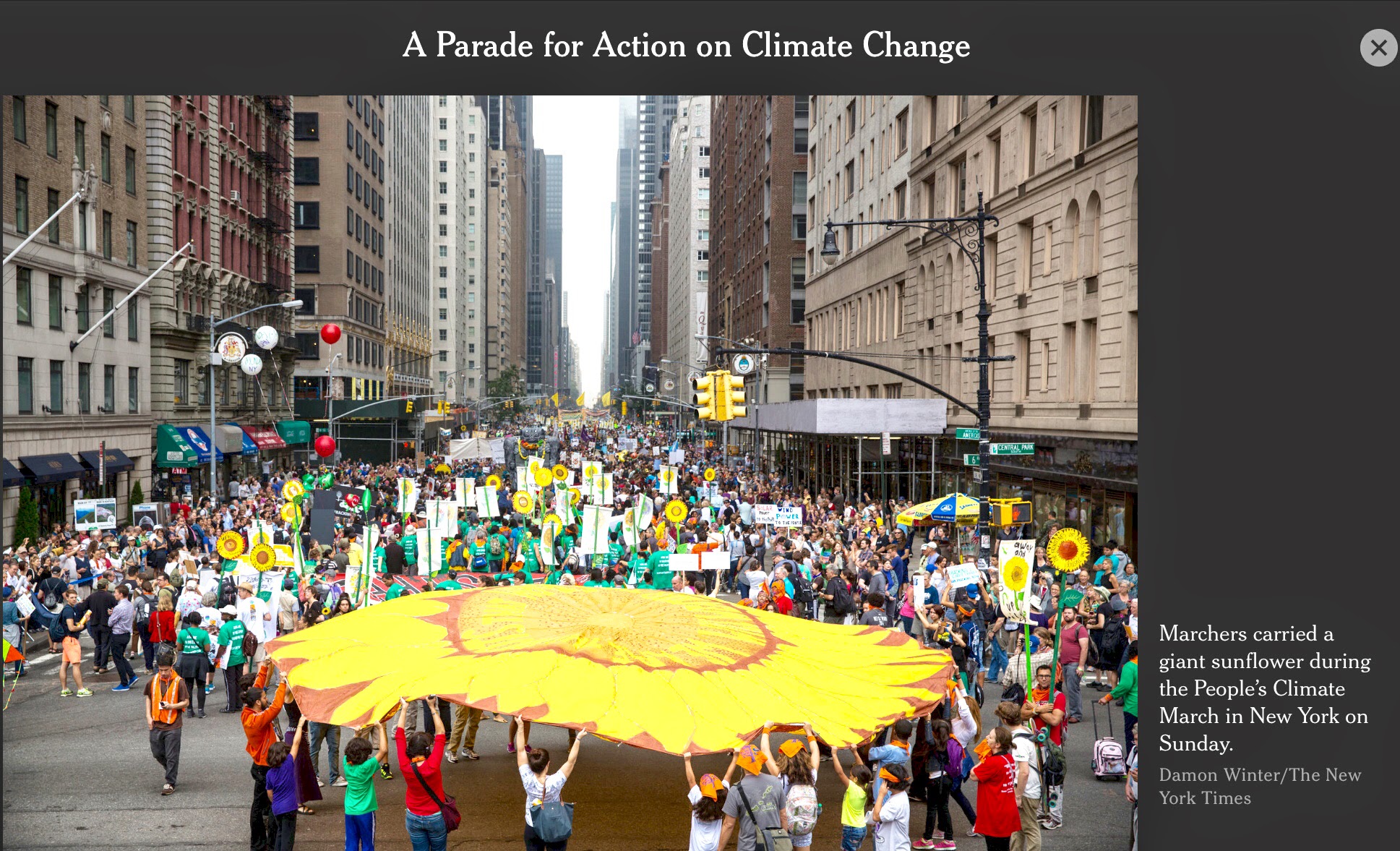
After months of planning, the People’s Climate March began rolling through a large swath of Midtown Manhattan on Sunday, taking public frustration over stalled efforts to curb carbon emissions to the streets in a noisy, vivid display of unity.

At 11:30 a.m., the march began moving east along 59th Street from Columbus Circle, proceeding along a circuitous, two-mile route, and drawing labor and immigrant groups, students and politicians, scientists and religious leaders. The march will turn south on Avenue of the Americas, head west on 42nd Street to 11th Avenue and finish at 34th Street.

The protest comes two days before a climate summit at the United Nations, which will be attended by President Obama. The meeting is expected to create a framework for a potential global agreement on emissions late next year in Paris.

The timing of the march is significant in another regard. Last week, meteorologists at the National Oceanic and Atmospheric Administration announced that this summer — the months of June, July and August — was the hottest on record for the globe, and that 2014 was on track to break the record for the hottest year, set in 2010.

“Climate change is no longer an environmental issue; it’s an everybody issue,” Sam Barratt, a campaign director for the online advocacy group Avaaz, which helped plan the march, said on Friday.

“The number of natural disasters has increased and the science is so much more clear,” he added. “This march has many messages, but the one that we’re seeing and hearing is the call for a renewable revolution.”

Mayor Bill de Blasio of New York, whose administration announced this weekend a sweeping plan to overhaul energy efficiency standards in all city-owned buildings, is among the high-profile participants expected to join the march, including the United Nations secretary general, Ban Ki-moon; former Vice President Al Gore; the actors Leonardo DiCaprio and Mark Ruffalo; at least two United States senators; and one-third of the New York City Council.

Additionally, nearly 2,700 climate events are planned in more than 150 countries to coincide with the march, considered the centerpiece of the international protest. They range from a small rally in Tanzania, to major demonstrations from Berlin to Bogata.

On Sunday morning, participants from across the country began to arrive at the staging area near the American Museum of Natural History. Rosemary Snow, 75, stretched her legs after a nearly 14-hour bus drive from Georgia.

“I thought we’d have a lot of younger people on the bus,” said Ms. Snow, who made the trip with her grandson. “There’s a really great mix of people.”

Ms. Snow had traveled with dozens of others who came from different parts of the state, including Valdosta, Savannah and Atlanta.

A professor at the University of Georgia, Chris Cuomo, from Decatur, Ga., said the group was organized by the Georgia Climate Change Coalition.

She said she hoped their presence at the rally would “let the rest of the world know that people from small-town America, urban America, rural America care about climate change.”

Nearby, Ahni Rocheleau of Santa Fe, N.M., was seated while eating a breakfast of organic yogurt and buckwheat pancakes. She is a member of the Great March for Climate Action, a cross-country walk to raise awareness for alternative and sustainable energy practices.

“We hope the heart and mind of the people will be awakened,” she said. “Coal is not the way to go.”

The march was expected to tie up traffic across a broad area of Manhattan, from the Upper West Side through Midtown. In a traffic advisory, the police braced the public for the closing of dozens of streets along the route. A lane for emergency vehicles, however, was kept open.

Nearly 500 buses have been bringing marchers from South Carolina, Kansas, Minnesota and Canada, while a “climate train” transported participants from California.

Marchers assembled before 11:30 a.m. north of Columbus Circle, specifically along Central Park West between 65th and 86th Streets, which the police planned to use as a staging area. A number of pre-march events were planned in the vicinity of Columbus Circle, including a labor event on Broadway, an interfaith religious service on West 58th Street and a rally by scientists outside the Hayden Planetarium on West 81st Street.

At 12:58 p.m., a moment of silence will be followed by a blare of noise — a symbolic sounding of the alarm on climate change — from horns, whistles and cellphone alarms. More than 20 marching bands and tolling church bells will contribute to the cacophony.

There will be no speeches, but the march will end with a block party on 11th Avenue between 34th and 38th Streets. There, participants can get a closer look at many of the floats and other artwork created for the march, including a 30-foot inflatable life preserver, 100 sunflowers and a model of the New York City skyline with bicyclists powering its lights.

New York’s political establishment was set to come out in force. On Friday, Mayor de Blasio announced on Twitter his intention to join the protest. “Proud to walk in #PeoplesClimate March on Sunday,” he wrote. “It’s everyone’s responsibility to leave a livable planet for the next generation.”

At least 17 council members planned to march. In a nod to the event, the Council announced a related package of bills on Friday aimed at reducing the city’s carbon footprint by connecting unemployed New Yorkers to green jobs, making buildings more energy-efficient and promoting low-carbon transportation. The legislation seeks an 80 percent reduction in the city’s greenhouse gas emissions by 2050.

With its bands and colorful floats, the march offers a festive atmosphere, but organizers said that the underlying message was somber. “We are trying to celebrate our lives and this planet in order to show that this is what we are fighting for,” said Leslie Cagan, the logistics coordinator for People’s Climate March. “It’s the human spirit — and everything else on this planet — that is in danger.”

The march was organized by a dozen environmental, labor and social justice groups, including the Sierra Club, Avaaz, New York City Environmental Justice Alliance, 350.org, the Transport Workers Union Local 100 and 1199 S.E.I.U. In addition, more than 1,570 “partner organizations” have signed on to march.

Organizers were hoping that the warm weather forecast for the day would yield a large turnout.

“Our biggest problem is the financial power of the fossil fuel industry,” said Bill McKibben, co-founder of 350.org and author of “The End of Nature.”

“We can’t match that money,” he said. “So we have to work in the currency of movements — passion, spirit, creativity and bodies — and it will all be on display on Sunday.” More


Curbing climate change: The deepest cuts

ON SEPTEMBER 23rd 120-odd presidents and prime ministers will gather in New York for a UN meeting on climate change. It is the first time the subject has brought so many leaders together since the ill-fated Copenhagen summit of 2009.


Now, as then, they will assert that reining in global warming is a political priority. Some may commit their governments to policies aimed at reducing greenhouse-gas emissions. What few will say is how many tonnes of carbon dioxide these will save—because they almost never do.

According to scientists, cutting carbon-dioxide emissions is an essential part of reducing catastrophic risks from climate change. Yet governments are persistently averse to providing estimates of how much carbon a policy saves. That may be because, in countries where climate change is controversial, it makes more sense to talk about the other benefits a scheme offers rather than its effect on carbon. Or it may be that, in countries which are enthusiastic about renewable energy, pointing out that it may not save that much carbon is seen as unhelpful. Or perhaps governments think climate change is so serious that all measures must be taken, regardless of cost (though their overall lacklustre record suggests this is not the case).

Whatever the reason, the end result is that while the world’s governments have hundreds of policies for tackling climate change, some of them very expensive—China, America and the European Union spend $140 billion a year on subsidising renewable energy—it is hard to say which policies are having the greatest effect.

So The Economist has made a stab at a global comparison of carbon-mitigation efforts. Chart 1 is the result. It ranks 20 policies and courses of action according to how much they have done to reduce the atmosphere’s stock of greenhouse gases. We have used figures from governments, the EU and UN agencies. As far as we know, this exercise has not been carried out before.

Apples, meet oranges

First, a health warning: the policies and actions on our list are not strictly comparable. Some are global, some regional and some national. Some are long-standing; some new. A couple are not policies at all, such as the collapse of the Soviet Union, which led to the closure of polluting factories and to inefficient state farms reverting to grassland, locking up carbon.

And the numbers almost all come with caveats. It is fairly easy to estimate how much carbon a new field full of solar cells or a nuclear-power plant saves by looking at the amount of electricity it produces in a year and how much carbon would have been emitted if fossil fuels had been used instead, based on the local mix of coal, gas and oil. But as Paul Joskow of the Massachusetts Institute of Technology has pointed out, the standard “levelised” calculations, which divide the total amount of power a plant will produce over its lifetime by its total lifetime cost, are a poor way to compare fossil fuels and renewable energy.

Other measures have problems, too. Take the effects of fuel-efficiency standards. Would companies have curtailed their cars’ emissions anyway to sell more of them to cost- and mileage-conscious drivers? And how much has better fuel efficiency encouraged drivers to drive farther?

A further complication is that many policies have benefits beyond—or indeed closer to hand than—those they offer in terms of climate. Burning less coal saves lives in the near future as well as reducing climate risks in decades to come. Saving forests preserves wildlife, not just carbon.

So our table should be treated with caution. It is only safe to say that one policy is better than another in climate terms if it beats it by a wide margin.

As it happens, though, there are some very wide margins to be found. One policy stands head and shoulders above all others. And it is one that few people other than climate-policy specialists will have thought of in this context: the Montreal protocol, a 1987 agreement to phase out substances such as chlorofluorocarbons (CFCs) used in air conditioners, refrigerators and so on. It was enacted to limit the damage such substances were doing to the ozone layer, a goal which it has achieved.

Like carbon dioxide and many other gases emitted by industry and agriculture—methane and nitrous oxide, for example—CFCs are greenhouse gases. And they are extremely potent ones, causing thousands of times more warming per molecule than carbon dioxide does. That means stopping CFC production, which was in the range of millions of tonnes a year, delivered a climate benefit equivalent to cutting carbon-dioxide emissions by billions of tonnes.

Collateral benefits

Guus Velders of the Dutch National Institute for Public Health and the Environment has compared the warming effect that would have come about if the emissions of such chemicals had continued to grow at the rate they were growing before the protocol with what has come about thanks to their banning. The net effect is equivalent to that of a whopping 135 billion tonnes of carbon dioxide. That is more than twice today’s total annual greenhouse-gas emissions, which are equivalent to about 50 billion tonnes of carbon dioxide (carbon dioxide itself makes up about three-quarters of that, with methane, nitrous oxide and some gases used in industry making up the rest). Durwood Zaelke of the Institute for Governance and Sustainable Development, a think-tank, says that if CFCs were uncontrolled the annual figure would be 8 billion tonnes higher. The Montreal protocol has had nearly as big an effect as all the rest of our list put together.

Trailing some way behind the Montreal protocol is a small group of measures—not really climate policies—that have been responsible for avoiding between 4% and 7% of greenhouse-gas emissions. According to the International Atomic Energy Agency, nuclear power avoided the production of 2.2 billion tonnes of carbon dioxide in 2010—that is, emissions would have been 2.2 billion tonnes higher if the same amount of electricity had been produced by non-nuclear plants. Energy from dams and other hydroelectric sources avoided 2.8 billion tonnes (though emissions of methane from the reservoirs behind some of those dams mean the net effects were less than that). Between them they generated 6,000 terawatt-hours of electricity in 2011, compared with 450TWhrs for wind and less than 60TWhrs for solar. The high rate at which new wind and solar capacity is being built will eat into this lead, but it will take some time to overturn it.

The other item in this group is something of a cheat. In 2007 Su Wei of China’s foreign ministry said that his country’s one-child policy, by reducing the number of births between the late 1970s and the mid-2000s by 300m, had reduced carbon emissions by 1.3 billion tonnes in 2005 (because there were fewer people to consume goods which generated greenhouse gases in their production). Taking this argument further, one could say that the fall in global fertility since 1960 cut emissions even more. That is not exactly a climate policy. But it is a reminder that greenhouse gases are powerfully influenced by factors far beyond the scope of climate-change policies.

Three other lessons emerge. First, policies to slow or reverse deforestation are more important than one might expect. Trees absorb carbon as they grow and release it when they are cut down. According to a recent study in Science, declining deforestation in Brazil meant that the country produced 3.2 billion tonnes less atmospheric carbon dioxide between 2005 and 2013 than it would have if the tree-felling had continued unabated. That is 400m tonnes a year. The slowdown in deforestation in tropical countries is one of the reasons that the conversion of forests to farmland now accounts for only 11% of greenhouse-gas emissions globally, much less than 20 years ago.

The other reason for deforestation’s dramatically reduced share of total emissions, though, is that industrial emissions of carbon dioxide have continued to grow rapidly. The rise is not as fast as it might have been. Rules that make vehicles more efficient and improve the energy efficiency of buildings and appliances have done more than might be expected. America has been setting standards for vehicle greenhouse-gas emissions and fuel efficiency since the mid 1970s; the current rules are forecast to reduce carbon-dioxide emissions by 6 billion tonnes in 2012-25, meaning by about 460m tonnes a year. America’s Department of Transportation reckons that overall such rules have reduced carbon-dioxide emissions by a cumulative 14 billion tonnes. Europe’s equivalent regulations for passenger cars and light trucks do less (European vehicles were more efficient to start with) but are still respectable; being adopted by overseas manufacturers who want to sell cars in Europe gives them an unquantified extra clout. More