

Month: July 2014
 © 2014
The cruel cease-fire charade
So far, the diplomatic effort to end the violence in Gaza has failed miserably, with Israel on Friday rejecting a cease-fire proposal from U.S. Secretary of State John Kerry. (On Saturday Israel and Hamas agreed to a 12-hour humanitarian pause in the fighting brokered by the United Nations.)

Washington’s attempt is representative of the overall failure of American policy toward the Israeli-Palestinian conflict, only on this occasion the consequences can be measured in the growing pile of dead bodies and the widespread devastation that includes numerous homes, public buildings and even artillery damage to several United Nations schools sheltering Palestinian civilians.
The U.S. approach fails because it exhibits extreme partisanship in a setting where trust, credibility and reciprocity are crucial. Kerry is undoubtedly dedicated to achieving a cease-fire, just as he demonstrated for most of the past year in pushing for a negotiated peace agreement between Israel and the Palestinian Authority. Yet the United States exhibited its tendency toward extreme partisanship when it designated Martin Indyk, a former staff member of the America Israel Public Affairs Committee (AIPAC) and former ambassador to Israel, as the U.S. special envoy to the peace talks.
The U.S. approach up to this point to achieving a cease-fire in Gaza has been undertaken in a manner that is either woefully ignorant of the real constraints or callously cynical about their relevance. This is especially clear from the attempt to garner a cease-fire by consulting only one side, Israel — the party bearing the major responsibility for causing massive casualties and damage — and leaving Hamas out in the cold. Even if this is a consequence of Hamas being treated as “a terrorist entity,” it still makes no sense. When Israel wanted to deal with Hamas in the past, it had no trouble doing so — for instance, when it arranged the prisoner exchange that led to the release of the single captured Israeli soldier Gilad Schalit back in 2011.
The basic facts are astounding: The U.S. relied on Egypt as the broker of a proposal it vetted, supposedly with the text delivered personally by Tony Blair to President Abdel Fattah El Sisi in Cairo, endorsed by the Netanyahu government, and then announced on July 15 via the media as a cease-fire proposal accepted by Israel, without Hamas even knowing the details. It’s a diplomatic analogue to the theater of the absurd. Last July, then-General Sisi was the Egyptian mastermind of a coup that brutally cracked down on the Muslim Brotherhood and criminalized the entire organization. The Sisi government has made no secret of its unrelenting hostility to Hamas, which it views as an offshoot of the Muslim Brotherhood. It destroyed the extensive tunnel network connecting Gaza with the outside world to circumvent the punitive Israeli blockade that has been maintained since 2007. Is there any reason for Hamas to go forward with such a cease-fire arrangement? As some respected Israeli commentators have suggested, most prominently Amira Hass, the “normalization” of the occupation is what the Israeli military operation Protective Edge is all about. Hass suggests that Israel seeks a compliant Palestinian response to an occupation that has for all intents and purposes become permanent. Such periodic shows of force aim to break once and for all the will to resist, associated with Hamas and its rockets.
Even more telling, the cease-fire’s terms were communicated to Hamas via the media, making the proposal “take it or leave it.” It also ignored the reasonable conditions Hamas had posited as the basis of a cease-fire it could accept. These conditions included ending the unlawful seven-year siege of Gaza, releasing prisoners arrested in the anti-Hamas campaign prior to launching the military operation on July 8, and stopping interference with the unity government that brought Hamas and the Palestinian Authority together on June 3. Kerry, by contrast, has urged restoring the cease-fire text that had been accepted by both sides in November 2012 after the previous major Israeli military attack upon Gaza.
Hamas’ chief leader, Khaled Meshaal, has been called “defiant” by Kerry because he would not go along with this tilted diplomacy. “Everyone wanted us to accept a cease-fire and then negotiate for our rights,” Meshaal said. This was tried by Hamas in 2012 and didn’t work. As soon as the violence ceased, Israel refused to follow through on the cease-fire agreement that had promised negotiations seeking an end of the blockade and an immediate expansion of Gazan fishing rights.
In the aftermath of Protective Edge is it not reasonable, even mandatory, for Hamas to demand a firm commitment to end the siege of Gaza? Israel as the occupying power has an obligation under the Geneva Conventions to protect the civilian population of an occupied people. Israel claims that its “disengagement” in 2005, involving the withdrawal of security forces and the dismantling of settlements, ended such obligations. Such a position is almost uniformly rejected in the international community, since the persistence of effective Israeli control of entry and exit, as well as air and sea, and violent incursions amounts to a shift in the form of occupation — not its end. Israel is certainly right to complain about the rockets, but it is wrong to impose an oppressive regime of collective punishment on the civilians of Gaza. More
Distributed Water Balance of the Nile Basin [HD]
Water is the new oil. This means that it will become, if it has not already done so, become a trigger for conflict.
This visualization shows how satellite data and NASA models are being applied to study the hydrology of the Nile basin. The Tropical Rainfall Measurement Mission (TRMM) Multisensor Precipitation Analysis fTMPA) provides three-hourly estimates of rainfall rate across much of the globe.
Here we see the seasonal cycle of monthly precipitation derived from TMPA for Africa, including the Nile Basin. The annual migration of the Intertropical Convergence Zone (ITCZ) from the Nile Equatorial Lakes region around Lake Victoria, source of the White Nile, northward into Sudan and the highlands of Ethiopia, headwaters of the Blue Nile, and back is evident in the seasonal cycle in precipitation. This precipitation cycle drives flow through the Nile River system. The Nile basin, however, is intensely evaporative, and the majority of the water that falls as rain leaves the basin as evaporation rather than river flow—either from the humid headwaters regions or from large resen/oirs and irrigation developments in Egypt and Sudan.
The Atmosphere Land Exchange Inverse (ALEXI) evapotranspiration product, developed by USDA scientists, uses satellite data to map daily evapotranspiration across the entire Nile basin, providing unprecedented information on water consumption. The balance of rainfall and evapotranspi ration can be seen in seasonal patterns of soil moisture, as simulated by the NASA Nile Land Data Assimilation System (LDAS), which merges satellite information with a physically-based land surface model to simulate variability in soil moisture—a critical variable for rainfed agriculture and natural ecosystems. Finally, the twin satellites of the Gravity Recovery and Climate Experiment (GRACE) can be used to monitor variability in total water storage, including surface water, soil moisture, and groundwater. The annual cycle in GRACE estimates of water storage anomalies clearly shows the seasonal movement of water storage due to precipitation patterns and the movement of surface waters from headwaters regions into the wetlands of South Sudan and the resen/oirs of the lower Nile basin.
The Nile is the longest river in the world and its basin is shared by 11 countries. Reliable, spatially distributed estimates of hydrologic storage and fluxes can provide critical information for water managers contending with multiple resource demands, a variable and changing climate, and the risk of damaging floods and droughts. NASA observations and modeling systems offer unique capabilities to meet these information needs.
Completed: 7 May 2013
Animator: Trent L. Schindler (USRA) (Lead)
Producer: Jefferson Beck (USRA)
Scientists: David Toll (NASA/GSFC)
Ben Zaitchik (Johns Hopkins University)
5Cs explores partnership with universities

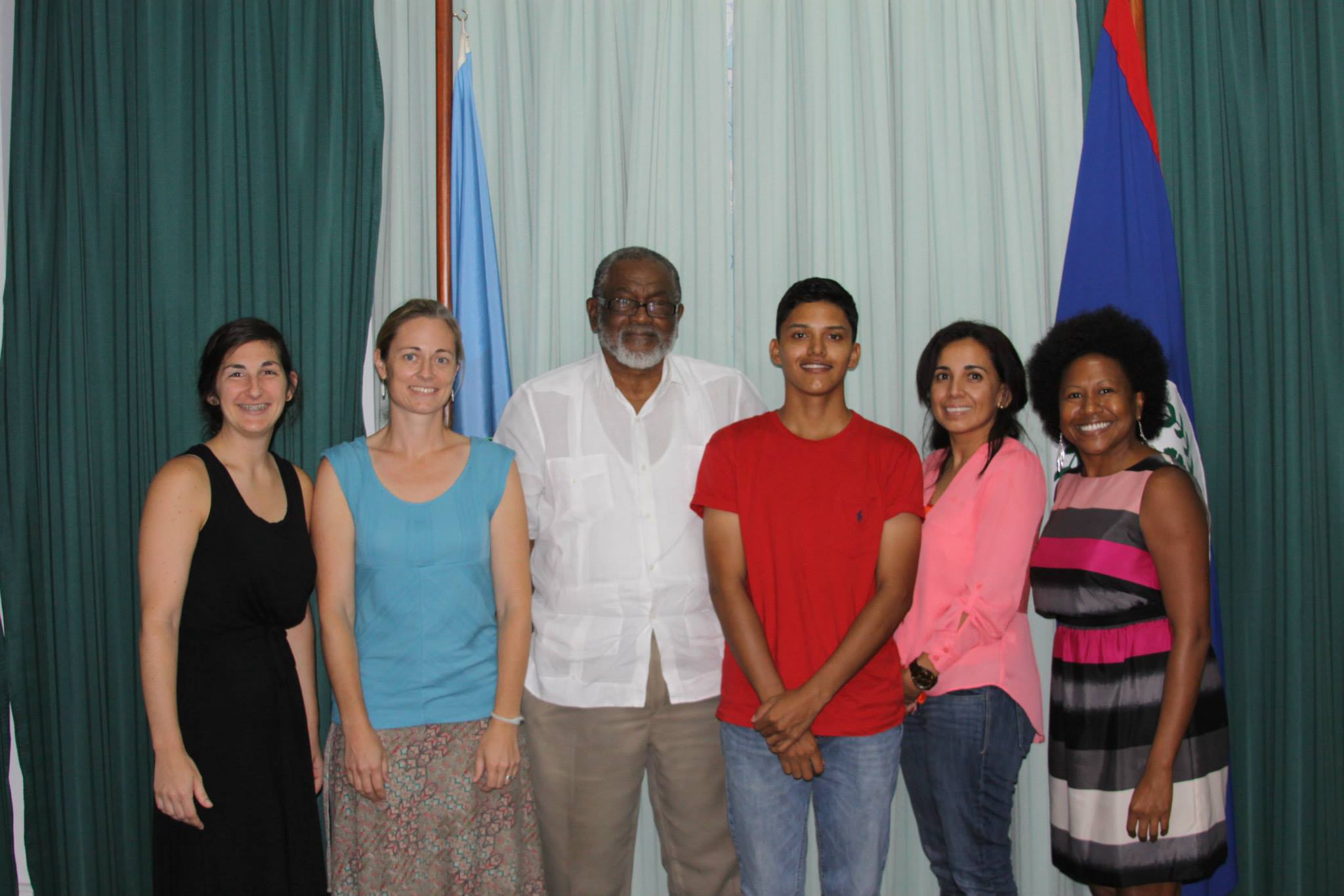 CCCCC Deputy Director and Science Advisor Dr Ulric Troz with the USF delegation
Christy Prouty, a Ph.D. student in Environmental Engineering at the University of South Florida, reflects on her Her area of research includes systems dynamics modeling which is used to understand the behavior of complex systems over time. She also enjoys internationally-focused research in water and sanitation
Climate change, sea level rise, community perceptions, drinking water, sanitation, coastal erosion, water quality monitoring, coral reef degradation, nutrient management, STEM education, and community capacity building— these were some of the topics discussed last month (June 6, 2014) during a meeting between the Caribbean Community Climate Change Center (5Cs) and a team of researchers affiliated with the University of South Florida’s Partnership for International Research and Education (USF PIRE) grant. During the introductions, the 5Cs shared insights about their field data and the ways it informed climate change models for predicting…
View original post 360 more words
Palestinian Recourse to the International Criminal Court: The Time has Come
Ever since this latest Israeli major military operation against Gaza started on July 8, there have been frequent suggestions that Israel is guilty of war crimes, and that Palestine should do its best to activate the International Criminal Court (ICC) on its behalf.

The evidence overwhelmingly supports basic Palestinian allegations—Israel is guilty either of aggression in violation of the UN Charter or is in flagrant violation of its obligations as the Occupying Power under the Geneva Convention to protect the civilian population of an Occupied People; Israel seems guilty of using excessive and disproportionate force against a defenseless society in the Gaza Strip; and Israel, among an array of other offenses, seems guilty of committing Crimes Against Humanity in the form of imposing an apartheid regime in the West Bank and through the transfer of population to an occupied territory as it has proceeded with its massive settlement project.
Considering this background of apparent Israeli criminality it would seem a no brainer for the Palestinian Authority to seek the help of the ICC in waging its struggle to win over world public opinion to their struggle. After all, the Palestinians are without military or diplomatic capabilities to oppose Israel, and it is on law and global solidarity must rest their hopes for eventually realizing their rights, particularly the right of self-determination and the right of return. Palestinian demonstrators in the West Bank are demanding that their leaders in the Palestinian Authority adhere to the Rome Statute, and become members of the ICC without further delay. It has become part of the message of Palestinian street politics that the Palestinians are being criminally victimized, and that the Palestinian Authority if it wants to retain the slightest shred of respect as representatives of the Palestinian people must join in this understanding of the Palestinian plight and stop ‘playing nice’ with Israeli authorities.
Such reasoning from a Palestinian perspective is reinforced by the May 8th letter sent by 17 respected human rights NGOs to President Mahmoud Abbas urging Palestine to become a member of the ICC, and act to end Israel’s impunity. This was not a grandstanding gesture dreamed up on the irresponsible political margins of liberal Western society. Among the signatories were such human rights stalwarts as Human Rights Watch, Amnesty International, Al Haq, and the International Commission of Jurists, entities known for their temporizing prudence in relation to the powers that be.
Adding further credence to the idea that the ICC option should be explored was the intense opposition by Israel and United States, ominously threatening the PA with dire consequences if it tried to join the ICC, much less to seek justice through its activating its investigative procedures. The American ambassador to the UN, Samantha Power, herself long ago prominent as a human rights advocate, revealed Washington’s nervous hand when she confessed that the ICC “is something that really poses a profound threat to Israel.” I am not sure that Power would like to live with the idea that because Israel is so vulnerable to mounting a legal challenge that its impunity must be upheld whatever the embarrassment to Washington of doing so. France and Germany have been more circumspect, saying absurdly that recourse to the ICC by Palestine should be avoided because it would disrupt ‘the final status negotiations,’ as if this pseudo-diplomacy was ever of any of value, a chimera if there ever was one, in the elusive quest for a just peace.
In a better world, the PA would not hesitate to invoke the authority of the ICC, but in the world as it is, the decision is not so simple. To begin with, is the question of access, which is limited to states. Back in 2009, the PA tried to adhere to the Rome Statute, which is the treaty governing the ICC, and was rebuffed by the prosecutor who turned the issue over to the Security Council, claiming a lack of authority to determined whether the PA represented a ‘state.’ Subsequently, on November 29th the UN General Assembly overwhelmingly recognized Palestine as ‘a nonmember observer state.’ Luis Moreno–Ocampo who had acted in 2009 for the ICC, and now speaking as the former prosecutor, asserted that in his opinion Palestine would now in view of the General Assembly action qualify as a state enjoying the option of becoming an ICC member. Normally, ICC jurisdiction is limited to crimes committed after the state becomes a member, but there is a provision that enables a declaration to be made accepting jurisdiction for crimes committed at any date in its territory so long as it is after the ICC itself was established in 2002.
Is this enough? Israel has never become a party to the Rome Statute setting up the ICC, and would certainly refuse to cooperate with a prosecutor who sought to investigate war crimes charges with the possible intention of prosecution. In this regard, recourse to ICC might appear to be futile as even if arrest warrants were to be issued by the court, as was done in relation to Qaddafi and his son in 2011, there would be no prospect that the accused Israeli political and military figures would be handed over, and without the presence of such defendants in the court at The Hague, a criminal trial cannot go forward. This illustrates a basic problem with the enforcement of international criminal law. It has been effective only against the losers in wars fought against the interests of the West and, to some extent, against those whose crimes are in countries located in sub-Saharan Africa. This biased form of international criminal law implementation has been the pattern since the first major effort was made after World War II at Nuremberg and Tokyo. Surviving German and Japanese leaders were prosecuted for their crimes while exempting the winners, despite Allied responsibility for the systematic bombing of civilian populations by way of strategic bombing and the American responsibility for dropping the atomic bombs on Hiroshima and Nagasaki. More
A Man Who Treated Hundreds of People Across Hunza

Here is a glimpse of a great man of Hunza (Gulmit-Gojal) who served people with broken limbs. In the present day Hunza, we may say what is the need for this rudimentary sought of treatment, but hundreds of people and thier families know the worth and importance of this great healer of broken limbs, when there were not hospitals let alone specialist orthopedics the hope was this man. However, in Hunza and overall in Gilgit-Baltistan still there is not any medical facility which serves the dire need of people to treat patients with broken legs, hands or other body parts. Each year people of Gilgit-Baltistan spend millions of rupees for treatment in the downtown Hospitals of Punjab and Karachi.
We salute this great man who single handedly keep on serving till now the people of Gilgit-Baltistan.
 Courtes: Arbab Sadoon
Palestinian Recourse to the International Criminal Court: The Time has Come

[Prefatory Note: “Palestine’s Dilemma: To Go or Not to Go to the International Criminal Court” was published on July 13, 2014 on the website of Middle East Eye, a site I strong recommend to all those with an interest in Middle East issues; this post represents a somewhat revised text, but within the framework of the original; the political plausibility of invoking the Inteernational Criminal Court to investigate allegations of criminality directed at Israel increases with each passing day.)
Ever since this latest Israeli major military operation against Gaza started on July 8, there have been frequent suggestions that Israel is guilty of war crimes, and that Palestine should do its best to activate the International Criminal Court (ICC) on its behalf. The evidence overwhelmingly supports basic Palestinian allegations—Israel is guilty either of aggression in violation of the UN Charter or is in flagrant violation of its obligations as the…
View original post 1,673 more words
We are wrong about desertification (Google / Agriit Institute)

Read at : Google Alert – desertification
How to combat desertification and the effects of climate change while feeding people
Rubanzayo Wa Mpiira
We live in a world where two thirds of its land is turning into a desert (most of this proportion has already turned into desert) and the world has to feed an increasing number of mouths that are growing towards 10 billion.
Fossil fuels – carbon, coal and gas – are by no means the only thing that is causing climate change and desertification. Desertification occurs only when we create too much bare ground. When rain falls on a bare ground, some of it keeps on the ground as flood while the remainder soaks into the soil. But because the ground is bare, water evaporates as fast as possible and the soil also releases carbon into the atmosphere.
We are told over and over repeatedly that desertification…
View original post 73 more words
Gaza Interview- Truthout
[Prefatory note: This is an interview with a knowledgeable Greek journalist covering a range of issues associated with the Gaza ordeal]
“Blood on American Hands”: Richard Falk on Palestine
Monday, 21 July 2014 13:03
By CJ Polychroniou, Truthout | Interview
A man holds the body of a child during a burial for a family of seven people killed yesterday in an Israeli attack in the Shajaiya neighborhood of Gaza City, July 21, 2014. As the bloody conflict entered its 14th day amid diplomatic pressure for a cease-fire, the Palestinian death toll reached 500, and thousands of people streamed toward Gaza City from the north Monday. (Photo: Tyler Hicks / The New York Times)
For over 20 years, Israel and the United States have been working to separate Gaza from the West Bank, in violation of the Oslo Accords they had just signed declaring them to be an indivisible territorial…
View original post 2,333 more words
 Democracy & Good Governance