Image

What does our society as a whole need to work on?

Planning For The Future

What does our society as a whole need to work on?

Firstly for their own self development.’

Second we need to work on these society wide if we are ever going to mature and evolve into an enlightened society and world.

I. The things we need to instill earlier in our education. These skills need to be taught and learned by hopefully our future generations of children.

  1. Empathy Skills
  2. Active Learning Skills
  3. The Scientific Method
  4. Critical Thinking

II. These are for me very important but lacking unfortunately by a sizable percentage of the population.

I. Open Mind.

II. Reason, Critical Thinking, etc.

III. Love, Empathy, etc.

IV. Non-Judgmental.

III. This is my own personal philosophy of peace and wisdom which I’ve repeatedly said multiple times in my written work.

  1. I am personally responsible for my own thoughts, feelings, writing, speech and actions irregardless of the other person or external situation.
  2. I will not return negative energy with more negative energy. I will endeavor to rise above the situation or a conflict.
  3. What I do and say is always a direct reflection of myself. What the other person does and says reflects the other person.

IV. Trying any of the following will not work with a person of a polar position.

The reason is that the other persons version of reality is just as real to them as your own viewpoint.

(Cognitive Distortion at work here is called ‘Emotional Reasoning).’

  1. Reason: Trying to reason with someone of dissimilar belief will not work.
  2. Arguments: Trying to argue with someone of dissimilar belief will not work.
  3. Insults: Trying to insult someone with dissimilar beliefs only goes to show how just really irrational you, yourself are.

With Respect,

The Power of Working as One: Connecting the Small Island Developing States

United Nations Development Programme

Small Island Developing States (SIDS) are facing multifaceted challenges caused by climate and debt-related crises while still rebuilding from the aftermath of the COVID-19 pandemic. The SIDS4 Conference in Antigua and Barbuda in late May 2024 has been another opportunity for a sharing, listening, and learning process among SIDS to amplify their voices. This was the fourth such conference in the last 4 decades.

Seychelles

From Samoa to Antigua & Barbuda …

The Samoa Pathway emphasized climatic threats to SIDS through sea-level rise and other adverse impacts of climate change, which continue to pose a significant risk to Small Island States. Additionally, SIDS have been grappling with external debt shocks, which have surged by 70 percentage points since 2009. Consequently, the average rate of external debt to gross domestic product has increased by 11 percentage points to 61.7 percent in 2019 (UN (United Nations) Resolution A/RES/77/245). This increased fiscal pressure requires that SIDS reengineer their future to foster their resilient prosperity. In this context, raising domestic revenue is becoming increasingly pertinent to bolster SIDS’ capacity for sustainable development.

(https://www.undp.org/mauritius-seychelles/blog/power-working-one-connecting-small-island-developing-states)

Here comes the sun? Cayman to go fully solar within 20 years

Policy seeks to curb market power of CUC

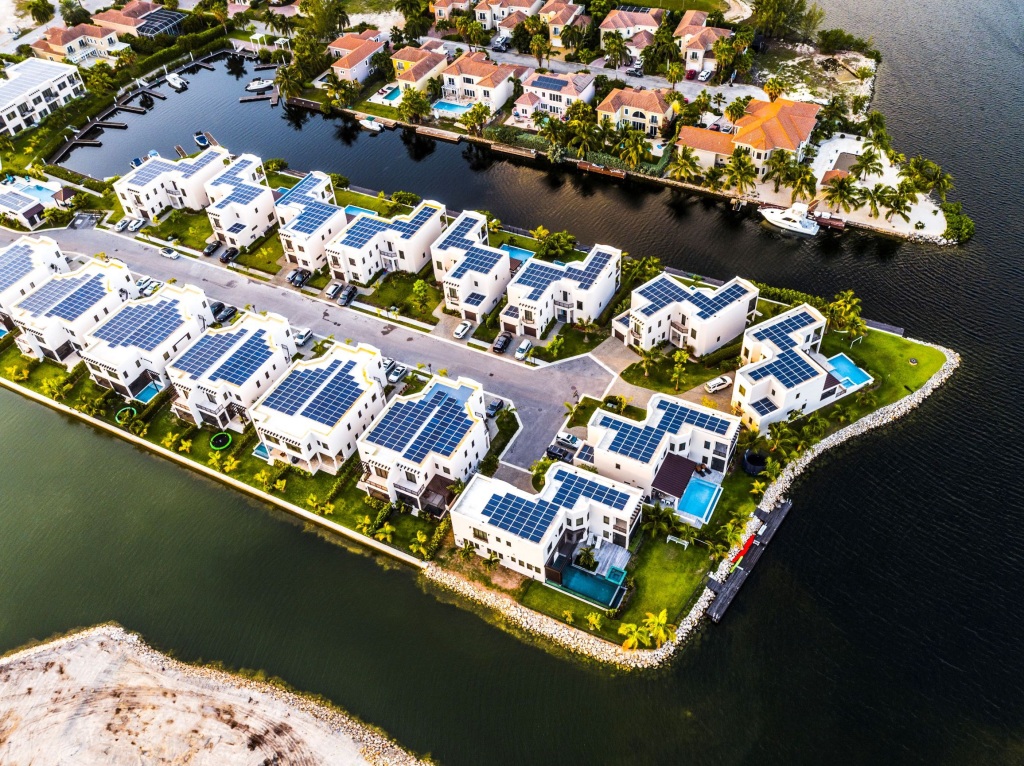
Solar panels are visible on the rooftops of homes at the Cypress Pointe development.

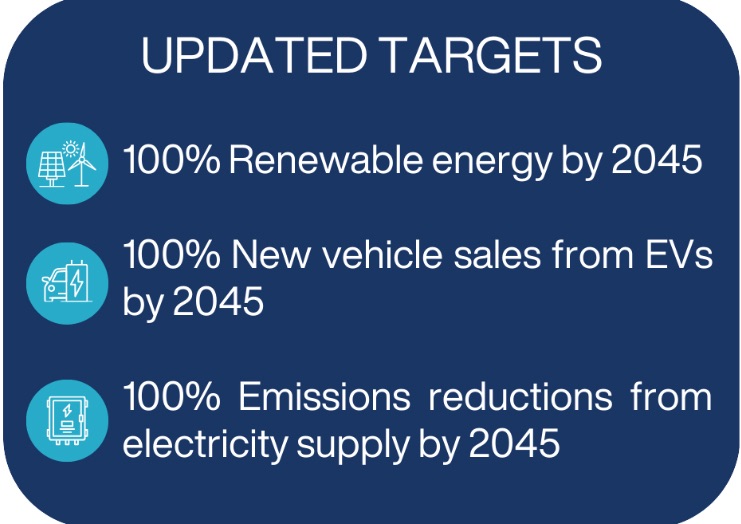
Cayman’s ambitious new (updated) energy policy seeks to get rid of fossil fuels and petrol-powered cars within a generation, transforming the island to 100% clean energy and electric vehicles.

The revised National Energy Policy, approved by Cabinet, also includes safeguards to ensure fair competition for green energy contracts.

The document, published Friday, was immediately welcomed by the Cayman Renewable Energy Association, which hailed it as “the largest step forward to date” on the road to an affordable, sustainable energy future for Cayman.

The headline commitment to reach 100% energy from renewable sources by 2045 is hugely ambitious given the slow rate of progress on incorporating solar and wind energy in Cayman so far.

Despite the benefit of year-round sunshine, the jurisdiction currently sits at 3% renewable penetration, with the rest coming from diesel-powered generators.

https://bit.ly/4d9eLu2

Five Year Review | Cayman Islands National Energy Policy 2024 – 2045

On 16 April 2024, Cabinet approved the updated National Energy Policy 2024-2045 and the accompanying Implementation and Monitoring Plan.

This is the first update to the National Energy Policy since its initial approval by the Cayman Islands Government in 2017.

Following an extensive consultative process as well as constructive dialogues and stakeholder feedback, the updated National Energy Policy includes revised targets, new definitions, and strategies to ensure market fairness and consumer inclusion. The Policy will be reviewed in two years, to ensure that the goals and implementation strategies remain feasible and aligned with global efforts to combat climate change.

The Vision of the National Energy Policy is:

“Enhancing and embracing a sustainable lifestyle through responsible and innovative energy supply and consumption”

https://www.gov.ky/energy/programmes/national-energy-policy

The cities stripping out concrete for earth and plants – BBC Future

From Australia to Ontario, cities are taking up unnecessary stretches of concrete and asphalt, allowing nature to take hold in their place.
On a hot July day, Katherine Rose picked up a sturdy metal pole and jammed it under the tempting lip of a pre-cut concrete slab. Rose, communications and engagement director at Depave, a non-profit in Portland, Oregon, was sweating in the heat – but she was going to win this fight.
The grubby, rectangular section of urban crust in front of her was about to move. Pushing down on her metal bar, applying it like a lever, she eased the concrete covering up and away. Now sunlight could fall once again on the ground below. A mess of gravel and dirt that was, to Rose, just bursting with potential.

(https://www.bbc.com/future/article/20240222-depaving-the-cities-replacing-concrete-with-earth-and-plants?fbclid=IwAR1xOC2kpLse0WOeNtC6eLt7dms1AjSyBum76oKeDJILFVG3QG7w9-szuH8_aem_AWsuO8VJdS4hGUWPANOyVTwzYcD3aaRdbef9nUxut7uVdHw4E30Lc0ih2wWvfepCbt4)

Offshore islands amplify, rather than dissipate, a tsunami’s power

A long-held belief that offshore islands protect the mainland from tsunamis turns out to be the exact opposite of the truth, according to a new study.

Common wisdom — from Southern California to the South Pacific — for coastal residents and scientists alike has long been that offshore islands would create a buffer that blocked the power of a tsunami. In fact, computer modeling of tsunamis striking a wide variety of different offshore island geometries yielded no situation in which the mainland behind them fared better.

Instead, islands focused the energy of the tsunami, increasing flooding on the mainland by up to 70 percent.

“This is where many fishing villages are located, behind offshore islands, in the belief that they will be protected from wind waves. Even Southern California residents believe that the Channel Islands and Catalina will protect them,” said Costas Synolakis of the USC Viterbi School of Engineering, a member of the multinational team that conducted the research.

The research was inspired by a field survey of the impact of the 2010 tsunami on the Mentawai Islands off of Sumatra. The survey data showed that villages located in the shadow of small offshore islets suffered some of the strongest tsunami impacts, worse than villages located along open coasts.

Subsequent computer modeling by Jose Borrero, adjunct assistant research professor at the USC Viterbi Tsunami Research Center, showed that the offshore islands had actually contributed to — not diminished — the tsunami’s impact.

Synolakis then teamed up with researchers Emile Contal and Nicolas Vayatis of Ecoles Normales de Cachan in Paris; and Themistoklis S. Stefanakis and Frederic Dias, who both have joint appointments at Ecoles Normales de Cachan and University College Dublin to determine whether that was a one-of-a-kind situation, or the norm.

Their study, of which Dias was the corresponding author, was published in Proceedings of the Royal Society A on Nov. 5.

The team designed a computer model that took into consideration various island slopes, beach slopes, water depths, distance between the island and the beach, and wavelength of the incoming tsunami.

“Even a casual analysis of these factors would have required hundreds of thousands of computations, each of which could take up to half a day,” Synolakis said. “So instead, we used machine learning.”

Machine learning is a mathematical process that makes it easier to identify the maximum values of interdependent processes with multiple parameters by allowing the computer to “learn” from previous results.

The computer starts to understand how various tweaks to the parameters affect the overall outcome and finds the best answer quicker. As such, results that traditionally could have taken hundreds of thousands of models to uncover were found with 200 models.

“This work is applicable to some of our tsunami study sites in New Zealand,” said Borrero, who is producing tsunami hazard maps for regions of the New Zealand coast. “The northeast coast of New Zealand has many small islands offshore, similar to those in Indonesia, and our modeling suggests that this results in areas of enhanced tsunami heights.”

“Substantial public education efforts are needed to help better explain to coastal residents tsunami hazards, and whenever they need to be extra cautious and responsive with evacuations during actual emergencies,” Synolakis said. More


Cayman Renewable Energy Association Launches

Cayman Renewable Energy Association launched last week. In this segment we learn more about the group’s mission and what they see as the next step in implementing alternative energy in Cayman.

James E. Whittaker of GreenTech Group of Companies and Jim Knapp of Endless Energy talk to Vanessa Hansen of Cayman 27 about the premise of the organiization and why it’s important to have the association in Cayman.