
CNN Correspondent Reveals Truth About Israel
Novara Media

CNN Correspondent Reveals Truth About Israel
Novara Media
Bethlehem, occupied West Bank – The churches of Palestine have announced the cancellation of all festive Christmas celebrations in an expression of unity with Gaza and rejection of the ongoing aggression against Palestinians, limiting them to masses and prayers.
Her Question Was Bad, His Answer Was Worse
Novara Media
How The US Twists The Israel-Palestine Narrative
Novara Media
Noam Chomsky refutes Israel’s claims
Free Will
Burning Conscience: Israeli Soldiers Speak Out
AlternateFocus
Jewish political scientist Dr.Norman Finkelstein Exposing LIES of Z!onist Tim Kennedy on Joe Rogan
TheDeenShowTV
Scholars of genocide are criticizing the dangerous use of the Holocaust to justify Israeli mass violence against Palestinians
Listen to the headlines and you will hear more and more frequent anecdotal evidence of the crisis facing our global fresh water supply. Only 3 percent of the water on earth is fresh, and of that some 2 percent is locked in the polar ice caps, thus leaving us with the astonishing conclusion that the entire population on earth is reliant on 1 percent of the available water worldwide to sustain its fundamental need.
That need is universal; each of us — no matter who we are, what we earn, or where we live — should consume at least two quarts of water per day to sustain basic daily physical health. According to the World Health Organization, an individual requires 18 gallons a day to provide medium term maintenance to include drinking, cooking, personal hygiene, washing clothes, cleaning homes, growing food, and sanitation and waste disposal.
There is an apocryphal story of a proposed reality television show focusing on water use of a middle-class American family of two adults and three children. The value entertainment was to derive from the inter-personal consequences of reliance on the minimal supply to meet the profligate use of water in the United States for domestic uses only. The trial was a disaster as the family chosen could not subsist a week on these conditions, deprived of infinite supply for cooking, showers, dishwashers and washing machines, lawn and garden watering, without serious negative psychological effect, inter-family conflict, and rejection of the experiment.
The headlines speak of water shortages everywhere, in large amounts, and in many forms. We read of cities closing down their water systems because of toxic run-off, of the poisoned water from fracking oil wells that leak into watersheds, streams, and rivers; of droughts that evaporate available water and radically decrease supply for irrigation of industrial farms and orchards; of wildfires that cannot be contained because there is no available water to fight them. There are many more examples; add them all up and you have a water crisis that threatens rich and poor everywhere in the world, has serious financial implications now and for the future, destroys communities, and indeed becomes a context for conflict.
All this threatens total supply and must force us to re-think how we manage the efficiency of our water use. Certain changes seem obvious: becoming more aware of the problem and modify personal use by turning off faucets, shortening showers, collecting rain water for gardens, not washing the car, replacing old appliances with conservation-certified new ones, and understanding that every gallon wasted by indifference is a gallon gone and irreplaceable for you or anyone else.
Individual actions can, of course, be scaled up by government actions and regulations. The Alliance for Water Efficiency, for example, exists as an authoritative voice for water conservation in North America, informs and advocates for the development of state and municipal laws, codes, and standards, and supports a national partnership with the US Environmental Protection Agency called “WaterSense” that promotes best water conservation management practices for homes, hotels, factories, businesses, treatment plants and water distribution infrastructure, and rewards the best examples of the most efficient water conservation technologies.
But this is nowhere near enough. Water consciousness must improve dramatically at all levels of society to enable us to recycle water effectively, to divert treated water to alternative use, to channel urban run-off from roofs and storm systems back into the usable water supply, to revolutionize our agricultural irrigation practices that today consume a vast majority of water resources worldwide, and regulate any and all industrial or extraction behavior that continues to pollute our waterways with harmful pollutants and poisons with unacceptable local health and downstream consequences.
And yet, in the United States at least, determined politicians are attempting to reverse any such intelligent controls by diluting or over-turning clean water laws and regulations already established in the name of protecting threatened corporate interests, denying the role of government to regulate destructive practice, and sustaining the status quo. Wouldn’t it be interesting to put those representative lawmakers in a situation like that American family? Where they would have to live together, with of their individual hypocrisies, compromised decisions, and destructive political ideologies? I wonder how long they would last having to live together up close and personal in today’s global fresh water crisis? More
Follow Peter Neill on Twitter: www.twitter.com/the_w2o
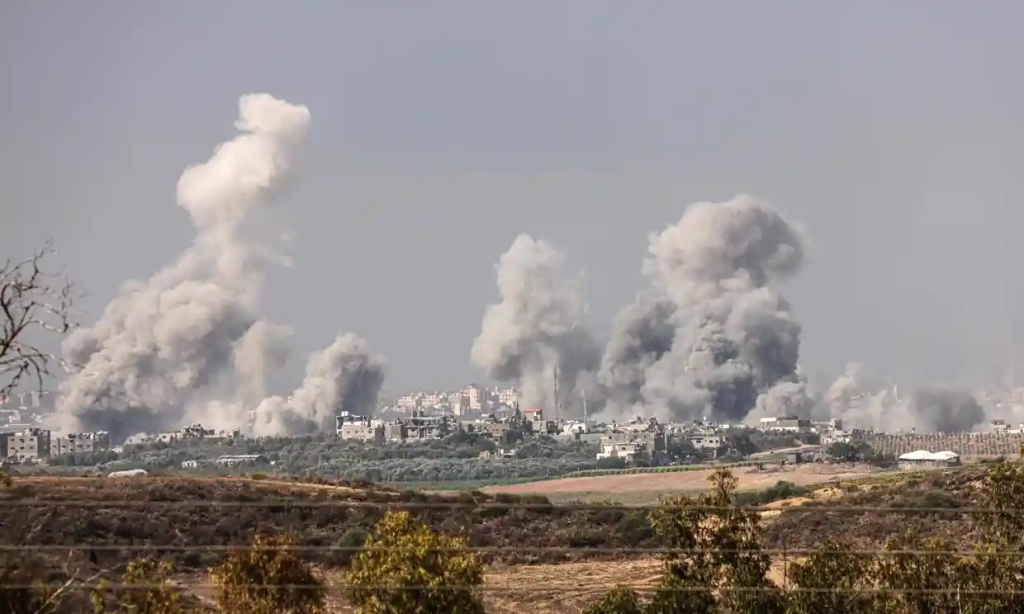
The carnage in the Gaza Strip has been horrendous: more than 1,900 dead, mainly civilians; its sole power plant destroyed (and so electricity and water denied and a sewage disaster looming); 30,000 to 40,000 homes and buildings damaged or destroyed; hundreds of thousands of residents put to flight with nowhere to go; and numerous U.N. schools or facilities housing some of those refugees hit by Israeli firepower.

And then there was the evident targeting by the Israelis of the Gazan economy itself: 175 major factories taken out, according to the New York Times, in a place that already had an estimated unemployment rate of 47%.
The last weeks represent the latest episode in a grim, unbalanced tale of the destructive urges of both the Israeli government and Hamas, in a situation in which the most fundamental thing has been the desire to punish civilians. Worse yet, indiscriminate assaults on civilian populations create the basis for more of the same — fiercer support in Israel for governments committed to ever worse actions and ever more recruits for Hamas or successor organizations potentially far worse and more fundamentalist), and of course more children traumatized and primed for future acts of terror and revenge.
Think of it as the Middle Eastern equivalent of a self-fulfilling prophecy, which means it hardly even qualifies as a prediction to say that Israel’s violent and punishing acts against the civilian population of Gaza will settle nothing whatsoever. In fact, for the Israelis, as Sandy Tolan suggests today, the Gazan War of 2014 may prove a defeat, both in the arena of global opinion (U.S. polls show that young Americans are ever more sympathetic to the Palestinians and disapproving of Israeli actions) and in relation to Hamas itself. History indicates that air strikes and other attacks meant to break the “will” of a populace, and so of a movement’s hold on it, generally only create more support.
These have been the days of the whirlwind in Gaza and in Israel, but don’t stop there. If you want a hair-raising experience, put these events in a larger regional context.
Following 9/11, the Bush administration and its neocon supporters dubbed the area that stretched from North Africa to Central Asia “the Greater Middle East” and referred to that vast expanse as “the arc of instability.” At the time, despite their largely Muslim populations, the nations of that sprawling region had relatively little in common; nor, on the whole, was it particularly unstable, even if the roiling Israeli-Palestinian situation already sat at its heart.
Ruled largely by strongmen and autocrats, those nations remained in a grim post-Cold War state of stasis. Three American interventions — in Afghanistan (2001), Iraq (2003), and Libya (2011) — blew holes through the region, sparking bitter inter-ethnic and religious conflict, as well as an Arab Spring (largely suppressed by now), while transforming most of the Greater Middle East into a genuine arc of instability. Today, what's happening there qualifies as the perfect maelstrom, as yet more states and groups, insurgent, extremist, or otherwise, are drawn into its maw of destruction.
To start on the eastern reaches of the Greater Middle East, Pakistan is now a destabilized democracy with a fierce set of fundamentalist insurgencies operating within and from its territory; Afghanistan is an almost 13-year nation-building disaster where the Taliban is resurgent and, in the latest “insider attack” at its top military academy, an Afghan soldier considered an American “ally” managed to kill a U.S. major general sent to the country to help “stand up” its security forces. Iraq is a tripartite disaster area in which another American-trained and -equipped army stood down rather than up and in which an extreme al-Qaeda offshoot, the Islamic State (IS) is at the moment ascendant. It has routed Iraqi and Syrian forces, and most recently, the supposedly fierce Kurdish pesh merga militia in northern Iraq, while endangering the Kurdish capital and possibly seizing the country’s largest dam. Turkish and Syrian Kurdish insurgents are being drawn into the fight in Iraq, as once again is the U.S.
Syria itself is no longer a country at all, but a warring set of extremist outfits facing what’s left of the patrimony (and military) of the al-Assad family. In Lebanon last week, regular army units found themselves battling IS extremists and their captured American tanks for the control of a border town. In Egypt, the military is back in power atop a disintegrating economy. In Libya, the chaos following the U.S./NATO intervention that led to the fall of autocrat Muammar Gaddafi never ended. Recently, factional militias fighting in Tripoli, the capital, managed to destroy its international airport, while diplomatic missions, including the U.S. one, were withdrawn in haste, and now the Egyptians are threatening an intervention of their own. Meanwhile, reverberations from the chaos in Libya have been spreading across North Africa and heading south. Only Iran (eternally under threat from the U.S. and Israel), Saudi Arabia (which helped bankroll the rise of the IS), and the Gulf States seem to have remained — thus far — relatively aloof from the chaos.
In sum, the vast region the Bush people so blithely called the arc of instability seems to be heading for utter chaos or a mega-conflict, while the predicted “cakewalk” of American forces into Iraq managed, in barely a moment in historical time, to essentially obliterate the regional borders set up by the European colonial powers after World War I. In other words, a world is being unified in turmoil and extremism, as thousands die and millions are uprooted from their homes, and all of this now surrounds the volatile, still destabilizing center that is the Palestinian/Israeli nightmare. There, as Sandy Tolan, a TomDispatch regular and the author of The Lemon Tree: An Arab, a Jew, and the Heart of the Middle East, points out, both Tel Aviv and Washington have, in recent years, ignored every chance to take a less violent path and so encouraged the arrival of the maelstrom. Tom – Follow TomDispatch on Twitter @TomDispatch.
Blown Chances in Gaza
Israel and the U.S. Miss Many Chances to Avoid War
By Sandy TolanAlongside the toll of death and broken lives, perhaps the saddest reality of the latest Gaza war, like the Gaza wars before it, is how easy it would have been to avoid. For the last eight years, Israel and the U.S. had repeated opportunities to opt for a diplomatic solution in Gaza. Each time, they have chosen war, with devastating consequences for the families of Gaza.
Let’s begin in June 2006, when the University of Maryland’s Jerome Segal, founder of the Jewish Peace Lobby, carried a high-level private message from Gaza to Washington. Segal had just returned from a meeting with Ismail Haniyeh, whose Hamas faction had recently won free and fair elections and taken power in Gaza. Hamas was seeking a unity government with the rival Fatah faction overseen by Mahmoud Abbas.
The previous year, Israel had withdrawn its soldiers and 8,000 settlers from Gaza, though its armed forces maintained a lockdown of the territory by air, land, and sea, controlling the flow of goods and people. Gazans believed they were trapped in the world’s largest open-air prison. For generations they had lived in overcrowded refugee camps, after their villages were depopulated by Israel and new Israeli cities built on their ruins in the years that followed Israel’s birth in 1948. By voting for Hamas in 2006, Palestinians signaled their weariness with Fatah’s corruption and its failure to deliver an independent state, or even a long-promised safe passage corridor between the West Bank and Gaza. In the wake of its surprise election victory, Hamas was in turn showing signs of edging toward the political center, despite its militant history.
Nevertheless, Israel and “the Quartet” — the U.S., the European Union, Russia, and the U.N. — refused to recognize the outcome of the democratic elections, labeling Hamas a “terrorist organization,” which sought Israel’s destruction. The administration of George W. Bush strongly pressured Abbas not to join a unity government. The Quartet suspended economic aid and Israel severely curtailed the flow of goods in and out of Gaza.
“It’s like meeting with a dietician,” remarked Dov Weisglass, a top aide to Israeli Prime Minister Ariel Sharon. “We have to make [Gazans] much thinner, but not enough to die.” Only years later did researchers prove that Weisglass was speaking literally: Israeli officials had restricted food imports to levels below those necessary to maintain a minimum caloric intake. Child welfare groups began to report a sharp rise in poverty and chronic child malnutrition, anemia, typhoid fever, and potentially fatal infant diarrhea. Human rights organizations denounced the measures as collective punishment. Avi Shlaim, a veteran of the Israeli army, author of numerous books on Middle East history, and professor of international relations at the University of Oxford, wrote:
“America and the EU [European Union] shamelessly joined Israel in ostracizing and demonizing the Hamas government and in trying to bring it down by withholding tax revenues and foreign aid. A surreal situation thus developed with a significant part of the international community imposing economic sanctions not against the occupier but against the occupied, not against the oppressor but against the oppressed. As so often in the tragic history of Palestine, the victims were blamed for their own misfortunes.”
These punitive measures were to remain in place until Hamas renounced violence (including stopping its cross-border rocket attacks), recognized Israel, and accepted all previous agreements based on the Oslo peace accords.
Which brings us back to that Washington-bound letter from Gaza. In the wake of the elections, Hamas was no longer the militant opposition to a ruling Fatah party, but a legally elected government operating under siege. Hamas leader Ismail Haniyeh, suddenly responsible for governing and facing a mounting economic, humanitarian, and political catastrophe, sought to defuse the situation. In his June 2006 hand-written note to President Bush that Jerome Segal delivered to the State Department and the National Security Council, he requested a direct dialogue with the administration.
Despite Hamas’s charter calling for the elimination of Israel, Haniyeh’s conciliatory note to the American president conveyed a different message. “We are so concerned about stability and security in the area that we don't mind having a Palestinian state in the 1967 borders and offering a truce for many years,” Haniyeh wrote to Bush. This essentially added up to an offer ofde facto recognition of Israel with a cessation of hostilities — two of the key U.S. and Israeli demands of Hamas.
“The continuation of this situation,” Haniyeh wrote to Bush, “will encourage violence and chaos in the whole region.”
A few lonely voices in the U.S. and Israel urged that the moment be seized and Hamas coaxed toward moderation. After all, Israel itself had been birthed in part by the Irgun and Stern Gang (or Lehi), groups considered terrorist by the British and the U.N. In the years before Israel’s birth, they had been responsible for a horrific massacre in the Palestinian village of Deir Yassin and the Irgun bombing of the King David Hotel, killing 91 people. Leaders of the two organizations, Menachem Begin and Yitzhak Shamir, later became prime ministers of Israel. Similarly, Yasser Arafat, whose Palestine Liberation Organization was considered a terrorist group by Israel and the West, recognized Israel’s right to exist in a pivotal 1988 speech, paving the way for the Oslo peace process. More
 © 2014
 Democracy & Good Governance