Edward Snowden should not face trial, says UN human rights commissioner

The United Nations's top human rights official has suggested that the United States should abandon its efforts to prosecute Edward Snowden, saying his revelations of massive state surveillance had been in the public interest.

Navi Pillay

The UN high commissioner for human rights, Navi Pillay, credited Snowden, a former US National Security Agency contractor, with opening a global debate that has led to calls for the curtailing of state powers to snoop on citizens online and store their data.

“Those who disclose human rights violations should be protected: we need them,” Pillay told a news conference.

“I see some of it here in the case of Snowden, because his revelations go to the core of what we are saying about the need for transparency, the need for consultation,” she said. “We owe a great deal to him for revealing this kind of information.”

The United States has filed espionage charges against Snowden, charging him with theft of government property, unauthorised communication of national defence information and wilful communication of classified communications intelligence to an unauthorised person.

Pillay declined to be drawn on whether President Barack Obama should pardon Snowden, saying he had not yet been convicted. “As a former judge I know that if he is facing judicial proceedings we should wait for that outcome,” she said. But she added that Snowden should be seen as a “human rights defender”.

“I am raising right here some very important arguments that could be raised on his behalf so that these criminal proceedings are averted,” she said.

Pillay was speaking after issuing a report on government surveillance, The Right to Privacy in the Digital Age (pdf), which says governments must accept stronger checks on their data surveillance powers and companies must do more to stand up to the state's demands for data.

Revelations of mass US surveillance based on documents leaked by Snowden sparked outrage among American allies including Germany, Brazil and Mexico. He has sought asylum in Russia.

The leaked documents revealed massive programmes run by the NSA that gathered information on emails, phone calls and internet use by hundreds of millions of Americans.

Mona Rishmawi, head of the rule of law branch of Pillay's office, said: “In this particular case, the way we see the situation of Snowden is he really revealed information which is very, very important for human rights. We would like this to be taken into account in assessing his situation.”

All branches of government must be involved in the oversight of surveillance programmes, and completely independent civilian institutions must also monitor surveillance, Pillay says in her report. Checks on government must also be clearly understandable by the public.

The report, which will be debated at the UN general assembly later this year, says any collection of communications data or metadata is potentially a breach of privacy.

Governments often force internet and telecoms firms to store metadata about their customers, which was neither necessary nor proportionate, Pillay said, adding that companies should always be ready to challenge government requests.

“This can mean interpreting government demands as narrowly as possible or seeking clarification from a government with regard to the scope and legal foundation for the demand; requiring a court order before meeting government requests for data; and communicating transparently with users about risks and compliance with government demands,” she told reporters.

She added: “I would say there are serious questions over the extent to which consumers are truly aware of what data they are sharing, how, and with whom, and to what use they will be put.

“And for how long is this data going to be out there? I would say that the same rights that people have offline must be protected online.”

An emergency data collection law being rushed through the British parliament may not address concerns raised by the European Court of Justice and is difficult to justify, Pillay said. More


Palestinian factions reportedly set 10 conditions for 10-year truce with Israel

Reports in Israeli and Palestinian media say that the two Palestinian resistance groups Hamas and Islamic Jihad have set forth ten conditions for a ceasefire and ten-year truce with Israel.

Israel’s Maariv said that an unnamed “senior Palestinian official” passed it a copy of the demands, which have been transmitted by the factions to Egypt.

They include an end to all armed hostilities, the end of the siege of Gaza, and the construction of internationally supervised air and seaports.

Palestinians sleep in UN school

While Hamas has not as yet officially stated these demands, they are in line with the group’s long-standing policy of offering Israel a multi-year truce.

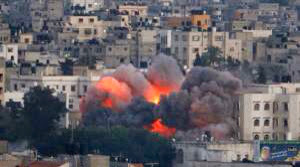
The reported conditions come after nine days of Israeli bombardment of the Gaza Strip that has killed more than 200 people, injured close to 1,400, and destroyed the homes of 8,200 others. Almost 80 percent of the dead, who include more than thirty children, are civilians, according to the UN.

Yesterday, Hamas refused to respond to a unilateral “ceasefire” declared by Israel that would have left the situation of siege on the Gaza Strip unchanged.

Airport, seaport and an end to violence

The ten conditions were translated by The Electronic Intifada from an Arabic version published by Ma’an News Agency:

  • Mutual cessation of the war and withdrawal of tanks to previous locations and the return of farmers to work their land in the agricultural border areas.
  • Release of all the Palestinians detained since 23 June 2014 and improvement of the conditions of Palestinian prisoners, especially the prisoners from Jerusalem, Gaza and Palestinians of the interior [present-day Israel].
  • Total lifting of the siege of Gaza and opening the border crossings to goods and people and allowing in all food and industrial supplies and construction of a power plant sufficient to supply all of Gaza.
  • Construction of an international seaport and an international airport supervised by the UN and non-biased countries.
  • Expansion of the maritime fishing zone to 10 kms and supplying fishermen with larger fishing and cargo vessels.
  • Converting the Rafah crossing into an international crossing under supervision of the UN and Arab and friendly countries.
  • Signing a 10-year truce agreement and deployment of international monitors to the borders.
  • A commitment by the occupation government not to violate Palestinian airspace and easing of conditions for worshipers in Al-Aqsa Mosque.
  • The occupation will not interfere in the affairs of the Palestinian government and will not hinder national reconciliation.
  • Restoration of the border industrial areas and their protection and development.

“Should have been met years ago”


Dr. Ramy Abdu, chair of the independent group Euro-Mid Observer for Human Rights (euromid.org, told The Electronic Intifada from Gaza City this morning:

I believe that these requirements should have been met years ago. The core of these requirements are not political but purely humanitarian and legally binding. The international community has called many times for their implementation. Palestinians have the right to move in and out freely like others in the world. They have the right to import and export, to control their borders and airspace. Israel argues that it left Gaza, so it should stop controlling the lives of Palestinians.

Abdu noted that his organization recently published a detailed proposal to establish a maritime link from Gaza to the rest of the world with an international role that could “alleviate security concerns.” More


How Politics and Lies Triggered an Unintended War in Gaza

In the flood of angry words that poured out of Israel and Gaza during a week of spiraling violence, few statements were more blunt, or more telling, than this throwaway line by the chief spokesman of the Israeli military, Brigadier General Moti Almoz, speaking July 8 on Army Radio’s morning show: “We have been instructed by the political echelon to hit Hamas hard.”

That’s unusual language for a military mouthpiece. Typically they spout lines like “We will take all necessary actions” or “The state of Israel will defend its citizens.” You don’t expect to hear: “This is the politicians’ idea. They’re making us do it.”

Admittedly, demurrals on government policy by Israel’s top defense brass, once virtually unthinkable, have become almost routine in the Netanyahu era. Usually, though, there’s some measure of subtlety or discretion. This particular interview was different. Where most disagreements involve policies that might eventually lead to some future unnecessary war, this one was about an unnecessary war they were now stumbling into.

Spokesmen don’t speak for themselves. Almoz was expressing a frustration that was building in the army command for nearly a month, since the June 12 kidnapping of three Israeli yeshiva boys. The crime set off a chain of events in which Israel gradually lost control of the situation, finally ending up on the brink of a war that nobody wanted — not the army, not the government, not even the enemy, Hamas.

The frustration had numerous causes. Once the boys’ disappearance was known, troops began a massive, 18-day search-and-rescue operation, entering thousands of homes, arresting and interrogating hundreds of individuals, racing against the clock. Only on July 1, after the boys’ bodies were found, did the truth come out: The government had known almost from the beginning that the boys were dead. It maintained the fiction that it hoped to find them alive as a pretext to dismantle Hamas’ West Bank operations.

The initial evidence was the recording of victim Gilad Shaer’s desperate cellphone call to Moked 100, Israel’s 911. When the tape reached the security services the next morning — neglected for hours by Moked 100 staff — the teen was heard whispering “They’ve kidnapped me” (“hatfu oti”) followed by shouts of “Heads down,” then gunfire, two groans, more shots, then singing in Arabic. That evening searchers found the kidnappers’ abandoned, torched Hyundai, with eight bullet holes and the boys’ DNA. There was no doubt.

Prime Minister Benjamin Netanyahu immediately placed a gag order on the deaths. Journalists who heard rumors were told the Shin Bet wanted the gag order to aid the search. For public consumption, the official word was that Israel was “acting on the assumption that they’re alive.” It was, simply put, a lie.

Moti Almoz, as army spokesman, was in charge of repeating the lie. True, others backed him up, including Defense Minister Moshe Yaalon. But when the truth came out on July 1, Almoz bore the brunt of public derision. Critics said his credibility was shot. He’d only been spokesman since October, after a long career as a blunt-talking field commander with no media experience. Others felt professional frustration. His was personal.

Nor was that the only fib. It was clear from the beginning that the kidnappers weren’t acting on orders from Hamas leadership in Gaza or Damascus. Hamas’ Hebron branch — more a crime family than a clandestine organization — had a history of acting without the leaders’ knowledge, sometimes against their interests. Yet Netanyahu repeatedly insisted Hamas was responsible for the crime and would pay for it.

This put him in a ticklish position. His rhetoric raised expectations that after demolishing Hamas in the West Bank he would proceed to Gaza. Hamas in Gaza began preparing for it. The Israeli right — settler leaders, hardliners in his own party — began demanding it.

But Netanyahu had no such intention. The last attack on Gaza, the eight-day Operation Pillar of Defense in November 2012, targeted Hamas leaders and taught a sobering lesson. Hamas hadn’t fired a single rocket since, and had largely suppressed fire by smaller jihadi groups. Rocket firings, averaging 240 per month in 2007, dropped to five per month in 2013. Neither side had any desire to end the détente. Besides, whatever might replace Hamas in Gaza could only be worse.

The kidnapping and crackdown upset the balance. In Israel, grief and anger over the boys’ disappearance grew steadily as the fabricated mystery stretched into a second and third week. Rallies and prayer meetings were held across the country and in Jewish communities around the world. The mothers were constantly on television. One addressed the United Nations in Geneva to plead for her son’s return. Jews everywhere were in anguish over the unceasing threat of barbaric Arab terror plaguing Israel.

This, too, was misleading. The last seven years have been the most tranquil in Israel’s history. Terror attacks are a fraction of the level during the nightmare intifada years — just six deaths in all of 2013. But few notice. The staged agony of the kidnap search created, probably unintentionally, what amounts to a mass, worldwide attack of post-traumatic stress flashback.

When the bodies were finally found, Israelis’ anger exploded into calls for revenge, street riots and, finally, murder.

Amid the rising tension, cabinet meetings in Jerusalem turned into shouting matches. Ministers on the right demanded the army reoccupy Gaza and destroy Hamas. Netanyahu replied, backed by the army and liberal ministers, that the response must be measured and careful. It was an unaccustomed and plainly uncomfortable role for him. He was caught between his pragmatic and ideological impulses.

In Gaza, leaders went underground. Rocket enforcement squads stopped functioning and jihadi rocket firing spiked. Terror squads began preparing to counterattack Israel through tunnels. One tunnel exploded on June 19 in an apparent work accident, killing five Hamas gunmen, convincing some in Gaza that the Israeli assault had begun while reinforcing Israeli fears that Hamas was plotting terror all along.

On June 29, an Israeli air attack on a rocket squad killed a Hamas operative. Hamas protested. The next day it unleashed a rocket barrage, its first since 2012. The cease-fire was over. Israel was forced to retaliate for the rockets with air raids. Hamas retaliated for the raids with more rockets. And so on. Finally Israel began calling up reserves on July 8 and preparing for what, as Moti Almoz told Army Radio, “the political echelon instructed.”

Later that morning, Israel’s internal security minister Yitzhak Aharonovitch told reporters that the “political echelon has given the army a free hand.” Almoz returned to Army Radio that afternoon and confirmed that the army had “received an absolutely free hand” to act.

And how far, the interviewer asked, will the army go? “To the extent that it’s up to the army,” Almoz said, “the army is determined to restore quiet.” Will simply restoring quiet be enough? “That’s not up to us,” he said. The army will continue the operation as long as it’s told.

The operation’s army code-name, incidentally, is “Protective Edge” in English, but the original Hebrew is more revealing: Tzuk Eitan, or “solid cliff.” That, the army seems to feel, is where Israel is headed. More

Contact J.J. Goldberg at goldberg@forward.com


All but four nations are subject to NSA surveillance – new Snowden leak

Previously undisclosed files leaked to the media by former intelligence contractor Edward Snowden now show that the United States National Security Agency has been authorized to spy on persons in all but four countries.

NSA Operations Center

The Washington Post published on Monday official documents provided by Mr. Snowden that shows new proof concerning the extent of the NSA’s vast surveillance apparatus.

One of the documents—a file marked “top secret” from 2010 and approved by the US Foreign Intelligence Surveillance Court—shows that the NSA has been authorized to conduct surveillance on 193 foreign government, as well as various factions and organizations around the world, including the International Monetary Fund, the European Union and the International Atomic Energy Agency.

“Virtually no foreign government is off-limits for the National Security Agency, which has been authorized to intercept information from individuals ‘concerning’ all but four countries on Earth, according to top-secret documents,” journalists Ellen Nakashima and Barton Gellman wrote for the Post.

The reporters write that the NSA’s ability to target the communications of foreign persons and parties is “far more elastic” than previously known, and that documents suggest the agency can acquire conversations that may not involve an intelligence target directly, but concern that individual or entity to a certain degree by relying on provisions contained within the Foreign Intelligence Surveillance Act.

Unless, of course, that person of interest is a citizen of one of the ‘Five Eyes’ nations that, together with the US, are involved in a global surveillance partnership of sorts.

According to the Post, the NSA’s computers automatically filter out phone calls from Britain, Canada, Australia and New Zealand that would otherwise be collected using FISA. Even those nations, however, aren’t entirely sparred.

Nakashima and Gellman go on to acknowledge that the list contains 28 sovereign territories, including the British Virgin Islands, where the NSA reportedly still does permit intelligence gathering [as] filtering out those country codes would otherwise slow the system down.

One former senior defense official who spoke to the journalists on condition of anonymity said that the broad authority is allowed so that the US government is able to assess any developing situations around the world at the drop of a hat.

“It’s not impossible to imagine a humanitarian crisis in a country that’s friendly to the United States, where the military might be expected on a moment’s notice to go in and evacuate all Americans,” the official said. “If that certification did not list the country,” the source suggested, then the NSA could not gather intelligence under the FISA Amendments Act, which allows for the interception of such communications.

“These documents show both the potential scope of the government’s surveillance activities and the exceedingly modest role the court plays in overseeing them,” Jameel Jaffer, deputy legal director for the American Civil Liberties Union, told the Post. More

The 28 sovereign territories undoubtly includes the Cayman Islands and all the other British Overseas Territories (OT's). I am sure that arrangement was made with the understanding that London would get the entire feed from the OT's. The NSA has vastly superior equipment to GCHQ. Editor


Drought in Syria: a Major Cause of the Civil War?

Syria's devastating civil war that began in March 2011 has killed over 200,000 people, displaced at least 4.5 million, and created 3 million refugees.

Figure 1. The highest level of drought,
“Exceptional”, was affecting much of
Western Syria in April 2014, as measured
by the one-year Standardized Precipitation
Index (SPI).
Image credit: NOAA's Global Drought Portal

While the causes of the war are complex, a key contributing factor was the nation's devastating 2006 – 2011 drought, one of the worst in the nation's history, according to new research accepted for publication in the journal Weather, Climate, and Society by water resources expert Dr. Peter Gleick of the Pacific Institute. The drought brought the Fertile Crescent's lowest 4-year rainfall amounts since 1940, and Syria's most severe set of crop failures in recorded history. The worst drought-affected regions were eastern Syria, northern Iraq, and Iran, the major grain-growing areas of the northern Fertile Crescent. In a press release that accompanied the release of the new paper, Dr. Gleick said that as a result of the drought, “the decrease in water availability, water mismanagement, agricultural failures, and related economic deterioration contributed to population dislocations and the migration of rural communities to nearby cities. These factors further contributed to urban unemployment, economic dislocations, food insecurity for more than a million people, and subsequent social unrest.”

More

Israel elected to leadership of UN committee on “Decolonization”

Just when it appeared that the United Nations could not be more ineffective in protecting Palestinian rights and holding Israel accountable for violating them, here comes the news that Israel has been elected as vice-chair of the UN Special Commitee on Decolonization – which deals among other things with matters related to Palestinian refugees.

Palestinians examine the ruins of
buildings demolished by Israeli
occupation forces in eastern Jerusalem,

According to UN minutes, the representative of Israel, the world’s last settler-colonial power, received 74 votes for the post, despite strong opposition from the Arab Group of UN member states.

Qatar, speaking on behalf of the Arab states, described Israel as a “State that violated the United Nations Charter and international law. Because its track record was rife with murder and its occupation had lasted more than 66 years, Israel was not qualified to preside over questions pertaining to Palestinian refugees, peacekeeping and the investigation of its own illegal practices.”

The Arab states had demanded a recorded vote, an unusual step, prompting objections from the ambassador of the United Kingdom which is a member of the Group of Western European and Other States that nominated Israel.

The Balfour Declaration

Canada took the opportunity to express its “unflinching support for Israel” and the United States said it “unequivocally supported Israel’s election.”

Saudi Arabia – whose own membership of the UN Human Rights Council has drawn much criticism – said that Israel’s election was “the moral equivalent of placing the apartheid regime of South Africa in charge of a committee to end racism.”

Theater of the absurd

Israel thanked its supporters, but perhaps its actions spoke louder than words. While this theater of the absurd was playing out in New York, Israeli occupation forces stepped up demolitions of Palestinian homes to make way for colonial settlements.

Its election comes just weeks after Israel announced yet another massive expansion of illegal colonies in the occupied West Bank.

On Wednesday alone, Israeli demolitions left seven Palestinian families homelessin the West Bank.

And take a look at the photostory by Silvia Boarini documenting Israel’s ongoing ethnic cleansing of Palestinian Bedouins in the southern Naqab (“Negev”) region of present-day Israel.

These latest measures of ethnic cleansing come amid Israel’s assault on West Bank cities over the past week, allegedly in search of three missing colonial settlers. Israel has so far abducted more than 300 Palestinians, raided 750 homes as well as dozens of charities and the Birzeit University campus.

If there were a UN Committee on How to Occupy and Colonize, Israel would indeed be the best candidate to lead it. More

The British are at the root of the Palestinian's problems as they, via the illegal Balfour Declaration, allowed the Jews to settle in Palestine (there was no israel then). And they did so while running the southern part of the ex-Ottoman Empire under a Mandate from the League of Nations. A mandate to govern the State of Trans-Jordan and Iraq on behalf of the citizens thereof. Editor