Declassified Memo of Rumsfeld’s Post-9/11 Middle East Visit Highlights Logistical Challenges; Unwavering Belief in WMD

Lauren Harper's avatarUNREDACTED: The National Security Archive Blog

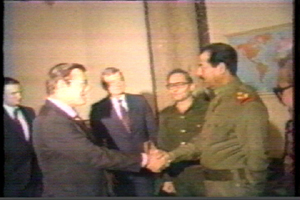
No stranger to the region, Rumsfeld served as Middle East envoy under President Reagan. Here Iraqi President Saddam Hussein greets  Rumsfeld in Baghdad on December 20, 1983. No stranger to the region, Rumsfeld served as Middle East envoy under President Reagan. Here Iraqi President Saddam Hussein greets Rumsfeld in Baghdad on December 20, 1983.

Less than one month after the September 11 attacks, Donald Rumsfeld embarked on a coalition building trip to the Middle East, his first visit to the region while serving as Secretary of Defense. Rumsfeld notes in his 2011 memoir Known and Unknown that at the time of his whirlwind October 3-5 visit to Saudi Arabia, Oman, Egypt, Uzbekistan, and Turkey, he knew that CENTCOM commander General Tommy Franks was planning to insert special operations teams into Afghanistan on the nights of October 6 and 7.1 Rumsfeld’s tour was therefore intended to shore up support for the U.S.’ nascent war on terror from the countries surrounding Afghanistan, and to assuage fears that U.S. military action in the region would be a “flash…

View original post 1,244 more words

Regime Change in Cuba

Normalization of relations with Cuba is not the result of a diplomatic breakthrough or a change of heart on the part of Washington. Normalization is a result of US corporations seeking profit opportunities in Cuba, such as developing broadband Internet markets in Cuba.

Before the American left and the Cuban government find happiness in the normalization, they should consider that with normalization comes American money and a US Embassy. The American money will take over the Cuban economy. The embassy will be a home for CIA operatives to subvert the Cuban government. The embassy will provide a base from which the US can establish NGOs whose gullible members can be called to street protest at the right time, as in Kiev, and the embassy will make it possible for Washington to groom a new set of political leaders.

In short, normalization of relations means regime change in Cuba. Soon Cuba will be another of Washington’s vassal states.

Conservatives and Republicans such as Peggy Noonan and Senator Marco Rubio, have made it clear that Castro is “a bad man who turned an almost-paradise into a floating prison” and that normalizing relations with Cuba will not “grant the Castro regime legitimacy.”

Noonan forgets about Guantanamo, Washington’s offshore torture prison in Cuba where hundreds of innocent people have been held and tortured for a large part of their lives by the exceptional Americans. The Cuban Revolution intended to free Cubans from foreign domination and from exploitation by foreign capitalists. Whatever the likelihood of success, a half century of Washington’s hostility has as much to do with Cuba’s economic problems as communist ideology.

The self-righteousness of Americans is extreme. Noonan is happy. American money is now going to defeat Castro’s life work. And if the money doesn’t do it, the CIA will. The agency has long been waiting to avenge the Bay of Pigs, and normalization of relations brings the opportunity. More


My grandma was a warrior.

Rez Chick's avatarJust A Rez Chick

There is always an uproar when a scantily clad model, celebrity, or even our own women wear war bonnets.  There is always an outcry and I have even stood my ground against this:  You can not do this.  It is wrong.  Women do not traditionally wear headdresses like men, etc.

There have been attacks on fashion shows, Gwen Stefani, Victoria’s Secret,  Halloween costumes, and these social media attacks have been successful.  There re always strong women behind them, giving the reasons why our women don’t wear warbonnets.  Most of the time, because they are nearly naked, the main reason is stereotyping Native women that way.   As if all native women hyper sexual vamps when the rate of sexual violence against native women is higher than the national rate.  The number of missing and murdered Native women is off the charts and rarely does each case see justice.

I…

View original post 416 more words

Arctic Methane Monster Shortens Tail: Shakova, Semiletov Study Shows ESAS Emitting Methane at Twice Expected Rate

robertscribbler's avatarrobertscribbler

ESAS emissions map

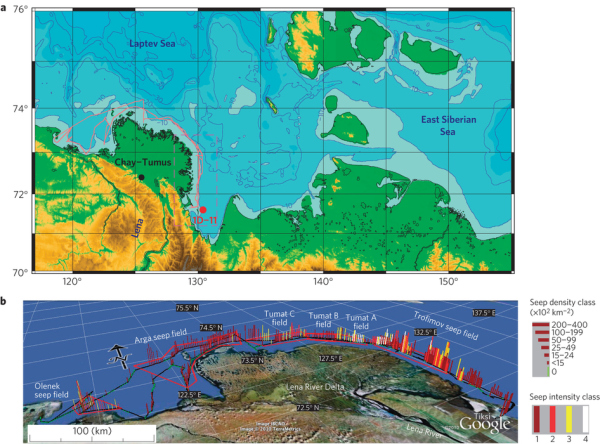
(ESAS Bathymetric and Methane Emissions Map. Image source: Nature)

Arctic Methane emissions have been a touchy subject ever since sporadic reports began trickling in during the mid-2000s that volumes of the gas coming from local sources were on the rise. Two of the scientists producing these reports, Igor Semiletov and Natalia Shakova have been observing a key region of the Arctic called the East Siberian Arctic Shelf (ESAS) since the mid 1990s. At that time, Semiletov and Shakova found no major emissions sources coming from this vast sea whose bottom is composed primarily of carbon-rich submerged tundra.

That all changed in 2010 when an expedition led by Semiletov and Shakova discovered bubbling structures tens of meters across on the shallow and vulnerable ESAS sea bed. Returning in 2011, the pair were surprised and terrified by methane bubbling up from structures as large as 1 kilometer across. During this time…

View original post 2,333 more words

Reflections on the UN Climate Talks (Guest Post)

caribbeanclimate's avatarcaribbeanclimate

Indi Mclymont-Lafayette (L), Journalist and the Regional Director of Panos Caribbean Indi Mclymont-Lafayette (L), Journalist and the Regional Director of Panos Caribbean

COP 20 wrapped up in Lima, Peru last week and many attendees are reflecting on the negotiations. Today Caribbean Climate features a review by Indi Mclymont-Lafayette, a Journalist and the Regional Director of Panos Caribbean – a non-government organisation that focuses on development communication.

Soo… what has been achieved after two weeks of talks?

That was the question one of my friends whatsapped me – knowing that I was attending the 20th United Nations Climate Talks in Lima, Peru from December 1-12.

I hesitated before answering.

Truth to tell, if you followed the achievements highlighted by the United Nations – then a lot had been done. The achievements included:

  • Country pledges to the Green Climate Fund (GCF) pushing it past a US$10 billion start up target.
  • Germany pledging and giving 55 million Euros (roughly US$68 million) to the Adaptation…

View original post 352 more words

Browse the IDRC Davos 2014 Outcomes Report

caribbeanclimate's avatarcaribbeanclimate

Global Risk Forum

The outcomes of the 5th International Disaster and Risk Conference (IDRC) Davos 2014, which was held from 24th -28 thof August in Davos, Switzerland, is now available.

The Outcomes Report is now available for download and consists of two major parts. Part I provides a summary of the findings of the post-conference expert workshop with focus on science and technology, education and training, and implementation (workshop participants are listed in the annex part III).

Part II shows all the various comments which have been provided by the IDRC Davos 2014 participants to the pre-zero and the zero draft concept. The comments are listed according to the numbering used in the existent zero draft. Many comments are very much in-line with the existent draft and might also serve for confirmation purposes of the existent zero draft.

The outcomes of the IDRC Davos 2014 expected to serve as a science & technology input for the post-2015…

View original post 89 more words

Bringing agriculture into Climate Change commitments

caribbeanclimate's avatarcaribbeanclimate

Government officials, representatives of UN bodies and agencies, intergovernmental organizations and civil society organizations are meeting at COP20 in Lima, Peru, to discuss a new global climate change agreement. Since the notion of agriculture is not on the agenda, The Technical Centre for Agricultural and Rural Cooperation ACP-EU (CTA) and other organisations working in agriculture and rural development are striving to establish formal arrangements for addressing agriculture within the next UN Climate Change negotiations. As week two of COP 20 gets into full gear, we urge you to join the online discussion by tweeting #cop20 or #foodsecurity.

Lima
6KEYISSUESStepping up the challenge: six issues facing global climate change and food security

To this end, on 7 December 2014, a special seminar, Stepping up to the challenge – Six issues facing global climate change and food security, was co-organised by CARE International, the CGIAR Research Program on Climate Change, Agriculture and…

View original post 283 more words