Regional Scientists To Present 1.5 Report at Caribbean Climate Change Conference

PRESS RELEASE – Port-of-Spain: October 9, 2017: When scientists and researchers meet in Trinidad at the International Climate Change Conference for the Caribbean this week, it will be in the aftermath of the devastation wrought in the region by successive monster storms in the current 2017 Hurricane Season.

The conference, which is being hosted by the Caribbean Community Climate Change Centre (CCCCC) in association with the European Union (EU) funded Global Climate Change Alliance Plus Initiative (GCCA+) runs from October 9 to 12. It brings together regional scientists to update regional stakeholders on the ongoing regional research in climate change, inform on actions being undertaken to build climate resilience across the region by regional and international organisations, and discuss issues related to climate finance and the science, policy and finance nexus.

Scientists will present the key findings of the 1.5 to Stay Alive research project for the Caribbean region, which was funded by the Caribbean Development Bank. This should offer more insight into the consequences of global warming exceeding a 1.5 degree Centigrade threshold and provide our regional climate change negotiators with a more robust science-based platform for further insisting at the forthcoming Conference of Parties (COP) at the United Nations Framework Convention of Climate Change (UNFCCC) that global mitigation efforts need to be scaled up so that global warming does not exceed this threshold.

The meeting is being held under the theme “Adaptation in Action” which CCCCC’s Deputy Executive Director and Science Advisor Dr. Ulric Trotz said because this best describes the focus of regional institutions and countries in the face of threats posed by Climate Change.

“The 2017 Hurricane Season shows us that we must be proactive in building resilience in the small nation states of the region. And while adaptation and mitigation are critical, climate financing is a much-needed lifeline if the region is to successfully pursue a low carbon climate resilient development pathway. We cannot survive unless we are able to build to withstand these super storms,” he said.

Climate negotiators and Inter-governmental Panel on Climate Change (IPCC) Focal Points from across the region are also in attendance.

Other sponsors include the Caribbean Development Bank (CDB), United Nations Development Programme Japan-Caribbean Climate Change Partnership (UNDP J-CCCP) and Food and Agriculture Organisation of the United Nations (FAO).

–END–

Climate Change Impacts Human Rights, Says UN Special Rapporteur

4 March 2016: A global temperature increase of one or two degrees Celsius would adversely affect human rights, including the rights to life, development, food, water, health and housing, the UN Special Rapporteur on human rights and the environment, John Knox, told the Human Rights Council (HRC).

Knox stressed that human rights obligations with respect to climate change include decisions about how much climate protection to pursue, as well as the mitigation and adaptation measures through which protection is achieved.

In its resolution 29/15, the HRC requested the UN High Commissioner for Human Rights to prepare a detailed 'Analytical study of the Office of the High Commissioner for Human Rights (OHCHR) on the relationship between climate change and the human right of everyone to the enjoyment of the highest attainable standard of physical and mental health (A/HRC/31/36).' The High Commissioner has asked for additional time and research, and will submit its report to the HRC at its 32nd session.


The Special Rapporteur shared an informal summary of inputs received on the 'Relationship between climate change and the human right of everyone to the enjoyment of the highest attainable standard of physical and mental health (A/HRC/31/CRP.4),' which is expected to inform OHCHR's final report. The informal summary notes, inter alia, that climate change: threatens to undermine the last half century of gains in development and global health; impacts physical and mental health in several ways; and disproportionately impacts the poor and other disadvantaged, marginalized and vulnerable groups.


According to the informal summary, respondents called for further integration of human rights in climate action at all levels of governance, as well as further analysis and study of the impacts of climate change on the right to health, among other recommendations.


During discussion, several delegations expressed support for protecting human rights in relation to climate adaptation and mitigation, including the European Union (EU) and Costa Rica. South Africa, on behalf of the African Group, supported enhanced, quick action to adapt to climate change to ensure the full realization of human rights, stressing that climate change threatens sustainable development. The Philippines called for reducing greenhouse gas (GHG) emissions to keep temperature rise below 1.5 degrees Celsius above pre-industrial levels and scaling up additional and predictable means of implementation. Brazil recognized the impacts of climate change on human rights, including economic, social and cultural rights. The EU asked how to better plan and manage urban areas to address synergies among climate change, sustainable development and urbanization.


The world does not need to wait until 2018 to start strengthening its efforts to address climate change and begin implementing the Paris Agreement on climate change, the Special Rapporteur reminded participants in his response, pointing to the use of renewable energy by Iceland, Morocco and Uruguay.


Knox presented on two aspects of his mandate, clarifying the human rights obligations relating to climate change, and on methods of implementing those obligations relating to the enjoyment of a safe, clean, healthy and sustainable environment, in Geneva, Switzerland, on 3 March 2016. [UNOG Press Release] [OHCHR Press Release] [A/HRC/31/36] [Special Rapporteur Website]


read more: http://larc.iisd.org/news/climate-change-impacts-human-rights-says-un-special-rapporteur/


Yes, Scientists Can Link Extreme Weather Events To Climate Change

When asked about a particular weather event’s link to climate change, scientists are typically cautious to make definitive statements — especially in the immediate aftermath, before they’ve had the chance to study the event.

But according to a new study, it’s getting easier for scientists to make the link between climate change and some forms of extreme weather. The study, published Friday by the National Academies Press, found that scientific advances over the past several years have helped scientists link increases in frequency and intensity of temperature and precipitation-related events like droughts and heat waves to climate change.

“In the past, a typical climate scientist’s response to questions about climate change’s role in any given extreme weather event was ‘we cannot attribute any single event to climate change,'” the report, completed by a committee of scientists, reads. “The science has advanced to the point that this is no longer true as an unqualified blanket statement. In many cases, it is now often possible to make and defend quantitative statements about the extent to which human-induced climate change (or another causal factor, such as a specific mode of natural variability) has influenced either the magnitude or the probability of occurrence of specific types of events or event classes.”

The report calls this branch of science, wherein researchers work to determine whether climate change contributed to a certain event, “event attribution.” To determine how and if climate change is linked to a certain event, scientists typically either reference the observational record of similar events — i.e. the recorded history of droughts leading back several decades — or use models to determine how likely a similar event would be in different warming scenarios. Most studies, the report states, use both of these tactics. More


TEDx University College of the Cayman Islands

Did you get a chance to see Shonda Rhimes (Grey’s Anatomy, Scandal, etc.) doing her TED talk on Monday evening? If not, you can catch her online at:http://www.ted.com/talks/shonda_rhimes_my_year_of_saying_yes_to_everything

Her talk entitled “My year of saying yes to everything” was absolutely inspiring.

But that’s what TED is about, as you already know if you were one of the 124 people who registered for this past Tuesday’s simulcast at UCCI of the big TED 2016 event in Vancouver, Canada.

However, nothing beats the thrill of seeing live speakers, engaging with them face-to-face, and discussing those great ideas with other TED event attendees.

Of course, the cheapest admission ticket for TED 2016 in Vancouver was US$8500. (Not an admission price that just anyone can afford in these challenging economic times.)

So, keep in mind that just next month, on March 19th, you can experience the same excitement of live speakers and great ideas at TEDxUCCI 2016. The theme this year is FutureVision…and it will undoubtedly be the most insightful TEDx ever for investigating the many pressing issues facing Cayman and the world.

From 10 a.m. until 3 p.m., you’ll hear great talks on topics including conservation, energy use and production, the ocean’s potential, heath, technical literacy, economic and social sustainability, creative professions, and dealing effectively with today’s complex world. There will also be a new production by the UCCI theatre arts students and great food prepared by UCCI’s Hospitality students.

Nick Robson of the Cayman Institute shall be presenting a talk entitled Predicting The Future. Come out and be entertained and hopefully learn a thing or two.

Early Bird 2-for-1: Bring a Friend for Free!

Through the end of this week, two registrants can pay just one admission fee to attend TEDxUCCI 2016. Both people must register for the TEDxUCCI 2016 event online atwww.TEDxUCCI.ky and then both registration confirmations can be taken to the UCCI campus within 10 working days for payment. As long as both registrations were made before February 21st, only one admission fee will be charged.

Admission costs $25 for non-students and $10 for students. But this week’s 2-for-1 special can provide as much as a 50% savings for TEDx-enthusiasts on a budget. TEDxUCCI 2016 is hosted by UCCI and generously sponsored by the Ministry of Community Affairs, Youth & Sports and Foster’s Food Fair.

To register or for more information, go to www.TEDxUCCI.ky or contact info@TEDxUCCI.ky


Buddhist Climate Change Statement to World Leaders 2015

October 29th, 2015

We, the undersigned Buddhist leaders, come together prior to the 21st Session of the Conference of Parties (COP21) to the UN Framework Convention on Climate Change (UNFCCC) in Paris, in order to add our voices to the growing calls for world leaders to cooperate with compassion and wisdom and reach an ambitious and effective climate agreement.

We are at a crucial crossroads where our survival and that of other species is at stake as a result of our actions. There is still time to slow the pace of climate change and limit its impacts, but to do so, the Paris summit will need to put us on a path to phase out fossil fuels. We must ensure the protection of the most vulnerable, through visionary and comprehensive mitigation and adaptation measures.

Our concern is founded on the Buddha’s realization of dependent co-arising, which interconnects all things in the universe. Understanding this interconnected causality and the consequences of our actions are critical steps in reducing our environmental impact. Cultivating the insight of interbeing and compassion, we will be able to act out of love, not fear, to protect our planet. Buddhist leaders have been speaking about this for decades. However, everyday life can easily lead us to forget that our lives are inextricably interwoven with the natural world through every breath we take, the water we drink, and the food we eat. Through our lack of insight, we are destroying the very life support systems that we and all other living beings depend on for survival.

We believe it imperative that the global Buddhist community recognize both our dependence on one another as well as on the natural world. Together, humanity must act on the root causes of this environmental crisis, which is driven by our use of fossil fuels, unsustainable consumption patterns, lack of awareness, and lack of concern about the consequences of our actions.

We strongly support “The Time to Act is Now: A Buddhist Declaration on Climate Change,” which is endorsed by a diverse and global representation of Buddhist leaders and Buddhist sanghas. We also welcome and support the climate change statements of other religious traditions. These include Pope Francis’s encyclical earlier this year, Laudato Si’: On Care for Our Common Home, the Islamic Declaration on Climate Change, as well as the upcoming Hindu Declaration on Climate Change. We are united by our concern to phase out fossil fuels, to reduce our consumption patterns, and the ethical imperative to act against both the causes and the impacts of climate change, especially on the world’s poorest.

To this end, we urge world leaders to generate the political will to close the emissions gap left by country climate pledges and ensure that the global temperature increase remains below 1.5 degrees Celsius, relative to pre-industrial levels. We also ask for a common commitment to scale up climate finance, so as to help developing countries prepare for climate impacts and to help us all transition to a safe, low carbon future.

The good news is that there is a unique opportunity at the Paris climate negotiations to create a turning point. Scientists assure us that limiting the rise in the global average temperature to less than 1.5 degrees Celsius is technologically and economically feasible. Phasing out fossil fuels and moving toward 100 percent renewable and clean energy will not only spur a global, low-carbon transformation, it will also help us to embark on a much-needed path of spiritual renewal. In addition to our spiritual progression, in line with UN recommendations, some of the most effective actions individuals can take are to protect our forests, move toward a plant-based diet, reduce consumption, recycle, switch to renewables, fly less, and take public transport. We can all make a difference.

We call on world leaders to recognize and address our universal responsibility to protect the web of life for the benefit of all, now and for the future.

For these reasons, we call on all Parties in Paris:

  1. To be guided by the moral dimensions of climate change as indicated in Article 3 of the United Nations Framework Convention on Climate Change (UNFCCC).
  2. To agree to phase out fossil fuels and move towards 100 percent renewables and clean energy.
  3. To create the political will to close the emissions gap left by country climate pledges so as to ensure that the global temperature increase remains below 1.5 degrees Celsius, relative to pre-industrial levels.
  4. To make a common commitment to increase finance above the US$100 billion agreed in Copenhagen in 2009, including through the Green Climate Fund (GCF), to help vulnerable developing countries prepare for climate impacts and transition towards a low-carbon economy.

The time to act is now.

Yours sincerely,

His Holiness the Dalai Lama Tenzing Gyatso, 14th Dalai Lama

Zen Master Thich Nhat Hanh, Patriarch of the Plum Village International Community of Engaged Buddhists

His Holiness the 17th Gyalwang Karmapa, Head of the Karma Kagyu

More

The International Summit on Indigenous Environmental Philosophy

The International Summit on Indigenous Environmental Philosophy

THE PURPOSE OF THE SUMMIT

APRIL 26 – MAY 1, 2010

Indigenous communities are perhaps the most impacted by Climate Change and the least responsible for causing it. Indigenous elders and environmental specialists have also been the first to warn of changes and offer viable suggestions for response strategies yet their critical messages have usually gone unheeded by dominant societies. The International Summit on Indigenous Environmental Philosophy provided a forum for Indigenous thinkers from around the world to gather in a retreat setting to discuss how Indigenous Environmental Philosophy is distinct from Western Environmental Philosophy. Following much discussion and compromise, the following consensus statement was unanimously approved:

Redstone Statement, 1 May 2010

“Leave Us A Future!”

We are Indigenous environmental philosophers who have come from the four corners of the earth to Redstone, Oklahoma, to discuss the future of the planet.

Indigenous environmental philosophy respects a mutually supportive network of interconnected physical and spiritual entities that is sustainably maintained, and which connects the ancestral past with the distant future. The vision of our Indigenous peoples is to reach spiritual and material well-being through conscious action. Mother Earth is a living, dynamic being with inherent value, and her principles must be actively embodied in order to remain in harmony and balance.

Today, we are at a tipping point at which humanity is in danger of being removed from the cycles of Mother Earth. We bring this urgent message in response to Indigenous women, youth and children from around the world who have consistently asked us to leave them a more balanced planet.

We come as individuals from cultures whose authority originates from our unique relationships with nature and the environment. Our ways of living, and very existence, are threatened by the resistance of nation-states to include our institutions as part of the solutions that can save our planet. Consequently, we issue this call to the world.

Environmental, social, economic, and political conflicts over natural resources and access rights, climate change concerns, and other significant issues threatening international and local communities did not suddenly erupt on the global landscape. Rather, they are an outcome of the historical process that today affects every area of creation. Spiritual, cultural, social, economic, and political structures and values lost their connections to the communities and now focus exclusively on the individual. The world shifted from the circle of community to the ascendancy of the individual, resulting in a dangerous environmental imbalance with significant spiritual and health consequences. Balance must be restored in order to heal the earth, and it must include the participation of all ages, races, genders and cultures.

Effective mechanisms necessary for restoring balance include implementing the following:

1. Recognition of the interdependence of all things;

2. Indigenous self-determination;

3. Indigenous land, air, water, territory, and natural resource management;

4. Protection and preservation of Indigenous traditional knowledge, lifeways and languages, cultures, sacred sites, and folklores/oral traditions;

5. Indigenous authority over all actions impacting Indigenous communities;

6. Respect for, and protection of, traditional agricultures and genetic resources;

7. Seed sovereignty and food security;

8. Rights of movement, rights of access, rights of participation and communication in the exchange of environmental knowledge and culture.

We must assure the well-being of both humanity and nature. This requires a unification of diverse people who are open to ideas; people who are wise, clear, and profoundly human; and people who can transcend the self-imposed limits of their minds, reaching deep into their conscience and spirit for solutions.

All governments, communities, leaders, individuals, industries, and corporations must immediately act together to restore the balance that is essential for continued existence.

We call for a review of existing commercial practices and an end to any further non-sustainable exploitation and degradation of natural resources- for all generations to come. We also call for a portion of profits to be invested in the development of renewable energy resources.

We as Indigenous environmental philosophers breathe life into this statement and commit to implementing the provisions contained in it. More


Welcome to a New Planet Climate Change “Tipping Points” and the Fate of the Earth

Not so long ago, it was science fiction. Now, it’s hard science — and that should frighten us all. The latest reports from the prestigious and sober Intergovernmental Panel on Climate Change (IPCC) make increasingly hair-raising reading, suggesting that the planet is approaching possible moments of irreversible damage in a fashion and at a speed that had not been anticipated.

Scientists have long worried that climate change will not continue to advance in a “linear” fashion, with the planet getting a little bit hotter most years. Instead, they fear, humanity could someday experience “non-linear” climate shifts (also known as “singularities” or “tipping points”) after which there would be sudden and irreversible change of a catastrophic nature. This was the premise of the 2004 climate-disaster film The Day After Tomorrow. In that movie — most notable for its vivid scenes of a frozen-over New York City — melting polar ice causes a disruption in the North Atlantic Current, which in turn triggers a series of catastrophic storms and disasters. At the time of its release, many knowledgeable scientists derided the film’s premise, insisting that the confluence of events it portrayed was unlikely or simply impossible.

Fast forward 11 years and the prospect of such calamitous tipping points in the North Atlantic or elsewhere no longer looks improbable. In fact, climate scientists have begun to note early indicators of possible catastrophes.

Take the disruption of the North Atlantic Current, the pivotal event in The Day After Tomorrow. Essentially an extension of the Gulf Stream, that deep-sea current carries relatively warm salty water from the South Atlantic and the Caribbean to the northern reaches of the Atlantic. In the process, it helps keep Europe warmer than it would otherwise be. Once its salty water flows into sub-Arctic areas carried by this prolific stream, it gets colder and heavier, sinks to lower depths, and starts a return trip to warmer climes in the south where the whole process begins again.

So long as this “global conveyor belt” — known to scientists as the Atlantic Meridional Overturning Circulation, or AMOC — keeps functioning, the Gulf Stream will also continue to bring warmer waters to the eastern United States and Europe. Should it be disrupted, however, the whole system might break down, in which case the Euro-Atlantic climate could turn colder and more storm-prone. Such a disruption might occur if the vast Greenland ice sheet melts in a significant way, as indeed is already beginning to happen today, pouring large quantities of salt-free fresh water into the Atlantic Ocean. Because of its lighter weight, this newly introduced water will remain close to the surface, preventing the submergence of salty water from the south and so effectively shutting down the conveyor belt. Indeed, exactly this process now seems to be underway. More


Climate Expert James Hansen: The Planet May Become Ungovernable

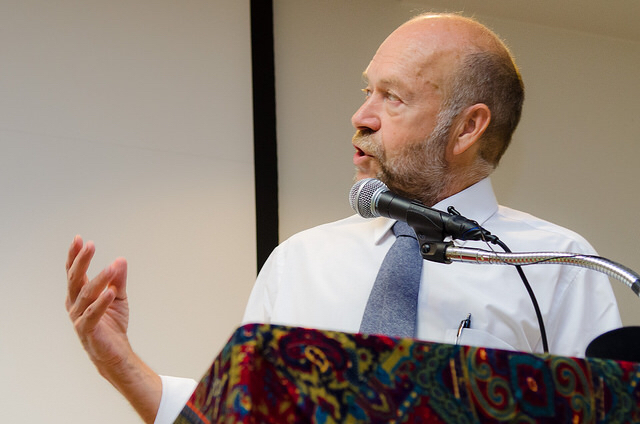
The repercussions of climate disruption are still not being acknowledged fully, warned climatologist Dr. James Hansen, addressing an audience of Baby Boomer and Greatest Generation climate activists on September 9.

Dr. Jim Hansen

“We’ve now got an emergency,” he told about 150 “elder activists” at Calvary Baptist Church in Washington, DC, who were participating in Grandparents Climate Action Day.

Hansen — formerly NASA’s head climate scientist, now adjunct professor at Columbia University — is probably best known for bringing definitive evidence of global warming to Congress in testimony in 1988. In July of this year, he released a report with sixteen co-authors studying glacier melt in Greenland and Antarctica. Unlike previous models, the new report takes into account some feedback loops which may be hastening the loss of ice sheet mass far faster than anticipated.

Time is running out to transition to renewable energy, Hansen said, yet the most “relevant” people in power aren’t aware of the situation’s gravity. “Even people who go around saying, ‘We have a planet in peril,’ don’t get it. Until we’re aware of our future, we can’t deal with it.”

Mass species extinction, extreme weather events, dry spells and fires are climate change impacts which are happening now. A warmer atmosphere and warmer oceans can lead to stronger storms, he explained. Superstorm Sandy, for example, remained a hurricane all the way up the Eastern seaboard to New York because Atlantic waters were abnormally warm.

“Amplifying impacts” and feedback loops will accelerate the changes, according to Hansen. “It will happen faster than you think,” he said. If major coastal cities become “dysfunctional” because of sea level rise, as he believes is possible, the global economy could be in peril of collapse.

It is therefore imperative to stop using coal, oil and gas as energy sources now. “We’ve already burned as much as we can afford,” he said. Fossil fuels already burned will continue to have impacts, because the climate system “has inertia.” “We’ve only felt the warming for half of the gases that are up there,” he said.

The use of fossil fuels is still on the rise in spite of the dangers, he said, because governments subsidize them and don’t make companies bear the real costs to society. The only viable way to make the price of fossil fuels “honest,” in his opinion, is to implement a “fee and dividend” system.

While Hansen denounced “unfettered capitalism”and “scary” trade agreements in the works, he believes government regulation can steer captains of industry onto the right path. “We’ve got to make the system work for us,” he said. “If you properly harness the market, it will work for you.”

He gave an example of incentives and tax breaks for solar panels, which he has on his own home, and how he contributes electricity to the grid. Yet one audience member took issue with a corruption-free scenario. “Come to Virginia, I dare you!” he said. (In Virginia, where Dominion Virginia Power has a stranglehold on state politics, “standby” fees and other barriers stifle solar panel installation by individuals.)

Hansen, a grandparent himself, was the keynote speaker at Grandparents Climate Action Day, an event to mobilize elder activists and promote a policy agenda aimed at reducing greenhouse gas emissions.

Hansen believes elders possess resources and wisdom which, combined with the zeal of youth, can help find solutions to climate change. “Older people have a lot of clout, a lot of votes, and time,” he said. With more older people getting involved, there will be more pressure to make needed changes.

Fellow speaker John Sorensen, co-founder of the Conscious Elders Network, echoed this point. The 80 million elders in the U.S. — 25 percent of the population — are living longer and healthier lives with more time and resources to devote to activism.

Hansen is supporting a lawsuit in which 21 young people are suing the U.S. government. (One of the plaintiffs is his granddaughter Sophie.) The lawsuit alleges that the federal government knew decades ago that burning fossil fuels and climate were linked, but continued on the same course anyway.

In his testimony for Youth v. Obama, Hansen said, “In my opinion, this lawsuit is made necessary by the at-best schizophrenic, if not suicidal, nature of U.S. climate and energy policy.”

The judiciary, he believes, is the only viable recourse left for the younger generation, “because the courts will be less under the thumb of the fossil fuel industry.”

“Young people have all these rights that are guaranteed by the constitution, and that’s what we’re asking the courts to look at, and I think this may be our best chance to force the government to do its job,” he said.

Most of the elders participating in Grandparents Climate Action Day probably won’t live to see the worst effects of climate change, yet they were eager to learn about the earth future generations will inherit. One participant explained her reason for being there. After working with children for her whole career, she realized that “all of it mean[s] nothing if we don’t have a livable planet.”

“Young people have all these rights that are guaranteed by the constitution, and that’s what we’re asking the courts to look at, and I think this may be our best chance to force the government to do its job,” he said.

Most of the elders participating in Grandparents Climate Action Day probably won’t live to see the worst effects of climate change, yet they were eager to learn about the earth future generations will inherit. One participant explained her reason for being there. After working with children for her whole career, she realized that “all of it mean[s] nothing if we don’t have a livable planet.” More


Hope, Dear, Debt and Paranoia – By Albert Bates

Hope, fear, debt and paranoia have been recurrent themes running through our past month as we traversed the northwest corner of the European continent through Iceland, Britain and Denmark.

Iceland is the country that told the world its bankers are not too big to jail and it will not be blackmailed by London, Bonn, or the European central banks. It is still taken to the woodshed regularly and reminded who is in charge. Icelanders are not free to leave their country or to take money with them if they are allowed to go.
Britain is Europe's bad boy, master of every latest Ponzi scheme and constantly one step ahead of collapse, eking astonishing profits as all about her topple and fall. Denmark is a dreamweaver, whose sheer powers of imagineering seem to emanate an aura that can warp reality. With nothing but fairy dust to back its notes and debts, it is poised to test the durability of its famed social capital when placed in the vice grip of open imigration. Like many former bastions of European liberalism, it has taken a hard swing to the right and is getting set for the clown show that follows.
The United States is far along down the circus trail, having starved its science, educational and social programs for decades while feeding its population a steady diet of numbing pharmaceuticals, mind-rotting television, high fructose corn syrup and GMOs, until they can be readily induced in their coma to vote against their own interests, over and over, producing a government of popular lunacy — clownocracy — a Mad Hatter's Tea Party overseen by Donald Trump, as Queen of Hearts; “a sort of embodiment of ungovernable passion – a blind and aimless Fury” (description by Lewis Carroll).
Debt is a theft of the options of future generations. To escape debt and claw their way back from penury people will rape, plunder and pillage every last sacred resource, leaving not an inheritance but a ruin. Cascading debt may sweep much of civilization away, perhaps in Jubilee, but the damage will have been done to foundations — and be visited as ecosystem death. Every dollar that cannot possibly be repaid in sweat and hours becomes a drain on Earth's operating system. We grew giddy wealthy on our energy slaves. Don't look now, but they just left and winter is coming.
Obstruction is an occupational hazard we accept because we are in the business of bringing hope, otherwise labeled permaculture, or ecovillage, but we are frequently obstructed and overpowered by those other three elements — fear, debt and paranoia. From time to time we break through enough to peer over the horizon and see what might yet be.
Fear and paranoia are what drive the security state apparatus we encounter most closely and personally when we stand in long lines at airports and then let some gentleman we have only just met fondle our genitals. Of course, we could avoid having our genitals fondled if we would agree to placing ourselves in front of his death ray for a few milliseconds. We know that a few milliseconds won't kill us on the spot but its like buying a ticket in the cancer lottery, and we go through airports often so if we didn't do this fondling ritual we might soon have a shoebox full of such raffle tickets, and who knows? We might win.
Research suggests that anywhere from six to 100 U.S. airline passengers each year may be getting cancer from the machines. Still, any time you opt out, some brainwashed TSA officer will try to persuade you that scanners are “safe,” or equal to “less than three minutes of air travel,” glossing over the fact that even the lowest doses of ionizing radiation — the kind beamed directly at the body by the scanners and qualitatively not much different in the non-ionizing radiation of millimeter wave devices — will increase your lifetime risk of cancer and inherited damage to your offspring, increasing your and their susceptibility to hundreds of genetically related diseases and disabilities.
It is refreshing to go through airports in Europe and not have to go through these machines because they are banned in Europe and would have been banned in the United States had the scientific or medical community made the call. As it was, the call was made by apparatchiks who skipped the legally required public comment period before deploying the scanners, and bypassed the Food and Drug Administration by waving their Patriot Act, and then, in defending these cruel devices, relied on a small body of unpublished research to insist the machines were safe, ignoring contrary opinions from U.S. and European authorities that recommended precautions, especially for pregnant women. Rapiscan employed Chertoff Group, founded by Homeland Security Nomenklatura Michael Chertoff, to make sure the government worked for them. More

Islamic Climate Change Declaration Calls for Zero Emissions Strategy


18 August 2015: Islamic leaders, during an International Islamic Climate Change Symposium, called on the world's 1.6 billion Muslims to take an active role in combating climate change and urged governments to agree to a new climate change agreement in Paris.


The Symposium convened to discuss proposed messages from the Islamic community and to mobilize stakeholders in advance of the Paris Climate Change Conference in December 2015. It also aimed to seek consensus on an ‘Islamic Declaration on Climate Change,' which was drafted and circulated for comments prior to the symposium.


Approximately 60 participants, including international development policymakers, faith group leaders, academics and other experts, attended the Symposium, which met from 17-18 August 2015, in Istanbul, Turkey. The event provided the opportunity for: networking with leaders from other faiths and secular organizations; promoting inter-faith and cross-movement cooperation around joint messages; focusing on the role and contribution of Muslims to the climate movement; and securing high-level representation from participating stakeholder groups. The Symposium reaffirmed that the Islamic faith community represents a significant section of the global population and, thus, can be influential in the climate change discourse.


The 'Islamic Declaration on Climate Change,' agreed to by participants, presents the moral case, based on Islamic teachings, for Muslims and people of all faiths to act on climate change. It was drafted by international Islamic scholars from around the world and is “in harmony” with the Papal Encyclical.


The Declaration urges: setting clear targets and monitoring systems; phasing out greenhouse gas emissions; committing to 100% renewable energy and/or a zero emissions strategy; and richer countries and oil-producing states to lead the way in phasing out their emissions by 2050. The Declaration also calls for, inter alia: the provision of financial and technical support to poorer countries to phase out greenhouse gases; limiting temperature rise to below 2°C, and preferably below 1.5°C; investing in a green economy; and prioritizing adaptation efforts with support to more vulnerable countries.


In addition, the Declaration urges corporations, finance and the business sector to, inter alia: reduce their carbon footprint; commit to 100% renewable energy and/or a zero emissions strategy; adopt a “circular economy that is wholly sustainable”; consider social and ecological responsibilities; and help in divesting from the fossil fuel driven economy.


Welcoming the Declaration, UNFCCC Executive Secretary Christiana Secretary Christiana Figueres said that Islam's teachings, which emphasize the “duty of humans as stewards of the Earth and the teacher's role as an appointed guide to correct behavior,” provides guidance to take action on climate change.


The Pew Research Center data estimates that 84% of the world's population is religiously affiliated, which points to the importance of support by faith groups for climate action. Many other faiths and denominations have also called for governments to act on climate change, including through the Papal Encyclical, a forthcoming Buddhist Declaration on climate change and a Rabbinic Letter on the Climate Crisis. [Symposium Website] [Islamic Declaration on Climate Change] [UNFCCC Press Release] [Climate Action Network Press Release] More