From Miasma to Ebola: The History of Racist Moral Panic Over Disease

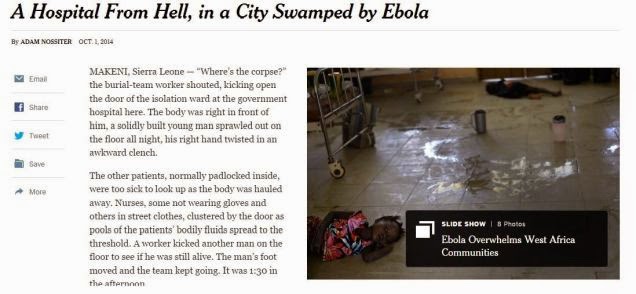
On October 1st, the New York Times published a photograph of a four-year-old girl in Sierra Leone. In the photograph, the anonymous little girl lies on a floor covered with urine and vomit, one arm tucked underneath her head, the other wrapped around her small stomach. Her eyes are glassy, returning the photographer’s gaze. The photograph is tightly focused on her figure, but in the background the viewer can make out crude vials to catch bodily fluids and an out-of-focus corpse awaiting disposal.

The photograph, by Samuel Aranda, accompanied a story headlined “A Hospital From Hell, in a City Swamped by Ebola.” Within it, the Times reporter verbally re-paints this hellish landscape where four-year-olds lie “on the floor in urine, motionless, bleeding from her mouth, her eyes open.” Where she will probably die amidst “pools of patients’ bodily fluids,” “foul-smelling hospital wards,” “pools of infectious waste,” all overseen by an undertrained medical staff “wearing merely bluejeans” and “not wearing gloves.”

Aranda's photograph is in stark contrast to the images of white Ebola patients that have emerged from the United States and Spain. In these images the patient, and their doctors, are almost completely hidden; wrapped in hazmat suits and shrouded from public view, their identities are protected. The suffering is invisible, as is the sense of stench produced by bodily fluids: these photographs are meant to reassure Westerners that sanitation will protect us, that contagion is contained.

Pernicious undertones lurk in these parallel representations of Ebola, metaphors that encode histories of nationalism and narratives of disease. African illness is represented as a suffering child, debased in its own disease-ridden waste; like the continent, it is infantile, dirty and primitive. Yet when the same disease is graphed onto the bodies of Americans and Europeans, it morphs into a heroic narrative: one of bold doctors and priests struck down, of experimental serums, of hazmat suits and the mastery of modern technology over contaminating, foreign disease. These parallel representations work on a series of simple, historic dualisms: black and white, good and evil, clean and unclean.

The Western medical discourse on Africa has never been particularly subtle: the continent is often depicted as an undivided repository of degeneration. Comparing the representations of disease in Africa and in the West, you can hear the whispers of an underlying moral panic: a sense that Africa, and its bodies, are uncontainable. The discussion around Ebola has already evoked—almost entirely from Tea Party Republicans—the explicit idea that American borders are too porous and that all manners of perceived primitiveness might infect the West.

And indeed, with the history of American and European panic over regulating foreign disease comes a history of regulating the perception of filth from beyond our borders, a history of policing non-white bodies that have signified some unclean toxicity.


If the history of modernity can, as Dominique Laporte suggests in his genealogical meditation History of Shit, be written as a triumph of cleanliness over bodily refuse, then so too could the European colonization of Africa and India. The sanitary crusade of the nineteenth century is central to the violent project of empire. Western medicine, with its emphasis on personal hygiene, functioned (and in some arenas still functions) as colonialism's benevolent cover—an acknowledgment that, while empire was about profit at all costs, that it could also conceal this motive slightly by concerning itself with bettering the health of debased bodies.

The bureaucratic annals of colonialism are filled with reports on the unsanitary conditions of life and unhygienic practices of natives. Dr. Thomas R. Marshall, an American in the Philippines, wrote of the “promiscuous defecation” of the “Filipino people.” An 1882 British report, “Indian Habits,” observed that, “The people of India seem to be very much the condition of children. They must be made clean by compulsion until they arrive at that degree of moral education when dirt shall become hateful to them, and then they will keep themselves clean for their own sakes.” Dirtiness and defecation indicated their primitiveness and savagery; it reaffirmed the white body's privileged position and claim to moral and medical modernity.

This intense focus on hygiene emerged from an old medical doctrine known as miasma. According to the miasma theory, illness was the direct result of the polluting emanations of filth: sewer gas, garbage fumes and stenches that permeated air and water, creating disease in the process. Filth, however, had many incarnations. It could be literal, or also a catch-all metaphorical designation for anything that made people uncomfortable about race, gender and sexuality. (This idea underpins phrases still in use today, for example: a “dirty whore”).

So, the medical mission of hygiene was simultaneously a moral and medical imperative. And it was this fervent belief in miasmas that led to colonial administrations deeply interested in the bodily fluids of bodies of color; as Lord Wellesley, the British governor of India, briefly noted in an 1803 report, “Indians defecate everywhere.”

But if colonial governments exercised concern over what they believed to be the contaminated cultures of native populations, it was more likely the result of panic over the health of their own officials and soldiers. “The white man's grave,” as one nineteenth-century British colonist called Sierra Leone, was a dangerous trap of foreign disease, carried by the contagious peoples who inhabited valuable land. Their culture, like their natural resources, must be conquered. Who better to do that then scientifically advanced westerners who valued cleanliness and life?

Miasma theory proved a powerful science through which to construct “the African” or “the Indian.” Long after its late-nineteenth-century demise and subsequent replacement with an epidemiological understanding of contagion, the metaphors it produced endured. The move from miasma theories to germ theories simply added pathological depth to older social resentments. Minorities might look clean: but who knew what invisible, contagious threats lurked within?

These stereotypes showed up everywhere. Take, for example, Victorian soap advertisements: ordinary markers of domesticity that, according to feminist scholar Anne McClintock, “persuasively mediated the Victorian poetics of racial hygiene and imperial progress.” In a Pears' Soap advertisement from around 1882, race is linked to dirtiness and ignorance: blacks could become clean (here, actually, white) if they just bathed; they barely know how to clean themselves; they need a white man to teach them cleanliness, civilization, culture, etc. More


The Smithsonian Institution Announces an Official Climate Change Statement

Living in the Anthropocene: Prospects for Climate, Economics, Health, and Security

In conjunction with the one-day symposium “Living in the Anthropocene: Prospects for Climate, Economics, Health, and Security,” the Smithsonian has released the following statement on climate change:

Rapid and long-lasting climate change is a topic of growing concern as the world looks to the future. Scientists, engineers and planners are seeking to understand the impact of new climate patterns, working to prepare our cities against the perils of rising storms and anticipating threats to our food, water supplies and national security. Scientific evidence has demonstrated that the global climate is warming as a result of increasing levels of atmospheric greenhouse gases generated by human activities. A pressing need exists for information that will improve our understanding of climate trends, determine the causes of the changes that are occurring and decrease the risks posed to humans and nature.

Climate change is not new to the Smithsonian—our scholars have investigated the effects of climate change on natural systems for more than 160 years. We look at processes that occurred millions of years ago alongside developments taking place in today’s climate system.

The Smithsonian responds to climate change in four ways: by increasing knowledge of the human and natural environment through research; by making our findings available to the public; by protecting the Institution’s core asset, the national collections; and by operating our facilities and programs in a sustainable manner.

Research underlies all that we do. Scholars use the Smithsonian’s unparalleled collection of more than 138 million objects and specimens, together with our global network of marine and terrestrial monitoring stations, to examine climate change through multiple lenses. Smithsonian research scientists use satellite- and place-based sensors to study the changing composition of air, water and soil. They study climate history at geological and archaeological field sites around the world. Finally, they excel at baseline studies carried out over decades, which are recognized as essential to tracking the long-term effects of climate change.

The 500 Smithsonian scientists working around the world see the impact of a warming planet each day in the course of their diverse studies. A sample of our investigations includes anthropologists learning from the Native people of Alaska, who see warming as a threat to their 4,000-year-old culture; marine biologists tracking the impacts of climate change on delicate corals in tropical waters; and coastal ecologists investigating the many ways climate change is affecting the Chesapeake Bay.

The dissemination of knowledge gained through research is a public responsibility of the Smithsonian. Our scientists continually communicate with the scholarly community through publications and academic interactions. At the same time, the Smithsonian’s unique combination of museums and interconnected array of traveling exhibitions, publications, media and Web-based tools provide platforms to reach hundreds of millions of people each year across the world. Our goal is to explain in clear and objective terms the causes and effects of climate change as documented in our research and the research of our colleagues.

The Smithsonian has assembled collections of scientific specimens unsurpassed anywhere else in the world. These collections provide invaluable documentation of cultures and global biodiversity for scientists, scholars and the public. Extreme weather, rising sea levels and storm surges pose significant threats to the museums and research centers that house these collections, many of them located on low-lying land. Our charge is to protect, now and far into the future, this irreplaceable resource from the impacts of climate change and other hazards.

We are always striving to operate in ways that minimize the Smithsonian’s environmental footprint, meeting Institutional goals to decrease the use of potable water and fossil fuels, reduce direct and indirect greenhouse gas emissions and increase use of renewable energy. The National Museum of African American History and Culture is set to be the “greenest” Smithsonian museum yet, designed to achieve a LEED Gold rating, and the new Mathias Laboratory building at the Smithsonian Environmental Research Center is on track to receive LEED Platinum certification.

The Smithsonian will continue, as it has for more than a century and a half, to produce basic scientific information about climate change and to explore the cultural and historical significance of these changes. The urgency of climate change requires that we boost and expand our efforts to increase public knowledge and that we inspire others through education and by example. We live in what has come to be called the Anthropocene, or “The Age of Humans.” The Smithsonian is committed to helping our society make the wise choices needed to ensure that future generations inherit a diverse world that sustains our natural environments and our cultures for centuries to come. More


Water as a single post-2015 UN Sustainable Development Goal

We need a single post-2015 Sustainable Economic and Social Development Goal for Water with four concrete targets responding to the major challenges: access to truly safe water for basic needs, access to decent sanitation, primary treatment of all wastewater (see my previous post), and, last but not least, rebalancing overdraft of freshwater.

I made my proposals already on several occasions and would like to use this platform to bring them to the attention of an even wider group of people. They are based on a broad consultationearlier this year and then further developed in many discussions with persons from civil society, private sector and government. A single goal for water with four concrete targets as part of the Post-2015 UN Sustainable Development GoalsThe discussion on the post-2015 Goals is ongoing both in New York and in capitals of UN member countries.

The proposals of a single water goals with the four targets as specified below need, if you agree with them, your support whenever and wherever possible

1) Water as a human right – implement the universal accesses to safe drinking water bringing ‘improved’ water to all people by 2025 at the latest, with a parallel focus and longer-term perspective (i.e., beyond 2025) on quality, i.e., moving from an ‘improved’ water perspective to ‘truly safe drinking water’, and on bringing this water actually to the homes of individual citizens. While it is essential for achieving this target that infrastructure costs (including capital costs) are fully covered, water to cover the very basic needs must be free for those who are unable to pay

2) Accelerate the provision of access to improved sanitation to at least 120 million additional people per year, aiming for universal access before 2050. Data on actual improvements achieved show that this is realistically possible; with further strengthened efforts political leaders might aim for even more ambitious targets.

3) Adequate treatment of all municipal and industrial wastewater prior to discharge by 2030. Best practice initiatives and learning to reduce groundwater pollution by agricultural production (traditional, organic, etc.). According to FAO only about half of the 285 cubic-kilometres of wastewater are treated, and only some 10% of treated municipal wastewater is directly re-used. This means there is potential here to close the gap – as outlined in my previous post here on LinkedIn

4) Finally, yet fundamentally, we must address the water overdraft, i.e., bringing freshwater use/waste (initially measured as withdrawals) back into line with sustainable supply (natural renewal minus environmental flows). Without change in the way we are using water today, we risk shortfalls of up to 30% of global cereal production due to water scarcity by 2030. First priority must be on this target 4, if we can’t overcome water overuse, water shortage will impact all other targets above. Cost effective and comprehensive actions are needed, combining the supply side and demand side by increasing the efficiency of water use and managing wastewater as a reusable resource. The 2030 Water Resources Group that I am chairing, a disruptive public-private partnership, is participating in these efforts. But it is an initiative that still needs more support – we are looking for more companies and other stakeholders to join.

Need for reality checks of goals, need for good management, and need for a broader policy context.

All of these targets need to be checked against reality: we did it with data of improvements of the past. But then it is also about good management of their local implementation, rather than solemn declarations, that is what is most needed in the coming years.

And they need to be put in the context of other policies and urgent policy changes:

  • more efforts to reduce loss and waste of food, again a management task, also with the necessary investment in infrastructure, and more responsibility of consumers in advanced economies;
  • we must further liberalise international trade (of virtual water) so, water intensive staple food, for instance, can be grown in regions where water is abundant;
  • land and other property, but also usage rights, for instance private rights to use water particularly of small farmers must be better protected;
  • and governments must no longer wait and stop mandates and subsidies for biofuels.

Water plays a complex role in society and human life, which makes its management quite challenging. This means further discussion on all the points I’ve made over the past few posts remains necessary. More


Plastic Bags Fact Sheet

Bookmark and Share

Plastic Bags Fact Sheet

Earth Policy Release
October 16, 2014

Grain

Worldwide, a trillion single-use plastic bags are used each year, nearly 2 million each minute.

The amount of energy required to make 12 plastic shopping bags could drive a car for a mile.

City, state, and national governments around the world are trying to limit plastic bag litter and waste with bans and fees.

The oldest existing plastic bag tax is in Denmark, passed in 1993. Danes use very few light-weight single-use plastic bags: about 4 per person each year.

At least 16 African countries have announced bans on certain types of plastic bags, to varying levels of effectiveness. Before a ban on thin bags—which tear readily and get caught by the wind—went into effect in 2003, plastic bags were christened South Africa’s “national flower” because of their prevalence in bushes and trees. Thicker bags are taxed.

Many European countries tax plastic bags or ban free distribution. The EU Parliament is discussing measures that could require member states to cut plastic bag use by 80 percent by 2019. A memo on the proposal noted that “plastic bags have been found in stomachs of several endangered marine species,” including various turtles and porpoises, and 94 percent of North Sea birds.

The provinces of Ontario and Quebec have each halved their plastic bag use through a variety of measures, including store incentives for using reusable bags and retailer-imposed fees.

Livestock choking on plastic bags—from camels in the United Arab Emirates to sheep in Mauritania and cattle in India and Texas—have led communities to consider regulation.

Currently 100 billion plastic bags pass through the hands of U.S. consumers every year—almost one bag per person each day. Laid end-to-end, they could circle the equator 1,330 times.

Over 150 U.S. cities and counties ban or require fees for plastic bags. California passed the first statewide ban in 2014, though Hawaii had a de facto ban through county ordinances. Over 49 million Americans live in communities that have passed plastic bag bans or fees.

U.S. cities with bag bans include San Francisco (as of 2007), Portland (2011), Seattle (2012), Austin (2013), Los Angeles (2014), Dallas (to begin in 2015), and Chicago (2015).

The plastics industry has spent millions of dollars to challenge plastic bag ordinances.

Washington, D.C., was the first U.S. city to require food and alcohol retailers to charge customers 5¢ for each plastic or paper bag. Proceeds are shared between stores and environmental clean-ups.

A timeline tracing the history of the plastic bag and examples of plastic bag ordinances from the United States and around the world are at www.earth-policy.org.

# # #


Data and additional resources available at www.earth-policy.org.

Feel free to pass this information along to friends, family members, and colleagues!

Research Contact: Janet Larsen (202) 496-9290 ext. 14 | jlarsen@earth-policy.org


Earth Policy Institute
1350 Connecticut Avenue NW, Suite 403, Washington, DC 20036
Follow us on:
EPI Fan Page EPI on Twitter EPI RSS EPI Youtube Channel

5 Things to Know About Climate Change in the Caribbean!

caribbeanclimate's avatarcaribbeanclimate

Natural events and human activities contribute to an increase in average temperatures around the world. Increases in greenhouse gases such as Carbon Dioxide (CO2) is the main cause. Our planet and our region are warming. This leads to a change in climate.

  1. The Caribbean is a minute contributor to global greenhouse gas emissions, but will be among the most severely impacted.
  2. We are already experiencing its impacts. More frequent extreme weather events, such as the 2013 rain event in the Eastern Caribbean; the extreme droughts being experienced across the region, with severe consequences in places like Jamaica; the 2005 flooding in Guyana and Belize in 2010. And further Climate Change is inevitable in the coming decades.
  3. Inaction is VERY costly! An economic analysis focused on just three areas - increased hurricane damages, loss of tourism revenue and infrastructure damages - could cost the region US$10.7 billion by 2025. That is…

View original post 128 more words

I’m fighting to keep my home above water

My name is Milañ Loeak, I’m from the Marshall Islands, and I bring you a message on behalf of my Climate Warrior brothers and sisters from across Oceania.

You’ve probably heard it all before — that the climate is changing, that the ocean is rising, that my home in the islands will be the first to go. But the people of the Pacific are not drowning, we are fighting. And the biggest threat to our homes is the fossil fuel industry.

So here’s how we’re fighting back: there’s a coal port in Newcastle, Australia and it’s the largest in the world, shipping approximately 617,000 tons of coal every single day. If the port were a country, it would be the 9th highest emitting country in the world. That’s why I have travelled to Australia to shut it down for a day.

Using traditional canoes, I and 30 other Pacific Climate Warriors are going to paddle into the oncoming path of coal ships. Behind us will be hundreds of Australians in kayaks, on surfboards and whatever else they can find, united with us as we stand up to the fossil fuel industry.

But we need more than hundreds of Australians standing with us — we are going to need you too.

The fossil fuel industry will try to dismiss us. They will launch their PR machine to say that we are just a small group acting alone and that we do not speak for others. But we know that we are not acting alone. We are standing with front line communities around the world when we say it is time to end our addiction to fossil fuels before it destroys our homes, our communities, and our culture.

As the Pacific Climate Warriors paddle into the water on October 17th, show that you stand with us — click here to sign on to our call for solidarity.

Stopping one day of coal exports alone won’t keep our homes above water, but it marks the rise of the Pacific Climate Warriors, and the beginning of our defense of the Pacific Islands.

I ask you to join us in this fight — because we cannot save the Pacific Islands on our own.

Warm Pacific wishes,

Milañ Loeak, Republic of the Marshall Islands


350.org is building a global climate movement. Become a sustaining donor to keep this movement strong and growing.


Live Updates:- Caribbean Launch: IPCC AR5 Report Overview. What does it mean for the Caribbean?

caribbeanclimate's avatarcaribbeanclimate

Bookmark this page for live updates during the event.

The Caribbean Community Climate Change Centre (CCCCC) will host the Caribbean Launch of The Fifth Assessment Report (AR5) of the United Nations Intergovernmental Panel on Climate Change (IPCC)  this evening at 6pm (-4 GMT).

The public education event, which will be held at the Frank Collymore Hall, Central Bank of Barbados, is intended to raise the profile of Climate Change as a key development challenge in the Region, and the high degree of scientific certainty surrounding the predictions about our changing and variable climate.

The report offers some specific messages about the impacts of climate change on small island states – and some of its general findings on climate change adaptation and mitigation are of particular relevance to Small Island Developing States such as those in the Caribbean. The 120 minute public education launch event, which will be live streamed via…

View original post 111 more words

Iowa Roots: Speaking Truth to Power

James Hansen writes: I was lucky to be born in Iowa. The nature of my childhood and later education at the State University of Iowa, odd as it seems, have relevance to fundamental political matters that I hope Iowans will think about. I will argue that Iowa could alter our nation’s course on energy and climate, matters of monumental importance to our children and indeed to all life on Earth.

James Hansen

I was born in 1941 in a small farmhouse in western Iowa, the fifth of seven children. My father was an itinerant tenant farmer, moving from one farm to another, sharing crops with the owner.

By 1945 small farms were disappearing. My father took a job as bartender and we moved a small house to a lot in Denison Iowa. Our life then seems hard by today’s standards. There were three bedrooms for nine of us. Even after we got a septic system the toilet was in the cellar, which required going outdoors. The only sink was in the kitchen, which was also the dining room. Washing up was done in turn, quickly. Our parents quarreled vehemently when our mother took a job as a waitress. I shrank in fear from our father’s angry voice.

Yet it was a good life to grow up in small town Iowa in a time of rising expectations. Today’s young people face a harder situation, with diminishing opportunities. That hurts deeply because, as I will explain, it is unnecessary, a result of tragic political machinations for which we adults must accept responsibility.

Politics back then was simpler. My father shouted “give ‘em Hell, Harry!” and slapped the table while listening to President Truman on the radio. My father called the Republican Party “the rich man’s party.” But shortly before my parents divorced he took me to listen to General Eisenhower speaking from the back of a train, as he came through Denison on a whistle-stop campaign trip in 1952. My father decided that he “liked Ike”, so he voted Republican.

Politicians were more honest regarding fundamental situations. Truman was blunt, with courage to remove war-hero MacArthur, thus maintaining civilian control of policy. Eisenhower warned us about the rising military-industrial complex. Below I contrast this with today’s situation.

It was easier in those days for young people to get ahead. I had a paper route from 3rd grade and by high school was the distributor of the Omaha World Herald for Denison (competing with the Des Moines Register for customers). From such a job I could save enough for college, where costs were within reach of all. Costs today have exploded. With our federal government in cahoots with banks, many college students look forward to decades of debt, not a better life.

My good fortune was to go to the University of Iowa. Professor James Van Allen was building instruments in the basement of the physics building, including the one on the first U.S. satellite, which discovered Earth’s radiation belts. In an exciting research environment Prof. Van Allen taught us how science works. The only “authority” was the rigorous objectivity of science.

Prof. Van Allen did not shirk from speaking truth to power and the public. When microwave ovens were introduced and fear of microwave radiation began to spread, Prof. Van Allen offered to sit on a microwave oven while it cooked his dinner. He helped quell irrational fear.

Prof. Van Allen told me about new data on the planet Venus. It led me to study why Venus was so hot and to propose an instrument for a mission to Venus after I joined NASA. The extreme heat on Venus turned out to be caused by the large amount of CO2 in the planet’s atmosphere.

CO2 was known to be increasing rapidly on Earth, because of our burning of fossil fuels – coal, oil and gas. What would it mean for life on our planet? I formed a small team at the NASA Goddard Institute for Space Studies to study the problem.

We showed that Earth was warming by the amount expected due to the CO2 increase. Later we showed that Earth was out of energy balance: Earth is absorbing more energy from the sun than it is radiating to space as heat. This confirms the most fundamental physics, as it is the added CO2 that reduces heat radiation to space. The conclusion is based on data, not models.

One implication: more warming is “in the pipeline”, without additional increase of atmospheric CO2. In turn, it follows that CO2 emissions must be reduced rapidly or young people in coming decades will face unacceptable consequences: continually retreating shorelines, shifting climate zones with extermination of many species, increasing occurrence of climate extremes with widespread disruption to food and water supplies, more severe droughts and heat waves, more damaging forest fires, stronger storms, and greater flooding.

Implications for energy policy are crystal clear. Most remaining fossil fuels must be left in the ground, unless the CO2 is captured and buried. There is no serious scientific debate about this.

Remarkably, scientific analysis also shows that the policies needed to achieve fossil fuel phasedown would also address problems such as underemployment and growing income disparities. Why are such policies not pursued, if they are in the best interests of the public?

I learned why when I worked for the government. I was repeatedly warned not to connect the dots in the climate problem all the way to policy implications. End steps must be left to “policy-makers” and, it turns out, to special interests. NASA did not want to annoy the powers that be.

Scientists are trained to analyze complex problems and connect all the dots. If we fail to tell the whole story clearly, if we shirk speaking truth to power, we fail our children and grandchildren.

The truth is that present energy and climate policies of the United States and the United Nations are dishonest and tragic.

Out of one side of their mouths our leaders profess to understand that we have a planet in peril and that we must rapidly phase down CO2 emissions. At the same time they encourage pursuit of almost every fossil fuel that can be found, while knowing that such policies make achievement of climate goals impossible.

The fundamental reason that fossil fuel emissions continue to increase is that they appear to the consumer to provide the cheapest energy. This apparent cheapness is a mirage. Why? (1) We subsidize fossil fuels directly, and indirectly by protecting supply lines. (2) Impacts of air and water pollution are borne by the public; e.g., if your child gets asthma, you pay the costs, not the fossil fuel company. (3) Costs of climate catastrophes are borne by the victims and taxpayers.

We should make the price of fossil fuels honest by collecting a gradually rising carbon fee from fossil fuel companies. It is easy to collect, at domestic mines and ports of entry. 100% of the collected money should be given to the public, an equal amount to each legal resident, distributed electronically to bank accounts or debit cards. Not one dime to the government.

The person doing better than average in limiting his “carbon footprint” will make money. He will have an incentive to reduce fossil fuel use via future purchases. Entrepreneurs will have an incentive to develop no-carbon products. Businesses will be able to plan energy investments.

Detailed economic studies show that a carbon fee of $10 per ton of CO2, increasing $10 each year, will reduce U.S. CO2 emissions 33% in 10 years. That is 12 times more than the amount of carbon in the oil that would be carried by the Keystone XL pipeline.

While a tax would depress the economy, a fee with 100% of the money distributed to the public spurs the economy. After 10 years national employment increases 2.1 million jobs! The simple explanation is that honest pricing of energy makes the economy more efficient.

I should explain why I say that our governments’ policies are “dishonest and tragic.” They are dishonest because they pretend that policies that try to “cap” emissions could actually phase down emissions rapidly, for example the “cap-and-trade” of the Kyoto Protocol or Democratic bills in Congress. These amount to tax increases, they depress the economy, and they reduce emissions very little. And what “cap” would India accept – three times that of the U.S.? This is why governments allow all fossil fuel development, fracking, deep-ocean and Arctic drilling, mountaintop removal – because they know that their carbon policies are ineffectual.

Why tragic? Because policies that would actually work, fee-and-dividend in particular, do not cost the economy anything. They would spur the economy, create jobs, and modernize our infrastructure as we move to clean energies and energy efficiency.

Is it possible that Iowa, perhaps in cooperation with one or more neighboring states, such as Nebraska, Minnesota or Wisconsin, could help avert the tragedy? I believe it is conceivable that Midwest common sense could affect national and international policies by providing an example. A regional carbon fee cannot rise too high without disadvantaging local industry, because states do not have the practical ability to impose border tax adjustments. However, up to a reasonable level the net effect of a carbon fee would be beneficial, if the proceeds went to the public.

There is a conservative tendency in the Midwest. But conservatives are not the enemy of the planet. Historically conservatives have been the environments best friend. Conservation and creation care should be in the blood of conservatives.

A political divide has developed because conservatives fear that liberals will use the climate issue to increase taxes and government intrusion into their lives. These concerns provide fertile ground for anti-science nut-cases (global warming is a hoax!) to flourish.

Most conservatives I know are thoughtful. They do not want to go down in history as being responsible for blocking effective action to stabilize climate. Gaining their support for a rising revenue-neutral carbon fee, which is in fact a conservative approach, is possible.

A rigorously nonpartisan organization, Citizens Climate Lobby, has grown rapidly in the past several years. Their objective is to promote fee-and-dividend. They are unfailingly polite and respectful, but also knowledgeable and determined. They have met with legislators in almost all states. They could be a valuable resource in helping to organize a Midwest climate initiative.

Finally, I point out that, although a gradually rising carbon fee is the essential foundation for a successful policy to rapidly phase down our fossil fuel addiction, there are other requirements. The crucial technical need is abundant affordable carbon-free electricity generation.

Today, except for limited hydroelectric and biomass power plants, there are two options for baseload electricity: fossil fuels and nuclear power. We will not be able to phase out fossil fuel power plants without major contributions from nuclear power.

Most nuclear power plants in operation today are of a 40-50 year-old technology, yet they have saved millions of lives by displacing fossil fuel power plants. Fossil fuel air pollution kills more than 3.7 million people per year globally. Pollution is much less in the U.S. than in China or India, yet thousands of people are killed by it every year in the U.S. In contrast the one major nuclear accident in the U.S., at Three Mile Island, Pennsylvania, may result in the death of 1-2 people, which is undetectable among the 40,000 cancer deaths that will occur from other causes among the Pennsylvania residents exposed to radiation.

Modern nuclear technology has major improvements including passive shutdown in case of emergency and an ability to cool the nuclear fuel without external power. It is also possible to include reactors in the nuclear fleet that “burn” nuclear waste and utilize 99% of the energy in the nuclear fuel, compared with less than 1% in the older technology. Thus the nuclear waste problem can be solved and, if we choose, we can stop mining uranium because we have shown that an inexhaustible amount of nuclear fuel can be sieved from the ocean.

There is an analogy between the nuclear and aircraft industries. At the time of the earliest airplanes, who would have imagined that we would fly huge aircraft with more than 100 people at altitudes of 10 miles without parachutes! If a window broke at that altitude, everyone could die! So we worked on the technology. Now the chance you will lose your life by flying from New York to LA is much smaller than if you drove your car. Yes, there is still danger, especially due to human error, and we must be vigilant and develop control systems to minimize danger.

President Clinton in his State-of-the-Union message in 1993 made the chilling announcement that he was eliminating unnecessary programs such as nuclear power research and development. However, nuclear technology is not disappearing from Earth, on the contrary, and if the U.S. drifts further toward technical mediocrity, leaving nuclear leadership to nations such as Russia, the world will be a more dangerous place. If the United States chooses to focus on being a petro-state, the economic well-being of our children eventually will decline further.

Fortunately, all clean energy technologies would be spurred by the carbon fee-and-dividend approach, providing a broad revival of our technology leadership in many areas, especially clean energies which should all be free to compete rather than specified by politicians. The result would be greatly improved economic well-being for future generations.

It is not always easy to speak truth to power, but all citizens have the opportunity if they choose. I have one minor, easy suggestion for you to consider, and another requiring more effort. More


Take a PDC with Rhamis Kent in Marrakesh, December 22nd to January 5th, 2015!

marrakeshorganics's avatarMarrakesh Organics

The Course

banner

We will be running a Permaculture Design Course (PDC) December 22nd to January 5th, 2015!

This 15-Day course follows the standard accredited 72-hour design course syllabus and will include several hands-on sessions including making Bio-vital compost, Bio Fertilizer, Actively Aerated Compost Tea, Vegetable beds and Organic Gardening, land surveying, natural building and much more!

This Course is in English only, there will be no translation.

The course will be hosted in an organic olive farm in the foothills of the gorgeous Ourika valley, 25 Km south of Marrakesh, right on the way to historical and scenic destinations such as the Siti Fatma waterfall, Lake Lalla Takerkoust, the Oukaimeden ski resort, the ancient Berber village of Tinmel and the Toubkal national park.

The course covers in detail the ecological basis of Permaculture design, the ethics, the principles of design, strategies for restoring soils, managing water, partitioning land between intensity of…

View original post 741 more words