Ben Gurion ’48 letter barred return to Haifa

Over many decades, Israel’s self-serving deceptions about the Nakba in 1948 have been exposed for the lies Palestinians already knew them to be.

It was long accepted in the west that, as Israel claimed, Palestinians left their homes because they had been ordered to do so by neighbouring Arab leaders. The lie usefully distracted diplomats and scholars from the much more pertinent question of why Israel had refused to allow 750,000 Palestinian refugees to return to their homes after the war finished, as international law demanded.

The myth about the Arab leaders’ order, which had been steadily undermined by the work of the “new historians” of the late 1980s, was decisively punctured two years ago by an Israeli scholar who was given the wrong file by Israeli army archivists. It showed the story of the Arab leaders’ order was concocted by Israeli officials.

The same files should also have ended an equally diverting and lengthy debate about how many Palestinian villages Israel ethnically cleansed in 1948. Most Palestinian scholars were agreed it was well over 500; Israeli experts variously claimed it was between 300 and 400. Not that hundreds of ethnically cleansed villages was not bad enough, but Israel was happy to engage in a debate designed to make Palestinians look like inveterate exaggerators. Again, Israel’s archives confirmed the Palestinian account, with 530 villages razed.
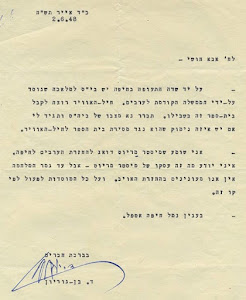
Now another, related deception has been exposed. For decades Israel’s supporters have been arguing that Haifa, one of Palestine’s most important cities, was not ethnically cleansed of its population. The tens of thousands of Palestinians who fled under Israeli attack in April 1948 were later urged to return, according to Israel’s supporters, but they chose not to. Further proof, it seemed, that the Palestinians had only themselves to blame for losing their homeland. They chose to stay away.

Strangely, none of Israel’s propagandists ever seriously tried to suggest that the other 700,00 or so Palestinian refugees had been invited back home. It seemed as if the welcome supposedly extended in Haifa was reason enough for all Palestinians in exile to put aside their fears of Israel’s shoot-to-kill policy at its new borders and make the journey home.

But now a letter signed by David Ben Gurion, Israel’s first prime minister and the engineer of its ethnic cleansing policy in 1948, shows that, far from Haifa’s doors being thrown open, Ben Gurion ordered that the refugees be barred from returning.

Written on 2 June 1948, the letter was sent to Abba Khoushy, soon to become Haifa’s mayor. It states: “I hear that Mr. Marriot [Cyril Marriot, the British consul in Haifa] is working to return the Arabs to Haifa. I don’t know how it is his business, but until the war is over we don’t want a return of the enemy. And all institutions should act accordingly.”

Of course, that policy was not reversed after the war, as Ben Gurion hinted it might be. And one can wonder how much more specific his orders were to his army commanders if this was what he was telling civilian administrators.

The myth about Haifa was encouraged by Golda Meir, who wrote in her autobiography that Ben Gurion told her: “I want you to immediately go to Haifa and see to it that the Arabs who remain in Haifa are treated appropriately. I also want you to try and persuade the Arabs who are already on the beach to return home. You have to get it into their heads that they have nothing to fear.”

Meir added: “I went immediately. I sat on the beach there and begged them to return home… I pleaded with them until I was exhausted but it didn’t work.”

Heartbreaking – if only it were true.

How much longer must we wait to explode all the other myths associated with the Nakba, and much of Israel’s history ever since? More

www.haaretz.com/news/features/.premium-1.658179


LAC Negotiators Prepare for Paris

19 May 2015: Senior officials and negotiators from Latin American and Caribbean (LAC) countries gathered for a meeting, titled ‘4th Meeting of Chief Climate Change Negotiators of Latin America and the Caribbean,’ to discuss the content of a climate change agreement, which is expected to be adopted during the 21st session of the Conference of the Parties (COP 21) to the UNFCCC in Paris in December 2015.


The meeting, which took place from 14-15 May 2015, in Santiago, Chile, brought together representatives from 20 countries in the region. It was organized by the Economic Commission for Latin America and the Caribbean (ECLAC) and the UN Environment Programme (UNEP), and promoted by the Governments of Chile and Brazil, with support from the EU and France. It aimed to deepen the understanding of priorities, national circumstances and differing positions of countries in the region regarding environmental issues. Participants also discussed, inter alia, regional priorities and needs regarding adaptation, loss and damage, mitigation, finance, national contributions and vulnerability.


During the opening session, Edgardo Riveros, Chilean Under-Secretary of Foreign Affairs, said the region can make a contribution that reflects its capacities and priorities, while promoting the concept of climate justice, given that environmental degradation contributes to deepening inequalities. France’s Ambassador to Chile, Marc Giacomini, noted that France seeks to support a process for a “Climate Alliance” in order to reach an ambitious accord that is “forged collectively.” Alexandra Knapton, the EU’s representative in Chile, expressed hope that LAC countries will show leadership and present ambitious mitigation contributions.


Alicia Bárcena, ECLAC Executive Secretary, emphasized the “asymmetries of climate change,” noting that while LAC produces 9% of global CO2 emissions, it is one of the most vulnerable regions to the impacts of climate change. She added that ECLAC has proposed that countries build a “countercyclical investment architecture with a portfolio of low-carbon projects,” noting that equality-centered development requires diversified production. ECLAC estimates that a temperature rise of 2.5°C could lead to a loss of about 3% of the region’s GDP by 2050.


Attending the meeting as President Pro Tempore of the Community of Latin American and Caribbean States (CELAC), Ecuador noted its intention to promote opportunities for dialogue in advance of the Meeting of Foreign Ministers and Ministers of Environment of CELAC to be held in October in Quito, Ecuador, in order to forge consensus on a CELAC regional position on climate change. [ECLAC Press Release] [Government of Chile Press Release] [Government of Ecuador Press Release]


read more: http://larc.iisd.org/news/lac-negotiators-prepare-for-paris/


Live Webcast: Climate Change and Water in Developing Countries – May 27, 2015

caribbeanclimate's avatarcaribbeanclimate

Thumbnailer

The World Water Congress kicked off in Scotland yesterday (May 25th, 2015). Since 1973, the International Water Resources Association (IWRA) has held a World Water Congress every three (3) years in various locations around the world.

The objective of the World Water Congress is to provide a meeting place to share experiences, promote discussion, and to present new knowledge, research results and new developments in the field of water sciences around the world. For almost four (4) decades the World Water Congresses have been excellent events for the identification of major global themes concerning the water agenda; and for the bringing together of a large cross-section of stakeholders for the development and implementation of decisions in the field of water.

Tomorrow (Wednesday, May 27th, 2015) you will have a great opportunity to watch and join in on a live discussion session on “Climate Change and Water…

View original post 47 more words

WHISPERS FROM JANUBI BALTISTAN – “Tales of Two Wazarats”

Ladakh Express's avatarLadakh Express

By Siddhartha Garoo

Any discussion about Jammu and Kashmir is so much dominated by what has happened and what continues to happen in Kashmir valley that little is known or understood about parts of former princely state that neither belong to Kashmir region nor to Jammu region. This vast land tract, which constitutes most of the land mass of the former princely state of Jammu & Kashmir is known by various names and is home to many distinct and proud ethnic groups with their own independent culture, history and traditions, which gets unnoticed because of the numerical strength of people from Kashmir valley and Jammu regions.

Photo source: webjazba Photo source: webjazba

The key to understand this “other Jammu & Kashmir” lies in terms “wazarats” that was used for two main ethnic and linguistic regions of the “wazarat of Gilgit” and “wazarat of Ladakh”. These wazarats were vassal states of the princely state…

View original post 530 more words

Book Review “The Path To Zero: Dialogues On Nuclear Dangers” By Richard Falk And David Krieger

This book ought to be required reading for college students everywhere in the world, and also for decision-makers.

Mushroom cloud from the atomic bombing of Nagasaki on August 9, 1945

It shakes us out of our complacency and makes us realize that widespread, immediate and dedicated public action is urgently needed if we are to save human civilization and the biosphere from a thermonuclear catastrophe. The book is published by Paradigm Publishers, 2845 Wilderness Place, Boulder, CO 80301, USA. (www.paradigmpublishers.com) On the back cover there are endorsements, with which I entirely agree, by Archbishop Desmond Tutu and David Ellsberg.

“We are greatly privileged, like flies on the wall, to join this conversation between two remarkable stalwarts. Richard Falk and David Krieger, in the campaign for a nuclear-free world. It is unconscionable that so many of us seem to accept the prospect of our 'mutually assured destruction', the immoral massacre of millions of civilians, and to view with equanimity such a gross violation of international law. Falk and Krieger discuss persuasively and cogently the folly of reliance on nuclear weapons that can cause apocalyptic devastation. If we want to survive in a habitable world, then we have no choice: we must heed, and do so urgently, these lovers of mankind.” Archbishop Desmond Tutu, Nobel Peace Laureate

“In 'The Path to Zero', Falk and Krieger engage in a stunningly eloquent dialogue on a range of nuclear dangers, and our common responsibility to put an end to them. This is urgent reading for citizens, scientists, policy-makers and political leaders, actually for anyone who cares about the future of civilization and life on earth”, Daniel Ellsberg, Whistleblower

Other enthusiastic endorsements come from Jonathan Schell, Commander Robert Green and Maude Barlow.

The book has ten chapters: 1 The Nuclear Age; 2 Nuclear Deterrence; 3 Nuclear Proliferation; 4 Nuclear Arms Control and Nuclear Disarmament; 5 Nuclear Weapons and Militarism; 6 Nuclear Weapons and Nuclear Energy; 7 Nuclear Weapons and International Law; 8 Nuclear Weapons, Culture and Morality; 9 Nuclear Weapons and Democracy; 10 The Path to Zero.

The two authors

Richard Falk is Albert G. Milbank Professor of International Law and Practice Emeritus at Princeton, where he was a member of the faculty for 40 years. Since 2002 he has been a research professor at the University of California-Santa Barbara. He has been Special Rapporteur on Occupied Palestine for the UN Human Rights Council since 2008, and served on a panel of experts appointed by the President of the UN General Assembly, 2008-2009. He is the author or editor of numerous books, including “Legality and Legitimacy in Global Affairs” (Oxford 2012).

David Krieger is a Founder of the Nuclear Age Peace Foundation, and has served as President of the Foundation since 1982. Under his leadership, the Foundation has initiated many innovative projects for building peace, strengthening international law, abolishing nuclear weapons, and empowering peace leaders. Among other leadership positions, he is one of 50 Councilors from around the world on the World Future Council. He is the author and editor of numerous books and articles related to achieving peace in the Nuclear Age. A graduate of Occidental College, he holds MA and PhD degrees in political science from the University of Hawaii.

Flaws in the concept of nuclear deterrence

In discussing the concept of nuclear deterrence, the two authors emphasize the fact that it violates the fundamental ethical principles of every major religion. Dr. Krieger comments:

Krieger: “Who are we? What kind of culture would be content to base its security on threatening to murder hundreds of millions of innocent people? ”

The two authors also point out that the idea of deterrence is an unproved theory, based on the assumption that accidents will not happen, and that leaders are always rational. In fact, we know historically that the world has come extremely near to accidental nuclear war on very numerous occasions, and there are also many historical instances of irrational behavior by leaders. This cannot continue indefinitely without a catastrophe. See:http://www.cadmusjournal.org/article/issue-4/flaws-concept-nuclear-deterrance

The illegality of nuclear weapons

As Dr. Krieger and Prof. Falk point out, the threat or use of nuclear weapons violates international law. The fact that planning an aggressive war or conducting one is a crime according to the Nuremberg Principles is discussed. The two authors also review in detail the 1996 Advisory Opinion of the International Court of Justice, which was asked by the UN General Assembly and the World Health Organization to rule on the legality of the threat or use of nuclear weapons. The ICJ ruled that under almost all circumstances, the threat or use of nuclear weapons would be illegal. The only possible exception was the case where a country might be under attack and its very survival threatened. The Court gave no ruling on this extreme case. Finally, the ICJ ruled unanimously that states possessing nuclear weapons have an obligation to get rid of them within a short time-frame.

Falk: “It may be time for the General Assembly to put this question to the ICJ: What legal consequences arise from the persistent failure of the nuclear weapon states to fulfill their obligations under Article VI of the NPT. In my view, the nonnuclear states have also been irresponsible in not insisting on on mutuality of respect in the nonproliferation setting. It may be up to civil society actors to bring wider attention to this disrespect for the vital norms of international law…”

http://www.icj-cij.org/docket/files/93/7407.pdfhttp://www.currentconcerns.ch/index.php?id=711https://www.wagingpeace.org/author/john-avery/http://human-wrongs-watch.net/2015/03/27/tactical-nuclear-weapons-in-europe-the-dangers-are-very-great-today/http://www.countercurrents.org/avery250514.htm

Colonialism and exceptionalism

Falk: “We need to remember that the expansion of Europe at the expense of the non-Western world rested on violence and the superiority of European weaponry and strategic logistics, including naval power. This link between Western militarism and historical ascendancy is, in my view, one of the deep reasons why there is such an irrational attachment to nuclear weaponry, making it very diffiicult to renounce as the supreme expression of political violence.”

Krieger: “I would like to add that there is a general orientation in much of Western society to subordinate international law to geopolitical desire, in other words, not to allow international law to be a limiting factor in seeking geopolitical advantage. International law is thus applied when useful and ignored when self-interest and convenience dictate. This is a striking manifestation of the double standards that have served the interests of the powerful in both the colonial and postcolonial worlds.”

http://www.informationclearinghouse.info/article41866.htmhttp://www.informationclearinghouse.info/article36494.htm

The Nuclear Non-Proliferation Treaty

In discussing the Nuclear Non-Proliferation Treaty, Prof. Falk and Dr. Krieger point out that that it has several serious flaws: It is unsymmetrical, giving a special status to the nuclear weapons states, and forbidding all others to possess these weapons. The treaty encourages the “peaceful” use of nuclear energy, which in practice opens the door to acquisition of nuclear weapons by many nations and which exposes the world to radioactive fallout from accidents like Chernobyl and Fukushima, and very long-term dangers from radioactive wastes. Finally, membership in the NPT is not universal. Here are some comments by the two authors:

Falk: “In my view, the failure of the nuclear weapon states to pursue nuclear disarmament over a period of more than forty years, despite the injunction to do so by the International Court of Justice, is a material breach of the NPT that would give any party the option of pronouncing the treaty void.”

Krieger: “It would be wonderful to see a strong and concerted effort by non-nuclear-weapon states to challenge the nuclear weapons club. I think that the most effective thing that such states could do would be to start the process of negotiating a nuclear weapons convention and, if necessary, to do it without the nuclear weapon states.”

Falk: “My proposal is a two-year ultimatum by as many nonnuclear states as possible, threatening to withdraw from the NPT unless serious nuclear disarmament negotiations get underway.”

Dr. Krieger is not in complete agreement with Prof. Falk regarding such an ultimatum. He feels that even though it is flawed in many ways, it is still so valuable that its continuation ought not to be threatened.

Krieger: “One of the great problems with the NPT is that it encourages the peaceful use of nuclear energy, which actually opens the door to nuclear weapons proliferation. It ends up making the treaty work against itself. Of course, Israel is not a party to the treaty, nor are India and Pakistan. This demonstrates a fundamental weakness of international law, that is, the exemption of nations that do not sign a treaty from the law. This would be unworkable in domestic law, and it is equally so in international law.”

Krieger: “The nuclear plant operators are willing to downplay for short-term gain the catastrophic risks that are involved in the use of nuclear reactors to boil water. They are wiling to generate wastes that will adversely affect the health and well-being of of untold generations to follow us on the planet. ¡K The tragedy is that governments embrace and support this industry, demonstrating that they also do not place the interests of their people and the future at the forefront of their planning and decision making.”

http://www.baselpeaceoffice.org/article/global-wave-2015-and-peace-planet-un-nuclear-non-proliferation-conference

No first use; no hair-trigger alerted missiles

In their concluding chapter, the two authors agree that a No First Use declaration could be a useful first step. Prof. Falk comments:

Falk: “What conceivable justification, consistent with a deterrence rationale for the retention of nuclear weapons, is there for not assuring other governments that the United States will only use such weaponry in retaliation a prior attack with nuclear weaponry? It is rather clear that such a declaration, especially if backed up by non-nuclear deployments, would both give the United States some new claim to leadership with respect to the weaponry and exert enormous psychological pressure on other nuclear weapon states to follow the American lead.”

This, of course, could be linked to taking all nuclear weapons systems off hair-trigger alert, which is probably the most important first step towards avoiding the catastrophe of an accidental nuclear war. Dr Krieger comments:

Krieger: “Those responsible for maintaining nuclear arsenals on hair-trigger alert are delusional if they think that it can be maintained indefinitely without dire consequences.”

Developments since the publication of the book

Since the publication of Prof. Falk and Dr. Krieger's book in 2012, several events have taken place which the authors probably would have discussed if they had occurred earlier. For example, on 2 April, 2013, the Arms Trade Treaty was passed by a massive majority by a direct vote in the UN General Assembly. The ATT had remained blocked for more than 10 years in the consensus-bound Conference on Disarmament in Geneva. Its passage gives us hope that a Nuclear Weapons Convention can similarly be passed by a direct vote in the UN General Assembly, where the vast majority of nations are in favor of the complete abolition of nuclear weapons. Even if bitterly opposed by the nuclear weapons states, a Nuclear Weapons Convention would have great normative value.http://www.cadmusjournal.org/article/issue-6/arms-trade-treaty-opens-new-possibilities-un

Another development which Prof. Falk and Dr. Krieger would certainly have discussed, had it occurred earlier, is an heroic law suit by the Republic of the Marshall Islands, suing the nuclear weapons states for violation of Article VI of the Nuclear Non-Proliferation Treaty. In fact Dr. Krieger and his organization, the Nuclear Age Peace Foundation, are actively supporting the Marshall Islands in this David-versus-Goliath-like law suit. http://www.wagingpeace.org/tag/marshall-islands/

Finally, the two authors would probably have discussed the hubris of Washington's power-holders in threatening war with both Russia and China. The effect of this colossally misguided US action has been to firmly unite China and Russia. In fact the BRICS countries, with their vast resources, are now moving away from using the dollar as a reserve currency for international trade. The probable effect will be the collapse of the already-strained US economy, and as a consequence, the fall of the US Empire. Prof. Falk and Dr. Krieger both wonder whether they have been too America-centric in their discussions of nuclear abolition. The probable fall of the United States from its present position of global hegemony may mean that US leadership will not, in the future, be the key to nuclear abolition.http://www.countercurrents.org/roberts110515.htmhttp://www.truth-out.org/opinion/item/19734-hubris-versus-wisdomhttp://beforeitsnews.com/alternative/2014/04/wolfowitz-doctrine-us-plans-for-russia-2945824.html

Some conclusions

When the Cold War ended in 1991, many people heaved a sigh of relief and concluded that they no longer had to worry about the threat of a nuclear Armageddon. Prof. Falk and Dr. Krieger show us that this comforting belief is entirely false, that the dangers are greater than ever before, and that it is vital to bring this fact to the urgent attention of today's young people, who were born long after the tragic nuclear destruction of Hiroshima and Nagasaki, or perhaps even born after the end of the Cold War.

Ultimately, the complete abolition of nuclear weapons is linked with a change of heart, the replacement of narrow nationalism by loyalty to humanity as a whole, and the replacement of militarism by a just and enforcible system of international law.

John Avery received a B.Sc. in theoretical physics from MIT and an M.Sc. from the University of Chicago. He later studied theoretical chemistry at the University of London, and was awarded a Ph.D. there in 1965. He is now Lektor Emeritus, Associate Professor, at the Department of Chemistry, University of Copenhagen. Fellowships, memberships in societies: Since 1990 he has been the Contact Person in Denmark for Pugwash Conferences on Science and World Affairs. In 1995, this group received the Nobel Peace Prize for their efforts. He was the Member of the Danish Peace Commission of 1998. Technical Advisor, World Health Organization, Regional Office for Europe (1988- 1997). Chairman of the Danish Peace Academy, April 2004. http://www.fredsakademiet.dk/ordbog/aord/a220.htm. He can be reached at avery.john.s@gmail.com

Suggestions for further reading:

Ban Ki-moon. “The United Nations and security in a nuclear-weapon-free world.” Address to the East-West Institute, October 24, 2008. http://www.un.org/apps/news/infocus/sgspeeches/search_full.asp?statID=351

Green, Robert, “Breaking Free from Nuclear Deterrence.” Santa Barbara: Nuclear Age Peace Foundation, 10th Annual Frank K. Kelly Lecture on Humanity's Future, 2011, http://www.wagingpeace.org/wp-content/uploads/2013/06/2011_kelly_lecture.pdf

“Legality of the Threat or Use of Nuclear Weapons.” Advisory Opinion of the International Court of Justice, The Hague, July 8, 1996. http://www.icj-cij.org/docket/files/93/7407.pdf

McCloy-Zorin Accords. “Joint Statement of Agreed Principles for Disarmament Negotiations,” signed on September 20, 1961, unanimously adopted by the United Nations General Assembly on December 20, 1961. http://www.nuclearfiles.org/menu/key-issues/nuclear-weapons/issues/arms-control-disarmament/mccloy-zorin-accords_1961-09-20.htm

Model Nuclear Weapons Convention. “Convention on the Prohibition of the Development, Testing, Production, Stockpiling, Transfer, Use and Threat of Use of Nuclear Weapons and their Elimination, April 2007.” http://www.inesap.org/publications/nuclear-weapons-convention

Obama, Barak, Remarks of President Barak Obama, Hradcany Square, Prague, Czech Republic, April 5, 2009. http://prague.usembassy.gov/obama.html

Rotblat, Joseph, “Remember Your Humanity”, Nobel Lecture, Oslo, Norway, December 10, 1995, http://www.nobelprize.org/nobel_prizes/peace/laureates/1995/rotblat-lecture.html

Russell-Einstein Manifesto, issued in London, July 9, 1955, http://www.pugwash.org/about/manifesto.htm

Santa Barbara Declaration, “Reject Nuclear Deterrence: An Urgent Call to Action,” http://www.wagingpeace.org/santa-barbara-declaration-reject-nuclear-deterrence-an-urgent-call-to-action/

Treaty on the Non-Proliferation of Nuclear Weapons, entered into force on March 5, 1970.http://www.state.gov/www/global/arms/treaties/npt1.html

Vancouver Declaration. “Law's Imperative for the Urgent Achievement of a Nuclear-Weapon-Free World,” Vancouver, Canada, March 21, 2011. http://www.lcnp.org/wcourt/Feb2011VancouverConference/vancouverdeclaration.pdf


IRENA: Renewable Energy Employs 7.7 Million People Worldwide

19 May 2015: The International Renewable Energy Agency (IRENA) has released a report stating that the renewable energy industry employs more than 7.7 million people worldwide, an 18% increase from 6.5 million in 2014.

The report, titled ‘Renewable Energy and Jobs – Annual Review 2015,’ also provides, for the first time, a global estimate of jobs supported by large hydropower.


IRENA Director-General Adnan Amin said renewable energy is “a major global employer” generating strong economic and social benefits, and that the increase is being driven, in part, by declining renewable energy technology costs. He said the increase is expected to continue as the business case for renewable energy becomes stronger. Amin noted that IRENA’s research estimates that doubling the share of renewable energy in the global energy mix by 2030 will result in more than 16 million jobs worldwide.


Kandeh Yumkella, Special Representative of the UN Secretary-General for Sustainable Energy for All (SE4ALL) Initiative, underscored the importance of the findings at the Second SE4ALL Forum being held 18-21 May 2015 in New York City, US.


The report finds that renewable energy employment is impacted by regional shifts, industry realignments, growing competition, and advances in technologies and manufacturing processes. Employment in the sector is increasingly in Asia, with five of the 10 countries with the most renewable energy jobs, namely: China, India, Indonesia, Japan and Bangladesh. The EU and the US currently represent 25% of global renewable energy jobs, compared to 31% in 2012. The 10 countries with the largest renewable energy employment figures are: China, Brazil, the US, India, Germany, Indonesia, Japan, France, Bangladesh and Colombia.


The largest renewable energy employers worldwide are the solar PV industry with 2.5 million jobs, liquid biofuels with 1.8 million jobs, and wind power, which passed the one million job mark for the first time. Solar, wind, biofuels, biomass, biogas and small hydropower have all seen employment increases, according to the report.


Other findings include: France leads Europe in biomass, ground source heat pumps and biofuels employment; China is the world’s largest overall renewable energy employer with 3.4 million jobs; Brazil is the leading employer in biofuels with 845,000 jobs; total solar employment in the US increased 22% from 142,700 to 173,800, with employment of women increasing from 26,700 to 37,500; and Germany is the leading renewable energy employer in Europe with 371,400 jobs. [IRENA Press Release] [Publication: Renewable Energy and Jobs – Annual Review 2015] More


Weak climate deal would jeopardise new development goals – experts – TRFN

LONDON, May 15 (Thomson Reuters Foundation) – The world's chances of achieving new international development goals will be slim without more ambitious action to curb climate change, researchers said.

Dr. Ulric 'Neville' Trotz

Pakistan, for example, is unlikely to be able to end poverty by 2030 if accelerating climate change brings worse weather disasters, water scarcity and other problems, a new report from the UK-based Climate and Development Knowledge Network said.

But if global warming is held to 2 degrees Celsius – the aim of negotiations toward a new U.N. climate deal at the end of the year in Paris – Pakistan would have only a “low” risk of failing to eradicate poverty, the report said.

Planned new sustainable development goals (SDGs) aimed at ending poverty, improving gender equality, and giving access to water and clean power have a much higher chance of being achieved if action to limit climate change is ambitious, the report's authors said.

But if weaker efforts on climate change put the world on track for a 3 to 5 degree Celsius temperature rise, Asia and sub-Saharan Africa could see poverty rates 80 percent to 140 percent higher, the report found.

If the new sustainable development goals, expected to be agreed in New York in September, have strong targets, they could lift ambition in the year-end climate deal, the report said.

“There's a simple message: Climate action is developmental action,” said Ulric “Neville” Trotz, a science advisor at the Caribbean Community Centre for Climate Change in Belize.

Countries need to fully incorporate climate action into national development plans, he added.

The report, by a team of economic policy and development experts, is one of the first attempts to put rough numbers on how the two new global deals due this year on climate change and sustainable development might interact.

States are negotiating over a proposal for 17 new sustainable development goals, backed by 169 targets, focused on everything from reducing inequality, hunger and climate change to managing forests and oceans better and promoting sustainable economic growth.

At the climate negotiations in December, leaders will aim to put in place an agreement, which would take effect in 2020, to curb carbon emissions and help poorer countries adapt to climate change and adopt a cleaner development path.

ZERO POVERTY, ZERO EMISSIONS

There are huge areas of overlap, experts say, not least because climate change impacts – such as water insecurity and more weather-related disasters – can cut harvests and incomes, and lead to children leaving school, as well as forcing governments to divert development funds to disaster relief.

“There's a simple message: Climate action is developmental action,” said Ulric “Neville” Trotz, a science advisor at the Caribbean Community Centre for Climate Change in Belize.

Investing in cleaner, cheaper energy could not only cut climate risks but also improve health and provide the power needed to spur economic growth, the researchers said.

Many Caribbean islands, for example, rely on expensive imported fossil fuels, making their economies uncompetitive.

They are also extremely vulnerable to climate-related impacts, such as sea-level rise and stronger storms, said economist Anil Markandya, one of the report's authors.

“Unless we change the architecture of our energy sector, we might as well forget development under the SDGs,” Trotz said.

Funding that change would require international support, such as from the new Green Climate Fund (GCF), he added.

Andrea Ledward, head of climate and environment for Britain's Department of International Development and a GCF board member, told a launch event for the report there is a need to “break down the firewall” between funding for climate and development projects because the two areas are so closely tied.

Rich nations have committed to mobilise by 2020 an annual $100 billion in climate finance that is “new and additional” to existing funding.

Jonathan Reeves of the International Institute for Environment and Development said that while climate and development funding streams could be merged, the accounting must be kept separate to ensure the money is “new and additional”.

He warned that the least-developed countries have the most to lose if efforts to address climate change fail.

“If your country is going to be submerged within a couple of generations by sea-level rise, you're not even going to be thinking about achieving the SDGs,” he said.

Ilmi Granoff, a researcher with the Overseas Development Institute in London, said public support for an ambitious climate deal and strong sustainable development targets could be won by focusing on a new, understandable aim for all countries: “zero poverty and zero emissions within a generation”. (Reporting by Laurie Goering; editing by Megan Rowling) More


Superadobe/Earthbag Orphanage Withstands Nepal Earthquake

Cal-Earth Low-cost Sustainable Earthen Housing Solutions Proved Effective and Safe in Earthquakes

Hesperia, Calif., May 5, 2015 — Cal-Earth Institute today announced they received confirmation that the Superadobe/Earthbag orphanage project built for the Pegasus Children’s Project in the northern Khathmandu valley in Nepal survived the 7.6 magnitude earthquake on 25 April 2015, and the structures are all still standing.

The Superadobe (sandbags/barbed wire) building system developed at Cal-Earth (U.S. Patent #5,934,027) integrates traditional earth architecture with contemporary global safety requirements, and passes severe earthquake code tests in California. The technology has been published by NASA, endorsed by the United Nations, featured in countless world media outlets, and awarded the prestigious Aga Khan Award for Architecture in 2004.

A UK organization, Small Earth, built over 40 domes in 2006 for the Pegasus Children’s Project in Nepal, which is home to over 90 children and their caretakers, all of who are confirmed safe after the earthquake. Trained by a Cal-Earth alumni in 2005, Small Earth’s founder, Julian Faulkner, shared the news: “The domes have come through relatively unscathed with just surface cracking to the plasterwork… in the village below the site 15 houses have collapsed and many others are badly damaged with all the villagers now sleeping under tarpaulins in the fields.”

Faulkner stated the superficial damage to the buildings is a “testament to the quality of training we received that has enabled us to further develop the technology for use in climates as diverse as the temperate UK, the monsoon-drenched Himalayas and the African savannah.” Pegasus is raising funds to rebuild a brick structure that was destroyed during the quake, but feel validated in their choice to build earthbag domes to withstand the extreme conditions.

The Cal-Earth organization is dedicated to addressing the pressing needs of all the Earth’s homeless population and displaced people. The global housing shortage currently includes some 20-40 million refugees and displaced persons, and hundreds of millions more who live in substandard or slum housing. With compounding environmental challenges and the acceleration of natural and man-made disasters, this shortage will only become more severe in the coming decades. Cal-Earth believes the time to act is now, in order to ensure that everyone has a safe and sustainable place to live.

Cal-Earth is responding to the growing need to educate people in the face of compounding environmental challenges and the acceleration of natural and man-made disasters. On May 11, 2015, Cal-Earth will launch its first online class for download and streaming: Introduction to Superadobe. Cal-Earth is working toward raising addition funding to create more online content so that anyone, from anywhere, will be able to learn sustainable earth architecture in person or online. More

About Cal-Earth

Cal-Earth, the California Institute of Earth Art and Architecture, is a 501 (c)(3) nonprofit organization committed to providing solutions to the human need for shelter through research, development, and education in earth architecture. Cal-Earth envisions a world in which every person is empowered to build a safe and sustainable home with their own hands, using the earth under their feet. Currently, Cal-Earth reaches over 1.5 million through worldwide outreach and social media, in addition to more than 1,500 visitors who come to the Hesperia site annually for workshops and tours.

http://calearth.org

http://www.small-earth.com

http://www.pegasuschildren.btck.co.uk

http://tinyurl.com/CalEarthKCET

Media Contact:

Sheefteh Khalili

sheefteh@calearth.org

+1.760.440.8344


Piloting the integration of Climate Change Adaptation and Coastal Zone Management in Southwest Tobago

caribbeanclimate's avatarcaribbeanclimate

Trinidad and Tobago is highly vulnerable to the impacts of global climate change; particularly rising temperature, decreased precipitation and sea level rise (SLR). It is anticipated that these changes will have adverse effects on the physical environment and economy. There is therefore a need to reduce the risks associated with the expected impacts of climate change on the country by mainstreaming climate change adaptation into development planning. In December 2012, the Government of Trinidad and Tobago signed a technical cooperation (TC) with the Inter-American Development Bank (IADB) to undertake a pilot study on integrating climate change adaptation (CCA) into coastal zone management (CZM) in SW Tobago.

The Institute of Marine Affairs is the executing agency. Activities under this project began in April 2013 and are expected to be completed in June 2015. The objective of this TC is to develop an ICZM program that incorporates CCA and disaster risk management using an ecosystem based approach. The lessons learnt from this TC will directly inform the development of the broader national ICZM Policy Strategies…

View original post 922 more words