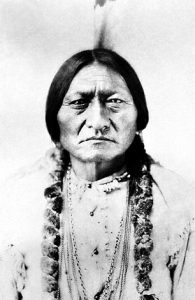
This Day in Resistance History: Sitting Bull’s Railway Speech

kswheeler's avatarGrand Rapids Institute for Information Democracy

On September 8, 1883, the Sioux leader Sitting Bull made a speech to government officials, railroad barons, and the U.S. military in honor of the completion of the Northern Pacific Railway. And on this one occasion, after a long and bloody attempt to defend his people and their lands from White invaders, Sitting Bull seized the chance to express his opinion of those he had opposed for so long against tremendous odds.

Some context: The lands of northern Montana and Idaho had not drawn as many settlers as other parts of the U.S. west, and for good reason. The harsh prairie environment included scalding summer heat, winter temperatures ranging from 10 to 40 degrees below zero, relentless winds without any tree breaks to slow them down, and a lack of water. But to the Sioux, these lands were perfect. The prairie tableland meant that they could ride their horses during…

View original post 960 more words

CARDI Review: Improving Lives Through Agricultural Research – Issue 14

caribbeanclimate's avatarcaribbeanclimate

The Caribbean Agricultural Research and Development Institute (CARDI) has a new issue of CARDI Review. The new issue is the first of three issues which will appear in the next few months.

  • The first paper examines the issue of planting densities for hot pepper and arrives at the conclusion that yields could be increased by planting at higher intra-row densities.
  • The second paper showcases work which is being undertaken to mitigate against the effects of climate change, which already appears to be a factor that farmers have to contend with. Ten sweet potato cultivars and landraces were evaluated during the severe Trinidad dry season of 2014.

There were some clear conclusions as to the most drought tolerant: but results like this will, of course, need to be verified by further evaluations in different geographic environments. They also need to be repeated in other harsh climatic conditions before definite conclusions can be drawn…

View original post 23 more words

Gallery

When the Rastaman Speaks: Climate Change and Food Security

caribbeanclimate's avatarcaribbeanclimate

Dizzanne Billy, 24, is President of theCaribbean Youth Environment Network (CYEN) inTrinidad and Tobago, where she works in the areas of education and public awareness on a number of environment and development issues. She is a climate tracker withAdopt-A-Negotiator and a young advocate for climate change action.

“Rastaman ah (is) the usual suspect.”– Prophet Benjamin

Discrimination is not uncommon in the Caribbean. But Carus John-Bejai is breaking the mold. At 23, this rastaman is flying through a PhD at the University of Nottingham, hoping to shed critical insight for Trinidad’s farmers in a changing climate.

Carus has always been intrigued by plants. Following the support from his parents, he began to see his love for plants as a way of “improving the living standards of not only those who rely directly on the sector but of the global population as a whole.”

Big words for such a…

View original post 974 more words

Is climate change the culprit in Tropical Storm Erika?

caribbeanclimate's avatarcaribbeanclimate

In this handout provided by the National Oceanic and Atmospheric Administration (NOAA) from the GOES-East satellite, Erika, a tropical storm is pictured losing strength as it passes over Haiti on Aug. 29, 2015. NOAA/NASA GOES ProjectGetty Images

Rescue teams are still searching for dozens of missing villagers in rural areas of the Caribbean island of Dominica, days after Tropical Storm Erika caused massive flooding and landslides.

The storm has already killed at least 20, and Prime Minister Roosevelt Skerrit says that number could rise as helicopters reach areas cut off by eroded roads.

Dominica was the island worst affected by the storm — which weakened over eastern Cuba on Saturday, losing its title of tropical storm after drenching Haiti and the Dominican Republic. Heavy rains could still hit parts of Florida.

In his address to the nation late Friday, Skerrit continued his call-to-action after tweeting that Dominicans are “living the effects of…

View original post 537 more words

CDB advances climate change and disaster risk management of member countries

caribbeanclimate's avatarcaribbeanclimate

CBD’s Vice President of Operations Patricia McKenzie shared some camera time with Steven Hillier (2nd Left), Disaster Risk Reduction Adviser of the Department For International Development of the United Kingdom. Also in photo are Ronald Jackson, Executive Director of CDEMA, and Andrew Dupigny (right), Acting Director of Projects at CDB CBD’s Vice President of Operations Patricia McKenzie shared some camera time with Steven Hillier (2nd Left), Disaster Risk Reduction Adviser of the Department For International Development of the United Kingdom. Also in photo are Ronald Jackson, Executive Director of CDEMA, and Andrew Dupigny (right), Acting Director of Projects at CDB

The Caribbean Community (CARICOM) agenda for reducing risks and building resilience in the region got a much-needed boost recently. Twenty-three disaster risk management and community development professionals from 15 countries gathered at the headquarters of Caribbean Development Bank (CDB) for an intensive five-day workshop on project design and implementation organised by Community Disaster Risk Reduction Fund (CDRRF).

Speaking at the opening ceremony of the workshop, CDB’s vice president for operations emphasised the need for a broader reach and deepened relations with borrowing member countries (BMCs).

“We want to optimise the facility provided by CDRRF to assist in building capabilities at…

View original post 573 more words

Caribbean Water Ministers Will Address Water and Climate Issues to Help Shape the Development Agenda

caribbeanclimate's avatarcaribbeanclimate

In September, the United Nations will finalise a Post-2015 Development Agenda known as the Sustainable Development Goals (SDGs). The SDGs follow and expand on the Millennium Development Goals (MDGs) which expire at the end of the year and will be “the global community’s plan of action” for all dimensions of sustainable development (economic, social and environmental) for the next fifteen (15) years.

On the heels of establishing this new universal Agenda; Caribbean Ministers with responsibility for water resources management from more than ten (10) countries, will meet on August 27th and 28th, 2015 at the InterContinental Hotel in Miami, Florida to discuss critical regional water and climate issues. Both water and climate change are reflected as priorities in the soon to be confirmed SDGs, with Goal 6 being: “Ensure availability and sustainable management of water and sanitation for all” and Goal 13 being: “Take urgent action to combat climate change and its impacts.”

This Ministerial Meeting is…

View original post 380 more words

Caribbean Strives to Protect Coastal and Marine Ecosystems

caribbeanclimate's avatarcaribbeanclimate

Coral colony off the Rosario Islands, Colombia | Photo: EFE Coral colony off the Rosario Islands, Colombia | Photo: EFE

The Caribbean Community (CARICOM) is partnering with a number of governments as it strives to help boost the resilience of member states to climate change. 

The CARICOM region, with its 15 islands, is considered one of the world’s most important areas of biodiversity. The region is now moving fast towards the sustainable management of both marine areas and coastal resources.

A new partnership between CARICOM and the German government involves the protection of these precious resources from the impacts of climate change.

“Our story is about how we were able to set the boundaries in terms of the fisheries reserve. You realise now as ecotourism, as the product developed, we have more users of the area. We need to protect the reef. We need to protect the fisheries industry,” says Anthony Charles, representative of the Soufriere Marine Management Agency. That body is responsible…

View original post 267 more words

The Russell-Einstein Manifesto Fifty Years On

In the tragic situation which confronts humanity, we feel that scientists should assemble in conference to appraise the perils that have arisen as a result of the development of weapons of mass destruction, and to discuss a resolution in the spirit of the appended draft.

Dr. Albert Einstein

We are speaking on this occasion, not as members of this or that nation, continent, or creed, but as human beings, members of the species Man, whose continued existence is in doubt. The world is full of conflicts; and, overshadowing all minor conflicts, the titanic struggle between Communism and anti-Communism. Almost everybody who is politically conscious has strong feelings about one or more of these issues; but we want you, if you can, to set aside such feelings and consider yourselves only as members of a biological species which has had a remarkable history, and whose disappearance none of us can desire. We shall try to say no single word which should appeal to one group rather than to another. All, equally, are in peril, and, if the peril is understood, there is hope that they may collectively avert it. We have to learn to think in a new way. We have to learn to ask ourselves, not what steps can be taken to give military victory to whatever group we prefer, for there no longer are such steps; the question we have to ask ourselves is: what steps can be taken to prevent a military contest of which the issue must be disastrous to all parties?

http://www.spokesmanbooks.com/Spokesman/PDF/85russein.pdf