

Double Down News
gaza
Brits Accused Of War Crimes In Gaza
Novara Media
Israeli Agent Makes BOMBSHELL ADMISSION About Epstein, Trump, Clinton
Raw News And Politics 212K
John Mearsheimer: The Palestinian Genocide and How the West Has Been Deceived IntoSupporting It
Tucker Carlson
With Tucker Carlson and John Mearsheim
INTERVIEW: The Epstein Factor connecting dead children in Gaza with abused ones in the US
George Galloway
Exposing a global economy of genocide | Francesca Albanese |
The Big Picture
Middle East Eye
What Jeffrey Sachs Just Said About Trump STUNNED Everyone! | Donald Trump News| US News| Tarrif War
ET NOW
The Persecution of Francesca Albanese
The sanctioning by the Trump administration of Francesca Albanese, the United Nations Special Rapporteur, is an ominous harbinger of the end of the rule of international law.
CHRIS HEDGES
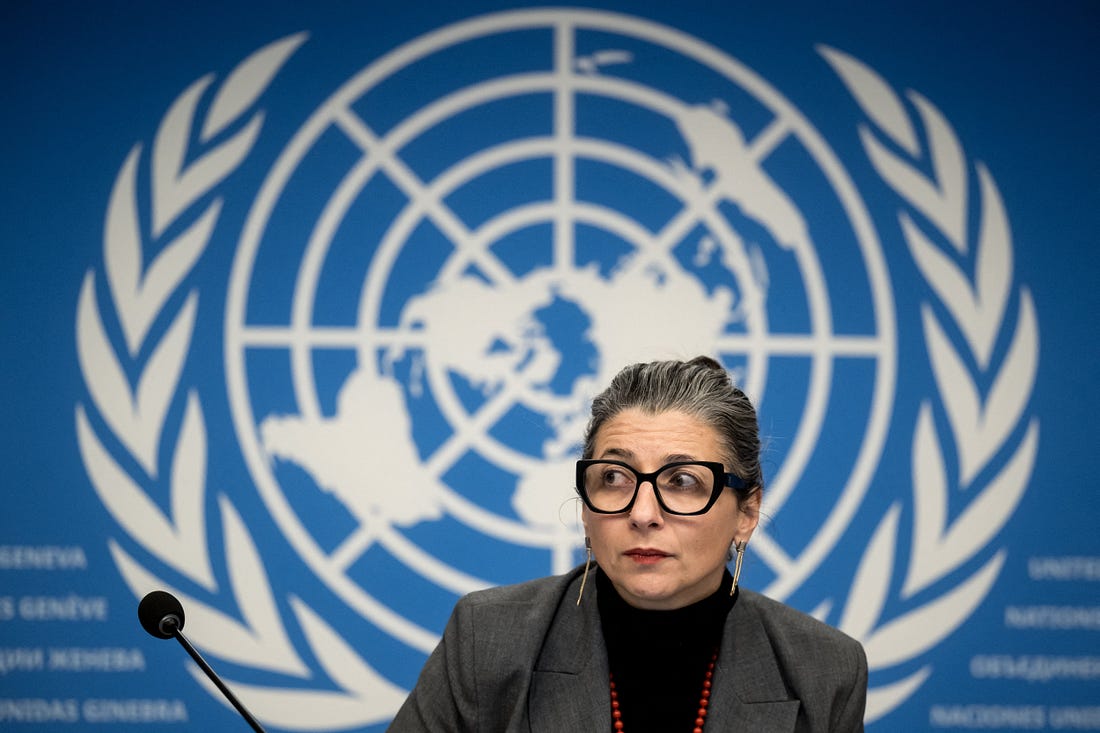
United Nations (UN) Special Rapporteur on the occupied Palestinian territories Francesca Albanese holds a press conference in Geneva on December 11, 2024. (Photo by Fabrice Coffrini / AFP via Getty Images)
When the history of the genocide in Gaza is written, one of the most courageous and outspoken champions for justice and the adherence to international law will be Francesca Albanese, the United Nations Special Rapporteur, who today the Trump administration is sanctioning. Her office is tasked with monitoring and reporting on human rights violations that Israel commits against Palestinians.
Albanese, who regularly receives death threats and endures well-orchestrated smear campaigns directed by Israel and its allies, valiantly seeks to hold those who support and sustain the genocide accountable. She lambasts what she calls “the moral and political corruption of the world” that allows the genocide to continue. Her office has issued detailed reports documenting war crimes in Gaza and the West Bank, one of which, called “Genocide as colonial erasure,” I have reprinted as an appendix in my latest book, “A Genocide Foretold.”
She has informed private organizations that they are “criminally liable” for assisting Israel in carrying out the genocide in Gaza. She announced that if true, as has been reported, that the former British prime minister David Cameron threatened to defund and withdraw from the International Criminal Court (ICC) after it issued arrest warrants for Israeli Prime Minister Benjamin Netanyahu and former defense minister Yoav Gallant, which Cameron and the other former British prime minister Rishi Sunak could be charged with a criminal offense for, under the Rome Statue. The Rome Statue criminalizes those who seek to prevent war crimes from being prosecuted.
She has called on top European Union (EU) officials to face charges of complicity of war crimes over their support for the genocide, saying that their actions cannot be met with impunity. She was a champion of the Madleen flotilla that sought to break the blockade of Gaza and deliver humanitarian aid, writing that the boat which was intercepted by Israel, was carrying not only supplies, but a message of humanity.
You can see the interview I did with Albanese here.

Her latest report lists 48 corporations and institutions, including Palantir Technologies Inc., Lockheed Martin, Alphabet Inc. (Google), Amazon, International Business Machine Corporation (IBM), Caterpillar Inc., Microsoft Corporation and Massachusetts Institute of Technology (MIT), along with banks and financial firms such as BlackRock, insurers, real estate firms and charities, which in violation of international law, are making billions from the occupation and the genocide of Palestinians.
You can read my article on Albanese’s most recent report here.
Secretary of State Marco Rubio condemned her support for the ICC, four of whose judges have been sanctioned by the U.S. for issuing arrest warrants for Netanyahu and Gallant last year. He criticized Albanese for her efforts to prosecute American or Israeli nationals who sustain the genocide, saying she is unfit for service as a special rapporteur. Rubio also accused Albanese of having “spewed unabashed antisemitism, expressed support for terrorism, and open contempt for the United States, Israel, and the West.” The sanctions will most likely prevent Albanese from travelling to the U.S. and will freeze any assets she may have in the country.
The attack against Albanese presages a world without rules, one where rogue states, such as the U.S. and Israel, are permitted to carry out war crimes and genocide without any accountability or restraint. It exposes the subterfuges we use to fool ourselves and attempt to fool others. It reveals our hypocrisy, cruelty and racism. No one, from now on, will take seriously our stated commitments to democracy, freedom of expression, the rule of law or human rights. And who can blame them? We speak exclusively in the language of force, the language of brutes, the language of mass slaughter, the language of genocide.
“The acts of killing, the mass killing, the infliction of psychological and physical torture, the devastation, the creation of conditions of life that would not allow the people in Gaza to live, from the destruction of hospitals, the mass forced displacement and the mass homelessness, while people were being bombed daily, and the starvation — how can we read these acts in isolation?” Albanese asked in an interview I did with her when we discussed her report, “Genocide as colonial erasure.”
The militarized drones, helicopter gunships, walls and barriers, checkpoints, coils of concertina wire, watchtowers, detention centers, deportations, brutality and torture, denial of entry visas, apartheidesque existence that comes with being undocumented, loss of individual rights and electronic surveillance, are as familiar to desperate migrants along the Mexican border, or attempting to enter Europe, as they are to Palestinians.
This is what awaits those who Frantz Fanon calls “the wretched of the earth.”
Those that defend the oppressed, such as Albanese, will be treated like the oppressed
 Democracy & Good Governance