
Briahna Joy Gray: Is Israel KILLING HOSTAGES? Inside the IDF’s Reported Oct 7 ‘Hannibal Directive’
The Hill

Briahna Joy Gray: Is Israel KILLING HOSTAGES? Inside the IDF’s Reported Oct 7 ‘Hannibal Directive’
The Hill
URL: https://www.commondreams.org/news/arms-trade-2666819054
Orders at many of the world’s biggest arms companies are “near record highs” due to rising geopolitical tensions in recent years, ananalysis published Wednesday by _Financial Times _revealed.
The London-based newspaper analyzed the order books of the world’s 15 top arms makers and found their combined backlogs were $777.6 billion at the end of 2022—a 10% increase from 2020.
According to_FT_:
The trend’s momentum continued into 2023. In the first six months of this year—the latest comprehensive quarterly data available—combined backlogs at these companies stood at $764 billion, swelling their future pipeline of work as governments kept placing orders.
The sustained spending has spurred investors’ interest in the sector. [Member of Chartered Institute for Securities & Investment’s] global benchmark for the industry’s stocks is up 25% over the past 12 months. Europe’s Stoxx aerospace and defense stocks index has risen by more than 50% over the same period.
Private equity firms including BlackRock, Vanguard, Capital Group, and State Street are dominant or major shareholders in most of the weapons companies analyzed by_FT_. These Wall Street speculators are “the ones driving the perpetual wars to maintain their bankrupt financial system,” according to the International Schiller Institute, a Washington, D.C.-based think tank.
“In the U.S., the defense budget was $858 billion in 2023, and it is rapidly heading towards $1 trillion per year,” the institute said last week. “Meanwhile our highways and railroads, our bridges and tunnels, our hospitals and schools are crumbling. And the rest of the world also desperately needs American technology and capital goods to help their development, working with China and Russia, rather than driving the planet towards World War III against them.”
The West’s scramble to arm Ukraine’s homeland defense against ongoing Russian invasion and occupation played a significant role in surging arms orders.
For example, Hanwha Aerospace, South Korea’s largest weapons manufacturer, recorded the biggest increase in new orders—FT says its backlog soared from $2.4 billion in 2020 to $15.2 billion at the end of last year—largely due to sales of K-9 self-propelled howitzers to countries supplying arms to Ukraine.
Rheinmetall, a German firm that makes Panther main battle tanks, nearly doubled its backlog from $14.8 billion to $27.9 billion, also in large part because of Ukraine-related sales.
However, many of the company’s swollen backlogs predate the Ukraine war, which began in February 2022.
“The reality is lead times for policymaking, budgets, and placing orders are so long that the invasion of almost two years ago is only just appearing in orders and barely in revenues, except for a few shorter-cycle specialists such as Rheinmetall,” Nick Cunningham, an analyst at the insurance firm Agency Partners, told_FT_.
Israel’s assault on Gaza—which began in October and is already one of the most devastating in modern history, with an average of 1,000 bombs dropped daily on the densely populated strip—is not included in FT‘s analysis, but is a boon to arms-makers and a large part of the reason why last year’s record backlogs are expected to reach new heights in 2023 and beyond.
As Common Dreamsreported earlier this year, global military spending rose to an all-time high of over $2.2 trillion last year, according to the Stockholm International Peace Research Institute.
Gabor Mate explains how he sees the Palestine Israël conflict
Hamid Acharrab
Noam Chomsky: US is world’s biggest terrorist
Global Conversation
Israeli flags adorn EU buildings after Hamas attacks. Is the bloc united? | Israel-Palestine conflict News
“I was shocked. Especially when I saw [the Israeli flag] on the EU Parliament building. It’s the house of democratically elected representatives of Europe, many of whom do not simply ‘stand with Israel’.
“I was also shocked at how quickly the EU institutions put up the flags, I think it was even faster than Russia’s invasion of Ukraine. Considering the incredibly complex situation of Israel and Palestine, I think this rapid step is incredibly irresponsible.”
Ross Coulthart | Non-Human Craft Too Large To Move
Project Unity
Rear Admiral Tim Gallaudet, Ph.D., US Navy (ret) discusses UP and SCU’s upcoming conference.
Scientific Coalition for UAP Studies
On a bright fall day last year off the coast of Southern California, an Air Force B-1 bomber launched an experimental missile that may herald the future of warfare.

LRAS Missile launched from B-1 bomber
Initially, pilots aboard the plane directed the missile, but halfway to its destination, it severed communication with its operators. Alone, without human oversight, the missile decided which of three ships to attack, dropping to just above the sea surface and striking a 260-foot unmanned freighter.
Warfare is increasingly guided by software. Today, armed drones can be operated by remote pilots peering into video screens thousands of miles from the battlefield. But now, some scientists say, arms makers have crossed into troubling territory: They are developing weapons that rely on artificial intelligence, not human instruction, to decide what to target and whom to kill.
As these weapons become smarter and nimbler, critics fear they will become increasingly difficult for humans to control — or to defend against. And while pinpoint accuracy could save civilian lives, critics fear weapons without human oversight could make war more likely, as easy as flipping a switch.
Britain, Israel and Norway are already deploying missiles and drones that carry out attacks against enemy radar, tanks or ships without direct human control. After launch, so-called autonomous weapons rely on artificial intelligence and sensors to select targets and to initiate an attack.
Britain’s “fire and forget” Brimstone missiles, for example, can distinguish among tanks and cars and buses without human assistance, and can hunt targets in a predesignated region without oversight. The Brimstones also communicate with one another, sharing their targets.
Armaments with even more advanced self-governance are on the drawing board, although the details usually are kept secret. “An autonomous weapons arms race is already taking place,” said Steve Omohundro, a physicist and artificial intelligence specialist at Self-Aware Systems, a research center in Palo Alto, Calif. “They can respond faster, more efficiently and less predictably.”
Concerned by the prospect of a robotics arms race, representatives from dozens of nations will meet on Thursday in Geneva to consider whether development of these weapons should be restricted by the Convention on Certain Conventional Weapons. Christof Heyns, the United Nations special rapporteur on extrajudicial, summary or arbitrary executions, last year called for a moratorium on the development of these weapons.
The Pentagon has issued a directive requiring high-level authorization for the development of weapons capable of killing without human oversight. But fast-moving technology has already made the directive obsolete, some scientists say.
“Our concern is with how the targets are determined, and more importantly, who determines them,” said Peter Asaro, a co-founder and vice chairman of the International Committee for Robot Arms Control, a group of scientists that advocates restrictions on the use of military robots. “Are these human-designated targets? Or are these systems automatically deciding what is a target?”
Weapons manufacturers in the United States were the first to develop advanced autonomous weapons. An early version of the Tomahawk cruise missile had the ability to hunt for Soviet ships over the horizon without direct human control. It was withdrawn in the early 1990s after a nuclear arms treaty with Russia.
Back in 1988, the Navy test-fired a Harpoon antiship missile that employed an early form of self-guidance. The missile mistook an Indian freighter that had strayed onto the test range for its target. The Harpoon, which did not have a warhead, hit the bridge of the freighter, killing a crew member.
Despite the accident, the Harpoon became a mainstay of naval armaments and remains in wide use.
In recent years, artificial intelligence has begun to supplant human decision-making in a variety of fields, such as high-speed stock trading and medical diagnostics, and even in self-driving cars. But technological advances in three particular areas have made self-governing weapons a real possibility.
New types of radar, laser and infrared sensors are helping missiles and drones better calculate their position and orientation. “Machine vision,” resembling that of humans, identifies patterns in images and helps weapons distinguish important targets. This nuanced sensory information can be quickly interpreted by sophisticated artificial intelligence systems, enabling a missile or drone to carry out its own analysis in flight. And computer hardware hosting it all has become relatively inexpensive — and expendable.
The missile tested off the coast of California, the Long Range Anti-Ship Missile, is under development by Lockheed Martin for the Air Force and Navy. It is intended to fly for hundreds of miles, maneuvering on its own to avoid radar, and out of radio contact with human controllers.
In a directive published in 2012, the Pentagon drew a line between semiautonomous weapons, whose targets are chosen by a human operator, and fully autonomous weapons that can hunt and engage targets without intervention.
Weapons of the future, the directive said, must be “designed to allow commanders and operators to exercise appropriate levels of human judgment over the use of force.”
The Pentagon nonetheless argues that the new antiship missile is only semiautonomous and that humans are sufficiently represented in its targeting and killing decisions. But officials at the Defense Advanced Research Projects Agency, which initially developed the missile, and Lockheed declined to comment on how the weapon decides on targets, saying the information is classified.
“It will be operating autonomously when it searches for the enemy fleet,” said Mark A. Gubrud, a physicist and a member of the International Committee for Robot Arms Control, and an early critic of so-called smart weapons. “This is pretty sophisticated stuff that I would call artificial intelligence outside human control.”
Paul Scharre, a weapons specialist now at the Center for a New American Security who led the working group that wrote the Pentagon directive, said, “It’s valid to ask if this crosses the line.”
Some arms-control specialists say that requiring only “appropriate” human control of these weapons is too vague, speeding the development of new targeting systems that automate killing.
Mr. Heyns, of the United Nations, said that nations with advanced weapons should agree to limit their weapons systems to those with “meaningful” human control over the selection and attack of targets. “It must be similar to the role a commander has over his troops,” Mr. Heyns said.
Systems that permit humans to override the computer’s decisions may not meet that criterion, he added. Weapons that make their own decisions move so quickly that human overseers soon may not be able to keep up. Yet many of them are explicitly designed to permit human operators to step away from controls. Israel’s antiradar missile, the Harpy, loiters in the sky until an enemy radar is turned on. It then attacks and destroys the radar installation on its own.
Norway plans to equip its fleet of advanced jet fighters with the Joint Strike Missile, which can hunt, recognize and detect a target without human intervention. Opponents have called it a “killer robot.”
Military analysts like Mr. Scharre argue that automated weapons like these should be embraced because they may result in fewer mass killings and civilian casualties. Autonomous weapons, they say, do not commit war crimes.
On Sept. 16, 2011, for example, British warplanes fired two dozen Brimstone missiles at a group of Libyan tanks that were shelling civilians. Eight or more of the tanks were destroyed simultaneously, according to a military spokesman, saving the lives of many civilians.
It would have been difficult for human operators to coordinate the swarm of missiles with similar precision.
“Better, smarter weapons are good if they reduce civilian casualties or indiscriminate killing,” Mr. Scharre said. More
Editorial
Professor Samdhong Rinpoche,, a leading Tibetan academic stated recently; “Today the challenges of the modernity pose existential threat to mankind and earth itself, if not tackled adequately and immediately. The first major challenge is of VIOLENCE. Its most visible forms are war and terrorism. Then there is the systematic or system generated violence. We are neither able to see it or understand it, but its scope and spread are frightening. The present situation is such that we have no will to resist violence, unless it directly affects us. This kind of violence is market driven which necessitates perpetuation of war or its possibility. In brief the entire world today is being governed by the market forces, which are described consumeristic system”. Violence, war and terrorism, along with poverty and disease are governance issues, global governance issies.
As Kofi Annan, then secretary-general of the United Nations (UN), told world leaders in 1998: “Good governance is perhaps the single most important factor in eradicating poverty and promoting development.” Governance is the exercise of economic, political, and administrative authority to manage a country’s affairs at all levels. Different definitions of good governance have been proposed by development organizations. The definition offered by the UN Development Programme highlights participation, accountability, transparency, consensus, sustainability, the rule of law, and the inclusion of the poorest and most vulnerable people in making decisions about allocating development resources.
All of the above are issues that we have to technology and resources to alleviate. Doing so would remove the necessity to produce weapons as described above, it could do away for the need for the military as we know it today. The world could be like Costa Rica whose military was abolished on December 1, 1948, by President José Figueres Ferrer. Our world could literally become a Paradise or Garden of Eden where peace reigned as everyones needs were fulfilled. Editor.
Israel's lies make it clear to the Palestinians that it will continue to wage a campaign of state terror and will never admit its atrocities or its intentions.
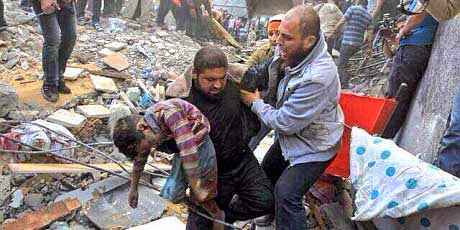
ALL GOVERNMENTS lie, including Israel and Hamas. But Israel engages in the kinds of jaw-dropping lies that characterize despotic and totalitarian regimes.
It does not deform the truth; it inverts it. It routinely paints a picture for the outside world that is diametrically opposed to reality. And all of us reporters who have covered the occupied territories have run into Israel's Alice-in-Wonderland narratives, which we dutifully insert into our stories — required under the rules of American journalism — although we know they are untrue.
I saw small boys baited and killed by Israeli soldiers in the Gaza refugee camp of Khan Younis. The soldiers swore at the boys in Arabic over the loudspeakers of their armored jeep. The boys, about 10 years old, then threw stones at an Israeli vehicle and the soldiers opened fire, killing some, wounding others. I was present more than once as Israeli troops drew out and shot Palestinian children in this way.
Such incidents, in the Israeli lexicon, become children caught in crossfire.
I was in Gaza when F-16 attack jets dropped 1,000-pound iron fragmentation bombs on overcrowded hovels in Gaza City. I saw the corpses of the victims, including children. This became a surgical strike on a bomb-making factory.
I have watched Israel demolish homes and entire apartment blocks to create wide buffer zones between the Palestinians and the Israeli troops that ring Gaza. I have interviewed the destitute and homeless families, some camped out in crude shelters erected in the rubble. The destruction becomes the demolition of the homes of terrorists.
I have stood in the remains of schools — Israel struck two United Nations schools in the last six days, causing at least 10 fatalities at one in Rafah on Sunday and at least 19 at one in the Jebaliya refugee camp Wednesday — as well as medical clinics and mosques. I have heard Israel claim that errant rockets or mortar fire from the Palestinians caused these and other deaths, or that the attacked spots were being used as arms depots or launching sites.
I, along with every other reporter I know who has worked in Gaza, have never seen any evidence that Hamas uses civilians as “human shields.”
There is a perverted logic to Israel's repeated use of the Big Lie — the lie favored by tyrants from Josef Stalin to Saddam Hussein. The Big Lie feeds the two reactions Israel seeks to elicit — racism among its supporters and terror among its victims.
By painting a picture of an army that never attacks civilians, that indeed goes out of its way to protect them, the Big Lie says Israelis are civilized and humane, and their Palestinian opponents are inhuman monsters.
The Big Lie serves the idea that the slaughter in Gaza is a clash of civilizations, a war between democracy, decency and honor on one side and Islamic barbarism on the other. And in the uncommon cases when news of atrocities penetrates to the wider public, Israel blames the destruction and casualties on Hamas.
George Orwell in his novel “Nineteen Eighty-Four” called this form of propaganda doublethink. Doublethink uses “logic against logic” and “repudiate[s] morality while laying claim to it.”
The Big Lie does not allow for the nuances and contradictions that can plague conscience. It is a state-orchestrated response to the dilemma of cognitive dissonance. The Big Lie permits no gray zones. The world is black and white, good and evil, righteous and unrighteous.
The Big Lie allows believers to take comfort — a comfort they are desperately seeking — in their own moral superiority at the very moment they have abrogated all morality.
The Big Lie, as the father of American public relations, Edward Bernays, wrote, is limited only by the propagandist's capacity to fathom and harness the undercurrents of individual and mass psychology. And since most supporters of Israel do not have a desire to know the truth, a truth that would force them to examine their own racism and self-delusions about Zionist and Western moral superiority, like packs of famished dogs they lap up the lies fed to them by the Israeli government.
But the Big Lie is also consciously designed to send a chilling message to Gaza's Palestinians, who have lost large numbers of their dwellings, clinics, mosques, and power, water and sewage facilities, along with schools and hospitals, who have suffered some 1,850 deaths since this assault began — most of the victims women and children — and who have seen 400,000 people displaced from their homes.
The Big Lie makes it clear to the Palestinians that Israel will continue to wage a campaign of state terror and will never admit its atrocities or its intentions. The vast disparity between what Israel says and what Israel does tells the Palestinians that there is no hope. Israel will do and say whatever it wants. International law, like the truth, will always be irrelevant. There will never, the Palestinians understand from the Big Lie, be an acknowledgement of reality by the Israeli leadership.
The Israel Defense Forces website is replete with this black propaganda. “Hamas exploits the IDF's sensitivity towards protecting civilian structures, particularly holy sites, by hiding command centers, weapons caches and tunnel entrances in mosques,” the IDF site reads. “In Hamas' world, hospitals are command centers, ambulances are transport vehicles, and medics are human shields,” the site insists.
“… [Israeli] officers are tasked with an enormous responsibility: to protect Palestinian civilians on the ground, no matter how difficult that may be,” the site assures its viewers. And the IDF site provides this quote from a drone operator identified as Lt. Or. “I have personally seen rockets fired at Israel from hospitals and schools, but we couldn't strike back because of civilians nearby. In one instance, we acquired a target but we saw that there were children in the area. We waited around, and when they didn't leave we were forced to abort a strike on an important target.”
Israel's ambassador to the United States, Ron Dermer, in a Big Lie of his own, said last month at a conference of Christians United for Israel that the Israeli army should be given the “Nobel Peace Prize … a Nobel Peace Prize for fighting with unimaginable restraint.”
The Big Lie destroys any possibility of history and therefore any hope for a dialogue between antagonistic parties that can be grounded in truth and reality.
And when facts no longer matter, when there is no shared history grounded in the truth, when people foolishly believe their own lies, there can be no useful exchange of information.
The Big Lie, used like a bludgeon by Israel, as perhaps it is designed to be, ultimately reduces all problems in the world to the brutish language of violence. And when oppressed people are addressed only through violence they will answer only through violence. More

 © 2014
