


Young Europeans Sue to Stop Treaty That Fossil Fuel Giants Use to Foil Climate Action
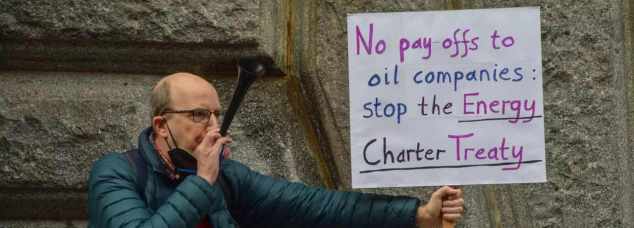
“It just can’t be that the fossil fuel industry is still more protected than our human rights,” said a 17-year-old German whose family was displaced during last summer’s deadly floods.
As The Guardian reported, five plaintiffs between the ages of 17 and 31, all of whom have recently endured disastrous hurricanes, floods, and fires, are trying to persuade the European Court of Human Rights (ECHR) that the 1994 Energy Charter Treaty (ECT) violates the right to life and the right to respect for private and family life—the second and eighth articles, respectively, of the European Convention on Human Rights.
The case marks the first time the ECHR will be asked to consider the ECT, an obscure agreement whose investor-state dispute settlement (ISDS) mechanism enables fossil fuel companies to sue governments over anticipated economic losses stemming from plans to move away from coal, oil, and gas.
Regenerative Rainmaking – How land management affects the soil and sky
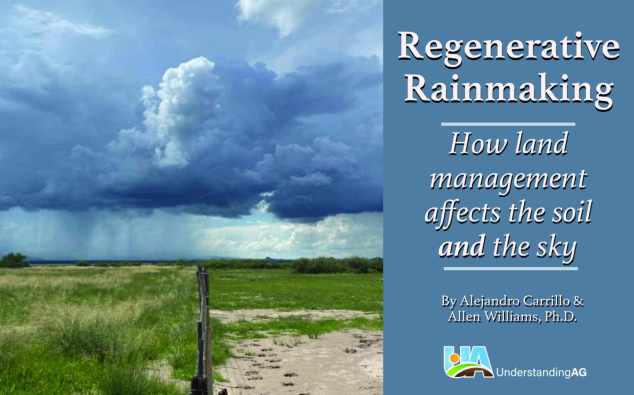
Rainmaking Microbes
Microbes are everywhere, including in the clouds. Scientific studies are now showing that they play an important role in creating precipitation (reference links to multiple related articles are provided at the end of this article). Microbes from the soil and plants can go airborne and facilitate a process called bio-precipitation. These microbes include bacteria, fungi and tiny algae.
For a cloud to produce precipitation that falls to earth as rain or snow, ice particle formation in the clouds is required. Just a decade ago it was thought that only small mineral particles, or other inert particles, could serve as nuclei for condensation to occur. However, we now know that aerosols in the form of microbes can catalyze ice particle formation that trigger precipitation.
The evidence is building that vegetation and soils are a crucial source of atmospheric biological ice nucleators in precipitation. They may, in fact, be the most efficient ice-forming catalysts in precipitation, not airborne mineral particles. These “rainmaking” microbes are significant influencers of the water cycle. They can also travel long distances in the atmosphere for dispersal on a global scale.
Right-Wing Judges Say It’s “Harmless” to Label Climate Activist a Terrorist

A PANEL OF three Trump-appointed judges this week upheld an excessive eight-year prison sentence handed down to climate activist Jessica Reznicek, ruling that a terrorism enhancement attached to her sentence was “harmless.”
The terror enhancement, which dramatically increased Reznicek’s sentence from its original recommended range, set a troubling precedent. Decided by a lower court in 2021, it contends that Reznicek’s acts against private property were “calculated to influence or affect the conduct of government.” The appellate justices’ decision to uphold her sentence, callously dismissing the challenge to her terrorism enhancement, doubles down on a chilling message:
Those who take direct action against rapacious energy corporations can be treated as enemies of the state.
The BIOT: A judicial vacuum now consuming Tamil refugees

The BIOT: A judicial vacuum now consuming Tamil refugees
In October 2021, a group of 89 Tamil asylum seekers hoping to claim asylum in Canada was intercepted while traversing the
Indian Ocean and brought to a joint UK-US military facility on Diego Garcia, the only inhabited island in the Chagos
Archipelago, otherwise known as the British Indian Ocean Territory (BIOT). Nine months on – and after 30 other arrivals
this April – these people are still stuck on the remote Indian Ocean atoll, and dozens have begun a hunger strike.
Despite supposedly landing on a British Overseas Territory, these asylum seekers have no clarity about their future, because, in
legal terms, the BIOT is a “grey hole”, likened by one academic to Britain’s own Guantánamo. Simply put, a range of international
treaties do not apply to this territory, which allows British and American authorities to keep them in limbo.
Windrush scandal caused by ‘30 years of racist immigration laws’ – report

The origins of the Windrush scandal lay in 30 years of racist immigration legislation designed to reduce the UK’s non-white population, according to a leaked government report.
The stark conclusion was set out in a Home Office commissioned paper that officials have repeatedly tried to suppress over the past year.
The 52-page analysis by an unnamed historian, which has been seen by the Guardian, describes how “the British Empire depended on racist ideology in order to function”, and sets out how this affected the laws passed in the postwar period.
It concludes that the origins of the “deep-rooted racism of the Windrush scandal” lie in the fact that “during the period 1950-1981, every single piece of immigration or citizenship legislation was designed at least in part to reduce the number of people with black or brown skin who were permitted to live and work in the UK”. https://bit.ly/3Gvn3MW
Farm vehicles have become so heavy they’re affecting the world’s soils
Vicki Robin—NYT best-selling author, Post Carbon board member, and host of our What Could Possibly Go Right? podcast—says:
“If global supply chains are disrupted, we need more local food and local energy. The question isn’t how can corporations feed the world, but how can our laws and institutions increase the ability of regions to feed themselves?”

What do you think? How do we convince our lawmakers that building #communityresilience and investing in #localization efforts are our BEST avenues forward?
Farm vehicles have become so heavy they’re affecting the world’s soils
May 17, 2022: The total weight of farming machinery has increased tenfold in the last 40 years, as machines become bigger and stronger. As they operate across fields, these machines slowly crush the soil and make it harder for plants to grow, risking reducing harvests across global cropland in the next decades, a new study found.
The average weight of modern agricultural machinery (36,000 kilograms or 80,000 pounds) exceeds by far the heaviest living terrestrial animals (the African bush elephant, which has a maximum body mass of 8,000 kilograms). Modern tractors are even heavier than some of the sauropod dinosaurs, the heaviest land animals that ever walked on Earth.
Cayman drops way down on TJN secrecy ranking
Cayman drops way down on TJN secrecy ranking –

CNS): The Cayman Islands is no longer the Tax Justice Network‘s most secret jurisdiction. The British overseas territory was rated number one in 2020 and number two in 2021, but this year it has dropped way down to number 14. The United States is now number one, Germany is number seven and Britain itself is number 13. The TJN said that Cayman dropped to 14th place in this year’s rankings after disclosing data showing that the scale of financial services it provides to non-residents was lower than expected.
The TJN has turned its attention to the onshore larger economies and, as successive governments and the financial services sector here have consistently claimed, it found that they are just as secretive as offshore jurisdictions, which TJN has previously viewed as traditional tax havens. It also found that it is in those countries where the serious financial crime is occurring. Read More
Are Hawaii and the Cayman Islands being sold to the global elite?
Are Hawaii and the Cayman Islands being sold to the global elite?

For over a century, the destiny of this island paradise has been in the hands of outsiders. Now native Hawaiians are reclaiming their culture, language and land.
“Hawaii is being sold to the global elite. It’s not give and take. It’s just take, take, take, take.” Filmmaker Chris Kahunahana
“They took it away in three generations. We’re going to get it back in one. Whatever it takes.” Waterman Pomai Hoapili.
It’s a slice of paradise for some but behind the postcard façade, native Hawaiians have a different story to tell.
Theirs is a stuggle for land, language and culture, forcibly taken from them by the United States of America.
Housing prices in Hawaii were already sky high, but in the midst of the pandemic they exploded as mainland Americans bought up island boltholes. The housing crisis is hitting native Hawaiians hardest, forcing many out of their own homes. The state of Hawaii now has the third highest homeless rate in the USA.
This is one of many problems facing native locals who are fighting to ʻKeep Hawaii Hawaiian’.
Reporter Matt Davis visits the Hawaiian Islands to hear from the people fighting to keep their culture alive. In a visually stunning journey, Davis explores the lives of people on the frontline of this modern-day native Hawaiian rennaisance.
“Resistance is not only how we get our land back,” says school principal Kalehua Krug. “But it is also medicine – that resistance is how we heal.”
At his school on the island of Oahu, the curriculum focuses on redsicovering the modern story of Hawaii after the kingdom was overthrown in 1893. The students study the Hawaiian language, hula dancing and other cultural practices alongside the mainstream curriculum.
Davis takes a tour around the back streets of Waikiki with celebrated filmmaker Chris Kahunahana, the first native Hawaiian to direct a feature film.
“Hawaii was seen as Hollywood’s back drop. It served as a beautiful location for a Caucasian centred hero,” he tells Davis. His movie Waikiki shows the darker side of these tropical islands – the reality for many native Hawaiians.
Davis visits the powerhouse community leader Twinkle Borge who has set up a permanent camp to provide shelter for Hawaiians who are sleeping rough. She reveals an extraordinary plan to reclaim land and build a village for her community.
And he goes out on the jet ski with waterman Pomai Hoapili in the middle of the worldʻs most famous surfing competition – the Pipeline Pro.
Between surfing on the North Shore and rescuing people caught in the giant waves, Pomai has enrolled in Hawaiian language classes. He practices speaking with his 10-year-old daughter, who’s also learning. He says it’s urgent for native Hawaiians to practice their culture.
“Be Hawaiian, speak Hawaiian live Hawaiian…If we stop down the line, people stop talking about us, we disappear…we’ve got to keep practicing.”
In Hawaii to compete in the Pipeline surfing competition, the world’s most famous surfer Kelly Slater asks the world to pay respect.
“Everyone who comes Hawaiian should, should take care of this place and really respect the culture and the locals,” says Slater. “It’s their home and it’s your place to visit, but, you know, take care of it and look after it and ever one can enjoy it.”
Coastal Fire Shows Even the Rich ‘Are Not Safe From Earth Breakdown’
Coastal Fire Shows Even the Rich ‘Are Not Safe From Earth Breakdown’
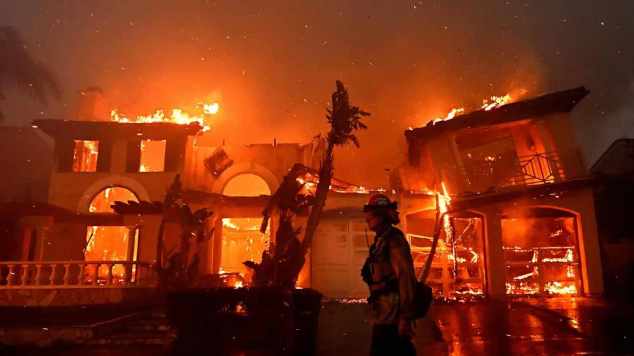
As a fast-moving brush fire near Laguna Beach, California destroyed well over a dozen homes on Thursday—including five multimillion-dollar mansions—a prominent environmental researcher and advocate warned that the wealthy are not immune from the disastrous effects of the climate emergency, even as the fossil fuel-driven crisis harms the poor disproportionately.
“No matter how rich you are, you are not safe from Earth breakdown,” tweeted Los Angeles-based climate scientist Peter Kalmus, a member of Scientist Rebellion.
Emphasizing that it is still May—months before the wildfire season typically reaches its peak—Kalmus said that “the only way out” of Southern California’s historic drought is to “fight side by side and to strip power away from the rich corporatists who are leading us deeper into catastrophe, even as their own homes burn.”
 Democracy & Good Governance