Marketing Terrorism

Global Consilium's avatarGlobal Consilium

Like a contest, terrorist groups like the Islamic State of Iraq and the Levant (ISIL), Boko Haram, Al-Qaeda and the Taliban, seem to be competing against each other. It seems like we are in an age where even terrorists are in a race for notoriety; for some kind of “celebrity status” that they can only obtain by expanding their influence with territorial gains, high numbers of supporters, and by committing bloodier terrorist acts as they go.

Unlike other less notorious terrorist groups, organizations like ISIL have taken very seriously the task of reinventing and differentiating themselves from the rest. Like a marketing strategy, this organization has made sure to become a recognized global brand. The Islamic State has a brand, marketing strategy, purpose and vast economic resources to carry out its plans. At every checkpoint and area under their control, ISIL has made it clear to put their flags up…

View original post 1,358 more words

New WPP Video: A Future of Floods and Droughts as Climate Changes

caribbeanclimate's avatarcaribbeanclimate

The Water Partnership Programme (WPP) published a new video that shows how climate change affects the Middle East, Latin America and Central Asia. The video looks at how climate change impacts the poor and most vulnerable populations. It is a free resource for those in the climate change community who want to raise awareness on the issue. The WPP works globally to counter the effects of climate change by supporting water-related programmes that promote innovative tools to help countries build resilience and prepare for an uncertain future.

View original post

How do agri-food systems contribute to climate change?

caribbeanclimate's avatarcaribbeanclimate

Agriculture and food security are exposed to impacts and risks related to the changing climate in several ways. On the other hand, agriculture and food production activities are also responsible for part of the greenhouse gas emissions that in turn cause climate change.

According to the latest conclusions by the Intergovernmental Panel on Climate Change, agriculture, together with deforestation and other human actions that change the way land is used (codename: AFOLU, Agriculture, Forestry and Other Land Use), accounts for about a quarter of emissions contributing to climate change.

IPCC-WGIII-AR5-2014-emissions-by-economic-sectors-fig-TS3 - Crop
Greenhouse Gas Emissions by Economic Sectors. Fig. TS.3, IPCC AR5 WGIII, Mitigation of Climate Change, Technical Summary, 2014

GHG emissions from farming activities consist mainly of non-CO2 gases: methane (CH4) and nitrous oxide (N2O) produced by bacterial decomposition processes in cropland and grassland soils and by livestock’s digestive systems.

The latest estimates released in 2014 by the UN Food and…

View original post 759 more words

Gallery

We are building a network of Climate Change Clubs!

caribbeanclimate's avatarcaribbeanclimate

The Caribbean Community Climate Change Centre (CCCCC) welcomed a group of 25 students from the Belmopan Comprehensive High School today for an interactive climate change exchange. The visit forms part of a broader engagement with young people in an effort to create a network of school-based environmental clubs with a strong climate change focus across the region. The initiative is being piloted by the Centre in five (5) schools in Belmopan, Belize with support from the Ministry of Forestry, Fisheries and Sustainable Development (MFFSD) under the “Enhancing Belize’s Resilience to Adapt to the Effects of Climate Change” project which is funded by the European Union.

The participating schools are:

  • Belmopan Comprehensive High School
  • Belize Christian Academy
  • Belmopan Baptist High School
  • Our Lady of Guadalupe High School
  • Belmopan Methodist High School

Through this means of youth engagement, we  are using a mixture of specially designed games, discussions, music and other tools…

View original post 78 more words

Designation as “special areas” in the Caribbean

caribbeanclimate's avatarcaribbeanclimate

The Wider Caribbean Region (WCR) has the greatest concentration of plant and animal species in the Atlantic Ocean Basin.  Yet these precious, and often irreplaceable, natural resources are disappearing at an astounding rate. The vast majority of all species are threatened by habitat loss or modification in addition to unsustainable practices such as over-fishing, unplanned coastal development and pollution. These same habitats are often the main source of food and income for many coastal communities.

The Protocol Concerning Specially Protected Areas and Wildlife (SPAW) of the Cartagena Convention, is a regional agreement for biodiversity management and conservation in the Wider Caribbean Region, in existence since 1990. It is managed by the United Nations Caribbean Environment Programme (CEP) and it became international law in 2000.  It aims to protect critical marine and coastal ecosystems while promoting regional co-operation and sustainable development.

To date, sixteen countries from the region have ratified the…

View original post 946 more words

Climate-Proofing Water Investment in the Caribbean

caribbeanclimate's avatarcaribbeanclimate

The Global Water Partnership-Caribbean (GWP-C) has embarked on a new initiative under its Water, Climate and Development Programme (WACDEP) called “Climate-Proofing Water Investment in the Caribbean” which is being executed in partnership with the Caribbean Community Climate Change Centre (CCCCC).

The initiative includes the development of a Caribbean Climate Resilience and Water Security Investment Plan (CCReWSIP) which aims to provide a coordinated and programmatic approach to identifying, prioritising and sourcing finance for actions to enhance the climate resilience of the Caribbean through improved water resources management.

The project is being funded by the Climate and Development Knowledge Network (CDKN) and falls within one of the key components of the GWP-C WACDEP which recognises the need to prioritise water investments which perform well under a full range of climate scenarios.

Also crucial to the GWP-C WACDEP is its emphasis on no/low regret investment options given climate uncertainties. Once completed, the…

View original post 56 more words

CBP Drone Fleet Under Scrutiny, Kill/Capture List Published, and Much More: FRINFORMSUM 1/8/2015

Lauren Harper's avatarUNREDACTED: The National Security Archive Blog

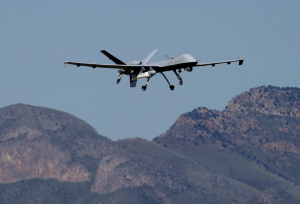
CBP drone take off from Fort Huachuca in Sierra Vista, Ariz. (Matt York/AP) CBP drone take off from Fort Huachuca in Sierra Vista, Ariz. (Matt York/AP)

Customs and Border Protection (CBP) caught 120,939 illegal boarder crossers in Arizona during 2013, but CBP’s fleet of 24 drones providing aerial border surveillance aided in fewer than two per cent of the apprehensions. This statistic is cited in a recent Department of Homeland Security (DHS) inspector general audit that found “little or no evidence” CBP’s current fleet – that surveys a mere “100 miles of the Arizona border and 70 miles of the Texas border” – warrants the agency’s planned $443 million expansion of the program. The DHS audit is released while “Congress considers whether to spend more on drone surveillance to secure the borders as part of immigration legislation.”

WikiLeaks has released a July 7, 2009, CIA analysis entitled “Making High-Value Targeting Operations an Effective Counterinsurgency Tool,” highlighting the limited overall effect of “high…

View original post 1,079 more words

Documenting Mexico’s Recurring Nightmare

Michael Evans's avatarUNREDACTED: The National Security Archive Blog

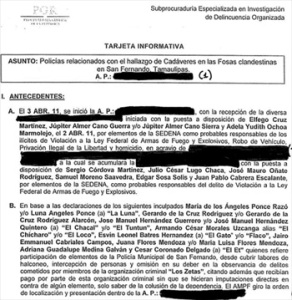
flyer San Fernando police delivered detainees to the Zetas drug gang, according to a newly-declassified memo.

As demonstrators across Mexico take to the streets to protest the government’s involvement in the September 2014 disappearance of 43 students in Iguala, Guerrero, a case bearing many of the same grim hallmarks is getting renewed attention.

Today, in a new article for The Nation, I examine newly-declassified evidence of police involvement in the 2011 San Fernando massacre and what it all means for access to information on human rights cases in Mexico.

In August 2010, the Zetas criminal group abducted and killed 72 people pulled from buses traveling the highways near San Fernando, Tamaulipas, a town more than 1,000 kilometers northeast of Guerrero. The remains of 193 people were discovered buried in dozens of mass graves in the same part of the state the following April. Members of the Zetas and 17 San…

View original post 369 more words

UNEP Manual Provides Guidance on Valuing SIDS’ Ecosystem Services

26 January 2015: The UN Environment Programme (UNEP) launched a manual on calculating the value of ecosystems in small island developing States (SIDS), with the aim of supporting a transition to a green economy. The manual underscores the importance of accounting for the contribution of ecosystem services to human well-being in order to quantify and value these benefits.

The ‘Guidance Manual on Valuation and Accounting of Ecosystem Services for SIDS' highlights the interdependence between SIDS' economies and the natural environment. In Antigua and Barbuda, Anguilla, Seychelles and Vanuatu, 50% of gross domestic product (GDP) comes from the tourism industry, according to the manual. In the Federated States of Micronesia (FSM), fisheries contribute 10% of GDP while 52% of Grenada's exports come from tuna, albacore, cocoa beans and nutmeg.

The manual provides a step-by-step methodological approach to select, design and implement island ecosystem services valuation and accounting exercises, and shares case study examples of accounting and valuation techniques. For instance, a 1% increase in the number of coastal protected areas is associated with a 2.9% increase in international coastal tourism arrivals. The manual also provides guidance on designing a payments for ecosystem services (PES) scheme in SIDS, using the example of Palau's Green Fee.

The manual aims to support policymakers in achieving sustainable development, taking into consideration SIDS' unique environmental, socio-economic and capacity issues. The manual emphasizes that “there is no simple solution” to valuing and accounting for SIDS' ecosystem services, emphasizing that economic valuation and accounting techniques depend on the category of island ecosystem services (cultural, provisioning or regulating) and the island's type of economic policy.

UNEP launched the manual at an event marking the close of the 2014 International Year of SIDS. [Publication: Guidance Manual on Valuation and Accounting of Ecosystem Services in Small Island Developing States] [UNEP Press Release] [UNEP Publications Website]


Amendment/Revision of Expressions of Interest: Coastal Protection for Climate Change Adaptation in the Small Island States in the Caribbean Project No. 2012.9762.1

caribbeanclimate's avatarcaribbeanclimate

The Caribbean Community Climate Change Centre (CCCCC) is seeking Expressions of Interest (EoI) for Consulting Services for the Implementation Consultant (IC) to assist the Caribbean Community Climate Change Centre (CCCCC) in the implementation of the Coastal Protection for Climate Change Adaptation in the Small Island States in the Caribbean Project. Qualified Independent Consultants are invited to submit a pre-qualification document. Funds have been earmarked for this Project by the German bilateral Financial Cooperation, provided through KfW Development Bank.

Ref-No: BZM 201297621

Project-No: 2012.9762.1

Deadline for submission of EoI is at 2:00 pm January 30, 2015, Belize Time.  Late submissions will not be accepted.

Peruse the official EoI request here.

EoIs should be submitted in one original and three copies to:

Project Manager
Caribbean Community Climate Change Centre
Attn: Ms. Dorett Tennyson, Procurement and Administrative Officer
Second Floor Lawrence Nicholas Building
Ring Road
P. O. Box 563
Belmopan…

View original post 41 more words