The Ludlow Massacre: Bitter and Prejudiced In the Extreme

Further | The Ludlow Massacre: Bitter and Prejudiced In the Extreme | Opinion

 This week marks the 108th anniversary of what Wallace Stegner called “one of the bleakest and blackest episodes of American labor history,” when armed thugs hired by John Rockefeller Jr. burned down a tent encampment and machine-gunned the families of striking coal miners in Ludlow, CO, killing at least 26 – including 15 women and children who suffocated in a pit – for the crime of seeking to be treated as human beings. 
The attack on April 20, 1914 against 1,200 striking mineworkers was the culmination of a long struggle in Colorado coal country, where the United Mine Workers had been organizing a diverse workforce of thousands of miners, many Greek, Mexican and Italian. 
Most worked for the massive Colorado Fuel and Iron Co. owned by the Rockefellers, America’s richest family, who despite growing public revulsion for the excesses of the Gilded Age still ran CFI like the Robber Barons they were. Miners died in the hundreds in cave-ins and from disease, working 12-hour days, seven days a week, for 80 cents per ton of coal; they got no pay for the so-called “dead work” of prepping a mine to minimize its hazards; they had to live in company shacks in company towns, shopping at company stores using company scrip, guarded by company thugs who ruled towns like concentration camp kapos.  Read More

NATO accession – Nordic perspective

NATO accession – Nordic perspective 

The war in Ukraine seems to have put an end to European indecision. Countries such as Switzerland, Austria, Sweden and Finland imposed sanctions on Russia. But Switzerland and Austria are hundreds of kilometers from the Russian border. Sweden and Finland, on the other hand, are on the brink. Consequently, these Nordic countries view with great concern the events in Ukraine and fear that the crisis may spread beyond Ukraine.
Russia’s invasion of Ukraine looks set to make what has hitherto been almost unimaginable the rapid accession of two Nordic countries – Sweden and Finland – to NATO. According to forecast analysis , the debate is no longer about “whether or not Sweden and Finland will join”, but “when and how soon they will join”.
It is a historic moment and time of great decisions in the geopolitics of these two Nordic states, decisions which will determine the security configuration in this region of Europe and beyond for many decades to come. The decision is by no means easy.
In Kosovo, for example, membership in the Alliance may enjoy unreserved support, but for the Nordic countries, joining NATO is not accompanied by much enthusiasm. First of all, it is a cold calculation that shows for the awareness that membership will not only bring security, but is likely to be followed by tensions in the Nordic-Russian region as well.
Below is a brief summary of the Swedish-Finnish view on NATO membership and the evolution of their foreign policy as a result of the Russian occupation of Ukraine.
From neutrality to non-alignment, then to membership
To understand the reasons why Sweden and Finland are not members of NATO one must first make a brief recollection of their history. Sweden has not been involved in the war for more than two hundred years. During the Cold War, it took a neutral position on the rivalry between NATO and the Warsaw Pact, an alliance of communist states rallying around the former Soviet Union that disintegrated with the end of the Cold War.
However, from the early 1990s onwards, Sweden’s position has evolved from a genuine neutrality to the status of a non-aligned country in terms of security. In other words, while Sweden continues to be a non-NATO member, its armed forces work closely with those of the Alliance, as well as contributing to joint peacekeeping forces ( including Kosovo ). The standard operating procedures of the Swedish army are in full compliance with those of NATO; Democratic control over the armed forces is complete and in accordance with the basic principles of consolidated democratic states.
However, the voice of those who in the past have called for NATO membership, both by the government and the public, has always been low. In fact, Swedish politics – almost its entire spectrum – has always been clear about Russian politics. She has not cultivated illusions about Moscow, a sentiment that has been encountered not infrequently in German politics, for example. Basically, the reason for staying out of NATO for Sweden is explained through its own history. Why change the security architecture if the current one has contributed to the country not going to war for more than two centuries? So there was no reason to modify the security configuration. At least not so far.
Finland, on the other hand, emerged from the bloody World War II, with lost territory but proud and proud of its citizens’s heroic battles against the Soviet Union. It shares the 1300 km border with Russia and, perhaps more than any other nation, understands very well the psyche of the Russian citizen, his ambitions, prejudices and fears.
Like Sweden, Finland during the Cold War adopted a position of neutrality towards East and West, but with ever-increasing tendencies of rapprochement with NATO, participating in its peacekeeping forces, as in Kosovo . Even in this country, the standard operating procedures are in full compliance with those of NATO, while the state has full democratic control over the armed forces. Unlike Sweden, Finland has been at war with Russia and precisely for the sake of cultivating stable relations has had to rule out the option of NATO membership. So far.
Finland has had to work hard to cultivate a relatively close relationship with Moscow, a relationship based on mutual respect and trust. This is a close relationship not like the one that can be encountered between two friends, but one that can be seen between enemies who, for the sake of coexistence, must find common bridges of cooperation. Thus Finland had to learn how to work and even cooperate with Russia. They are neighbors, after all.
It is no coincidence that Finns like former President Martti Ahtisaari have mediated in conflicts like the one between Kosovo and Serbia. This is because people like him have enjoyed the trust of the West but also of Russia. In Finland, support for NATO membership has always been higher than in Sweden, but such a step has not been taken due to maintaining the balance of peace with Russia. Either way, such a step can be taken very quickly.
Between safety and permanent voltage
The Kremlin’s ever-increasing aggression has led public opinion in both Sweden and Finland to vote in favor of NATO membership. The application for membership is likely to be made very soon, probably at the next NATO summit that is expected to be held in Madrid at the end of June . Finland will enter the membership dance with more taste and enthusiasm; Sweden will take this step with a little nausea and laziness.
The governments of both countries take this step without euphoria and with responsibility, aware that membership strengthens the security architecture but also carries with it a series of dilemmas and tensions in the field of security that can continue for decades.
With NATO membership, the Nordic region and the whole of northwestern Europe come under the Alliance’s security umbrella. Any attack on these states would be an attack on NATO, as stated by NATO Article 5 on collective defense.
But on the other hand, the whole security architecture of the Nordic-Russian region will move towards further militarization. There will be an increase in armaments, an increase in military spending, which means less money for health, education, the environment, and so on. The West-East partition along the Baltic Sea will also be concreted, which will lead to further isolation of Russia. A completely isolated enemy can be even more dangerous than the one with whom we maintain communication contacts, however rare they may be.
In this regard, especially Helsinki will have to rebuild political relations with Moscow, relations cultivated with sensitivity for decades. Furthermore, the risk of incidents and unconventional attacks, such as cyber attacks, will increase. And, finally, it is likely that we are entering an ice age, of a neo-brutal militarization of societies for decades. This crazy arms race is not a good omen for anyone, especially when dealing with criminal and completely irrational regimes like the Kremlin.
The constant militarization of states and societies leads to the escalation of new conflicts and reduces the space for peace. All this is happening in the circumstances when today’s Mordor – to borrow an analogy from the works of JRR Tolkien according to which Mordor is the epicenter of Evil in the world – that is, the Kremlin, shows no signs of softening in its savagery.
Is there any other way but to arm NATO membership? As is the case with Sweden and Finland, it is easy to call for peace, but in the face of brutal aggression coming from the Kremlin, there seems to be no alternative but to join NATO.  https://bit.ly/3K8PLDN
Armend Bekaj
Armend Bekaj is a Lecturer in the Department of Peace and Conflict Research at Uppsala University, Sweden. He has worked for a number of international organizations, including International IDEA in Sweden. He holds a PhD in Political Science from the University of Sheffield, UK.

Arundhati Roy on Religious Nationalism, Dissent, and the Battle Between Myth and History

Arundhati Roy on Religious Nationalism, Dissent, and the Battle Between Myth and History 

 Good afternoon, and thank you for inviting me to deliver the Sissy Farenthold lecture. Before I begin, I would like to say a few words about the war in Ukraine. I unequivocally condemn Russia’s invasion of Ukraine and applaud the Ukrainian peoples’ courageous resistance. I applaud the courage shown by Russian dissenters at enormous cost to themselves.
I say this while being acutely and painfully aware of the hypocrisy of the United States and Europe, which together have waged similar wars on other countries in the world. Together they have led the nuclear race and have stockpiled enough weapons to destroy our planet many times over. What an irony it is that the very fact that they possess these weapons, now forces them to helplessly watch as a country they consider to be an ally is decimated—a country whose people and territory, whose very existence, imperial powers have jeopardized with their war games and ceaseless quest for domination.

Scientists Stage Worldwide Climate Change Protests After IPCC Report

Over 1,000 scientists from 25 different countries staged protests last week following the release of the Intergovernmental Panel on Climate Change’s new report. The report warned that rapid and deep cuts to greenhouse gas emissions are necessary by 2025 to avoid catastrophic climate effects.
The group, called the Scientist Rebellion, writes in a letter that “current actions and plans are grossly inadequate, and even these obligations are not being met.” Their protests “highlight the urgency and injustice of the climate and ecological crisis,” per a statement from the organization.
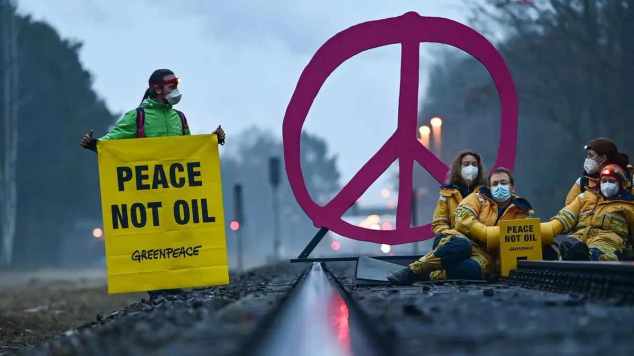
In Los Angeles, scientists including Peter Kalmus, a NASA climate scientist with the Jet Propulsion Laboratory, chained themselves to the JP Morgan Chase building.
“We’ve been trying to warn you guys for so many decades,” Kalmus says, his voice shaking. “The scientists of the world have been being ignored. And it’s gotta stop. We’re going to lose everything.”
They were met by about 100 police officers in riot gear and arrested, reports Salon’s Eric Schank  https://bit.ly/36sqfvo

Scientists Stage Worldwide Climate Change Protests After IPCC Report

Scientists Stage Worldwide Climate Change Protests After IPCC Report

Over 1,000 scientists from 25 different countries staged protests last week following the release of the Intergovernmental Panel on Climate Change’s new report. The report warned that rapid and deep cuts to greenhouse gas emissions are necessary by 2025 to avoid catastrophic climate effects.

The group, called the Scientist Rebellion, writes in a letter that “current actions and plans are grossly inadequate, and even these obligations are not being met.” Their protests “highlight the urgency and injustice of the climate and ecological crisis,” per a statement from the organization.

In Los Angeles, scientists including Peter Kalmus, a NASA climate scientist with the Jet Propulsion Laboratory, chained themselves to the JP Morgan Chase building.

“We’ve been trying to warn you guys for so many decades,” Kalmus says, his voice shaking. “The scientists of the world have been being ignored. And it’s gotta stop. We’re going to lose everything.”

They were met by about 100 police officers in riot gear and arrested, reports Salon’s Eric Schank https://bit.ly/36sqfvo

Manual for the ecological restoration of mangroves in the Mesoamerican Reef System and the Wider Caribbean

Manual for the ecological restoration of mangroves in the Mesoamerican Reef System and the Wider Caribbean
Scope of the Manual

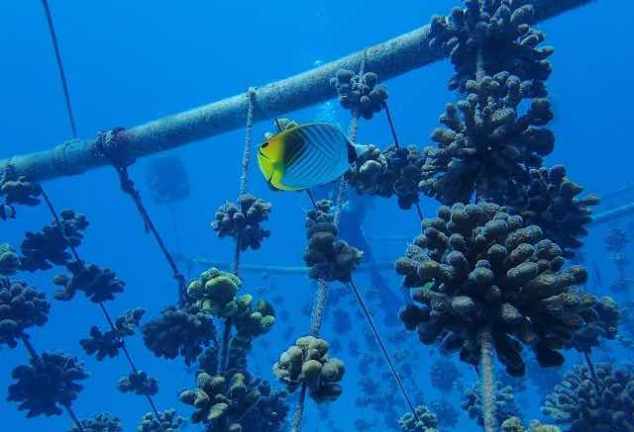
Mangroves in the Mesoamerican Reef Region (MAR) and the Wider Caribbean are the economic foundation of over 134 million people living in the coastal regions. Mangroves provide protection against floods and buffer against storms and hurricanes, to which the region is highly vulnera- ble. Additionally, due to their close relationship with other ecosystems, such as coral reefs and seagrasses, mangroves and the ecosystem services they provide are the conservation pillars of coastal ecosystems.
Among these services, the storage potential of blue carbon is one of the most essential services in mitigating the effects of climate change, in addition to supporting important tourism and fish- eries industries. However, every year the extent of mangroves continues to decline due to the im- pacts of climate change, change in land use, and the overexploitation of resources.
This manual contributes to strengthening local, national, and regional capacities for the eco- logical restoration of mangroves and the ecosystem services they provide in the MAR and the Wider Caribbean region. Within the framework of the Cartagena Convention and the United Na- tions Decade on Ecosystem Restoration 2021-2030, ecological restoration (ER) of mangroves is considered a Nature-based Solution (NbS) that allows addressing the effects of climate change. This favors biodiversity conservation and the economic well-being of the population, contribut- ing to the United Nations Sustainable Development Goals.
Mangrove ecological restoration in the MAR and the Wider Caribbean is a priority in the Regional Environmental Framework Strategy (ERAM, for its initials in Spanish) of the Central American Commission for Environment and Development (CCAD, for its initials in Spanish), in the devel- opment of the Blue Economy Regional Protocol, led by the MAR2R/CCAD/WWF-GEF Project as well as in the Regional Strategy and Action Plan for the Valuation, Protection and/or Restoration of Key Marine Habitats in the Wider Caribbean 2021-2030 (RSAP), developed under the Special- ly Protected Areas and Wildlife (SPAW) subprogram of the Cartagena Convention. https://bit.ly/3KTbhgK

Read More – Download

Register for Online Conference Global Crisis, Time for Truth

The organizers would like to inform you about the international online conference Global Crisis, Time for Truth, 

The conference will take place on 04.12.2021. The conference has organized by volunteers from more than 180 countries around the world and will be interpreted into approximately 100 languages. 

Please share information about the conference, let the whole world know about it. 


For Information & Registration Click HereInformation

The Return of the Taliban: The End of the US Empire?

Before 9/11, Nafeez Ahmed warned of an impending invasion of Afghanistan to control a strategic pipeline. 20 years on, the return of the Taliban is the predictable legacy of America’s failed strategy


 “We did not push the Russians into invading, but we knowingly increased the probability that they would,” said Zbigniew Brzezenski, former national security advisor to President Jimmy Carter. “That secret operation was an excellent idea. The effect was to draw the Russians into the Afghan trap.” 
The US and UK played the lead roles in channelling funds and arms to the newly formed ‘mujahideen’, which brought in up to a hundred thousand recruits from across the Muslim world. Pakistan and Saudi Arabia were the most prominent among the network of Muslim states funnelling financial, military and logistical support into Afghanistan, coordinated by the CIA, Pentagon, MI6 and Ministry of Defence. Read More

How the Taliban surge exposed Pentagon’s lies

 The handful of companies that run the biggest TV channels, newspapers and websites in the US are also part of a network of transnational corporations whose relentless economic growth has been spurred on by the “war on terror” and the channelling of trillions of dollars from the public purse into corporate hands.

The cosy ties between the US media and the military are evident too in the endless parade of former Pentagon officials and retired generals who sit in TV studios commenting as “independent experts” and analysts on US wars. Their failures in Iraq, Libya and Syria have not apparently dented their credibility.  Read More