

ET NOW
Month: June 2025
The Israel-Iran conflict may be about to reach a dangerous new level
Reports that the US’s ‘bunker buster’ bombs could destroy Iran’s Fordow uranium facility are now in doubt.
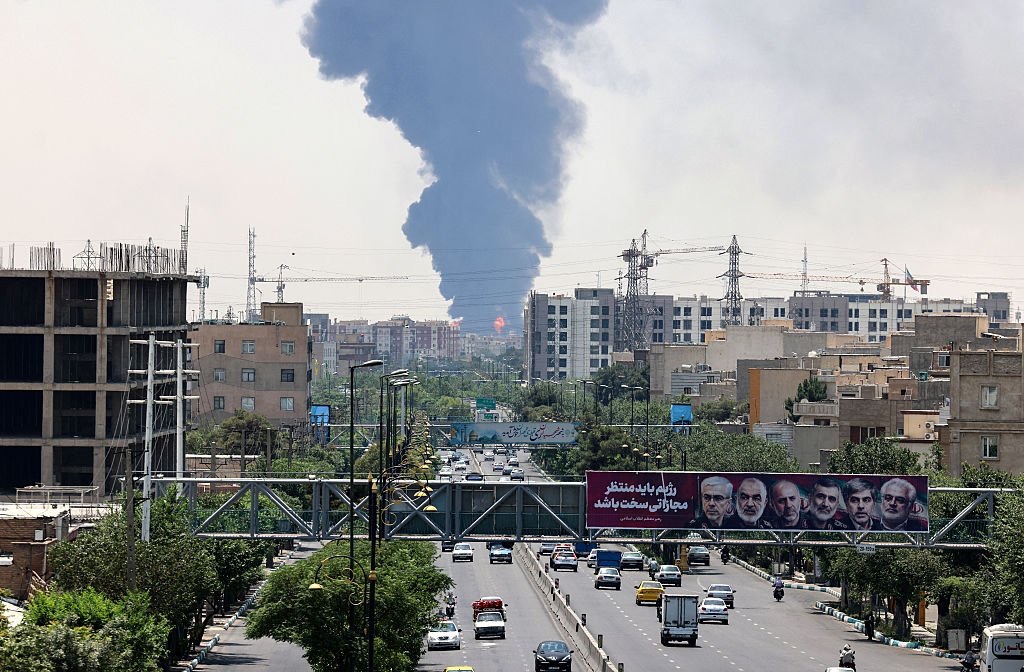
Portraits of Iranian military generals and nuclear scientists killed in Israel’s 13 June attack are displayed above a road, as heavy smoke rises from an oil refinery in Tehran that was hit by an Israeli strike on 15 June
| Atta Kenare/ AFP/ Getty Images
Donald Trump’s decision to allow “two weeks” to decide whether the US will join in Israel’s assault on Iran may be an effort at conflict resolution via diplomacy, or may have more to do with waiting for a second aircraft carrier strike group, the USS Nimitz, to arrive in the Middle East next week.
To give the US president the benefit of the doubt, he may genuinely hope to do some kind of deal with the Iranians. If that is so, it will be bad news for Israeli prime minister Binyamin Netanyahu, whose war aims are reliant on the direct involvement of the US.
Israel does not appear to have the conventional ‘bunker buster’ weapons needed to attack Iran’s underground Fordow uranium enrichment plant – but it has been widely assumed that the US does. Without carrying out such an attack, Netanyahu’s aim of wrecking the core of Iran’s nuclear ambitions will fail, and he will be in trouble politically.
Netanyahu’s predicament is made worse as Trump’s pause has enabled the foreign ministers of France, Germany and the UK to arrange a meeting with their Iranian opposite number, Abbas Araghchi. That meeting is expected to take place in Geneva later today, although Tehran has not confirmed Araghchi’s attendance.
The direction of this war over the next month depends very much on how far the US is involved. Israel would not be able to continue the war without the steady provision of weapons from the US, and even with that, an anonymous US official this week told the Wall Street Journal that Israel is running short of some of its anti-missile systems.
Beyond that, though, Israel is also reliant on a steady stream of intelligence coming from Washington, coupled with more direct involvement. The US Navy now has two air defence destroyers deployed to the eastern Mediterranean. These are directly linked to Israel’s missile detection systems, which are, in turn, linked with a powerful long-range radar run by US military personnel from within Israel.
Politically, this is an important consideration for Trump. Much of the domestic US opposition to Trump extending the war comes down to a desire to avoid putting US soldiers in harm’s way. In practice, though, the US already has a uniformed military presence in Israel and has done so for close to 20 years. American soldiers were deployed to run its Raytheon X-band radar system in 2009, two years after it was established near Dimona in southern Israel. While the radar is multidirectional, it is particularly focused on missiles launched from Iran.
As to Netanyahu’s war aims, they are essentially fourfold. First is in Gaza, where Israel is making life appallingly difficult for Palestinians in the hope they will be forced to leave and can be replaced by Jewish settlers. Where and how they would go is not clear, but whatever happens, the Israeli prime minister wants to see the Israel Defence Forces (IDF) in full and permanent control of the area.
The second aim is to annexe the whole of the occupied West Bank. There, too, Israel is already making life increasingly difficult for three million Palestinians, having imposed something approaching a complete lockdown on the area since the start of the assault on Iran.
While there are too many Palestinians in the West Bank to force them out entirely, far-right members of Netanyahu’s government would argue that, unlike in Gaza, those who do leave would have somewhere to go, given the common border with Jordan.
That far-right faction likely sees the conflict’s end result as a million Palestinians having been forced out of the West Bank and the area’s Jewish settler population, estimated to now be around 700,000, doubling in size. For them, this would represent a secure Israel, with the Palestinians decidedly second-class citizens who form a useful pool of low-cost labour.
The idea of a depopulated and then resettled Gaza and a ‘rebalanced’ West Bank may be little more than a pipedream, but must be taken seriously, especially when you look at Israel’s two other war aims. One is military dominance of neighbouring countries, not in the sense of large garrisons, but mainly through overwhelming air power. After all, Israel has repeatedly bombed targets in Lebanon, Syria and Yemen – the latter with direct US and British involvement – and will certainly do so in Iraq if ISIS rears its head.
There is a sense in the IDF and the current Israeli government that the country is invincible in military force projection. This extends to Netanyahu’s final war aim: destroying Iran’s nuclear programme and terminating its regime. These two aims go together, as destroying the nuclear programme makes little sense if the current regime, or anything like it, is still in power in Tehran.
The best option, as Israel sees it, might be a thoroughly weakened Iran that is politically fragmented with little centralised power for any one faction, rather than the election of a new democratic government. As the then-US ambassador in Wellington, Paul Cleveland, said during a 1986 spat between the US and New Zealand over nuclear-armed US warships visiting local ports: “Sometimes it is more difficult to deal with a messy democracy like New Zealand than with some Asian dictatorships.”
One development this week could significantly change the shape of the conflict, though. It has been widely reported that the US has a conventional weapon capable of destroying Iran’s Fordow facility. That is now in doubt, with officials in the Pentagon reportedly questioning whether even the US’s 13.6 tonne GBU-57 bomb would be powerful enough.
Instead, destroying Fordow might require the use of a tactical nuclear weapon. There is no indication that the US has such a weapon; the earth-penetrating B61-7 nuclear bomb it developed in the 1980s was withdrawn in the mid-2010s, and there is no suggestion that the Robust Nuclear Earth Penetrator, which the Pentagon was rumoured to be working on in the early 2000s, exists today.
Israel, though, is another matter. It first developed nuclear weapons at the end of the 1960s with French assistance and has maintained a substantial arsenal of around 90 warheads, with enough stored plutonium for around 200 more. Given Israel’s advanced technological nuclear capabilities, its six decades of experience and its perceived targeting requirements, it would be surprising if it hasn’t considered nuclear earth penetrating warheads.
If that is so, it could take the current confrontation with Iran to a very dangerous new level.
Reports of Orbs and Black Triangles Confirmed by Former Director of AARO
The Sol Foundation
Sol Briefing, June 2025
In this June 2025 edition of the Sol Briefing, Marik von Rennenkampff unpacks striking news from Timothy Phillips, former Acting and Deputy Director of the Pentagon’s All-domain Anomaly Resolution Office (AARO).
Phillips confirms that multiple UAP cases, some involving fiery orbs and black triangles, remain unresolved even after rigorous scientific investigation. This episode explores what that means, how it could shift future U.S. disclosure policy.
Israel Hides Damage From Devastating Iranian Missile Attacks
The CJ Werleman Show
Lord Hill-Norton (Admiral of the Fleet, Chief of the Defence Staff) UFOs & Extraterritorial Beings
UAP Files Podcast
Victor Gao Warns Israel & US: ‘China Does Not Want To See A War of Aggression Against Iran’
Al Arabiya English


Prof. Jeffrey Sachs : Trump and War.
Judge Napolitano – Judging Freedom
Iran’s Khamenei: “We Will Never Surrender” /Col Doug Macgregor & Lt Col Daniel Davis
Daniel Davis / Deep Dive
 Democracy & Good Governance