

The message is clear: the time for real transparency is now—not just to satisfy curiosity, but to restore public trust, improve national defense, and address a mystery that defies easy explanation.
Despite the federal government spending billions on high-tech air and space surveillance, the U.S. military cannot adequately identify or respond to repeated drone incursions over critical facilities, from Langley Air Force Base to nuclear sites and missile defenses in Guam.
If the Air Force cannot defend its own airspace from drones—some of which may be foreign intelligence assets—how can it hope to assure the public that “there’s nothing to see here”? The admission that no video evidence exists after weeks of overflights only adds to the public’s skepticism.
If they can’t control their own airspace, what kind of protection can we expect them to offer the capital?
We shouldn’t mince words about the psychological and political barriers surrounding UAP. There remains a deep-seated stigma and fear among policymakers, the media, and even the public. People fear ridicule. Politicians fear being labeled fringe. And military officials fear career repercussions.
This reluctance fuels a vicious cycle of ignorance – lack of data leads to skepticism, which in turn inhibits data collection and further disclosure.
We are at the bottom of a trust curve… This is an opportunity to restore trust. People aren’t necessarily asking for aliens—just the truth.
We should be especially critical of the government’s classification policies. Thousands of UAP-related reports remain unreleased, even though many involve footage from iPhones, night vision goggles, or commercial targeting pods—none of which constitute sensitive “sources and methods.”
Worse, there’s no one within the defense department making the effort to publicly release. Despite pledges, not a single new UAP video has been declassified in years.
There’s a pile of imagery that would be useful to the public, to scientists, to Congress—and it’s just sitting there.
Lack of transparency doesn’t protect the public—it undermines trust and breeds wild speculation, as with past national failures, like the Iraq WMD debacle, allowing history to repeat itself.
When the government withholds evidence, especially regarding UAP, the public doesn’t think, “they’re protecting us.” They think, “they’re hiding something.”
We should not dismiss the extraterrestrial possibility—especially when it fits the data better than any Earth-based, mundane explanation.
This hypothesis needs data. And the current lack of defined criteria for identifying non-Earth technology only adds to the confusion. The government is deliberately keeping it vague.
We’re seeing propulsionless craft, spheres with cubes inside them, performing maneuvers beyond our capabilities. What are we supposed to think?
In the following video, it is argued that rather than pushing for a sudden “full disclosure” event—which some people doubt will ever come—a more methodical strategy is advised. This involves revising classification guides and appointing dedicated advocates within agencies specifically tasked with processing UAP data for public release. In Congress, this means asking better, more probing questions – asking surveillance systems what they’re actually seeing, demanding data on how often jets are scrambled in response to unknowns, and seeking historical accounts directly from senior military leaders. Commissioning an oral history project to formally record the insights from senior officials with firsthand UAP experience is also crucial, as is supporting independent civilian and scientific efforts, like the Galileo Project and Enigma Labs, that are already collecting and analyzing UAP data.
Despite the significant bureaucratic resistance, we should be optimistic about future UAP transparency because of several encouraging signs: the continued interest from key members of Congress, the growing momentum of independent civilian science initiatives like the Galileo Project, a notable shift in tone from current government leaders (such as the AARO Director admitting they are seeing things they don’t understand), and a growing chorus of whistleblowers and trusted voices demanding accountability. These factors are making it increasingly difficult for the government to maintain the level of secrecy seen in the past.
It’s also worth noting that these steps are not the only things going forward and do not account for all the factors at play. While some people may have doubt about a sudden “full disclosure” event ever happening, contrary to that notion, a clear path to such an event has been identified and, we believe, will happen when the time is right, likely within the next few years.
This is about accountability. It’s about the public’s right to know what its government knows. And it’s about whether, in the 21st century, we can trust the government to tell the truth—even when the truth is inconvenient.
If we don’t get ahead of this, the damage to national security, public trust, and scientific progress will only deepen. We need the facts.
In conclusion, transparency is the only way forward. In a political environment polluted by distrust, telling the truth about what’s in our skies is one of the few nonpartisan ways to rebuild public trust.
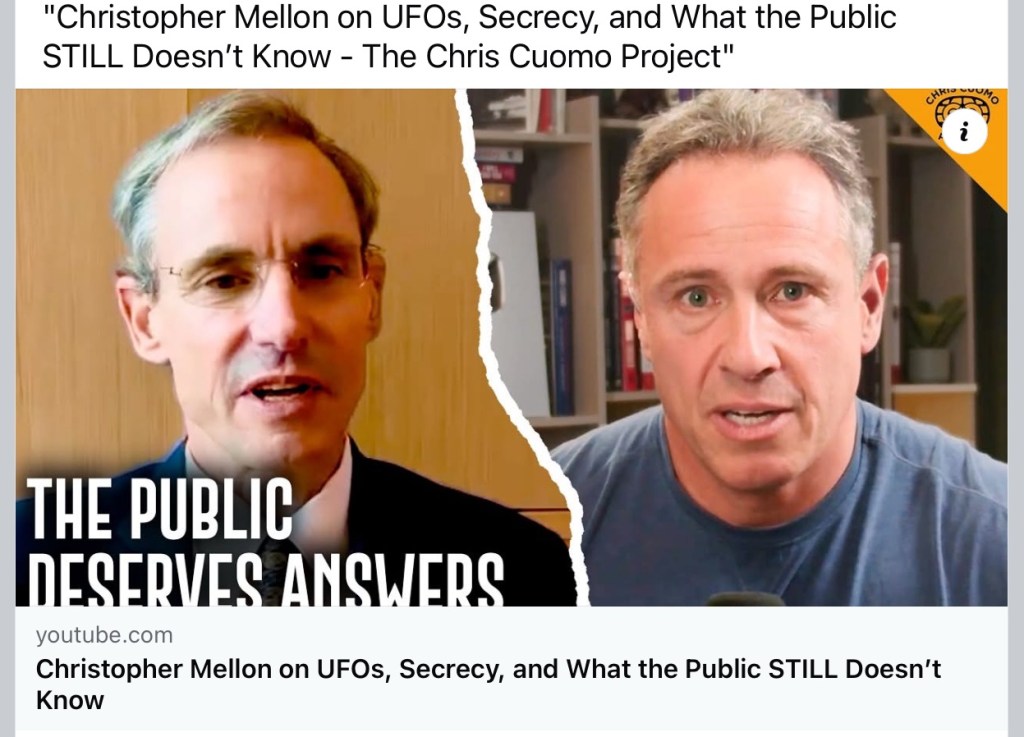
“Christopher Mellon on UFOs, Secrecy, and What the Public STILL Doesn’t Know – The Chris Cuomo Project”
 Democracy & Good Governance